

I have kept GBP/NOK on this desk's sheet since the ECB reference of 23 October 2025 printed 13.3275 kroner to the pound, long enough to see that the oil beta is not the whole cross.
| ECB date | GBP/NOK | GBP/USD | USD/NOK | Cross, log % | Cable, log % | USD/NOK, log % |
|---|---|---|---|---|---|---|
| 23 Oct 2025 | 13.3275 | 1.3339 | 9.9913 | 0.00 | 0.00 | 0.00 |
| 16 Dec 2025 | 13.6753 | 1.3437 | 10.1775 | +2.58 | +0.73 | +1.85 |
| 31 Dec 2025 | 13.5721 | 1.3466 | 10.0791 | +1.82 | +0.95 | +0.87 |
| 29 Jan 2026 | 13.1817 | 1.3817 | 9.5404 | −1.10 | +3.52 | −4.62 |
| 13 May 2026 | 12.3874 | 1.3510 | 9.1690 | −7.31 | +1.27 | −8.59 |
| 2 Jul 2026 | 13.1775 | 1.3306 | 9.9031 | −1.13 | −0.25 | −0.89 |
| 22 Oct 2026 | 12.5200 | 1.3376 | 9.3601 | −6.25 | +0.28 | −6.53 |
Log changes in that table run from 23 October 2025, because a log change adds when one rate is the product of two others. On an ordinary percentage the cross is 6.06% lower, 12.52 against 13.3275. In logs it is 6.25% lower, and the legs add: cable up 0.28%, USD/NOK down 6.53%.
The row that should bother a Brent-only reading is 29 January 2026. Cable printed 1.3817 that day, the high of this sample and a 3.52% log rise from the October start, while GBP/NOK was already 1.10% lower in logs because USD/NOK had fallen 4.62%. Sterling's strongest dollar print in the year still left the cross below where the sheet began, because the krone had overpowered the pound.
That split is why a GBP/NOK forecast keeps two calendars. On 5 November 2026 Norges Bank and the Bank of England both publish decisions. A Bank Rate move shows up in cable, and a Norwegian policy-rate move shows up in USD/NOK. The gap for that Thursday is 0.75 percentage points, a 4.50% policy rate in Norway against a 3.75% Bank Rate in Britain.
The same desk filed sterling against the Swedish krona as its own rate path. Sweden's external accounts lack Norway's petroleum channel, and that channel explains the past year in the table above. The 5 November gap is the part of GBP/NOK the channel leaves open.
Key facts
- GBP/NOK was 12.52 on the ECB reference dated 22 October 2026, against 13.3275 on 23 October 2025. Source: Frankfurter API, retrieved 23 October 2026, about 07:10 UTC.
- The high in this sample was 13.6753 on 16 December 2025 and the low was 12.3874 on 13 May 2026, so the latest print sits 1.07% above the low and 8.45% below the high. Source: ECB reference rates via Frankfurter, retrieved 23 October 2026.
- From 23 October 2025 to 22 October 2026 the log changes were GBP/NOK −6.25%, GBP/USD +0.28% and USD/NOK −6.53%. Source: ECB reference rates via Frankfurter, retrieved 23 October 2026.
- Norges Bank's policy rate is 4.50%, published 24 September 2026, with the next decision on 5 November 2026. Source: Norges Bank policy-rate page and press release, retrieved 23 October 2026.
- The Bank of England held Bank Rate at 3.75% on 17 September 2026 by 6 votes to 3, and lists the next decision as 5 November 2026. Source: Bank of England monetary policy summary, retrieved 23 October 2026.
- UK CPI rose 3.5% in the twelve months to September 2026. Norwegian CPI rose 3.4% and CPI-ATE rose 3.0% over the same span. Source: Office for National Statistics, 21 October 2026, and Statistics Norway, 9 October 2026.
What moves GBP/NOK
GBP/NOK is the price of one pound in Norwegian kroner. The pound is the base currency and the krone is the quote currency, so a higher print means the pound buys more kroner. A rising cross is a firmer pound in krone terms, and a falling cross is a firmer krone. The bull case on this page is 13.20 and the bear case is 12.10.
On a dealing desk, a cross is a pair whose name leaves the US dollar out, even though the dollar is still how the rate is usually built, and GBP/NOK equals GBP/USD times USD/NOK. On the 22 October 2026 reference that product is 1.3376 times 9.3601, which is 12.5201 and rounds to the 12.52 the payload reports. If cable rises 1% and USD/NOK stays at 9.3601, the cross rises from 12.52 to 12.6453, the base case of 12.65 to the nearest øre.
Norges Bank is Norway's central bank. A five-member Monetary Policy and Financial Stability Committee sets the policy rate about eight times a year, with low and stable inflation near the 2% target the Governor cited in September, and high employment beside it. The Bank of England's Monetary Policy Committee sets Bank Rate, the rate paid on overnight reserves, about eight times a year against a 2% target set by the government. On the latest settings the Norwegian policy rate sits 0.75 percentage points above Bank Rate.
The oil beta, in the plain sense used here, is the krone's tendency to firm when oil prices rise and to soften when they fall. Petroleum revenue lands in the Norwegian economy, and the currency often absorbs part of that swing. Over the year to 22 October, the USD/NOK leg carried almost the entire decline in the cross, which is what an oil-linked krone looks like when sterling spends the year as a passenger.
The two ingredients have their own pages, the desk's GBP/USD forecast and the desk's USD/NOK forecast. The prints used here are the ECB references for 22 October 2026 only, cable at 1.3376 and USD/NOK at 9.3601, pulled from the Frankfurter latest endpoint on the morning of 23 October, and the payload dates that fixing 22 October 2026.
The year the krone did the work
At the sample high of 13.6753 on 16 December 2025, both legs had helped, and a weaker krone did more of that rise than a stronger pound: cable was up 0.73% in logs from 23 October and USD/NOK was up 1.85%. From the 31 December reference of 13.5721 to 22 October 2026, the log decline in the cross is 8.07%. Cable accounts for 0.67 percentage points of that, and USD/NOK accounts for 7.40 percentage points.
The cross finished 2025 at 13.5721, stood at 13.1477 at the end of January with cable at 1.3760 and USD/NOK at 9.5549, and closed May at 12.4229, just above the 13 May low of 12.3874. That low landed on the same day USD/NOK printed 9.1690, the strongest krone against the dollar in this sample. June closed at 13.1246, August closed at 12.6471, the anchor for the base case, and October drifted from 12.7382 on 1 October to 12.52 on 22 October.
On 2 July GBP/NOK was back at 13.1775, within a few øre of the 29 January print, with cable at 1.3306 and USD/NOK at 9.9031. The spring damage was repaired because the krone had softened, with little help from sterling. By 22 October the cross was back within 1.07% of the May low, while cable, at 1.3376, stood above its 23 October 2025 print of 1.3339.
The oil beta, in plain language
Norges Bank put the oil move and the exchange rate in the same breath on 24 September. Since June, the Committee said, prices for oil and gas and various other commodities have risen, and a stronger krone will contribute to dampening imported goods inflation. Dearer energy raises domestic costs, while a firmer krone cheapens imports, so the two can arrive together.
The Bank of England's September minutes put a London number on the oil side. At the close on 14 September, Brent was $106 a barrel, and Brent and UK wholesale gas had risen by 36% and 78% since the period leading up to the July Monetary Policy Report. That $106 close is the oil figure used here, because it is the number the Committee wrote down, and the asset on this page remains GBP/NOK.
The spring low lines up with the strongest krone, and the July give-back lines up with a softer krone. The awkward residue is the January cable high that failed to lift the cross. A stronger krone was already cheapening imports, and the September decision still raised the rate.
Norges Bank's side of the cross
At its meeting on 23 September the Monetary Policy and Financial Stability Committee raised the policy rate from 4.25% to 4.50%. The press release was published at 10:00 on 24 September 2026. The Bank's policy-rate page still showed 4.5% when opened on 23 October, with the next announcement dated 5 November 2026.
Governor Ida Wolden Bache said, in that release: "Inflation has been above target for several years. By raising the policy rate, we are helping to reduce inflation. It will likely be necessary to keep the policy rate elevated for a time, and the Committee is prepared to raise the policy rate further if needed to bring inflation down to the 2% target within a reasonable time horizon." The full text is on the Norges Bank press release.
The same release records the June judgment that a further increase would likely be needed at one of the forthcoming meetings. CPI had run above the projection, while CPI-ATE, the consumer price index adjusted for tax changes and excluding energy products, had slowed and come in lower. An oil-driven headline can sit beside that softer underlying reading, and the Committee hiked in the same decision.
Statistics Norway's release of 9 October 2026 covers the month after that meeting. From September 2025 to September 2026, CPI rose 3.4% and CPI-ATE rose 3.0%. From August to September, CPI rose 0.5% and CPI-ATE rose 0.2%.
The forecast keeps the policy rate near its current level for a period and then declines somewhat, elevated for longer than in June, with inflation slowing from next year and reaching 2% in 2029. A hold at 4.50% on 5 November leaves the gap where it is unless the Bank of England moves. A further Norwegian increase, with Britain holding, is the krone-positive case, and an earlier decline is the case that helps the pound.
Sterling's own rate path
Bank Rate is 3.75%, and at its meeting ending on 16 September 2026 the Monetary Policy Committee voted 6 to 3 to leave it there, with three members preferring an increase of 0.25 percentage points, to 4%. The rate page, opened for this forecast, shows the same 3.75%, a next decision on 5 November 2026, and a current-inflation box of 3.5% against a 2% target.
The September summary says UK CPI inflation increased to 3.1% in August and was likely to rise further. The Office for National Statistics has since published the September outturn: CPI rose 3.5% in the twelve months to September 2026, up from 3.1% in August, with core CPI at 2.8% from 2.6%, motor fuels up 29.8% on the year, and petrol at 169.5 pence a litre in September, 8.2 pence higher on the month.
Andrew Bailey, Governor of the Bank of England, put the policy consequence on the rate page: "Today, we've held Bank Rate at 3.75%. So far, higher global energy costs have had a limited effect on price and wage setting in the UK. But the longer this volatility persists, the bigger the impact it will have on inflation, and the more likely it is we will need to raise Bank Rate to ensure that inflation falls back to our 2% target."
The Office for National Statistics posted the September CPI print on 21 October. That 3.5% figure is the one now sitting in front of the November meeting, a step above the 3.1% the September minutes were written against.
CPI at highest annual rate since October 2025.
The Consumer Prices Index (CPI) rose by 3.5% in the 12 months to September 2026, up from 3.1% the previous month.
Read more➡️ https://t.co/3lPEYS9mtQ pic.twitter.com/QjpBnYVV3TRelatedUSD/CZK Forecast: 22.70 Bull Case vs 20.40 Bear Case
— Office for National Statistics (ONS) (@ONS) October 21, 2026
The minutes, using energy prices as of the 14 September close, expected CPI around 3.75% in the fourth quarter of 2026 and slightly above 4% in the first quarter of 2027. Risks were tilted to the upside relative to the July Monetary Policy Report, and the majority still held, while the three who preferred 4% argued that an early-2027 inflation peak would land as wage settlements were being agreed.
Private-sector regular average weekly earnings rose 2.9% in the three months to July, the Committee's reading of underlying private-sector wage growth was around 3.5%, and unemployment was estimated at 4.9%. The September CPI print arrived after the meeting. Whether the Committee treats 3.5% as the energy effect it had already pencilled in, or as the start of second-round effects, is the sterling question for 5 November.
One Thursday, two decisions
| Policy rate | Latest inflation | Next decision | |
|---|---|---|---|
| Norway | 4.50% | CPI 3.4%, CPI-ATE 3.0% (September) | 5 November 2026 |
| United Kingdom | 3.75% | CPI 3.5% (September); August, in the minutes, was 3.1% | 5 November 2026 |
| Gap | 0.75 percentage points, higher in Norway | Headlines within 0.1 point; UK core CPI 2.8%, Norway CPI-ATE 3.0% | Same day |
The inflation headlines sit close together, while the policy rates differ by 0.75 percentage points in the krone's favour. Britain's headline was lifted hard by motor fuel, and Norway's headline includes an energy and tax mix that CPI-ATE is built to set aside.
If both banks hold, the gap stays at 0.75 percentage points, which is the combination closest to the published language, and GBP/NOK is left to oil and the broader dollar. If Bank Rate rises to 4.00% and the Norwegian policy rate stays at 4.50%, the gap narrows to 0.50 points and the cross is supported through cable. Cable alone, with USD/NOK frozen at 9.3601, would need a rate near 1.4102 to print 13.20, so the bull case needs the tone after the decision as well, or a krone that softens back toward the 2 July dollar rate.
If Norges Bank raises the policy rate to 4.75% and Bank Rate stays at 3.75%, the gap widens to a full percentage point, which supports a lower GBP/NOK. Getting from 12.52 to 12.10 on the krone alone, with cable frozen at 1.3376, would mean USD/NOK near 9.0461, through the 13 May low of 9.1690 if sterling's dollar rate stays put. If both banks raise by 0.25 percentage point, the gap stays at 0.75 and the cross can still move, because the two hikes are rarely priced with equal confidence.
Three levels to 31 March 2027
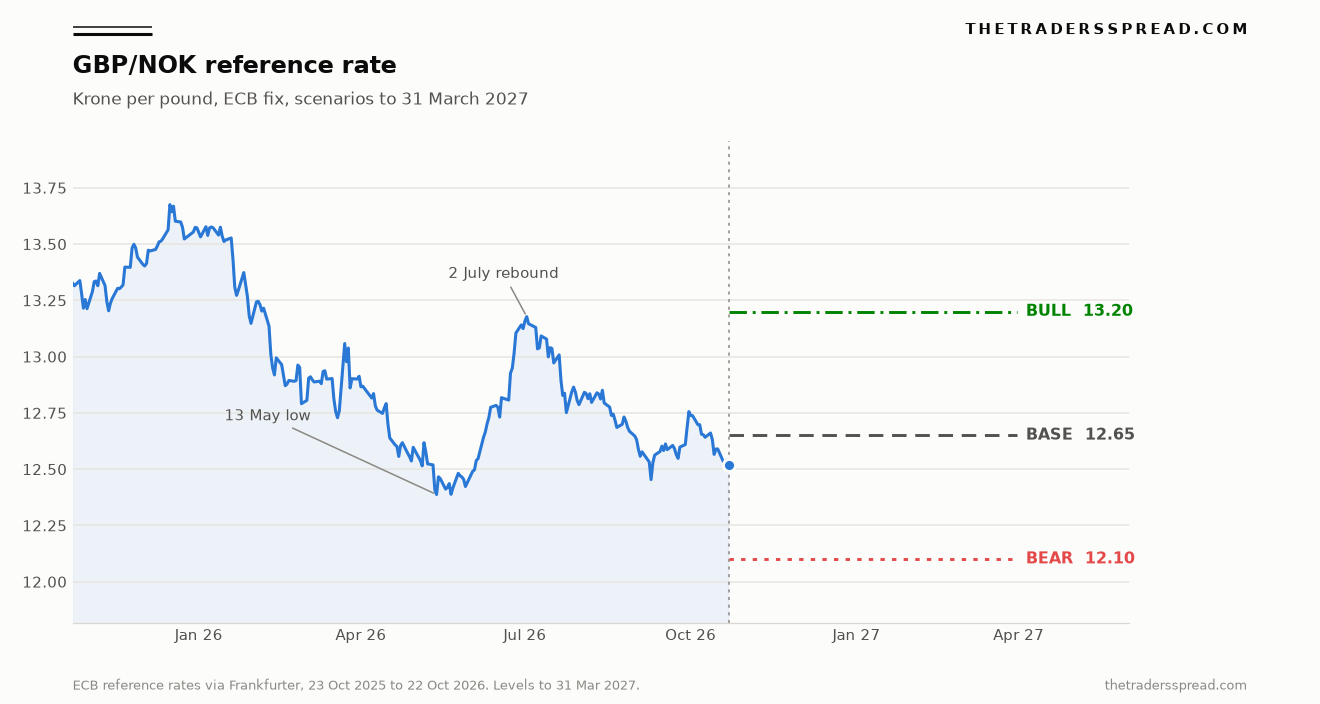
The chart is the ECB reference from 23 October 2025 through 22 October 2026, with three levels drawn flat out to 31 March 2027. Bull at 13.20 sits just above the 2 July reference of 13.1775. Base at 12.65 sits on the 31 August reference of 12.6471. Bear at 12.10 sits below the 13 May low of 12.3874.
| Case | Level | From 12.52 | What would have to be true |
|---|---|---|---|
| Bull | 13.20 | +5.43% | Bank Rate rises, or the Committee opens that door, while Norges Bank holds 4.50% and the krone softens toward the 2 July dollar rate, retesting 13.1775. |
| Base | 12.65 | +1.04% | Both banks hold on 5 November, the 0.75 point gap stays put, and one leg moves about 1% while the other is roughly steady, back near the 31 August reference of 12.6471. |
| Bear | 12.10 | −3.35% | Norges Bank hikes again, Bank Rate stays at 3.75%, and the krone pushes through the 13 May dollar low of 9.1690, or cable falls enough to share that work and break 12.3874. |
The distances are ordinary percentages from the 22 October reference, while the history table uses logs so the legs can be added. A 5.43% bull case and a 3.35% bear case are asymmetric on purpose, because further downside has to clear the May low and upside to the 2 July print is a retracement the table has already recorded.
Both committees meet again before 31 March, so a single decision-day spike is a poor stand-in for the level on that date.
Verdict
The base case is 12.65, a drift back toward the 31 August reference of 12.6471 by 31 March 2027, about 1.04% above the 22 October print of 12.52. Spot sits 1.07% above the 13 May low, and the language from both banks is closest to a hold on 5 November. The reading changes if 12.3874 gives way, which is the bear case at 12.10 and the invalidation of this base, or if the cross reclaims the July rebound and pushes through 13.20.
The bull case is 13.20 if sterling's rate path does the work the krone did last year. That means a Bank Rate increase on 5 November, or a Committee signal that one is close, while Norges Bank keeps the policy rate at 4.50% and talks about the decline already sketched in its forecast. It is helped if USD/NOK moves back toward the 9.9031 print of 2 July, the reference that 13.20 sits just above.
The bear case is 12.10 if the krone gets a second leg: another Norwegian increase, Bank Rate unchanged at 3.75%, and USD/NOK breaking the 13 May low of 9.1690, or a fall in cable that shares the job. That level is 3.35% under the latest reference and clears 12.3874 with a margin. The $106 Brent close on 14 September, and Norges Bank's line on higher oil and gas prices since June, is the force that could produce that second leg.
The 22 October ECB reference is the print these three levels are measured from. A later reference through 12.10 retires the base in favour of the bear case, and a later reference through 13.20 retires it in favour of the bull case. These scenarios are analysis of published rates and official decisions, and they are not a recommendation to buy or sell GBP/NOK or any other instrument.