

Fetch.ai did not finish the job its own merger guide set for mid-July 2024, and the jump in FET is not evidence that Binance has switched the market to an ASI ticker. The pair is still FETUSDT, base asset FET. In the 24 hours from 06:53 UTC on 4 October to 06:53 UTC on 5 October 2026, Binance's ticker put the last at $0.2556, up 14.670% (14.67% to two decimals) from an open of $0.2229. The high was $0.2650 and the low was $0.2219. Quote turnover was $46.93 million across 212,311 trades. The alliance token page, opened the same morning, still marks phase two, the FET-to-ASI switch at one for one, as date TBD. A catalogue check returned FETUSDT and no ASIUSDT symbol. The mid-July exchange migration in the June 2024 guide is not this book.
Read 14.67% as a rolling lookback and the shape changes. Almost all of the gain was the completed UTC session on 4 October, which opened at $0.2259 and closed at $0.2531, up 12.04% on $37.22 million of quote volume, the heaviest day in the eight sessions set out below. The 5 October candle was still open at the pull. It had traded between $0.2514 and $0.2650, and the kline's last print was $0.2555, one tick under the ticker. Against the 4 October close, that is a gain of about 1%, not a second 14% move. Bitcoin, on the same 24-hour Binance window, was up 1.36% at $86,201. Ether was up 1.02% at $2,722. FET's print is idiosyncratic to this book. It also sits 3.55% under its window high, and Binance's weighted average price for those 24 hours was $0.2481, below the last. Turnover did not all occur at the headline price.
Key facts
- FETUSDT last $0.2556, up 14.670% from $0.2229, in the 24 hours to 06:53 UTC on 5 October 2026. Quote turnover $46.93 million, 212,311 trades, high $0.2650, low $0.2219. — Binance 24-hour ticker, 5 October 2026
- The 4 October UTC candle closed at $0.2531, up 12.04% from the prior close, on $37.22 million of quote volume and 163,356 trades. — Binance daily kline, 5 October 2026
- The 5 October high of $0.2650 is the highest high in 120 daily candles beginning 8 June 2026. The low of that history is a $0.1192 wick on 17 August, when the candle closed at $0.1239. — Binance daily klines, pulled 5 October 2026
- Binance lists FETUSDT as trading, base asset FET, quote asset USDT. ASIUSDT is not a symbol on that catalogue. — Binance exchangeInfo, 5 October 2026
- Phase two, the FET-to-ASI conversion at one for one, is still marked date TBD. The same page lists circulating supply as 2.39 billion and total supply as 2.71 billion, without a date on those figures. — ASI token page, opened 5 October 2026
- Fetch.ai Innovation Lab lists MHacks cash prizes of $1,250, $750 and $500 for 3 to 4 October 2026 in Ann Arbor. The page does not mention the token price. — Innovation Lab hackpack, opened 5 October 2026
A 12% session, then a flat morning
The daily candles make the 24-hour percentage look like one lurch. It was not. From the 29 September close of $0.2225 to the 3 October close of $0.2259, FETUSDT chopped. Closes in that stretch ran from $0.2191 on 2 October to $0.2304 on 1 October. Quote volume on 3 October was $17.10 million, the lightest day in the table. Then 4 October opened at $0.2259, the same price as the prior close, and finished at $0.2531. The high was $0.2599 and the low was $0.2209, so the session revisited the old band and closed above it.
The morning candle is a different story.
By 06:53 UTC on 5 October the new session had printed $0.2650, the highest trade in 120 daily candles back to 8 June, and come back to a kline last of $0.2555. The low was $0.2514, still above the 4 October close. Quote turnover on the partial candle was $13.51 million, with 62,372 trades, against $37.22 million the day before. Treating 14.67% as "FET is rallying this morning" describes the wrong clock.
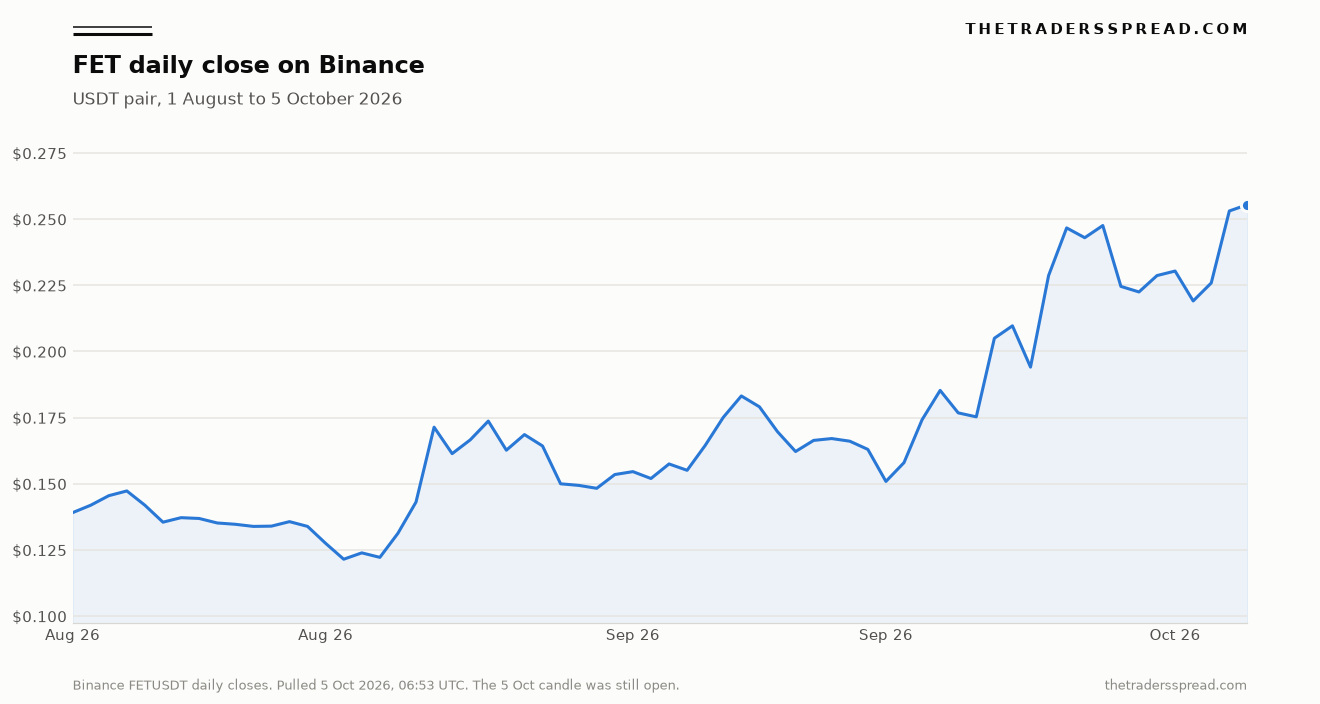
The chart is daily closes, not highs. The end dot is the still-open 5 October candle, last $0.2555 at the pull, so it sits under the $0.2650 high. The August trough on the line is the 17 August close of $0.1239. The $0.1192 wick is not plotted.
| UTC date | Open | High | Low | Close | Vs prior close | Quote volume |
|---|---|---|---|---|---|---|
| 28 Sep 2026 | $0.2476 | $0.2492 | $0.2202 | $0.2246 | -9.29% | $24.58m |
| 29 Sep 2026 | $0.2247 | $0.2358 | $0.2145 | $0.2225 | -0.93% | $27.65m |
| 30 Sep 2026 | $0.2224 | $0.2312 | $0.2105 | $0.2287 | +2.79% | $23.97m |
| 1 Oct 2026 | $0.2287 | $0.2456 | $0.2231 | $0.2304 | +0.74% | $29.03m |
| 2 Oct 2026 | $0.2303 | $0.2417 | $0.2146 | $0.2191 | -4.90% | $23.63m |
| 3 Oct 2026 | $0.2191 | $0.2312 | $0.2160 | $0.2259 | +3.10% | $17.10m |
| 4 Oct 2026 | $0.2259 | $0.2599 | $0.2209 | $0.2531 | +12.04% | $37.22m |
| 5 Oct 2026 (partial) | $0.2532 | $0.2650 | $0.2514 | $0.2555 | +0.95% | $13.51m |
Change is each UTC close against the previous close, from Binance daily klines pulled at 06:53 UTC on 5 October 2026. The 5 October row was still forming: kline last $0.2555, ticker last $0.2556. One tick. The headline uses the ticker. Quote turnover from 29 September through that partial session was $172.11 million. Inside that week, 4 October did the repricing.
A tape running ahead of what a project has actually published is not unique to this coin. Injective rose 15.9% during a vote on code it had stopped publishing. The mismatch here is plainer, because there is not even a vote on the table.
What the project published, and what it did not
The Fetch.ai blog index, opened on 5 October and sorted by date added, showed no item dated 4 or 5 October. The newest dated post on that first screen was the FetchCoder V2 note of 15 January 2026. Pinned entries above it were older. That is a check of the company's own news list, which is where a deal, a listing or a buyback would normally land.
What that January note does contain is a product quote, not a market one. "FetchCoder V2 is about turning ideas into intelligent software that works," Humayun Sheikh, chief executive of Fetch.ai, said in the 15 January 2026 announcement. "It gives developers the tools and confidence to bring autonomous agents to life, without guesswork, and with control over every step." Nothing in it refers to a price or a ticker change.
The other on-the-record line worth keeping is older still, and it is about a conference, not a candle. "What made the Agentic Interop Summit powerful was seeing agentic AI move from theory to execution," Sana Wajid, chief development officer at Fetch.ai, said in the company's 17 December 2025 recap. "From interoperable agents to real-world payments and orchestration, this was about proving that agents can already operate across systems, enterprises, and workflows in a way that's scalable and trustworthy." The recap says Fetch.ai and Google Cloud hosted that summit at the Google campus in Mountain View on Monday 8 December 2025. It is not a comment on this week's book.
No listing notice. No buyback. No partnership release dated to the move.
The nearest dated Fetch.ai item that overlaps the tape is a student hackathon, and the sums do not explain $46.93 million of quote turnover. The Innovation Lab MHacks hackpack, opened 5 October 2026, lists 3 to 4 October in Ann Arbor. Cash prizes for "Best Use of Fetch.ai" are $1,250, $750 and $500. Together, $2,500, about 0.005% of the 24-hour book. The page discusses agents, ASI:One and Agentverse. It does not mention a token price.
On 4 October at 15:26 UTC the Artificial Superintelligence Alliance account posted its sixteenth product update, covering 19 September to 2 October. The note, on X, is engineering: ASI:Chain node performance, a bridge migration, a delegated-staking fix, wallet software, and Omega 0.1.20-rc. It names a Technical Tuesday with Dr Ben Goertzel, described there as chief executive of the ASI Alliance and of SingularityNET, and Greg Meredith, founder of F1R3FLY. It does not mention price, a Binance notice, or a partnership. The 4 October candle had been open since midnight UTC. The update does not claim it.
There is a useful contrast with coins that did have a named counterparty. Quant rose 43% in 32 hours after The Clearing House picked it. FET's tape, on the pages checked this morning, has no equivalent sentence.
The coin Binance is actually matching
The mix-up is older than this week, which is why a green day gets misread as a finished rebrand. On 25 June 2024 Fetch.ai published a merger guide. Phase one, from 1 July 2024, folded SingularityNET's AGIX and Ocean Protocol's OCEAN into FET, and left FET markets open under the FET ticker. Holders on centralised exchanges, Binance named among them, were told no action was required: AGIX and OCEAN would convert to FET on 1 July, "followed by a smooth transition to ASI in mid-July." The ratios in that guide were 1 FET to 1 ASI, 1 AGIX to 0.433350 ASI, and 1 OCEAN to 0.433226 ASI.
More than two years later the alliance token page still calls the asset "ASI Token (FET)" and says FET "will automatically convert to ASI during Phase 2 of the merger. The date is TBD." It repeats the one-for-one FET ratio, the 0.433350 AGIX ratio, and a CUDOS rate of 118.344 CUDOS to 1 ASI after a 5% fee. Phase two still includes the line "Exchanges migrate spot markets from FET to ASI," still dated TBD. The page opened on 5 October 2026 does not describe a switch that has already happened.
Binance's symbol list matches the unfinished half. exchangeInfo for FETUSDT returned status TRADING, base asset FET, quote asset USDT. ASIUSDT returned HTTP 400. Among USDT pairs with base asset FET, ASI, OCEAN or AGIX, the only trading symbol in that pull was FETUSDT. This price is that pair. It is not a print from a market called ASIUSDT.
Membership has moved, and this piece will not invent the chapters it did not open. The June 2024 guide names Fetch.ai, Ocean Protocol and SingularityNET. The token page opened on 5 October 2026 describes Fetch.ai, SingularityNET and CUDOS, and says the alliance was formed through the tokenomic merger of those three. Ocean is in the old guide and absent from that description. The gap between the two pages is not an explanation of a 4 October candle. No primary page checked this morning offered it as one.
Supply on that page is a listed figure, not a live count: total 2.71 billion, circulating 2.39 billion, neither of them dated. Multiply 2.39 billion by the $0.2556 last and the arithmetic is about $611 million. That is a desk calculation on an undated webpage, not a vendor market-cap print. The same page says FET is on Ethereum, BNB Smart Chain, Cardano and Fetch.ai's own chain, for services, staking, governance and agent registration. Those are utility descriptions. They do not time-stamp a 12% session.
Where $0.2556 sits in four months of closes
The 120-candle file starts on 8 June 2026. The low trade is $0.1192 on 17 August and the high is $0.2650 on 5 October. From that wick to $0.2556 is 114.4%. From the 17 August close of $0.1239, the print the chart can show, the rise is 106.3%. Neither figure is a forecast. From the 6 August close of $0.1355 the change is 88.6%. From the 5 September close of $0.1645 it is 55.4%. From the 28 September close of $0.2246, after a 9.29% down day, it is 13.8%, close to the rolling 24-hour gain, because the sessions in between gave much of it back.
26 September's high was $0.2600, the prior peak in the file. The 5 October high of $0.2650 took it out by half a cent. The same file shows 28 September giving that late-September pop back in one session, from a $0.2476 prior close to $0.2246, on $24.58 million.
Bitcoin and ether are the cross-check, not the subject. Up 1.36% and 1.02% on the same exchange and the same 24-hour window, they did not move in any proportion that would explain a 12% close-to-close session in FET. 163,356 trades on 4 October say the repricing was traded. The public ticker does not name either side.
RelatedEigenLayer (EIGEN) vs Native Staking: Where the Yield Splits
What this changes
The clock changes, for anyone who saw a green 24-hour percentage and assumed the rally was still running at dawn UTC on 5 October. At 06:53 the new candle was about 1% above the prior close, after a $0.2650 high and a return to $0.2556. The level that marks the break is the 4 October close of $0.2531. Anchoring on 3 October's $0.2259 close asks a different question: how far the coin moved off the grind. The two questions are not the same number.
The name of the coin does not change.
Phase two remains undated on the alliance token page. Binance is still matching a base asset called FET. A reader who looks up ASIUSDT will not find the market priced here. The June 2024 guide's mid-July exchange migration has had more than two years. The documents opened on 5 October 2026 say it has not happened. A rally in the old ticker is not the conversion.
A builder calendar does not become a catalyst because it overlaps a candle. MHacks, the engineering update and the blog index were checked above. None of them prices the session. Compare a move that did have a late piece of paper: Derive rose 208% around a version-three plan that landed two days late. FET does not have the late plan. It has the move, and primary pages whose ticker-change date is still blank.
A primary notice dated 4 or 5 October, tying the session to a listing, a supply change, a completed ASI migration or a named buyer, would make the "nothing on the record" line false. A daily close back inside the $0.2191 to $0.2304 band of 29 September to 3 October would make 4 October look like 28 September, a heavy day that did not stick. Neither was true at 06:53 UTC. This piece does not set a price target.
Questions the tape actually raises
Did Fetch.ai (FET) rise or fall in the 24 hours to 5 October 2026?
It rose. Binance's FETUSDT 24-hour ticker, pulled at 06:53 UTC on 5 October 2026, showed a last price of $0.2556, up 14.670% from $0.2229. The window runs from 06:53 UTC on 4 October. The completed daily candle on 4 October did most of that work, closing up 12.04% at $0.2531. The 5 October candle, still open at the pull, was only about 1% above that close.
Is the Binance market FET or ASI?
It is FET. exchangeInfo listed FETUSDT as trading, with base asset FET and quote asset USDT. ASIUSDT was not a symbol. The alliance token page still says the FET-to-ASI ticker change is phase two, date TBD, at a ratio of one FET to one ASI. The price in this article is the FET pair Binance is actually running, not a market named ASI.
Did Fetch.ai announce a reason for the move?
Not on the pages opened for this piece. The blog index showed nothing dated 4 or 5 October 2026. The newest post on that screen was 15 January. The alliance's 4 October product update covers engineering work through 2 October and does not mention the price. The MHacks page overlaps the dates and lists $2,500 in cash prizes, with no reference to the token's market.
Why is the 24-hour percentage so much larger than the 5 October candle?
Because a 24-hour ticker is a rolling window, not a calendar day. From 06:53 UTC on 4 October the price went from $0.2229 to $0.2556. The UTC candle that starts at midnight on 5 October only covers the hours after the repricing had mostly happened. Its open was $0.2532. Using the rolling figure as if it were "today's session" double-counts 4 October.
Does this article set a price target for FET?
No. It records a move that has already printed, the Binance pair that printed it, and the primary pages that do not explain it. There is no bull case, no bear case, and no level offered as a destination. A later close back inside the late-September band, or a real primary notice, would change the account. Neither is a target.
This article is analysis, not a recommendation to buy, sell or hold FET or any other asset. Cryptocurrency prices move quickly and capital is at risk. Figures come from the Binance pulls and the project pages named above, timestamped 5 October 2026, and they will not match a later screen. The 5 October daily candle was still open at 06:53 UTC.