

What is a Balancer swap fee actually pricing: a surcharge added to the pool price, or a split of a charge the pool was already collecting? A surcharge would make the trader pay the protocol cut on top of the pool. A split would leave the trader's price at the pool's own fee and move only the share liquidity providers keep.
The protocol-fee page, opened on 12 November 2026, takes the second reading. Balancer takes its percentage from the fee liquidity providers were already earning. On that page the v3 swap-fee share is 25% and the v2 share is 50%. PancakeSwap's trade page, opened the same morning, prints the menu the trader pays: 0.01%, 0.05%, 0.25% and 1% on Exchange V3, and a fixed 0.25% on Exchange V2, each later divided among liquidity providers, a CAKE burn and the treasury. The Raydium swap-fee piece walks that single debit on a 0.25 percent tier, where adding the LP share again double-counts the dollars that left the trader.
Updated 12 November 2026.
The curve that sets the price
The weighted-math page describes Weighted Math as a generalisation of the constant product, x*y=k, for two or more tokens and for weights other than an even split. The value function is the product of each balance raised to its normalised weight, and those weights sum to 1. The weighted-pool page says the same rule in percents: weights sum to 100%, each weight is at least 1%, and v3 pools hold at most eight tokens.
Spot price between two tokens uses only that pair: the balance of the token being sold, divided by its weight, over the balance of the token being bought, divided by its weight. The page then multiplies that ratio by 1 divided by 1 minus the swap fee, because the fee comes off the input before the curve runs. A 0.25% fee on a spot price of 1 lifts the ratio to 1.002506, since 1 divided by 0.9975 equals that figure.
Exact-in output is the output balance times one minus a power: input balance, divided by input balance plus the amount that enters the curve, raised to input weight over output weight. The amount that enters is the amount sent, times one minus the swap fee. The in-given-out line on the same page is printed ahead of that fee adjustment, so the worked example stays with exact-in.
One hundred units through two weights
Take 8,000 units sold at weight 0.80 and 2,000 units bought at weight 0.20. The spot ratio is (8,000 / 0.80) divided by (2,000 / 0.20), which equals 1. Selling 100 units is 1.25% of the input balance, inside the rule that a swap stays within 30% of the token balance. At PancakeSwap's 0.25% V2 rate, inside the weighted band, 99.75 units enter the curve. Output is 2,000 times one minus (8,000 / 8,099.75) to the fourth power, because 0.80 / 0.20 is 4, and that output is 96.7165 units.
The same 100 units and the same 0.25% fee on a 5,000/5,000 pool at equal weights collapse the exponent to 1, which is the constant product, and the output is 97.7989 units. The 80/20 pool returns 1.0824 fewer units. These two outputs are the weighted-pool page's 80/20 compromise between impermanent loss on the heavy token and slippage on the thin side, using the real-number formula, with Vault rounding left to production.
PancakeSwap's Classic StableSwap page names the normal AMM as the constant product and lays a constant-sum curve, x+y=k, over it. The trade page prints the V2 fee and its destinations, and the solved output sits on Balancer's math page, so 97.7989 is that equal-weight formula at PancakeSwap's published 0.25% rate.
PancakeSwap's menu, from V2 to Infinity
On BNB Smart Chain and Ethereum the fee follows the pool the router selects. V3 has four tiers, 0.01%, 0.05%, 0.25% and 1%. V2 is the fixed 0.25%, and Aptos runs V2 only, with the same breakdown: 0.17% back to the pool, 0.0225% to the treasury, and 0.0575% to CAKE buyback and burn. StableSwap fees depend on the pair.
V3 liquidity is a non-fungible position with its own range. A position outside that range holds one token and stands out of trades. In the pools page example, 10 CAKE and 10 BNB of active liquidity face two one-token trades in a 0.25% pool, and in-range providers earn 0.0017 of each token. That is 68% of 0.25% of 1, matching the table: 68% to providers, 23% to the burn and 9% to the treasury at 0.25% and at 1%, with the 0.01% tier at 67/15/18 and the 0.05% tier at 66/15/19.
Infinity, on the CLAMM and LBAMM page, keeps both curves and adds hooks. CLAMM uses X*Y=K and an NFT position, and LBAMM uses bins and X+Y=K. A static fee is fixed at creation, and a dynamic fee comes from a beforeSwap hook. CLAMM static fees run up to 100% and LBAMM static fees cap at 10%. Protocol fee on static pools is 33% of the LP fee, capped at 0.4%, so 1% maps to 0.33% and 2% maps to the cap, with dynamic pools listed at a 0.03% default. That 33% of the LP fee stays off the share chart.
Classic StableSwap fees sit below the usual 0.25%, split 50% to providers, 40% to buyback and burn, and 10% to the treasury. USDT-BUSD, USDC-BUSD and USDC-USDT are 0.01%, which is 0.005%, 0.004% and 0.001%. HAY pairs, axlUSDC-USDT, BNBx-WBNB and stkBNB-WBNB are 0.04%, which is 0.02%, 0.016% and 0.004%. The Kitchen revises that list, so a pair off the table stays unpriced here.
Who is allowed to set the rate
The swap-fee page stores the initial fee at registration and charges it on the amount in: the amount given on exact-in, and the calculated amount on exact-out. The v3 Vault leaves the percent cap to the pool. Weighted pools are 0.001% to 10%, with a floor higher than v2, and stable pools on that page are 0.0001% to 10%. A hook can return a different percentage for one swap, and the stored static fee is the reference the hook receives.
PancakeSwap's EVM tiers are the four rates above. Solana's V3 list runs eighteen rates from 0.01% to 4%, and every tier pays 84% to in-range providers, 8% to the burn and 8% to the treasury. The page's 0.25% CAKE/SOL example collects 0.005 of each token across two trades, of which 0.0042 goes to providers and 0.0004 goes to each of burn and treasury.
| Venue | Curve the docs name | Trader-facing rate | Where the rate is set |
|---|---|---|---|
| Balancer weighted | Product of balance to the weight | 0.001% to 10% | Registration, then a static update or a hook |
| Balancer stable | Separate from the weighted product | 0.0001% to 10% | Pool bounds on the swap-fee page |
| PancakeSwap V2, including Aptos | Constant product, the normal AMM | 0.25% fixed | The trade page |
| PancakeSwap V3, EVM | Concentrated liquidity, in-range only | 0.01%, 0.05%, 0.25%, 1% | Tier chosen for the pool |
| PancakeSwap V3, Solana | Concentrated liquidity, one split | Eighteen tiers, 0.01% to 4% | The pools page |
| Infinity CLAMM | X*Y=K | Static up to 100%, or a hook | Fixed at initialisation |
| Infinity LBAMM | X+Y=K inside a bin | Static cap 10%, or a hook | Fixed at initialisation |
| Classic StableSwap | Constant sum on the constant product | 0.01% or 0.04% on printed pairs | The pair table |
A live weighted pool can quote any rate inside those bounds, so a single figure labelled as the Balancer fee is a pool setting, while V2 is the PancakeSwap line that is one rate for every pair on that page.
Where the fee unit goes
Balancer pays the protocol share first. The pool-creator page then divides what remains among liquidity providers and, if one was registered, the creator. The creator address is fixed at registration. Both creator percentages start at 0% and can rise to 100% of the remainder. At that default, providers keep 75% of the swap fee on v3 and 50% on v2.
The governance overview, opened the same day, matches the swap column: v3 takes 25% to the protocol, v2 remains at 50%, and yield fees stay at 10%. The protocol-fee table still prints v2 yield at 50% and v3 yield at 10%. We rank the swap column, where the pages agree, and leave the yield invoice beside it. BIP-919, as the overview summarises it, made the 25% cut, sent 100% of protocol fees to the DAO treasury, ended veBAL's fee rights, halted BAL emissions and authorised a NAV buyback. Earlier splits to veBAL holders, voting incentives, partners and the Balancer Alliance are terminated.
V3 fees move by burner contracts to the Omni-sig on each chain, then to Ethereum and the Protocol Fees Multisig at 0x7c68c42De679ffB0f16216154C996C354cF1161B. V2 fees go through Mimic, which swaps them to USDC and delivers them to the same multisig. From Balancer Onchain Ltd's safe the DAO portion is described as dividends to Balancer OpCo Ltd and then to the Treasury Safe.
On a 10,000 unit PancakeSwap trade the 0.25% tier is a 25 unit fee: 17 to providers, 5.75 to the burn and 2.25 to the treasury, the V2 page's 0.17%, 0.0575% and 0.0225%. The same arithmetic on the pools-page shares and the StableSwap split is the rest of the table.
A Balancer pool that happens to charge 0.25%, creator fee at zero, is the same 25 unit trader charge. V3 keeps 6.25 for the protocol and 18.75 for providers, and v2 keeps 12.50 for each side. That 0.25% is a comparison rate inside the legal band, and a live pool can sit from 0.001% to 10%. Adding the 6.25 on top of the 25, as if the trader paid 31.25, is the double count the Raydium piece flags.
| Documented case | Fee on 10,000 | LP | Protocol or burn | Treasury | Share leaving LPs |
|---|---|---|---|---|---|
| Balancer v3, pool fee 0.25%, creator at 0 | 25 | 18.75 | 6.25 protocol | Inside the DAO route | 25% |
| Balancer v2, same comparison rate | 25 | 12.50 | 12.50 protocol | Inside the DAO route | 50% |
| PancakeSwap V2 and V3 at 0.25% | 25 | 17 | 5.75 burn | 2.25 | 32% |
| PancakeSwap V3 at 1% | 100 | 68 | 23 burn | 9 | 32% |
| PancakeSwap V3 at 0.01% | 1 | 0.67 | 0.15 burn | 0.18 | 33% |
| PancakeSwap V3 at 0.05% | 5 | 3.30 | 0.75 burn | 0.95 | 34% |
| PancakeSwap Solana V3 at 0.25% | 25 | 21 | 2 burn | 2 | 16% |
| Classic StableSwap at 0.01% | 1 | 0.50 | 0.40 buyback | 0.10 | 50% |
The right-hand column is the chart, and a tall bar can still be a small charge on the trade. StableSwap's 50% of a 0.01% fee is 0.005% of notional. V2's 32% of a 0.25% fee is 0.08% of notional. Balancer v3's 25% of a 0.25% pool fee is 0.0625% of notional, while the same 25% of a pool at the 10% cap is 2.5% of notional. The share says who keeps the fee, and the tier says what the trader paid.
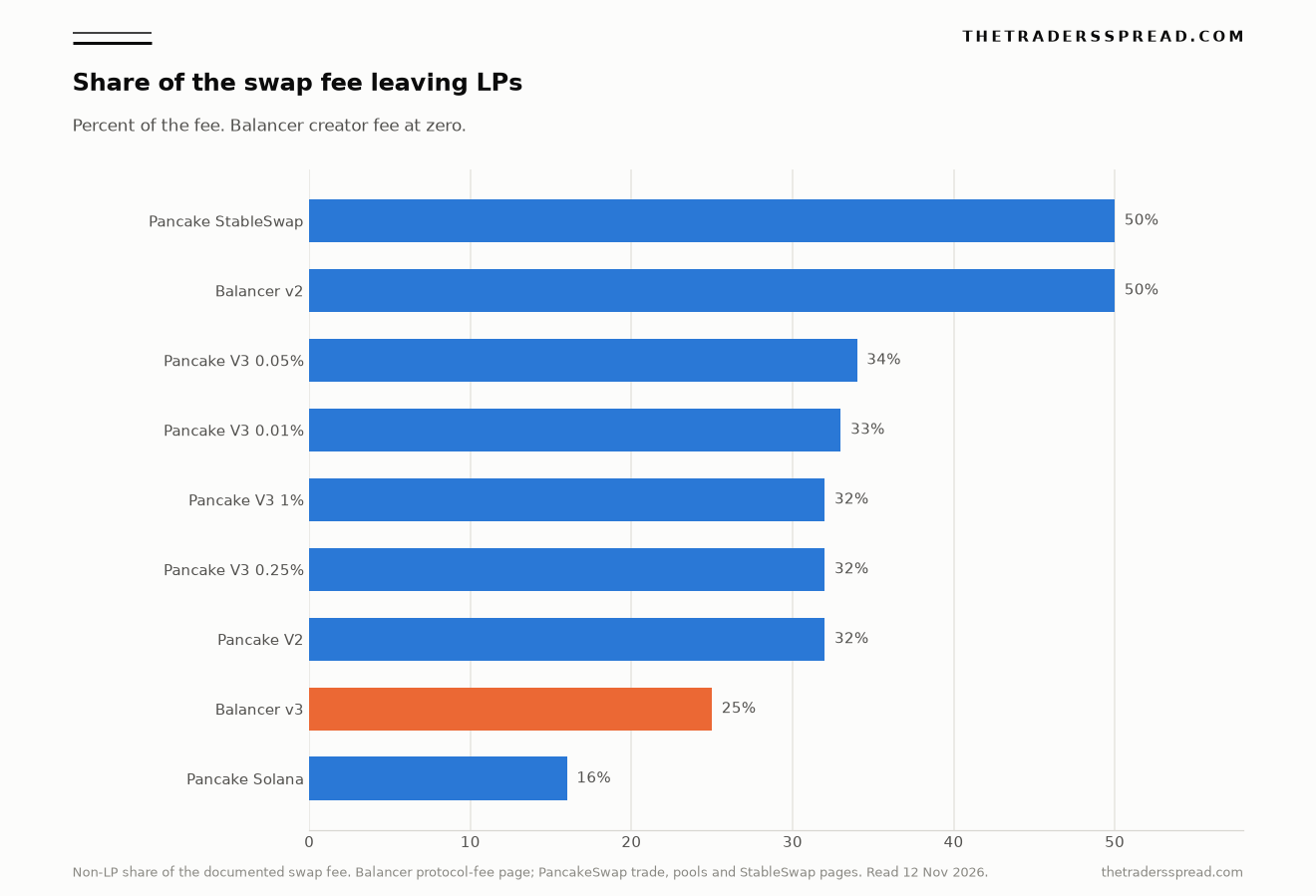
Solana keeps 84% with providers, the largest share on the chart. Balancer v3 at a zero creator fee keeps 75%. The EVM tiers keep 66% to 68%. Balancer v2 and Classic StableSwap each keep 50%, one by a protocol cut that now goes to the DAO treasury and the other by a 40% buyback plus a 10% treasury line. The Aerodrome fee piece separates a swap fee from a bribe and an emission, a second payment beside this table.
A second cut, and a hook that can move the first
A creator fee is how one Balancer pool leaves the chart. On the v3 example the protocol's 6.25 units stay fixed, and a creator fee of 20% of the remainder takes 3.75 from the 18.75 providers would have kept. They hold 15, and 40% of the fee leaves them, above every EVM tier here and still under the v2 and StableSwap rows. The creator page treats that higher cut as a weaker reason to deposit, and swap and yield creator fees are claimed together.
RelatedHow Does Drift (DRIFT) Set a Perpetual Funding Rate
Hooks move the rate the trader pays, and the protocol still takes its percentage of whatever the hook returns. A hook that returns 2% is a different trader price from a 0.05% static pool, and v3 still takes 25% of the 2%. Infinity fixes static versus dynamic at initialisation, and its protocol fee stays off the chart because the page quotes 33% of the LP fee, capped at 0.4%, and leaves the question of a carve-out versus an added charge open. V3 flash loans stay fee-free by design, off this comparison. A funding charge on a perpetual sits on the position, the neighbouring question in the GMX funding-fee piece.
What the documents describe while venues change state
Which pools still take a swap is a separate fact from the formulas on the pages opened on 12 November 2026. Balancer's account posted on 30 October 2026 that most pools were withdrawals only, as approved in BIP-928, that funds remained with the holder, and that extended partner pools stay live until 30 November 2026 (30 October status). BIP-928, dated 14 September 2026, is the proposal that post calls approved: a pause where contracts allow it, partner v3 pools through 30 November 2026, and a later treasury distribution to BAL holders in place of the BIP-919 buyback. A partner pool inside that window can still quote the v3 math.
PancakeSwap's account, on 9 November 2026, moved that round of trading-fee buyback and burn to 16 November 2026 while the buyback contracts were upgraded, and said the amount would be executed in full with trading and liquidity continuing (9 November status). The burn line in the table remains the documented destination. The publish.twitter.com oEmbed check on both posts timed out, so both remain links.
Reference prints, kept off the ranking
CoinGecko's simple-price payload for balancer and pancakeswap-token, last_updated_at 1794466740, which is 06:59:00 UTC on 12 November 2026, printed BAL at 0.115012 dollars, market cap 8,031,642.09 dollars, 24-hour volume 229,553.54 dollars. CAKE printed at 1.8 dollars, market cap 571,304,520.51 dollars, 24-hour volume 18,971,561.21 dollars (payload). These are reference prints, and they sit outside the fee ranking.
The document change that would reverse this
With the creator fee at zero, the chart already ranks who keeps the fee. On the curve, equal weights and the normal AMM are the constant product, and the 80/20 pool returns 1.0824 fewer units on the 100 unit sell at a 0.25% fee. The weights and the reserves set the execution. The protocol cut decides who keeps the fee after that price is set.
A revision of the protocol-fee table that lifts the v3 swap share above 34% would put v3 on the other side of every EVM bar, at a zero creator fee. A revision of the pools table that lifts the provider share on the four EVM tiers above 75% would put those tiers on the other side of v3. A creator fee above zero reverses that one pool, as the 20% case already does, under the creator page we have. The curve ranking would reverse if the weighted-math page dropped the weighted product for one constant product at every weight, or if the StableSwap page stopped describing the normal AMM as x*y=k.
FAQ
Does the Balancer protocol fee change the price the swapper pays?
The protocol-fee page says the cut is a fraction of the fee providers were already charging, so the swapper faces the pool's own fee. On v3 that fraction is 25% of the fee. On v2 the fraction remains 50% of the fee. A creator fee starts at 0% and applies after the protocol cut, which reduces the provider share. The swapper pays the pool fee once, and the Vault charges that fee on the amount in.
Why do V2 and the 0.25% V3 tier pay providers the same 0.17%?
On a 10,000 unit trade the V2 page assigns 17 to providers, 2.25 to the treasury and 5.75 to the burn. The V3 table gives the 0.25% tier 68% to providers, 23% to the burn and 9% to the treasury. Those shares of a 25 unit fee are 17, 5.75 and 2.25. The tier and the older fixed rate describe one split in two formats. The 1% tier uses the same 68/23/9 shares on a fee four times as large.
Who earns a V3 fee once the price leaves the range?
The pools page says a position earns trading fees while the price sits inside the range the provider set. Once the price leaves, the position holds one token of the pair and stands out of the trades until the price returns. Providers who remain in range take the liquidity-provider share of swaps that still clear. The pool's fee tier stays as it was. Solana uses the same in-range rule, with an 84% provider share on every listed tier.
Can a Balancer weighted pool charge any fee it likes?
The weighted-pool page sets the swap fee from 0.001% to 10%, and that floor is higher than in v2. Stable pools on the swap-fee page run from 0.0001% to 10%, because the v3 Vault leaves the cap with the pool. Weights sum to 100%, each weight is at least 1%, and a swap stays within 30% of the token balance. A hook may return another percentage for a single swap, while the stored static fee remains the reference.
What would put Balancer v3 on the other side of the PancakeSwap bars?
Lifting the v3 swap share above 34% on the protocol-fee table would put v3 past the 0.05% EVM tier, the highest non-LP share calculated here, with the creator fee still at zero. Lifting the provider share on the four EVM tiers above 75% would put those tiers past v3 instead. Either change is a change to a page. The CoinGecko prints from 06:59:00 UTC on 12 November 2026 sit outside both reversals.
This article is general information about documented pool mechanics and is not a recommendation to trade, provide liquidity, or buy either token.