

Where does an EigenLayer yield come from, once native Ethereum staking is already paying the validator in ETH? It comes from a second payer. Ethereum's consensus rules credit a validator for attestations and for the occasional block. EigenLayer, in the Layr-Labs core contracts documented as the v1.3.0 release, lets a staker point assets already in that job toward an outside service, and the service posts its own reward. The base coupon stays an ETH credit from the protocol. The extra coupon is a token the service chooses to submit.
That split is what a restaking rate is quoting when it sits beside a staking rate. On the page opened 23 October 2026, ethereum.org describes staking as a deposit that activates a validator, and it places restaking's additional rewards outside Ethereum protocol issuance. The RewardsCoordinator, read the same day, is a different pipe: it accepts ERC-20 tokens from actively validated services and accounts them to operators and to stakers who delegated. One stream is issuance, priority fees, and block-proposal payments. The other exists on the days an operator was registered with stake allocated to that service.
The arrangement resembles a bond that pays the issuer's coupon and, beside it, a securities loan whose fee comes from another party who can also take a defined slice of the collateral. Undelegated stake keeps the protocol coupon alone, and delegated stake adds a second claim whose token and penalties sit outside the beacon chain.
Updated 23 October 2026, with each figure tied to a page opened that day.
Key facts
- ethereum.org/staking displayed 43,948,738 ETH staked, 35% of supply, and a current APR of 2.5% when opened on 23 October 2026 (source: ethereum.org/staking, 23 October 2026).
- A home validator requires at least 32 ETH and can hold up to 2,048 ETH, with compounding credentials adding rewards into the effective balance (source: ethereum.org/staking, 23 October 2026).
- A slashed 32 ETH validator has 0.0078125 ETH burned at once, then a 36-day removal, with a correlation penalty on day 18 (source: ethereum.org rewards and penalties, page updated 28 September 2026, opened 23 October 2026).
- ELIP-002 sets the EigenLayer withdrawal delay and the deallocation delay at 100,800 blocks, about 14 days, and queued stake stays slashable through that window (source: ELIP-002, opened 23 October 2026).
- The mainnet config sets the global operator commission at 1,000 basis points, which the RewardsCoordinator notes describe as a 10% default (source: Layr-Labs mainnet.json and RewardsCoordinator.md, opened 23 October 2026).
- CoinGecko's coin endpoint priced EIGEN at $0.222871, market cap $217,489,000, rank 173, last updated 23 October 2026 at 07:04 UTC, under the name EigenCloud, formerly EigenLayer (source: CoinGecko /coins/eigenlayer, 23 October 2026).
1) The lock is a validator, a pod, or a token strategy
Native staking locks ETH in Ethereum's validator set. A validator proposes blocks, checks other validators, and attests to the chain head, with a floor of 32 ETH and a cap of 2,048 ETH on the staking page opened 23 October 2026. Compounding credentials fold rewards into the effective balance. The older sweep pays any balance above 32 ETH out to the withdrawal address, where it stops adding weight. The locked object is beacon-chain ETH, and the protocol is the counterparty.
Home staking keeps both keys with the person running the node. Delegated staking usually leaves the withdrawal key with the staker and the signing key with an operator. Liquid staking replaces the keys with a receipt. ethereum.org's table keeps restaking off that list and calls it a further, third-party use of staking tokens.
On the native path the ETH stays on the beacon chain. The core-contract overview has the user deploy an EigenPod through the EigenPodManager, as fee recipient or withdrawal credentials, with proofs of balance against beacon state. The liquid path deposits an ERC-20 in the StrategyManager and receives shares the DelegationManager can assign to an operator. The stETH rebase Lido posts each day and the minipool split Rocket Pool applies to an ETH reward are receipts around beacon yield. Depositing either receipt creates EigenLayer shares, a separate claim, and EIGEN can occupy a strategy of its own.
| Path | What is committed | Where it sits | Keys |
|---|---|---|---|
| Home staking | 32 to 2,048 ETH | Beacon validator balance | Staker holds both |
| Delegated staking | A full validator | Same beacon validator | Operator holds the signing key |
| Native restaking | Beacon ETH already validating | EigenPod as withdrawal credentials | Pod receives withdrawals |
| Liquid restaking | LST, EIGEN, or other ERC-20 | StrategyManager strategy | Delegation is separate |
2) Slashing authority splits between the protocol and the service
Ethereum slashes for contradictory signatures. The rewards-and-penalties page, updated 28 September 2026, names three: two blocks for one slot, an attestation that surrounds another, and two attestations for one target. A 32 ETH validator loses 0.0078125 ETH at once, scaled with balance, then enters a 36-day removal with a correlation penalty on day 18 that grows when others are slashed too. The page summary caps that immediate burn at 1 ETH. Offline behaviour is separate: missed rewards and a small ETH loss while the chain finalizes, with the inactivity leak reserved for a chain that has missed finality for more than four epochs.
The second pen belongs to the service. ELIP-002, a merged proposal dated December 2024 and written by Matt Nelson, Yash Patil, Matt Curtis, Gautham Anant, Brett Palatiello, and Bowen Li at Eigen Labs, says unique stake can be allocated to only one AVS at a time. The AVS creates operator sets, operators opt in and assign magnitude, and only that AVS can slash the slice. Unallocated stake stays outside the pen. Sreeram Kannan, founder and chief executive of Eigen Labs, dated the tools on 27 February 2026, writing in his note on agents and open innovation that EigenLayer "became protocol-complete with slashing and redistribution, fulfilling the promise we made with the first whitepaper."
ELIP-006, dated 30 April 2025, lets a redistributing set name a recipient at creation and then freeze that address. It leaves native ETH and EIGEN outside those sets: paying a recipient in beacon ETH would mean exiting validators, and the text declines to promise a partial withdrawal that covers a slash and still leaves 32 ETH, while EIGEN's outflow is delayed for intersubjective faults. On a burning set the earlier path remains. ERC-20s go to the dead address ending in e16e4, and slashed native ETH stays locked in the EigenPod.
| Regime | Who can slash | Named trigger | Where funds go |
|---|---|---|---|
| Ethereum consensus | The protocol | Double block, surround vote, or double attestation | Burn, 36-day removal, day-18 correlation penalty |
| Burning operator set | That set's AVS, on unique stake | A commitment the AVS defined | ERC-20 to the dead address; ETH locked in the pod |
| Redistributable set | Same AVS, on that set's unique stake | Same commitment, fixed recipient | Eligible ERC-20 to the recipient; ETH and EIGEN excluded |
| Offline validator | Penalties apart from slashing | Missed duties while the chain finalizes | Missed rewards and a small ETH loss |
A slash in one set reduces that allocation and leaves other sets' nominal amounts in place, because the magnitude comes out of the operator's total. The beacon question is still whether the signing key contradicted itself. The EigenLayer question is which set holds magnitude, and what that set wrote down.
3) ETH from the protocol, ERC-20 from the service
Native yield is paid in ETH: matching votes, timely inclusion, a proposed block, priority fees, and any builder payment. The staking page showed a 2.5% current APR beside 43,948,738 ETH staked and a 35% ratio on 23 October 2026, a snapshot that moves with stake and with fees. The protocol pays it on every active validator, and a pod only changes where the withdrawal can land.
Anything above that is an ERC-20 the AVS submits to the RewardsCoordinator. Version 1 weights an AVS-wide sum by delegated stake, version 2 names a sum per operator, version 2.1 limits it to one set, and version 2.2 weights a set by unique stake or total stake, looking backward or up to two years forward. The protocol mints the staking ETH and the service posts the restaking token. Mainnet config sets the operator's default cut at 1,000 basis points, the 10% the RewardsCoordinator notes expect, and ELIP-001 lets an operator replace it per AVS from zero to the full reward, with seven days before the new split applies.
EIGEN incentives are a third payer again, a subsidy on the same rewards path rather than beacon issuance or a fee one service earned. Adding the 2.5% APR to an incentive and to a service fee mixes those payers. The chart is the token such incentives are often denominated in, across the year ending 23 October 2026.
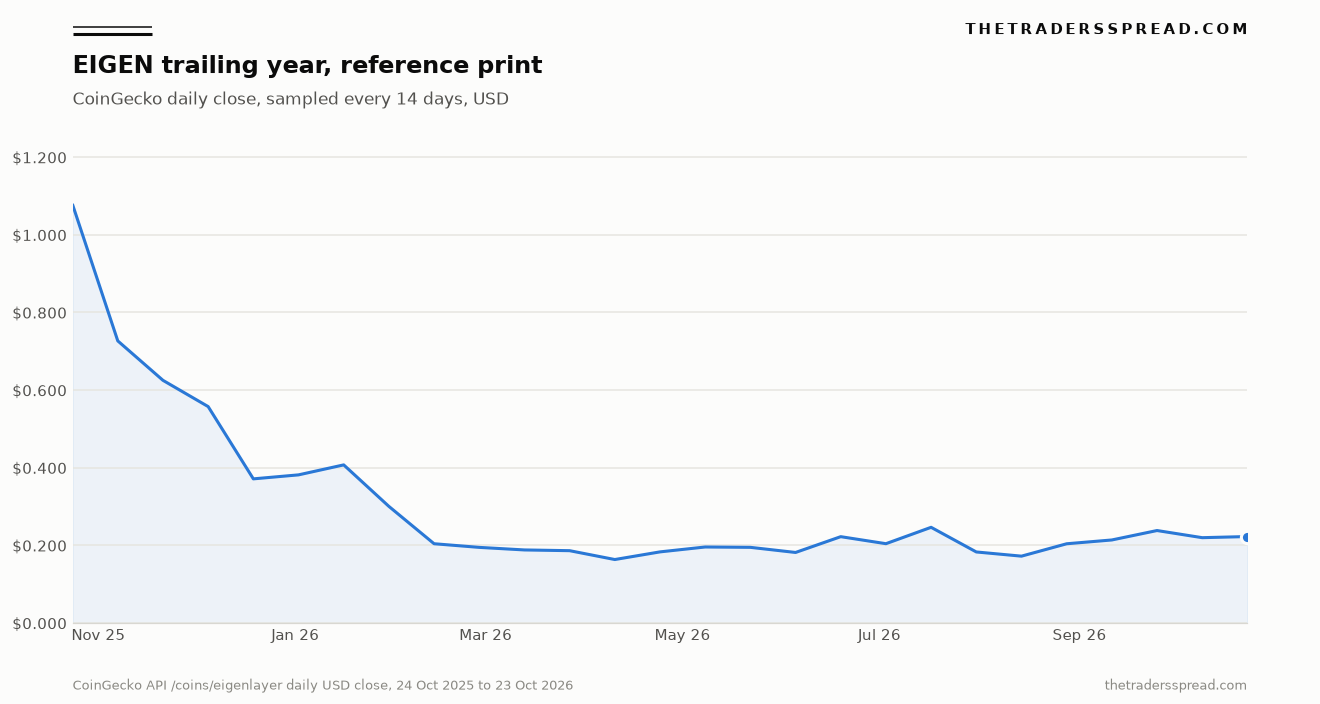
From about $1.08 in late October 2025 the samples settle near $0.20 by spring 2026, the purchasing power of an EIGEN-denominated reward on those dates.
4) Operators run the extra software
On Ethereum the operator is whoever runs the validator client. Delegated staking on ethereum.org leaves the withdrawal key with the staker, entrusts the signing key, and has the protocol pay the validator while the operator takes a fee. A home staker fills the role alone. A pool inserts its own operators. The software is consensus software, and the slash conditions are the three signature faults.
An EigenLayer operator is an address stakers delegate to, which then joins operator sets. Delegation, the withdrawal queue, and AllocationManager slashing meet in the DelegationManager, and the extra job is the AVS client. EigenDA's repository sends that operator to a node guide for storing and serving data, with stake allocated so a broken commitment can be penalised. ELIP-002 has the operator set an allocation delay first, then leaves stakers 100,800 blocks of queue if the new set looks wrong, shares still slashable throughout.
EigenCloud's account described the token side of the job on 9 March 2026. The post separates EIGEN's role in staking, slashing, and dispute resolution from the ETH that remains the beacon asset.
$EIGEN is the programmable trust layer behind EigenCloud.
— EigenCloud (@eigencloud) March 9, 2026
By powering staking, slashing and dispute resolution, EIGEN helps make autonomous AI agents economically accountable, so trust isn’t just promised, it’s enforced. pic.twitter.com/gKq4IKDi9C
The post treats EIGEN as the asset for commitments argued in public rather than proved by a double signature, which is why ELIP-006 keeps the token outside redistributable sets while outflow waits on intersubjective faults.
5) An AVS is the buyer of that work
ethereum.org's restaking page, updated 15 May 2026, calls the services actively validated services: a platform matching the parties, a native restaker connecting a validator, a liquid restaker depositing a Lido or Rocket Pool receipt, an operator doing the tasks, and services such as oracles, bridges, and data systems paying tokens. The contracts README uses the same name.
EigenDA is the case in hand. Its README describes a data-availability network on the restaking primitives and sends operators to a node guide: registration on chain, slashing through the AllocationManager, work off chain. ELIP-002 lets one AVS run many sets, pick strategies, and gate entry with a registrar. Its task examples include computation, proof checks, signature aggregation, and liveness pings, while the payer of the ERC-20 and the holder of the slash stay put. A set that takes only EIGEN offers EIGEN security. Pod-proved ETH locks a slash inside the pod. A liquid-token set puts the issuer between the staker and the beacon balance. Unique stake stops two sets taking the same unit, and one bad release can still fail every set that operator runs.
RelatedHow Lido (LDO) Sets Each Daily stETH Reward Rebase
6) A failed extra task and a missed attestation leave different scars
An AVS fault slashes unique stake in that set. For native ETH, ELIP-002 locks the amount in the EigenPod and leaves it inaccessible in that release, while an ERC-20 is sent to the dead address. The validator can keep attesting with credentials pointed at a pod that withholds the slashed part, so two books recorded the ETH and only one commitment was penalised. A beacon double-vote runs the other way: Ethereum burns the ETH, the next checkpoint proves a smaller balance, and the AVS holds less collateral even though its own software ran.
Getting out means clearing both queues. Beacon ETH uses the chain's exit queue, and the staking page credits Pectra with letting a withdrawal start from the withdrawal address. EigenLayer queues on the DelegationManager for 100,800 blocks, about 14 days, and ELIP-002 keeps a withdrawal, an undelegation, or a deallocation slashable until that delay ends. A slash during the wait is applied when the withdrawal completes. Finishing only the beacon exit leaves the pod queue standing.
| Action | Delay in the opened documents | Exposure while waiting |
|---|---|---|
| Consensus slash removal | 36 days, penalty on day 18 | Balance keeps declining |
| EigenLayer withdrawal | 100,800 blocks, about 14 days | Slashable until completion |
| Deallocation from a set | 100,800 blocks, about 14 days | That set can still slash |
| Operator split change | Seven days | Fee change only, visible in advance |
A liquid receipt can trade away from the ETH it claims, the same gap as the rebase and minipool notes above, and a later slash cuts the shares. An ERC-20 slash can leave the issuer's validators untouched. A native slash is the pod lock. The 35% ratio counts ETH in validators, while an earlier desk note on one listed treasury's ETH is about who holds the unstaked float.
Frequently asked questions
Is an EigenLayer yield the same payment as a staking yield?
They are different streams that a dashboard can add. Native staking credits ETH for attestations, proposals, priority fees, and builder payments under Ethereum's rules. EigenLayer's extra payment is an ERC-20 that an actively validated service submits through the RewardsCoordinator for operators and delegators registered over a stated period. The payers, the units, and the conditions for losing funds stay distinct, which is why one combined APR hides the split between protocol ETH and a service token.
Who is allowed to slash restaked ETH?
Ethereum can slash a validator for a contradictory block or attestation, on the three conditions in the rewards-and-penalties page. An AVS can separately slash unique stake that an operator allocated to that AVS's set, and other sets keep their own allocations. On a burning set, native ETH is locked in the EigenPod and ERC-20s go to a dead address. Redistributable sets pay a fixed recipient, and ELIP-006 leaves native ETH and EIGEN outside those sets.
What does the operator actually run?
On a home validator the staker runs Ethereum's execution, consensus, and validator clients and is the operator. On EigenLayer the operator is a delegated address that also runs AVS software and opts into operator sets. EigenDA's repository describes one such job as a data-availability node on the restaking primitives. Delegators skip that software and accept the operator's allocations, the set's slashing conditions, and the reward split then in force.
How long is the money locked on the way out?
Beacon ETH follows Ethereum's exit queue, and under the Pectra changes on ethereum.org a withdrawal can start from the withdrawal address, while EigenLayer runs a separate DelegationManager queue. ELIP-002 sets that delay at 100,800 blocks, about 14 days, and deallocation from an operator set uses the same length. Shares sitting in the queue remain slashable until the delay ends, so finishing the beacon exit still leaves the EigenLayer lock where it stood.
Where does the EIGEN token fit beside ETH?
ETH in a validator secures consensus, and native restaking proves that balance into an EigenPod for use as AVS collateral. EIGEN is a separate ERC-20 that can sit in its own strategy and be allocated as unique stake, and incentive submissions can pay it out. ELIP-006 keeps the token outside redistributable sets because outflow is delayed for intersubjective faults. The $0.222871 print on 23 October 2026 prices that token, apart from the 2.5% protocol APR.
What would still need re-reading in April 2027?
Whether the split still matches the contracts stays open until three pages move: a proposal after ELIP-006 that pays a recipient in native ETH or admits EIGEN to redistributable sets, the operator's allocation record after magnitude has moved between sets, and the protocol APR then shown on ethereum.org beside the ERC-20 that service is submitting. An EIGEN price print, taken alone, answers a different question from which payer funds the coupon and which rulebook can take the ETH.
The mechanics above are drawn from the documents opened on 23 October 2026. They describe how the two yields are paid and how the two penalties work, and they leave any decision about staking, restaking, or holding a token with the reader.