
Polkadot (DOT) showed up in a cash notice before it showed up in the governance result. On 28 September 2026, 21Shares told holders of the Polkadot Staking ETF, ticker TDOT, that the fund would pay $0.045029 a share. The ex-dividend and record date was 29 September. The money was payable on 30 September. The release says the cash is staking rewards earned on the DOT the trust holds, the same treatment it applied that day to ether, Solana, Hyperliquid and Sui.
The June payment on this product was larger. A Nasdaq release on 26 June put the prior distribution at $0.056134 a share, payable 30 June, back when the trust was still named the 21Shares Polkadot ETF. September's figure is 19.8% smaller. Over those three months the token did the opposite. Binance's DOTUSDT daily close went from $0.822 on 30 June to $1.223 on 30 September, a rise of 48.8%. The cheque shrank while the coin rallied.
At 07:48 UTC on 1 October 2026 the same market's last print was $1.235. On the rolling 24-hour window that was 2.2% above an open of $1.208, with a high of $1.264, a low of $1.198 and about $13.3 million of quote turnover. Against the 30 September close of $1.223, the last was only a touch higher. The interesting gap is not the overnight wiggle. It is the gap between a price that has already moved and a vote that has not finished.
OpenGov referendum 1944, "dotUSD: A Native Stablecoin for Polkadot", was still in its deciding state on a chain read at 07:21 UTC that morning. Confirming had not started. The aye share of the conviction-weighted tally was 98.4%. Support, the figure that actually has to clear the Root track's curve, was 0.108% of the electorate. A headline that says the stablecoin has passed is reading the wrong number.
Key figures
- DOTUSDT last $1.235 at 07:48 UTC on 1 October 2026, up 2.2% on the rolling 24-hour window from $1.208 — Binance 24-hour ticker, 1 October 2026.
- 30 September close $1.223, up 48.8% from the 30 June close of $0.822, and 38.8% below the 1 January 2026 close of $1.999 — Binance DOTUSDT daily closes.
- 18 August 2026 close $0.752, the lowest daily settle of the year, with an intraday low of $0.723. The 1 October last is 64.2% above that close — Binance daily klines.
- TDOT distribution $0.045029 a share, payable 30 September 2026, against $0.056134 payable 30 June 2026, a 19.8% cut — 21Shares releases of 28 September and 26 June 2026.
- Referendum 1944 tally: conviction-weighted ayes 4,379,991 DOT, nays 70,810 DOT (98.4% aye). Support 1,815,399 DOT against an electorate of 1,675,935,697 DOT, or 0.108%. State: Deciding, confirming null — Subsquare index of on-chain state, block time 07:21 UTC, 1 October 2026.
- Simple averages of daily closes through 30 September: 20-day $1.125, 50-day $0.982, 200-day $1.067. The 1 October last sits above all three — computed from Binance DOTUSDT closes.
A smaller payment than June
The September notice is a GlobeNewswire release out of New York, timestamped 5:37 p.m. Eastern on 28 September. Five funds share the dates. TETH pays $0.031602, TSOL $0.076590, THYP $0.191360, TSUI $0.052939. TDOT is the low print at $0.045029, ex-dividend and record on 29 September, payable on 30 September.
A staking ETF does not pay a coupon written into a prospectus. The trust stakes DOT, rewards arrive as more DOT, and the cash is whatever those rewards are worth after costs. A higher token price can lift the dollar figure. A lower reward rate or a smaller staked share can swamp it. The 19.8% cut, against a 48.8% rise in the daily close, says the per-share amount is not a tracker of spot.
The name caught up in late August. Item 5.03 of a Form 8-K filed 26 August 2026 states that on 25 August the sponsor filed a Delaware certificate changing the trust from "21Shares Polkadot ETF" to "21Shares Polkadot Staking ETF". The June Nasdaq release still used the old name. The 30 September cash is the first quarterly payment under the new one.
None of this makes TDOT the flow behind the rally. It is one Nasdaq product passing rewards through on coins it already holds. The same sheet paid Sui holders that morning. Sui's own tape is a separate story, the session when DeepBook's app went live. The payment is real. It is a poor proxy for the vote.
98% aye, and the vote is still open
Referendum 1944 was submitted on 7 September 2026 at 15:49 UTC. Deciding started the next morning, 8 September at 07:35 UTC, when the decision deposit landed. It sits on Root, the track the Polkadot wiki ranks as OpenGov's highest privilege. The record's own parameters: a decision period of 403,200 blocks, a confirm period of 14,400, a decision deposit of 100,000 DOT, and a support line that starts at 50% of issuance and falls to zero across that window.
The tally, read at 07:21 UTC on 1 October, is not ambiguous, and it is not a pass.
Conviction-weighted ayes were 4,379,991 DOT. Conviction-weighted nays were 70,810 DOT. Of the weighted votes cast, 98.4% were aye. That is the approval ratio, and on Root the approval curve never asks for less than half. Approval is not the binding test this late in the window.
Support is. It does not multiply by conviction. It counts DOT locked in favour, plus abstentions, against the electorate. Support was 1,815,399 DOT. The electorate on the same referendum record was 1,675,935,697 DOT, so 0.108%. At $1.235 that electorate is about $2.07 billion of DOT, and the support behind a protocol stablecoin is about $2.2 million. Write-ups that quote 4.4 million DOT in favour are reading the weighted aye column. The token lock is the smaller number.
The alarm says the same thing in blocks. Deciding began at block 32,907,208, so the 403,200-block window ends at block 33,310,408. The alarm sits at block 33,309,535, 873 blocks earlier. Confirmation needs 14,400 blocks. At a six-second block, 873 blocks is about an hour and a half, and 14,400 is a day. On this tally, 1944 does not have the runway to pass.
To open a runway, confirmation has to be underway at least 14,400 blocks before the window shuts. At that earlier block the line is still at 1.79% of issuance, or 29.9 million DOT, about 16 times the support on the book.
The 7 September close was $1.063 on 27.2 million DOT of Binance volume. The 8 September close was $1.246, up 17.2%, on 26.2 million DOT. The prior 30 sessions averaged 6.3 million DOT a day, so those two prints were about four times normal. A 15 September low of $0.934 gave a large piece back. A second push set a high of $1.306 on the 26th. On the 28th, the day the TDOT notice went out, the bar opened at $1.268 and closed at $1.182. The 30 September close was $1.223. The vote-day spike did not hold.
The year on one chart
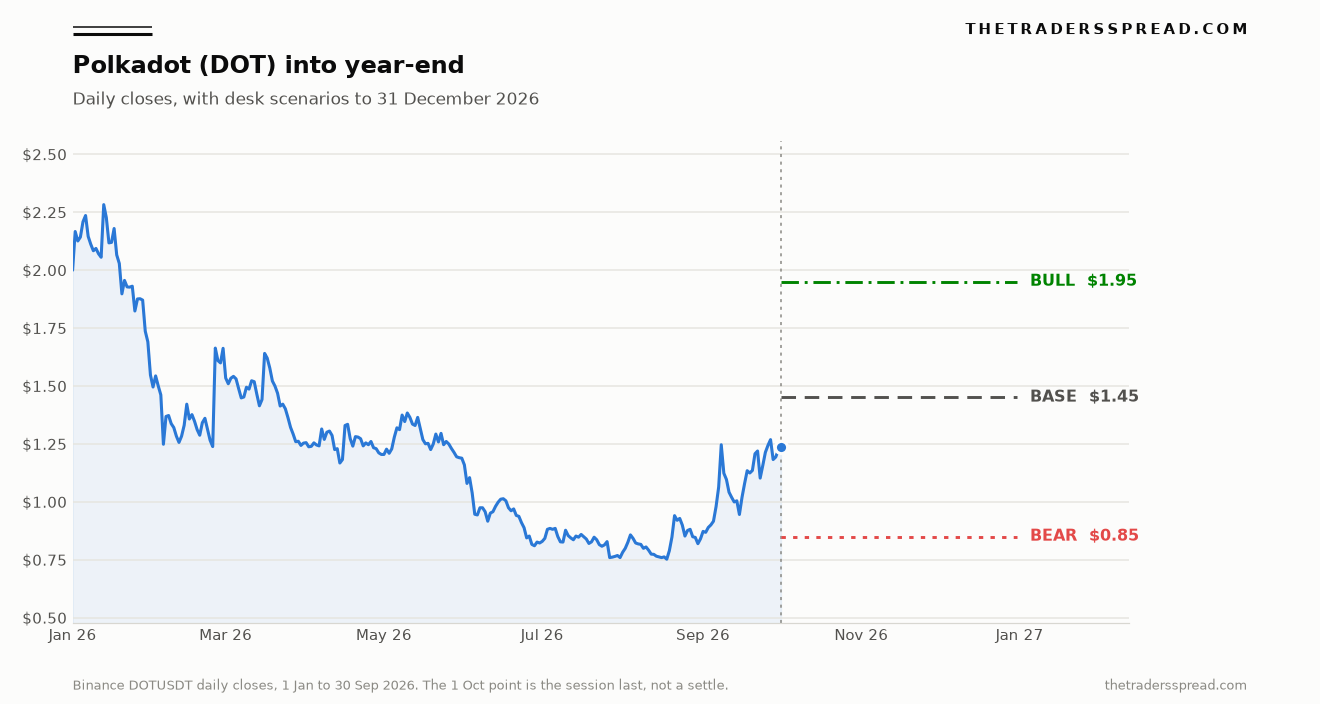
The chart is Binance's daily closes from 1 January 2026 through 30 September, with the 1 October point set to the $1.235 last rather than an unfinished daily settle. Three lines run from that last print to 31 December. Bull at $1.95, base at $1.45, bear at $0.85. They are this desk's scenarios, not orders and not market-implied odds.
The year opened at a 1 January close of $1.999. The 2026 high was 13 January, at $2.343. June ended at $0.822, and the lowest daily settle was 18 August, at $0.752. The recovery still leaves the last 38.2% under the 1 January close and 72.2% under the $4.439 intraday high of 6 October 2025. A 10 October 2025 candle wicked to $0.633 and closed at $2.946. That wick is not the low that matters. The August close is.
Through 30 September the 20-day average was $1.125, the 50-day $0.982 and the 200-day $1.067. The last sits above all three. That is the bullish mechanical case, and it does not survive a return to the summer base. $0.85 sits between the 1 September close of $0.872 and the August close. $1.45 is 11% above the 26 September high of $1.306. $1.95 is 2.5% under the 1 January close: a round-trip to where 2026 started, not a call for the October 2025 high.
| Scenario | Level | Versus the $1.235 last | What has to be true |
|---|---|---|---|
| Bull | $1.95 | +58% | Support on 1944 rises enough to confirm, and price accepts above the September highs and back toward the 1 January close. |
| Base | $1.45 | +17% | The vote times out or passes late, and the recovery from $0.752 still breaks $1.31 without needing a new 2026 high. |
| Bear | $0.85 | -31% | The September rally is faded back toward the August base. The year's low at $0.752 is not required. |
From the last print, $1.45 is a 17% rise and $0.85 is a 31% fall, which is why a bullish lean and a low conviction can sit in the same note. The averages say the trend off August is intact. The referendum arithmetic says the story told about that trend is ahead of the chain. The same discipline, upside and failure level both written down, is in the Bittensor bull and bear cases and the Celestia year-end range.
Phase one does not lock DOT
The text of referendum 1944, put forward by the Polkadot Community Foundation, asks OpenGov to create a protocol-owned asset called dotUSD and open a DOT/dotUSD pool on Asset Hub. The seed is $2.5 million of USDT, used to mint dotUSD, and $2.5 million of DOT. The same call marks dotUSD a sufficient asset, sets a peg-stability cap, and creates a coinage instance.
The foundation's disclaimer in the same text is blunt. PCF says it is putting the proposal forward in an administrative capacity and will not deploy, operate, control or custody dotUSD. "dotUSD is a decentralized, protocol-native stablecoin project. It would have no issuer and would instead operate autonomously via on-chain logic."
The design the filing describes is Liquity v2's, adapted. The worked example uses 300 DOT at $5, so $1,500 of collateral and a mint of up to $1,000, a 150% ratio. Five dollars is not this market. At the $1.235 last, 300 DOT is about $371, and the same illustration mints about $247. The filing says a minimum ratio is enforced. It does not say, beside that example, that 150% is the minimum. Root has not approved the mechanism.
Phase one is the part the filing says is already built. Users mint dotUSD one-for-one against USDT, redeemable for one dollar, subject to a cap. No oracle. No vaults. No liquidation. Phase two is the DOT vault, the oracle, the stability pool and redemptions. The $5 million seed is treasury money for a pool. A timeout on 1944 leaves phase two unauthorised even if the USDT buffer already sits on a chain.
The filing names the awkward loop. In Maker, it says, the stablecoin depends on Ethereum and Ethereum depends only marginally on Dai. With dotUSD the relationship would run both ways. Phase one is the buffer meant to defend the peg without selling DOT. A DOT-backed dollar, on a network that wants the dollar so it can stop paying security in DOT, can become a circular trade.
Gavin Wood put the cash version of that argument on a stage a year earlier. At the Web3 Summit in Berlin in July 2025, the Polkadot founder told the room, in remarks reported by Liam Kelly for DL News on 19 July 2025: "Here's the headline figure: $500 million. This is about the annual spend for Polkadot's security." His proposal, in the same account, was to cut that "from half a billion to a little over $100 million" by paying validators a fixed cost in cash. The bridge to the stablecoin was one sentence. "There is a lot to be gained from creating a native stablecoin on Polkadot. That means we can pay fiat, but not have quite the same cost to the DOT ecosystem."
Referendum 1944 is the treasury proposal he said would follow. It is not the cost cut. The filing mentions a hard cap of 2.1 billion DOT and a Dynamic Allocation Pool that would budget staking and treasury spend in dollars. Those are claims in the text. The number a reader can check today is the electorate, 1.676 billion DOT. He declined, in that interview, to say when a stablecoin would launch.
The pre-image depends on system chains at version 2.5, which the text points at as referendum 1942. Even a clean confirmation would still be an enactment, then a pool, then a cap on a USDT buffer, and only later a vault that locks DOT. The first stage mints a dollar against USDT. It does not take DOT off the market.
RelatedBasic Attention (BAT) Rises 26.7% in the Week to 18 Oct
Base, bull, bear
This desk's weights, which are judgement and not a market price, are 40% on the base, 35% on the bear and 25% on the bull. The bias is bull because the working objective sits above the last. Conviction is 2 out of 5. The catalyst people are citing does not, on the tally above, confirm in time.
Base, $1.45, to 31 December 2026. The August low holds, the 200-day average near $1.07 continues to act as a shelf, and price pushes through the September highs near $1.31 without needing referendum 1944 to pass. A timeout in early October would hurt the narrative. It would not, on its own, put the close back at $0.75. $1.45 is 17% above $1.235. The working objective on this note is $1.45. The level that kills the idea is $0.85.
Bull, $1.95. Support climbs toward the 30 million DOT that would let confirmation finish inside the window, and the tape accepts a move back to the 1 January close. That is a 58% rise from $1.235, still under the 13 January high of $2.343. It is the scenario in which Wood's 2025 argument and the 2026 price point the same way. The tally does not fund it. Until the alarm moves, $1.95 is the tail.
Bear, $0.85. The referendum times out, the September spike is treated as a positioning event, and the close drifts back toward the 1 September print without having to break $0.752. A 31% decline from $1.235 sounds large until it is set against the 64.2% rise off the August close already in the price. $0.85 is that giveback. A daily settle under $0.85 retires the base case.
What would change the weights is participation, not another aye percentage. If support rose by an order of magnitude before the curve meets it, the bull weight goes up and $1.95 stops being a tail. If the last loses the 200-day average, the bear weight becomes the centre. The next TDOT declaration will show whether September's smaller cheque was a one-quarter dip. It will not show whether Root passed.
Questions that still decide the quarter
Has Polkadot approved dotUSD? No. On 1 October 2026 referendum 1944 was in the deciding state on the Root track, with confirming still null. The conviction-weighted tally was 98.4% aye. Support was 0.108% of an electorate of 1.676 billion DOT. The track needs both curves, and then a day of confirmation. Approval is not the missing piece. Turnout is.
Why did the TDOT payment fall if DOT rose? The payment is staking rewards, net of the fund's costs, converted into a per-share dollar amount. It is not a fixed yield on the token price. September's $0.045029 was 19.8% below June's $0.056134, while the Binance daily close rose 48.8% between 30 June and 30 September. Share count, the portion staked and the reward rate can all move the per-share figure the other way from spot.
Does a passed vote lock up DOT and squeeze the float? Not in phase one. The filing says phase one mints dotUSD one-for-one against USDT, with a cap, and without vaults or liquidations. The treasury seed is $2.5 million of USDT and $2.5 million of DOT for a pool on Asset Hub. DOT collateral and liquidations are phase two. A vote that never confirms authorises none of it.
Where does $1.95 sit against the year's range? It is 58% above the $1.235 last and about 2.5% under the 1 January 2026 close of $1.999. It is below the 13 January high of $2.343 and far below the 6 October 2025 intraday high of $4.439. As a year-end case it is a repair of the 2026 drawdown, not a new high.
What retires the $1.45 base? A settle under $0.85, which sits between the 1 September close and the 18 August close and would give back the rally this note is leaning on. A failure of support to grow, by itself, does not retire $1.45. That failure is already the centre of the base case. The price level does the retiring.
Is the 24-hour change the same as the move off August? No. The rolling 24-hour window into 07:48 UTC on 1 October was 2.2%, from $1.208 to $1.235. The move off the 18 August close of $0.752 to that same last is 64.2%. One is a session. The other is the recovery the scenarios are judging. Mixing them makes a quiet day look like a trend.
This is analysis, not a recommendation. Polkadot and the TDOT shares are volatile, and you can lose money. The $1.95, $1.45 and $0.85 levels are scenarios built from Binance closes and from an OpenGov tally dated 1 October 2026. They are not instructions to transact. Governance parameters and fund distributions change, and a tally read on one morning is not the tally at the end of the decision window.