

Aptos is not a payments rail that opened last week between the United Arab Emirates and Nigeria. The document behind that claim is a pilot agreement HashKey MENA dated in Dubai on 4 June 2026, and it does not disclose a dirham, a naira or a stablecoin of settled corporate flow. What changed on 28 September was distribution. At 16:00 UTC the verified Aptos account on X posted the same HashKey address again, three months after the release and two days after APT had already made its local high. A repost can refresh a headline. It cannot move the date on the issuer's page, and it cannot turn a pilot into a finished corridor. On Binance APTUSDT the last print at 07:35 UTC on 2 October 2026 was $0.8217, up 6.300% from the rolling 24-hour open of $0.7730, with a high of $0.8436 and a low of $0.7529.
The pair turned over 11.61 million APT, about $9.18 million of quote, in 123,248 trades. None of that is corridor volume. On daily closes the coin is up 40.2% from $0.586 on 2 September and down 5.8% from $0.8724 on 25 September. The intraday high on 26 September was $0.8897. The account posted after that high, into a fade, not in front of a breakout.
Treat the September note as a new fundamental and the levels below will look timid. Treat it as a three-month-old pilot and a year-end map near the recent range is the honest one. From here to 31 December the working path is a base of $0.85, a bull case of $1.25 and a bear case of $0.55. The bull case sits above the live print. The bear case sits below it. The base is a hold of prices already traded, not a new regime.
Two other readings refuse to line up with a fresh payments boom. DefiLlama put decentralised-finance value locked at $55.7 million on 2 October, against $199.6 million on 4 June and $782.4 million a year earlier. The stablecoin chart showed about $1.07 billion that day, against about $1.29 billion on 4 June. Price has bounced. Locked value has not, and the dollar stock is smaller than on the day HashKey published.
There is a third text. On 17 September the Sui Foundation wrote that Daya, the African firm in the HashKey pilot, had integrated Sui as settlement infrastructure and that the integration was live. The Aptos repost came eleven days later and linked back to June.
The facts underneath the map
- Binance APTUSDT last $0.8217 at 07:35 UTC on 2 October 2026, up 6.300% from an open of $0.7730. High $0.8436, low $0.7529, quote turnover about $9.18 million.
- Daily-close path to that print: up 40.2% from 2 September, down 5.8% from 25 September, down 55.9% from the 1 January close of $1.864, down 84.7% from the 3 October 2025 close of $5.373.
- Session low on 30 August was $0.509. Intraday high on 26 September was $0.8897, two days before the Aptos account recirculated the June release.
- HashKey MENA dates the Corridor Pilot Agreement with the Aptos Foundation and Daya to 4 June 2026 in Dubai. The Aptos post of the same URL is timestamped 28 September 2026 at 16:00 UTC.
- DefiLlama TVL $55.7 million on 2 October versus $199.6 million on 4 June. Stablecoin chart about $1.07 billion versus about $1.29 billion on those same dates.
- CoinGecko at 07:21 UTC: circulating supply 871.1 million APT, market cap about $716 million, rank 94. Aptos mainnet coin supply at 07:24 UTC: 1.210 billion APT issued.
- Year-end scenarios: bull $1.25, base $0.85, bear $0.55. Editorial weights 20%, 45% and 35%. Not market odds, and not an instruction.
What the June release actually promises
HashKey MENA FZE is the Dubai entity in the release. It describes a Virtual Assets Regulatory Authority licence, virtual-asset service provider reference VL/25/03/002, covering spot exchange services and over-the-counter broker-dealer services. That is not written up as a new payments permission granted in September for Nigerian payouts. The pilot is "structured to operate within VARA's licensing framework". A compliance sentence is not a volume statistic.
The commercial shape is specific, and limited. HashKey MENA said it had signed a Corridor Pilot Agreement with the Aptos Foundation for a business-to-business stablecoin corridor. Daya, called a pan-African stablecoin payments platform, is the African operating partner. On- and off-ramps are planned for the Nigerian naira and other African currencies, alongside SWIFT and bank wires, virtual local-currency accounts, and payment APIs. HashKey MENA casts itself as the Middle East over-the-counter node, with dirham, dollar and multi-currency ramps on a first-party basis. The foundation is the ecosystem partner, there to help fund cheaper execution on the protocol.
Read the tense. The release says the pilot "enables corporates to explore" regional trade settlement, and that a two-phase rollout will let firms fund local payments by on-ramping at one node and off-ramping at the other. The initial phase is "intended to lay the foundation" for a model in which stablecoins "may serve" as the primary settlement asset. May serve. Intended. Explore. A reader who needs a cleared notional will not find one, because the authors did not put one there.
Paul Joe, whom TechCabal identified on 5 June as co-founder of Daya, is the named voice in the HashKey release. He said: "Africa is already a front-runner in stablecoin adoption. What's been missing is the regulated infrastructure and scalable liquidity to connect that demand to the rest of the world. By joining HashKey's Asia Connect network as the African node, with settlement on Aptos, we're plugging into a network that already runs from Hong Kong to the Philippines to Vietnam to the UAE."
4 June was not a celebration on the Binance candles. APT closed at $0.755 that session and at $0.667 the next day, when TechCabal wrote the partnership up. From the 4 June close to the $0.8217 print the pair is up 8.8%. Over those months DeFi value locked fell by about seven-tenths and the stablecoin stock fell by roughly $220 million. A pilot can still be real. The price and the balances have not behaved as if a new settlement engine switched on in June and then again in September.
Daya's September pages point at more than one chain
On 17 September the Sui Foundation published a partnership note in a different tense. It says Daya has integrated Sui as settlement infrastructure, live across Daya Business, Daya Pro and the APIs, for cross-border payments and treasury moves. It says Daya is live in Nigeria and plans South Africa, Ghana and Kenya. It says Daya "holds the relevant licenses" and does not name them, and it publishes no payment volume. What it does claim is present-tense settlement on Sui, eleven days before Aptos recirculated a June URL.
Tomiwa "Aleph" Lasebikan, co-founder and chief executive of Daya, is quoted there: "We're excited to partner with Sui because it means real businesses across Africa can move stablecoins without paying a cent in fees." The fee line is his, about a gasless design. This article does not audit a fee schedule. The useful fact is the name, the title and the date. The chief executive of the African firm in the Aptos corridor was, in mid-September, describing Sui as a rail those businesses would use.
Both statements can be true. A payments firm can pilot one chain and settle on another. The mistake is to read the 28 September Aptos post as proof that corporate naira and dirham now clear on Aptos, when the fresher primary page about Daya's live product names Sui. Sui's own tape had a separate 24.4% burst that fortnight as its DeepBook app went live. That move is not Daya's flow. It is a reminder that a settlement headline and a price are different objects.
The round behind Daya is small beside the corridor language. UrbanGeekz reported on 26 June that Hivemind Capital led a $2.4 million pre-seed, with Lattice Fund, Alliance DAO, the Aptos Foundation and Globelink Investment participating, and that Lasebikan and Paul Joe founded the firm in October 2025. The Aptos account, on 28 September, repeated the round size and the foundation's role, and sent readers back to the June URL. It also described fees that "stay a fraction of a cent", which is the account's wording, not a measured corridor cost. A $2.4 million pre-seed can build a product. It does not show that the product already settles UAE-Nigeria trade.
A chart of the drawdown, and a shelf of dollars
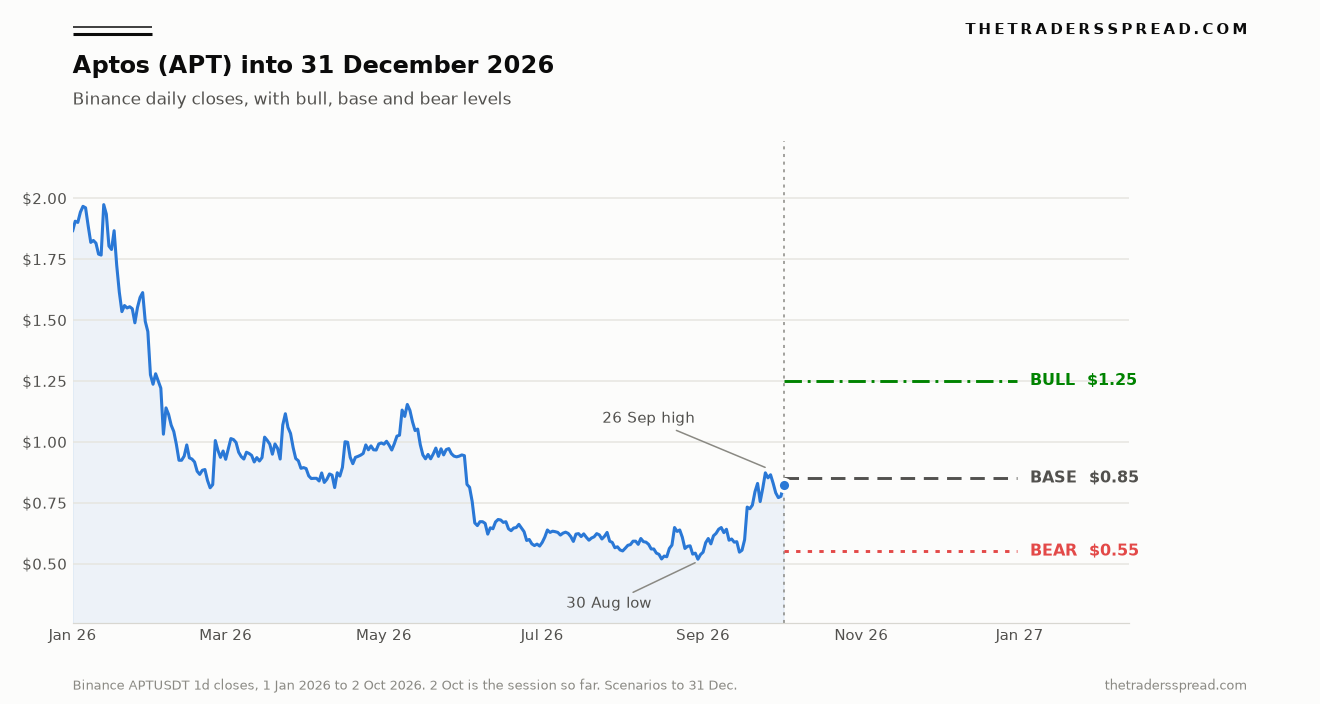
Daily closes from 1 January 2026 through the 2 October session. The last point is the $0.8217 ticker, not a settled end-of-day close. Bull, base and bear run out to 31 December. January's prices above $1.80 stay on the plot so $1.25 does not look like a return to the year's starting point. It is not.
| Measure | 4 June 2026 | 2 October 2026 |
|---|---|---|
| APT, Binance | $0.755 close | $0.8217 last, 07:35 UTC |
| DeFi total value locked | $199.6 million | $55.7 million |
| Stablecoins, all pegged dollars | $1.29 billion | $1.07 billion |
| USDT on Aptos | $903 million | $522 million |
| USDC on Aptos | $129 million | $365 million |
Price is Binance. The other rows are DefiLlama daily points, rounded. A live per-asset snapshot the same morning showed USDT at $522 million, USDC at $361 million, BlackRock's BUIDL at $162 million and World Liberty's USD1 at $20 million. USDC's daily point and that snapshot differ by a few million dollars. The direction does not.
USDT is the awkward row. The Tether-only chart was $903 million on 4 June and $977 million on 26 August, then $522 million on 2 October, with large single-day gaps rather than a smooth leak. A gap can be redemptions, a bridge unwind, or a reclassified balance. The feed does not say which. USDC rose from $129 million on 4 June to $365 million on the 2 October point, and that rise does not replace the USDT drop.
BUIDL's Aptos chart was about $242 million on 4 June and $162 million on 2 October. A tokenised Treasury balance is not a remittance, and it has not grown with the headline. Ondo's 11% gain on an SEC order is a different tokenised-dollar tape: a filing can move a coin without moving the balances under it.
Value locked near $56 million, against about $1.07 billion of stablecoins, is the ratio to keep. On these feeds Aptos is a shelf for dollar tokens more than a DeFi venue. On 28 September, the day of the repost, the stablecoin chart was about $968 million and value locked was $55.3 million. Neither series made a high that week.
Issued coins are not the same thing as a bid
At 07:24 UTC on 2 October the Aptos mainnet view for coin supply returned 1,209,543,619.71 APT, using the eight decimal places on the coin record. CoinGecko at 07:21 UTC reported a total supply within about a hundred coins of that, a circulating supply of 871.1 million APT, and a market cap of about $716 million. Coinpaprika at 07:20 UTC showed a market cap of $716.6 million against a price of $0.823. Rank on CoinGecko was 94.
About 338 million APT, roughly 28% of issued supply, sits outside the circulating figure. That gap is not a dated unlock here. Calendars are often waved at Aptos for mid-October. This article does not print an unlock size or an unlock day, because no primary schedule confirmed the coin amount. Most of the issued coin is already in the circulating count. A year-end case that needs a sudden shortage of APT has to argue with 871 million coins already outside that gap.
The 1 January close was $1.864, so the last print is 55.9% lower, and 84.7% lower than the 3 October 2025 close of $5.373. CoinGecko's high is $19.92 on 26 January 2023. Its low is $0.511 on 30 August 2026, the session Binance marks at $0.509. The corridor story sits between that floor and that old peak. The 6 January session high was $2.011.
The last daily close at or above $1.25 was 2 February 2026, at $1.279. The last intraday high at or above $1.25 was 4 February, at $1.281. The 10 May high was $1.239, and the coin has not traded $1 since 27 May, when the high was $1.004. A print of $1.25 by 31 December would be a return to early February, still about 38% under the 6 January high. A retracement. Not a new high.
Three paths to 31 December
The base case is $0.85. That is 3.4% above the $0.8217 anchor, and inside a range already traded: the high on 29 September was $0.8549. The base says the late-September bounce is not given back in full and is not extended into a trend. It matches a neutral stance. The reference print on the data panel is that Binance last. It is the anchor the scenarios are measured from. It is not an order.
RelatedPolygon (POL) Price Prediction: $0.13 Bull vs $0.07 Bear
The bull case is $1.25. Getting there means clearing the 26 September high of $0.8897 and holding it, then retracing toward early-February supply. Three dull conditions would make that less fictional. A daily close above $0.8897 that does not reverse within a week. A stablecoin stock that stops registering large down-gaps and holds above the $1.07 billion reading. A figure, from HashKey, Daya or the foundation, for corporate value settled on Aptos under the pilot. None of the three is in hand. Without them the weight on $1.25 is 20%.
The bear case is $0.55, a 33% decline from the anchor and a neighbourhood the coin occupied in mid-September. The 16 September low was $0.524 and the close was $0.555. A move to $0.55 gives back the late-September spike. It does not, on its own, break the 30 August low of $0.509. A daily close under $0.509 would be worse than the bear case drawn here. The weight on $0.55 is 35%: the rally is young, the catalyst is old, value locked is near the lows, and the USDT series has been stepping down.
The other 45% sits on the base. The weights are an editorial split so the paths add to one. They are not a prediction-market price. Conviction is 2 out of 5. The levels are tied to prints a reader can look up, and the distance between them is too wide for a stronger number to be anything but theatre.
The bull weight rises if APT holds above $0.8897 and the stablecoin chart stays above the 2 October reading. The bear weight rises on a daily close under $0.509. A published corridor volume would matter more than another repost. If APT trades $0.55, the base has failed. A move through $1.25 would fail it from the other side. Celestia's year-end page is the same exercise on another coin, not a multiple for Aptos.
Questions that survive the repost
Did Aptos open a UAE to Nigeria payments corridor in September 2026?
No primary page retrieved for this article says that. HashKey MENA's release is dated 4 June 2026 and describes a pilot with the Aptos Foundation and Daya, aimed at the naira and other African currencies, without a settled-volume figure. The Aptos account recirculated that URL on 28 September. A September text that does claim a live Daya integration names Sui, not Aptos.
What is the Aptos price prediction into the end of 2026?
Base $0.85, bull $1.25, bear $0.55, from a Binance last of $0.8217 at 07:35 UTC on 2 October 2026. The bull case is a return to early-February prices. The bear case gives back the late-September spike toward the mid-September shelf. The base is inside the range traded on 29 September. Editorial weights are 45% base, 35% bear and 20% bull.
Why can APT rise while DeFi value locked falls?
They are different books. From 2 September to 2 October the Binance daily path was up about 40%, while DefiLlama chain value locked stayed near $56 million. Stablecoins, at about $1.07 billion, dwarf that DeFi number and are still below the June and January readings. A bounce in the token can be positioning. It does not require the locked-value series to agree, and this time that series did not.
How much APT is in circulation?
CoinGecko reported 871.1 million APT circulating at 07:21 UTC on 2 October, and a market cap near $716 million. The chain's supply view, a few minutes later, showed 1.210 billion APT issued. About 338 million coins sit between those figures. This piece does not turn that gap into an October unlock. The size and the day were not confirmed from a primary schedule.
Is Daya using only Aptos?
The June HashKey release describes a pilot with settlement language pointed at Aptos. The Sui Foundation's 17 September note says Daya's business, pro and API products settle on Sui and are live in Nigeria, with plans for South Africa, Ghana and Kenya. Neither page publishes a share of flow by chain. Until one of them does, "only Aptos" is a stronger claim than the documents support.
What licence does HashKey MENA cite?
The 4 June release cites VARA reference VL/25/03/002, covering spot exchange services and over-the-counter broker-dealer services. The pilot is described as sitting inside that framework. The page does not present a separate September approval for a Nigeria payout product. Sui's note mentions Daya's permissions only as "the relevant licenses", with no register number.
This is analysis, not a recommendation. Scenario levels, weights and the reference print can be wrong. Capital is at risk, and a round number in a headline does not limit a loss.