

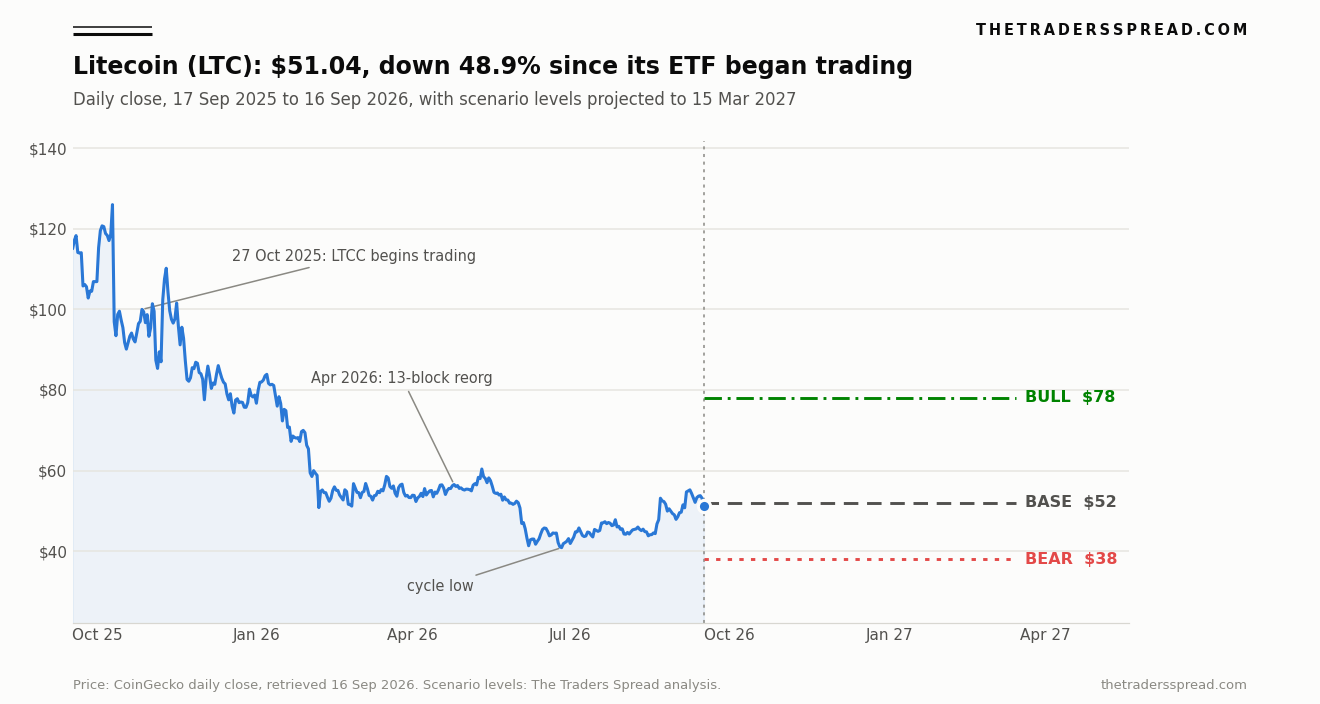
The most repeated claim about Litecoin is that it is still waiting for a spot ETF to arrive and re-rate it, and that claim has been wrong for almost eleven months. The Canary Litecoin ETF has traded on Nasdaq under the ticker LTCC since 27 October 2025, the date its sponsor records as the trust's initial share purchase in its Form 10-Q for the period ended 30 June 2026. LTC closed at $99.96 that day, on CoinGecko daily data. It trades at $51.04 on 16 September 2026, down 48.9% since the wrapper everyone wanted opened for business. The fund itself held 126,930 LTC and $5,301,668 of net assets at the end of June. That is 0.16% of circulating supply, and 0.134% of Litecoin's $3.96bn market capitalisation.
Which reframes the whole question. Litecoin's two named catalysts are both far smaller than their headlines, and the second one is smaller for a reason almost nobody prices. The 2027 halving cuts the LTC block reward from 6.25 to 3.125, and is routinely written up as a 50% supply shock to miners. It is not, because Litecoin is merge-mined with Dogecoin and shares its Scrypt hashpower with it. Blockchair put Litecoin's 24-hour hashrate at 2.686 PH/s on 16 September 2026 and Dogecoin's at 2.672 PH/s, or 99.5% of it: the same machines, secured to both chains. Dogecoin's block subsidy was worth $1,086,219 that day against Litecoin's $186,296. Litecoin supplies 14.6% of what a Scrypt miner earns from block rewards. Halve it and the merged pay cheque falls 7.3%, not 50%.
Key facts
- LTC spot $51.04, down 3.28% on the day, market cap $3.96bn, rank 25 — CoinGecko, 16 September 2026
- Canary Litecoin ETF net assets $5,301,668 against $11,334,155 of paid-in capital — SEC Form 10-Q, period ended 30 June 2026, filed 7 August 2026
- NAV per share fell from $18.81 to $10.20 in six months while shares outstanding rose from 370,000 to 520,000 — same filing
- 92.40% of the 84,000,000 LTC cap is mined; 6,387,721 coins remain — CoinGecko supply data, 16 September 2026
- Annual issuance runs 1,332,254 LTC, about $68.0m at spot, or 1.72% of supply — derived from Blockchair block data, 16 September 2026
- Total on-chain fees across 162,419 transactions came to roughly $431, or 0.23% of the day's block subsidy — Blockchair, 16 September 2026
- Litecoin Core has shipped five releases since 26 April 2026 after 17 months without one, every one of them MWEB security work — GitHub release history, 12 September 2026
What $5.3m of demand actually looks like
Canary Capital launched LTCC with a forecast attached. "Given the continued demand for spot crypto products and growing education around the potential of crypto and blockchain technologies, we believe there will be strong demand from retail and institutional investors alike seeking access to Litecoin exposure," said Steven McClurg, CEO and founder of Canary Capital, in the launch announcement. Eleven months of filings let us mark that to market.
The trust's own accounts are unsparing. Investors have paid in $11,334,155 since inception. Net assets stood at $5,301,668 on 30 June 2026, against a cost basis of $10,557,010 on the coins, leaving an accumulated deficit of $6,032,487. The vehicle has lost 53.2% of the money put into it.
The share count is the detail that matters more than the drawdown, though, because it separates two very different failures. If holders had fled, shares outstanding would have fallen. They rose, from 370,000 at the end of 2025 to 520,000 at the end of June, and stood at 520,000 again on 29 July 2026. People kept buying into a NAV that was sliding from $18.81 to $10.20 per share. LTCC did not fail because nobody wanted it. It failed to matter because the pool of people who wanted it was small enough that $5.3m of committed capital sits inside a $3.96bn asset without touching the price, and a 0.95% sponsor fee grinds against it the whole time.
Set that against what a crypto ETF looks like when the demand is real. Our note on Solana's ETF assets passing $1.06bn describes a wrapper roughly 200 times LTCC's size. Same regulatory door, same year, wildly different traffic through it.
The timing compounds the point. Litecoin's twelve-month high was $125.96 on 10 October 2025, seventeen days before LTCC bought its first coins. The listing did not start the rally. It marked the end of one.
The halving is a Dogecoin story
Litecoin's next halving lands at block 3,360,000. Blockchair recorded height 3,178,769 at 06:55 UTC on 16 September 2026, which leaves 181,231 blocks. The chain produced 584 blocks in the preceding 24 hours against a 576 target, so it is running slightly ahead of its 2.5-minute schedule. At that pace the halving arrives in late July 2027. The public halving countdowns agree closely, putting the event at 27 July 2027 and the remaining distance at 181,223 blocks, within twenty minutes of the figure the chain data implies.
The reward drops from 6.25 LTC to 3.125 LTC. Every retail preview treats that as a halving of miner income. The arithmetic of merged mining says otherwise.
Dogecoin's reward is fixed at 10,000 DOGE per block and never halves. It shares Litecoin's Scrypt hashpower through merged mining, which is why the two hashrates track each other so closely. At 16 September 2026 prices the split of a Scrypt miner's block-subsidy income runs like this.
| Chain | Block reward | Blocks in 24h | Daily subsidy | Share of merged income |
|---|---|---|---|---|
| Litecoin | 6.25 LTC | 584 | $186,296 | 14.6% |
| Dogecoin | 10,000 DOGE | 1,354 | $1,086,219 | 85.4% |
| Combined today | $1,272,515 | 100% | ||
| Litecoin after the 2027 halving | 3.125 LTC | 584 | $93,148 | 7.9% |
| Combined after the halving | $1,179,367 | a 7.3% fall |
Derived from Blockchair block and issuance data for both chains and CoinGecko spot prices, 16 September 2026. Dogecoin pays Scrypt miners 5.83 times what Litecoin does.
Two things follow. Litecoin's security budget is far less exposed to its own halving than the standard write-up assumes, which is genuinely reassuring on the hashrate question. It is also far more exposed to the Dogecoin price than to anything in Litecoin's own roadmap, and our piece on Dogecoin's 29% run over thirty days covers a market driven by legislative headlines rather than by anything Litecoin's developers control.
The supply-shock argument thins out from the other end too. Litecoin has already mined 92.40% of its 84 million cap. Annual issuance of about 1,332,254 coins is 1.72% of circulating supply, falling to 0.86% after the halving. On a $3.96bn market cap, $68.0m of annual issuance becoming $34.0m is not the kind of number that moves a price that trades $240m in a day.
Five security releases in five months
The story Litecoin sells about itself is age and reliability. Canary's own launch material called it a chain with "approximately 14 years of continuous 100% uptime." The last six months complicate that considerably.
In March 2026 a validation gap in Litecoin's MimbleWimble Extension Blocks let an attacker mint value out of nothing. The postmortem published by Litecoin developer David Burkett on 28 April 2026 sets out the flaw plainly. "The intended rule is simple: when an MWEB input spends a previous output, the metadata supplied by the input must match the actual MWEB UTXO identified by the input's output ID," the document states, per Bitcoinist's detailed account of the incident. "That check existed in some paths, including normal mempool and block construction paths. But it was not fully enforced in the block connection path."
At block height 3,073,882 an MWEB input worth no more than 1.2084693 LTC supported a pegout of 85,034.47285734 LTC. Developers coordinated privately with mining pools, froze the resulting outputs, and negotiated a recovery: 84,184.47278630 LTC returned, with 850 LTC kept by the actor as an agreed bounty. The full amount was pegged back into MWEB at block 3,078,098. No user funds were confirmed lost.
April went less well. A second actor tried the same path at block 3,095,931, and although upgraded nodes rejected the malformed data, the rejection exposed a separate failure mode. Burkett's postmortem describes what happened next: "During the April incident, this caused upgraded mining nodes to reject the bad block but also become unable to continue normal mining operations quickly enough. Unupgraded miners, which did not enforce the MWEB fix, continued extending the invalid chain until upgraded miners coordinated and overtook it." Thirteen invalid blocks were produced before the valid chain won, and the reorg cost external infrastructure real money, including a cross-chain venue that had already settled an 11,000 LTC swap.
The repair cadence tells you how deep this went. Litecoin Core released v0.21.4 in November 2024 and then nothing for seventeen months. Since 26 April 2026 it has shipped v0.21.5.4, v0.21.5.5, v0.21.5.6, a v0.21.5.7 distributed only to mining pools rather than published, and v0.21.5.8 on 12 September 2026, which adds a soft-forking consensus rule at height 3,172,640 and warns that miners who do not upgrade will produce blocks upgraded nodes reject.
Four days before this article, in other words, Litecoin was still hardening the same subsystem.
None of that is fatal, and the disclosure has been unusually candid by the standards of the sector. It does sit awkwardly against a pitch built on being the boring, proven option, and it is worth weighing next to how the market prices explicit privacy risk elsewhere, which our Zcash outlook takes up in detail.
The payments claim, measured
Litecoin is sold as digital silver to Bitcoin's digital gold, a cheap fast rail for actual payments. The chain data supports half of that.
Fees really are negligible. Blockchair recorded a median transaction fee of 888 litoshis on 16 September 2026, about $0.00045, with an average of roughly $0.0027. Settlement takes 2.5 minutes. For moving value between exchanges it does the job, and it has done the job without interruption for fifteen years.
The volumes are the problem. Litecoin processed 162,419 transactions in that 24-hour window, and total fees paid across all of them came to something near 8.45 LTC, or $431. Against a block subsidy of $186,296, fee revenue is 0.23% of what secures the chain. A payment network that genuinely displaced card rails would show a fee market. Litecoin shows almost none, which means its security rests entirely on issuance and, through merged mining, on Dogecoin's.
MWEB was supposed to widen the use case by adding optional privacy. It narrowed the distribution instead. After the upgrade activated in May 2022, Upbit, Bithumb, Coinone, Korbit and Gopax all ended won-denominated LTC support. Upbit's notice cited the Act on the Reporting and Use of Specific Financial Transaction Information, saying the optional feature "corresponds to an anonymous transmission technology" under that law, per Forkast's contemporaneous report. Litecoin lost an entire national market to a feature most of its users never touch, and four years later that trade-off has not been resolved in either direction.
The comparison that flatters Litecoin least is the one it invites. Silver trades as an industrial metal with monetary optionality. Litecoin has the monetary optionality, priced 87.56% below its May 2021 peak of $410.26, and very little industry underneath it. Our Bitcoin scenario work at least has a reserve-asset thesis and an institutional bid to argue about.
RelatedHow Ondo Finance Works When Treasuries Become Tokens
The call
Base case, $52, and roughly 50% likely on a three-to-six month view. This is the honest answer for an asset whose named catalysts have already fired. LTC has rallied 15.47% in thirty days without a story attached, and it sits 24.9% above the $40.87 low of 26 June 2026. Nothing in the issuance schedule, the ETF flow or the developer roadmap argues for a re-rating in either direction before the halving comes into view in mid-2027. Drift is the default.
Bull case, $78, around 20%. That level is where LTC closed on 31 December 2025, so it requires unwinding the entire 2026 de-rating. Realistically it needs a broad risk-on crypto tape rather than anything Litecoin-specific, plus enough of a halving narrative building through the first half of 2027 that the 7.3% merged-subsidy reality never gets checked. High-beta assets do make that move. LTC gained 52.8% from here would still leave it 81% below its all-time high.
Bear case, $38, around 30%. This breaks the June low and needs less than the bull case does. A fresh MWEB incident during a period of active consensus changes would do it. So would Dogecoin weakness, which now transmits directly into Litecoin's security budget, or simple attrition as 1.72% annual issuance meets a market that trades 6.06% of its cap in a day and has no marginal buyer of size. The ETF is not that buyer at $5.3m.
What would change my mind: LTCC net assets crossing roughly $50m, which would mean the institutional bid finally showed up and my read of the demand pool was wrong. On the other side, a clean twelve months of MWEB with no emergency releases, combined with any Korean relisting, would repair the distribution damage and make the digital-silver framing defensible again. Fee revenue rising above 2% of the security budget would change the payments argument entirely. None of those look likely by March 2027, which is precisely why the base case is drift rather than a call.
FAQ
Is there a spot Litecoin ETF trading in the US?
Yes. The Canary Litecoin ETF trades on Nasdaq under LTCC and has done since 27 October 2025, the initial share purchase date recorded in its SEC filings. It holds physical LTC rather than futures and charges a 0.95% sponsor fee. At 30 June 2026 it held 126,930 LTC worth $5,301,668, which is a fraction of one percent of Litecoin's market capitalisation.
When is the next Litecoin halving?
It occurs at block 3,360,000. Litecoin stood at height 3,178,769 on 16 September 2026, leaving 181,231 blocks. At the recent pace of 584 blocks a day that points to late July 2027, and public countdowns put the date at 27 July 2027. The block reward falls from 6.25 LTC to 3.125 LTC at that point.
Why does Dogecoin matter to Litecoin's halving?
The two chains are merge-mined, so one Scrypt computation can secure both. Their 24-hour hashrates differ by less than one percent. Because Dogecoin's 10,000-per-block reward never halves and is currently worth 5.83 times Litecoin's daily subsidy, cutting Litecoin's reward in half reduces a merged miner's total block-subsidy income by about 7.3% rather than 50%.
What happened with Litecoin's MWEB privacy layer in 2026?
A validation gap let an attacker peg out 85,034.47285734 LTC in March 2026 from an input worth under 1.21 LTC. Developers recovered the funds after negotiating a bounty. A second attempt in April triggered a 13-block reorganisation of an invalid chain. Litecoin Core has published five releases since April 2026 addressing the subsystem, most recently on 12 September.
How much Litecoin is left to mine?
About 6,387,721 LTC of the 84,000,000 maximum, with 92.40% already issued as of 16 September 2026. New supply currently runs near 1,332,254 coins a year, roughly $68.0m at the current price and 1.72% of circulating supply. That rate halves at the 2027 halving, taking annual dilution to approximately 0.86%.
Why is Litecoin delisted in South Korea?
Five won-market exchanges ended support in June 2022 after the MWEB upgrade added optional transaction privacy. Upbit cited the Act on the Reporting and Use of Specific Financial Transaction Information, stating the feature corresponds to anonymous transmission technology under Korean law. The restriction has not been reversed, and it removed a significant retail market from Litecoin's distribution.
Disclaimer
This article is analysis and information, not investment advice, and nothing in it is a recommendation to buy or sell any asset. Prices and on-chain figures were retrieved on 16 September 2026 and change continuously. Cryptocurrency is volatile and capital is at risk, including the risk of total loss. Readers should do their own research and consider consulting a regulated financial adviser before making any decision.