

What fee is the market pricing when it calls a Raydium pool cheap? Raydium stores the swap fee on the pool before the trader arrives, and the amount people call an LP fee is a slice of that same debit. Apply the percentages on the protocol-fees page to 1,000 USDC at a 0.25 percent tier and the trade fee is 2.50 USDC, of which 2.10 USDC is the LP line, 0.30 USDC is the 12 percent line and 0.10 USDC is the 4 percent line. Adding 2.50 to 2.10 to 0.30 produces 4.90, which counts the LP and protocol pieces a second time. How Raydium works, on a swap, is one fee with several destinations.
The protocol-fees page and the buybacks page, both opened on 28 October 2026, call that 12 percent a RAY buyback taken from the trading fee. The fee-comparison page calls the same 12 percent protocol, and on Standard AMM v4 it says the slice is paid entirely to treasury. A reader who stacks "swap fee", "protocol revenue" and "LP fee" as three invoices will overstate what left the wallet. The destinations are real and the debit is single, which is the same accounting problem as a reward that several parties claim in How Rocket Pool (RPL) Splits a Minipool ETH Reward.
Updated 28 October 2026, with the config reads and the reference print cited below.
Key facts on a Raydium swap fee, each tied to a source and a date.
- Reference print 1.77 dollars, market cap 478,071,190 dollars, fully diluted value 982,834,527 dollars, circulating supply 269,963,562.98 against a max of 555,000,000, 24-hour volume 26,086,131 dollars, and CoinGecko total value locked 1,145,976,305 dollars. Source: CoinGecko raydium, last_updated 06:22:59 UTC, 28 October 2026.
- CPMM index 0, account D4FPEruKEHrG5TenZ2mpDGEfu1iUvTiqBxvpU8HLBvC2, carries tradeFeeRate 2,500 (0.25 percent of volume), protocolFeeRate 120,000, fundFeeRate 40,000, creatorFeeRate 500 and a pool-creation fee of 150,000,000 lamports (0.15 SOL). Source: api-v3.raydium.io/main/cpmm-config, 28 October 2026.
- That response held 21 CPMM configs. Eight are flagged for the interface, and the trade-fee list skips 0.01 percent. Source: the same response, 28 October 2026.
- The CLMM config endpoint returned 18 configs. Index 1 is tradeFeeRate 2,500 with tick spacing 60. Every row carries protocolFeeRate 120,000 and fundFeeRate 40,000. Source: api-v3.raydium.io/main/clmm-config, 28 October 2026.
- On a 0.25 percent CLMM or CPMM pool, the protocol-fees page splits the trading fee 84 percent to LPs, 12 percent to the buyback line and 4 percent to treasury, equal to 0.210, 0.030 and 0.010 percent of the trade. Source: docs.raydium.io/ray/protocol-fees, opened 28 October 2026.
- Standard AMM v4 on the protocol-fees page is 88 percent to LPs and 12 percent to the buyback line, at a 0.25 percent trade fee. Source: docs.raydium.io/ray/protocol-fees, opened 28 October 2026.
The pool is chosen with its tier already attached
A swap starts by naming an input amount and a pool that already points at a fee record. On CPMM and CLMM that record is an AmmConfig, chosen when the pool was created and read again by the swap. On Standard AMM v4 the numerators sit on the pool's own AmmInfo, fixed at creation, at a published default of 25 over 10,000, or 0.25 percent. The route picks a pool, and the pool brings the rate written at creation.
The protocol-fees page lists common CPMM tiers of 0.01, 0.25 and 1 percent. The 21 configs returned on 28 October 2026 run from a 0.005 percent trade fee to 4 percent, and both that list and the fee-comparison page skip 0.01 percent and zero. Five configs share a 0.25 percent trade fee and differ by creator rate, from 500 on interface index 0 to 12,500 on index 20. Eight carry the interface flag and creatorFeeRate 500, at 0.25, 0.30, 0.50, 1, 1.5, 2, 2.5 and 4 percent. Hidden index 16 pairs the 0.005 percent trade fee with creator rate 14,950.
CLMM's fees chapter still prints index 0 at 0.01 percent and tick spacing 1, index 1 at 0.05 percent and tick spacing 10, and index 2 at 0.25 percent and tick spacing 60. The 28 October clmm-config response had 18 rows, with indexes 0 and 2 absent, index 1 at tradeFeeRate 2,500 and tick spacing 60, and index 4 at 0.01 percent. The fee-comparison page's count on 9 September 2026 was 21 configs, including 0.5 percent. The October tradeFeeRate list leaves 5,000 out, and every remaining row still carries protocolFeeRate 120,000 and fundFeeRate 40,000.
Input is reduced before the curve runs
On CPMM the trade fee comes off the input before the constant product runs. Curve's stableswap, in How Curve Finance Works When Stableswap Sets a Price, takes its fee from the coin that leaves, so the two designs charge on opposite sides of the trade. Orca's Whirlpools, in the April 2026 fee-comparison table, are listed at a 0.3 percent default, a 0.01 percent floor and an 11 percent protocol share.
The CPMM fees chapter walks a 1,000 dollar swap against index 0 with creator fees off: 2.50 dollars, then 2.10 to LPs, 0.30 to protocol and 0.10 to the fund. With the creator rate set to 1,000, the chapter adds 1.00 dollar and the trade-fee split stays on the 2.50. On the input side the program adds the rates, rounds the combined charge up once, and the curve prices what remains. On the output side the creator charge comes off after the constant product, while the trade fee stays on the input.
Protocol, fund and creator amounts can sit in the vault and still sit outside the balances the curve uses, so a raw token-account balance overstates the next price. A Token-2022 transfer fee can land before the vault. The fee-comparison page's stack, a 1 percent input-mint fee, a 0.25 percent pool fee and a 0.5 percent output-mint fee, comes out near 1.74 percent, from one minus 0.99 times 0.9975 times 0.995. The 0.98 in an intermediate line is an exchange rate, and the mint fee is paid to the mint authority.
One debit, three destinations
Twelve percent of the swap fee is the protocol slice, not twelve percent of the trade. On CPMM and CLMM, tradeFeeRate 2,500 over 1,000,000 is 0.25 percent of volume, and protocolFeeRate 120,000 over 1,000,000 is 12 percent of that fee, or 0.03 percent of volume at this tier. fundFeeRate 40,000 is 4 percent of the fee, or 0.01 percent of volume. AMM v4 encodes the trade fee as 25 over 10,000 and the protocol share as 12 over 100. A raw 2,500 read beside a raw 25, with the denominators ignored, makes a quiet pool look a hundred times more expensive than a legacy one.
| Product | Trade fee the swap reads | LP share of that fee | Protocol share of that fee | Fund line |
|---|---|---|---|---|
| AMM v4 | 0.25 percent, 25/10,000 | 88 percent, 0.22 percent of the trade | 12 percent, 0.03 percent of the trade | Blank on the protocol-fees page |
| CPMM | Live index 0 is tradeFeeRate 2,500 | 84 percent, 0.21 percent of the trade at 0.25 percent | 12 percent of the trade fee | 4 percent of the trade fee |
| CLMM | Live index 1 is 2,500, tick spacing 60 | 84 percent of the trade fee, to in-range liquidity | 12 percent of the trade fee | 4 percent of the trade fee |
The tier is the rate stored on the config, not the yield an LP books. At 0.25 percent and an 84 percent LP share, the LP line is 0.21 percent of volume. AMM v4's 88 percent share is 0.22 percent of volume. The gap is the fund column that AMM v4's protocol-fees row leaves blank.
The fee-comparison page sends AMM v4's 12 percent entirely to treasury. The buybacks page calls that 12 percent a RAY buyback and names holding address DdHDoz94o2WJmD9myRobHCwtx1bESpHTd4SSPe6VEZaz. The treasury page lists USDC addresses for CLMM and CPMM, with AMM v4 absent. An admin write hits the next swap for every pool on that config, accrued fees keep the old rate, and only the matching owner collects.
Collection happens on a later transaction
The swap books the slices, and payout of protocol, fund and creator balances waits for a later transaction. On CPMM the LP share stays in the reserves until the LP tokens are burned. Protocol and fund wait for CollectProtocolFee and CollectFundFee, and creator balances wait for CollectCreatorFee. Since 19 September 2026 a share of the creator bucket can move into the protocol counter when it is collected, as a floor of creator fee times share rate over 1,000,000, with the dust left for the creator. The swap itself still accrues the whole creator fee, which is why protocol revenue jumps on collection days.
Each CLMM step takes its trade fee from that step's input, floors out protocol and fund, and gives the remainder to in-range liquidity. A position outside the price stops accruing, and the swap still charges the tier.
Raydium's own account said, on 20 May 2026, that dynamic fees and single-sided fees were live on CLMM, with rates that adapt and an option for LP fees to accrue in one token for the life of the pool.
Dynamic fees and single-sided fees are now live on Raydium CLMM.
— Raydium (@Raydium) May 20, 2026
Fee rates adapt automatically to market conditions. Pool creators can now set LP fees to accrue solely in the quote token for the lifetime of the pool. pic.twitter.com/97Xkpu5vJR
The CLMM fees chapter, opened 28 October 2026, is the mechanism behind that post. Dynamic fees add a volatility surcharge to the config rate, capped at 10 percent of volume, and the surcharge uses the same fee-growth fields as the base fee. Single-sided collection is fixed at creation, either from the input token or pinned to token 0 or token 1. Up to three reward streams are funded emissions. An empty interval leaves those tokens in the vault, and adding a reward to the 0.25 percent tier counts a subsidy as a trader payment.
Neighbouring charges sit on their own lines
Live index 0 stores creatorFeeRate 500, or 0.05 percent of volume, while the CPMM fees chapter's default table still prints 0 for that index. Account D4FPEruKEHrG5TenZ2mpDGEfu1iUvTiqBxvpU8HLBvC2 carried 500 on 28 October 2026. A pool with enable_creator_fee left false charges a creator fee of zero, and Initialize defaults the flag to false. Index 16 pairs a trade fee of 50, or 0.005 percent, with a creator rate of 14,950, or 1.495 percent. The flag decides which of those two numbers the pool actually charges.
A new CPMM or AMM v4 pool costs 0.15 SOL on the protocol-fees page, separate from rent and from the swap, and CLMM's creation-fee line there is blank. The 9 September 2026 fee-comparison samples show a Solana base fee of 0.000005 SOL per signature. A LaunchLab trade before graduation is a 1 percent fee, half to the pool seed and half to the LaunchLab treasury, and the graduated pool inherits a CPMM split. Those three charges are different moments.
That comparison page, table dated April 2026, lists Uniswap v3 at a 0.3 percent default and a protocol share from 0 to 25 percent. The price path around one fee change is a separate record, Uniswap (UNI) Rose 128% on Robinhood Chain Fees, Then Fell 18%. Raydium's CPMM and CLMM rows, read on 28 October 2026, sit at 12 percent plus 4 percent of the trade fee.
RelatedHow Curve Finance Works When Stableswap Sets a Price
The reference print stays outside the numerator
None of the fee fields reads the market price of RAY. CoinGecko's raydium payload at 06:22:59 UTC on 28 October 2026 showed 1.77 dollars, and the contract on that payload is 4k3Dyjzvzp8eMZWUXbBCjEvwSkkk59S5iCNLY3QrkX6R.
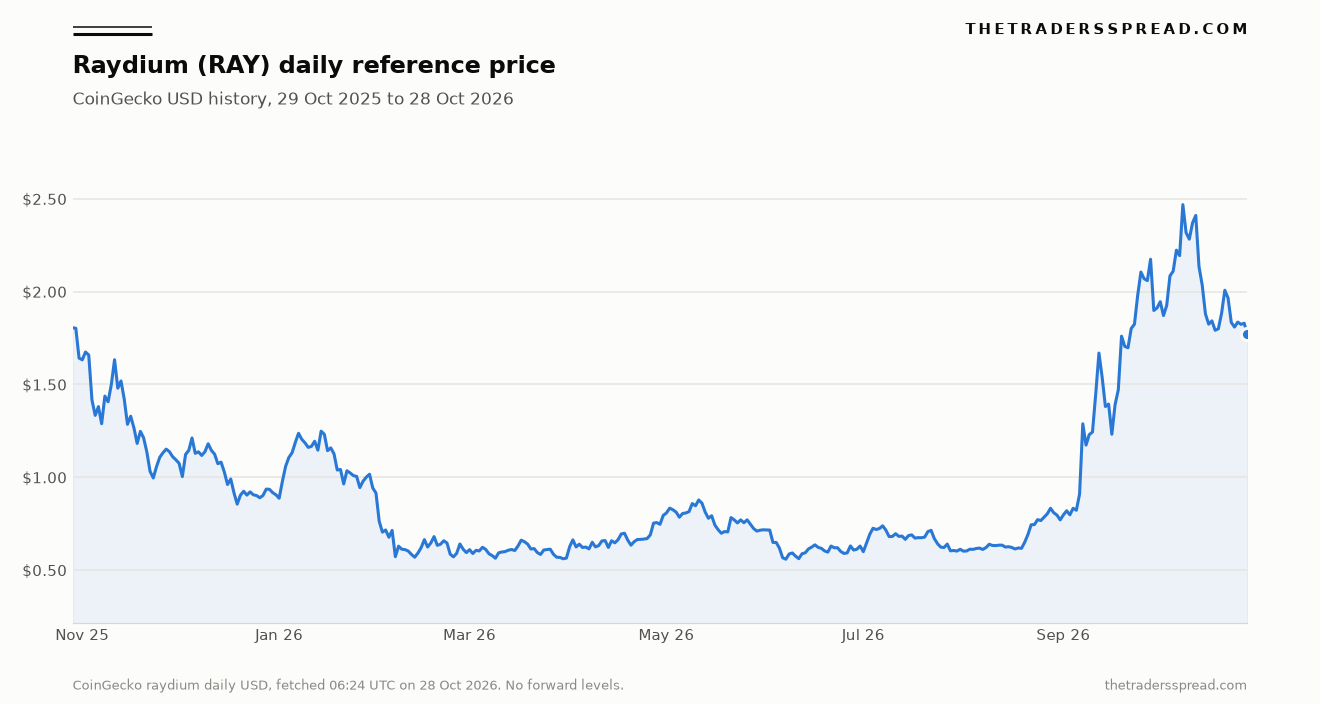
The daily series fetched at 06:24 UTC the same morning is 365 points from 29 October 2025 to 28 October 2026, low 0.5581 dollars on 7 June 2026, high 2.4686 dollars on 8 October 2026, last point 1.7713 dollars. Index 0's trade fee was 2,500 through that window. A route that averages a 0.05 percent CLMM hop with a 0.25 percent CPMM hop is blending two configs, and each pool's own tier stays put.
FAQ
Who receives the LP share?
On AMM v4 and CPMM the LP share stays in the reserves and is realised when LP tokens are burned. On CLMM it accrues to positions whose range contains the price, and it is collected when liquidity is decreased. A position left outside the price stops accruing while the price stays outside, and in-range liquidity takes the LP piece of a swap that still charges the tier. Protocol and fund balances are collected later by their owners.
Why do the docs and the config endpoint disagree?
The protocol-fees page still lists 0.01 percent among common CPMM tiers. The fee-comparison page and the 21 configs returned on 28 October 2026 leave that rate out. The CPMM fees chapter prints creator_fee_rate 0 on index 0, and the live account D4FPEruKEHrG5TenZ2mpDGEfu1iUvTiqBxvpU8HLBvC2 carries 500. The CLMM summary table's index 1 is 0.05 percent, while the live index 1 is 0.25 percent with tick spacing 60. The endpoint is the list a quote has to read.
When does a creator fee get added?
A creator fee is added only when the pool was created with that flag on. The rate sits on the shared AmmConfig, and the flag sits on the pool. With the flag off, the effective rate is zero even where the config stores 500. With the flag on and the rate at 1,000, the CPMM fees chapter's 1,000 dollar example adds 1.00 dollar on top of the 2.50 dollar trade fee.
Do Token-2022 fees and network fees belong to the tier?
A Token-2022 transfer fee is charged by the mint, and CPMM computes its trade fee on what remains after that cut. The fee-comparison example stacks a 1 percent input transfer fee, a 0.25 percent pool fee and a 0.5 percent output transfer fee into about 1.74 percent. Solana's base fee in the 9 September 2026 samples is 0.000005 SOL a signature, paid to the network, and a 0.15 SOL pool-creation fee is a different transaction.
Does the RAY print set the swap fee?
The swap fee is the config field. CoinGecko's raydium print at 06:22:59 UTC on 28 October 2026 was 1.77 dollars, with a market cap of 478,071,190 dollars. The daily series from 29 October 2025 to 28 October 2026 runs from 0.5581 dollars to 2.4686 dollars, which is the chart above. The index-0 trade fee that day was 2,500 over 1,000,000. The print can move through that range while the numerator stays put.
Which figure is the cheap pool?
When a quote calls one Raydium pool cheaper than another, which figure is actually in the comparison: the config's trade-fee rate, the LP's slice of it, or a route that has already blended two pools?
This article explains how a Raydium swap fee is set and split. It is not a recommendation to trade RAY, to provide liquidity, or to treat the reference print as a target.