

Traders still describe the Aerodrome lock as a governance token that carries a vote and zero cashflow, yet the lock is the claim on exchange revenue and it pays only while that weight points at a pool. A swap fee is a cut of a trade. A bribe, later named a Liquidity Payment in the Aero glossary, is someone else’s deposit meant to attract that weight. Emissions are new AERO minted for liquidity providers who staked into a gauge. Add the three and the same trade is counted more than once.
Updated 27 October 2026, with each figure below carrying the date of the page or the contract read that produced it.
Aerodrome launched on Base on 28 August 2023 as an automated market maker with a vote-escrow on the Velodrome V2 design. Liquid AERO is the ERC-20 that emissions pay out. The original lock minted veAERO, an ERC-721, and the upgrade passes that directing role to sAERO.
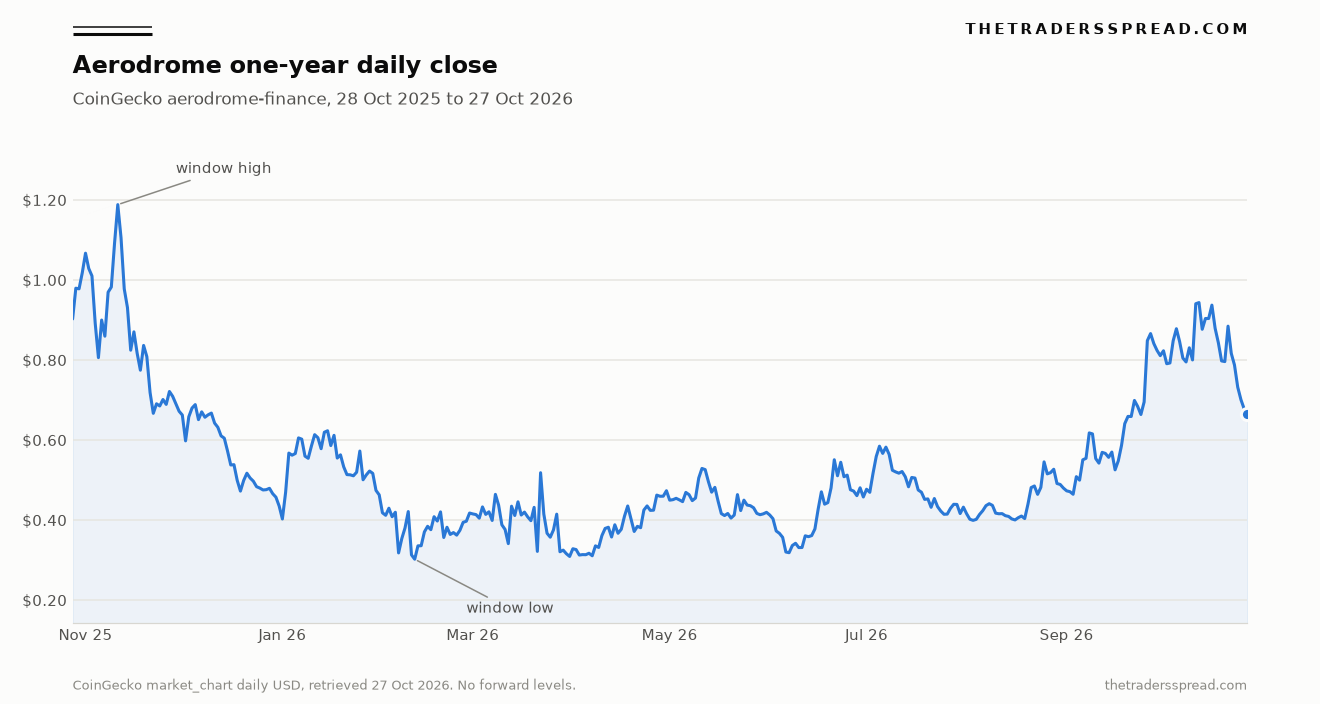
CoinGecko’s aerodrome-finance page, pulled at 06:20:58 UTC on 27 October 2026, showed $0.665478, a market cap of $555.6 million on 834.6 million tokens circulating, a total supply of 2.007 billion, and reported total value locked of $381.1 million. The successor page, id aero, printed $0.665489 at the same timestamp, a fully diluted figure of $1.417 billion, total supply of 2.129 billion, and a blank circulating supply, so its market cap sat at zero. Adding the two valuations would treat a migration as two coins. One-year daily history lives on the older id: from 28 October 2025 to 27 October 2026 the window high was $1.188 on 11 November 2025 and the low was $0.302 on 11 February 2026. The older all-time high, $2.32 on 7 December 2024, sits outside the chart, whose last point was $0.664 on 27 October 2026.
What the lock escrows
The docs state the ratio directly. One hundred AERO locked for four years becomes 100 veAERO, and the same hundred locked for one year becomes 25 veAERO. Weight decays with time remaining, unless auto-max lock holds the position as a standing four-year term. The cap is four years, 208 weeks, and the tokens come back when the term ends.
The NFT is a position in VotingEscrow on Base: a claim on vote-escrowed AERO, plus the right to aim emissions and collect the revenue attached to that aim. The canonical bridge and any third-party bridge pool hold different assets. Aero’s Metaswaps page describes a cross-chain route through pools, timed by blocks and message delivery, with zero dedicated bridge liquidity.
The upgraded stake keeps the shape. Aero’s getting-started page writes weight as staked balance times remaining duration, divided by a four-year maximum. Fixed terms run from six months to four years and the weight falls with the clock. Perpetual Stake pins weight at one-to-one, and switching it off starts a four-year wind-down before the AERO can be withdrawn. Unallocated sAERO is a valid NFT whose revenue waits on an aim.
In September 2026 the project account put the old bargain in three steps, acquire then lock then vote, and the revenue share follows. The post predates the upgrade and states the cashflow the empty-governance line leaves out.
Each week, veAERO holders vote to coordinate the flow of liquidity on Aerodrome.
— Aero (@aeroxyz) September 3, 2026
In return, they earn a share of 100% of the exchange's accrued revenue.
How to become a voter 👇
1️⃣ Acquire AERO
2️⃣ Lock AERO
3️⃣ Vote for pools & earn
Lock in and start earning today.…
Starting supply was 500 million, of which 450 million began as veAERO: 200 million to veVELO lockers (40%), 105 million to a public-goods fund (21%), 95 million to development funding (19%), and 50 million to Flight School (10%), each auto max-locked. Liquid AERO was 40 million of voter incentives (8%) and 10 million of genesis liquidity incentives (2%).
Fees leave the swap on their own
On v1 pools the fee is storage. The docs list PoolFactory at 0x420DD381b31aEf6683db6B902084cB0FFECe40Da. We opened that BaseScan page on 27 October 2026 and called stableFee and volatileFee on Base. The calls returned 5 and 30. The factory source comments those constructor values as 0.05% and 0.30%, with MAX_FEE a constant 300, commented as 3%. A fee manager can move the defaults, and a custom fee can override one pool, including a sentinel of 420 for a deliberate zero. Those two reads are that day’s defaults where a custom fee is unset.
Slipstream, the concentrated-liquidity venue, uses factory 0x5e7BB104d84c7CB9B682AaC2F3d509f5F406809A and a swap-fee module in place of one stable number and one volatile number. A per-pool Slipstream fee stayed unread this session, so a single Aerodrome fee is already a blend of venues.
Who receives the fee depends on the deposit. A provider can stake an emissions-eligible position and earn AERO, or leave it unstaked and earn trading fees. Staked swap fees become exchange revenue for the voters aimed at that pool. Aero’s tokens-and-rewards page says an AERO-earning deposit routes its swap fees to allocating token operators, while a fee-earning deposit keeps a portion of fees and stands outside the reward stream.
The about page also names a then-current default of 10% of unstaked fees on emissions-eligible Slipstream. The Aero pages we opened speak of a portion, and of a small percentage, and they leave the figure unnamed. Carrying 10% forward would invent a parameter.
On the old clock, staked swap fees from one epoch became voter rewards for the next, claimable after Thursday 00:00 UTC in the pool’s own tokens, so a Thursday screen is last week’s trading. A stable pool here is a different machine from the stableswap in our Curve piece, where the pool’s shape sets a price between similar assets.
A bribe arrives from outside the pool
External rewards, in whitelisted tokens, go only to voters on that pool, pro rata to votes, claimable after the epoch flips. The about page books them beside launch payments, which it treats as voting incentives on Ignition launches. A project deposits tokens to pull emissions toward its pool, and volume can be quiet while that incentive line is large.
A bribe can use the pool’s tokens and land in the same claim as fees. The about page’s vAPR formula defines weekly voting rewards as fees plus external incentives. Fees scale with volume and the rate, while incentives scale with an issuer’s budget, so one APR hides which piece remains if the issuer stops paying.
Aero’s glossary renames the deposit and keeps the split. Liquidity Payments are tokens posted so sAERO holders will allocate rewards to a pool, streamed back as exchange revenue. The glossary calls them incentives, and the later name for bribes. Trading fees, MEV capture, Liquidity Payments and Launch Payments stay separate ingredients.
The old epoch ran Thursday 00:00 UTC to Wednesday 23:59 UTC, with votes due by Wednesday 23:00 UTC. Incentives posted during an epoch were claimable the next Thursday, while fee rewards carried an extra week. Aero replaces that clock with an allocation that applies on submission, revenue that accrues as the pool trades, and a 47-hour cooldown before that stake can be aimed again, with revenue still accruing through the wait.
Emissions are a mint, and the rebase sits beside them
Weekly emissions opened at 10 million AERO, 2% of the initial 500 million. The emissions page describes 3% weekly growth for 14 epochs, then a 1% decay, then an Aero Fed under 9 million a week near epoch 67, with steps of 0.01% of supply, a ceiling of 1% a week and a floor of 0.01%. The about page records a different choice: the foundation held the rate near 10.92% annualized into the Aero launch, and it left the Fed’s later operation undescribed. A live weekly mint on the Minter stayed unread on 27 October 2026.
Only staked gauge liquidity earns the week’s emissions, and 5% goes to a team address. The page says veAERO supply leaves the liquidity-provider stream unchanged. The lock ratio drives a rebase for lockers: weekly emissions, times the square of one minus the locked share, times one half. April 2026 figures put supply near 1.88 billion, veAERO near 51% (about 958 million), average lock near 3.7 years, and emissions near 10.9% annualized. At 51% locked, half of 0.2401 is 0.120, so the rebase is about 12% of that week’s emissions. That 12% is our arithmetic, an extra mint beside an LP stream the docs treat as independent of the lock ratio.
That rebase is a different operation from the daily stETH reward rebase covered for Lido. One offsets dilution for vote-escrow holders once an epoch, and the other is a staking reward on ether.
By April 2026 the about page had Aerodrome above $185 billion of cumulative volume, above $270 million of swap fees, and about $450 million or more of revenue to token operators. Dividing 270 by 185,000 gives an implied average fee near 0.146%, between the 0.05% and 0.30% defaults, and the division is ours. Revenue runs ahead of fees because the revenue line includes incentives. The same page says 10,000 veAERO, voted at average efficiency, earned about $2,470 in 2025, with a warning that results vary, and that sum already mixes the two lines.
Old-contract supply on CoinGecko was 2.007 billion on 27 October 2026, above April’s 1.88 billion. Locked supply on VotingEscrow stayed unread, so 51% remains an April figure. The flight-school page, opened the same morning, still described four-week bonuses and a cumulative distribution above 42.6 million AERO, while the about page says Flight School concluded in April 2026.
Base is a stack of venues
Aerodrome volume gets called Base volume because the pools were deep and the chain’s name is shorter. DefiLlama’s Base DEX overview, retrieved about 06:24 UTC on 27 October 2026, showed $995.9 million of 24-hour chain DEX volume. Aero Slipstream was $376.0 million (37.8%), legacy Aerodrome Slipstream $167.7 million, Aerodrome V1 $3.1 million, Aero Basic $3.1 million, Uniswap V3 $175.1 million and Uniswap V4 $54.1 million. Legacy Slipstream plus V1 was another 17.2%. Combined, the Aero and Aerodrome rows reach 55.2% of the chain, a large share and still a different statement from the chain itself.
Over 30 days, legacy Aerodrome Slipstream showed $14.13 billion against a Base total of $29.55 billion, about 47.8%, on a window that crosses the upgrade. Aero Slipstream’s 30-day field matched its seven-day field at $1.31 billion. The 24-hour cut is the clean comparison.
The liquidity page, opened the same day, displayed value locked near $963.3 million, fees near $1.49 million and volume near $1.31 billion, with 281 tokens and an unlabeled window, against CoinGecko’s locked-value field of $381.1 million. Lending sits in a separate row: deposits in our Morpho note are collateral and loans, outside a DEX total, and Base is where both kinds of activity settle.
The weekly vote gave way to a live allocation
On 21 October 2026 at 20:00 US Eastern, 22 October at 00:00 UTC, Aerodrome and Velodrome upgraded into Aero. The hub and the launch note say old emissions stopped, new AERO emissions started, and AERO, VELO, veAERO and veVELO move to the new token and to sAERO. Upgraded supply is 94.5% Aerodrome community and 5.5% Velodrome community, matching each side’s share of combined revenue in the prior 52 weeks. CoinGecko records the contract move from 0x940181a94A35A4569E4529A3CDfB74e38FD98631 to 0x3f5bF3EdAc59d650D8fDf9657a71F2f904A3a4Ee. The new page’s high, $0.785 on 23 October 2026, is a few days of prices and a separate mark from December 2024.
The cashflow assignment is what stayed. An allocating sAERO stake earns the aimed pools’ exchange revenue in full, and an AERO-earning deposit hands its swap fees over in return for rewards. The weekly epoch is what ended. Predictive allocation applies on submission and waits 47 hours before the same stake can be re-aimed, a different habit from a vote that rolled forward from inaction.
RelatedHow Ondo Finance Works When Treasuries Become Tokens
On 19 October 2026 the project account pointed at its economy note, where dynamic fees and gauge caps were set out ahead of the launch.
New article on the Aero economy is LIVE ✈️
— Aero (@aeroxyz) October 19, 2026
From an analysis of Slipstream's upgraded Dynamic Fees module to Gauge Caps that will allow the rate of LP rewards to surge with volatility and risk, and much more.
Get ready for launch, and read below👇https://t.co/WYOvxdHwbj
Liquid tokens, and any veNFT that sat out the final epoch, could move when the portals opened. A veNFT that had voted waited an hour, because that lock was already inside the week’s fee and incentive split.
Three flows, side by side
The rows keep the birthplace, the recipient on an emissions-earning deposit, and the neighbour each flow is merged with. Aero wording covers the period after 22 October, and a missing live read is marked unread.
| Flow | Where it starts | Recipient on an emissions-earning deposit | Often merged with |
|---|---|---|---|
| Swap fee | A cut of the trade. V1 defaults on 27 October 2026 were 0.05% stable and 0.30% volatile, and Slipstream’s per-pool rate stayed unread. | Voters or token operators receive it, while the provider on an emissions-earning deposit takes AERO instead. | The bribe, and the emission that replaces the fee. |
| Bribe, later a Liquidity Payment | An outside deposit, plus launch payments booked the same way. | Weight aimed at that pool collects it, after Thursday 00:00 UTC in the old epoch, or while an Aero allocation is live. | The swap fee, inside one voting-rewards total. |
| Emissions and the locker rebase | A mint. The schedule opened at 10 million a week, a later page held about 10.9% annualized, and the 27 October mint stayed unread. | Staked liquidity earns it, plus a locker rebase driven by the lock ratio, with 5% of emissions going to a team address. | The swap fee, even in a week when that pool’s fees were thin. |
Arithmetic that keeps the flows apart
A hypothetical v1 volatile pool with $10 million of volume, at the 0.30% default, generates a $30,000 swap fee. Staked liquidity sends that $30,000 to the aimed voters or operators, and the providers are paid in emissions. An issuer’s separate $40,000 token deposit is the bribe. Freshly minted AERO streamed to the gauge is the third flow, and its dollar value moves with the token price.
Adding $30,000, $40,000 and the emissions’ dollar value, then calling the sum fees, counts an issuer’s budget and a mint as if both had been taken from the trade.
That $10 million already sits inside any chain total that counts the pool, so stacking Aerodrome volume on Base volume counts the swaps twice.
Questions that keep coming back
What is Aerodrome in crypto?
Aerodrome is the automated market maker that launched on Base on 28 August 2023. Traders swap against its pools, and providers either stake a deposit for AERO emissions or leave it unstaked and collect swap fees. Locking AERO created veAERO, later carried into sAERO, and that stake directs emissions and collects exchange revenue from the pools it aims at.
Does the lock pay if the weight sits unused?
Revenue follows the aim, so an unvoted veAERO position or an unallocated sAERO stake is a timed escrow with idle weight. Old-epoch fees and incentives were shared in proportion to votes actually cast. Aero sends exchange revenue to operators allocating to the pools that generated it, which means a valid NFT can sit out a week’s cashflow.
Is a bribe just a fee with another name?
A swap fee is a cut of volume, 0.05% or 0.30% on the v1 defaults read this session, or else a Slipstream rate from that pool’s module. A bribe is an outside deposit paid to voters or allocators. Aero’s glossary keeps both inside exchange revenue and still defines Liquidity Payments as the later name for bribes, so a summed line describes either one poorly.
Does locking AERO stake the Base bridge?
The lock escrows AERO in VotingEscrow or, after the upgrade, in an sAERO stake, for up to four years, and aimed weight directs emissions and collects exchange revenue. The Base bridge is other code holding other assets. Metaswaps describes pools and messages with zero dedicated bridge liquidity, and the asset inside the escrow is AERO.
Why do two CoinGecko pages both say AERO?
CoinGecko’s 27 October 2026 notice says the project rebranded from Aerodrome Finance to Aero and migrated contracts on Base. The older page still held the one-year history, a circulating supply and a market cap, while the newer page held a fully diluted figure, a blank circulating supply and a few days of prices. Adding those valuations counts one migration twice.
A checklist before the three numbers get added
- The pool fee comes from that pool’s factory, and the 27 October 2026 v1 defaults of 0.05% stable and 0.30% volatile stay off the Slipstream module.
- The incentive column stays apart from the swap, because a project deposits those tokens and only aimed weight collects them.
- Emissions and the rebase are both mints, one following votes or allocations and the other following the lock ratio, and the fee total leaves both out.
- The chain total sits beside the protocol row, and the 27 October DefiLlama pull still left a large share of Base DEX volume in other venues.
- Old veAERO and upgraded sAERO stay in separate columns, so the two supplies and the two CoinGecko valuations stay unadded.
- Every figure keeps its date, because the April 2026 docs, the 22 October upgrade and the 27 October reads answer different questions.
Figures here are reference data from the pages and contract reads dated in the text, a description of mechanics only, and they are not a recommendation to buy, sell, lock, vote, or allocate.