

$130.6 million a day is what NEAR Intents, the cross-chain swap layer that settles on NEAR Protocol (NEAR), averaged between 19 August and 14 September, according to DefiLlama. In the 30 days before, the figure was $64.6 million. The doubling started on the exact day the token turned. CoinGecko's 00:00 UTC print on 19 August was $1.588, NEAR's lowest since 18 May, and at 06:43 UTC on 15 September the token stood at $2.403, 51% higher, with a $3.14 billion market value that ranks 32nd. Measured from the 17 August print of $1.602, the gain is 50.0%, against 23.2% for bitcoin over the same stretch. So the price and the plumbing moved together. The harder question is who is pushing volume through that plumbing, and whether they ever touch the token. The account data below says fewer people are active on NEAR itself than a month ago.
That is the part the rally coverage has skipped. Daily active accounts on the NEAR chain averaged 75,329 from 19 August to 14 September, 10.4% below the 84,072 of the prior 30 days, per the nearblocks charts API. Transactions rose only 4.0%. Binance's NEARUSDT perpetual book, meanwhile, carried 40.7 million coins of open interest on 15 September against 45.0 million on 17 August. A 50% rally with fewer native users and fewer coins in open perpetual contracts fits neither of the usual explanations. It points instead to spot demand on centralised venues and to a surge in value settled by the Intents contract on behalf of market makers moving other chains' assets.
Key facts
- NEAR traded at $2.403 at 06:43 UTC on 15 September, 50.0% above the $1.602 print of 17 August — CoinGecko market_chart API, read 15 Sep 2026
- NEAR Intents averaged $130.6m of daily volume from 19 August to 14 September, 2.02 times the $64.6m of the prior 30 days — DefiLlama, read 15 Sep 2026
- Daily active NEAR accounts averaged 75,329 over the same window, down 10.4% — nearblocks.io charts API, read 15 Sep 2026
- Binance NEARUSDT open interest fell from 45.0m to 40.7m coins (−9.6%) while its dollar value rose to $100.4m on price alone — Binance futures API, read 15 Sep 2026
- Upbit's KRW-NEAR market peaked at 3.4% of global NEAR volume, with a local premium between −1.4% and +3.0% — Upbit API and Frankfurter FX, read 15 Sep 2026
- Bitwise filed Amendment No. 5 to its NEAR ETF registration on 28 August, naming ticker NRR on NYSE Arca with the fee still blank — SEC EDGAR, 28 Aug 2026
- The live protocol config caps NEAR inflation at 2.5% a year, and total supply grew 2.78% in 12 months to 1.306bn — NEAR mainnet RPC and nearblocks, read 15 Sep 2026
Where $3.5 billion went: inside the Intents doubling
NEAR's own documentation describes Intents in three steps. A user or an AI agent states an outcome, such as swapping one token for another. An off-chain network of market makers, which NEAR also calls solvers, competes to quote it. The accepted quote then executes through a Verifier smart contract on NEAR Protocol, which settles the trade (NEAR Docs). The assets being swapped can sit on other chains. DefiLlama nonetheless books all Intents volume to the Near chain, because that is where settlement happens.
The step change is sharp in the daily series. Volume was $80.9m on 18 August and $134.2m on 19 August, and it has not printed a day below $56m since. The window from 19 August to 14 September summed to $3.53bn over 27 days. The 4 September session, at $209.4m, is the third-largest day in the protocol's history, behind $265m on 21 November 2025 and $224m on 5 June 2026. The 9 September figure of $198.9m ranks sixth.
Monthly totals tell the same story at lower resolution. August's $2.78bn was the busiest month since the $3.66bn record of November 2025. September had logged $1.93bn by the 14th, and held at that pace for 30 days it would pass the November record, though a pace is not a result. Cumulative volume stands at $28.96bn.
Now the counterweight. The value locked in the Verifier contract across chains rose from $88.6m on 18 August to $135.0m on 14 September. That 52% increase matches NEAR's own price gain closely enough that we cannot separate new deposits from price effects without a token-level breakdown, which DefiLlama does not publish on this endpoint. The chain's native activity went the other way. New accounts averaged 11,670 a day, down 9.1% from 12,844, while daily transactions edged up 4.0% to 711,816. Our reading, which is inference rather than something the data proves, is that a small set of market-maker and relayer accounts is handling far more value per transaction. That says more about throughput than about NEAR winning users.
It also changes what the token is a bet on. A NEAR holder in 2021 was betting on apps and users arriving on the chain. A holder in September 2026 is, in effect, betting that cross-chain settlement keeps routing through NEAR's contracts, whoever the end users are.
Fifty per cent, against bitcoin's 23%
Every major coin rose from mid-August, so the first test of a NEAR-specific story is relative performance. The table uses CoinGecko's 00:00 UTC print on 17 August and each coin's latest print between 06:45 and 06:49 UTC on 15 September.
| Coin | 17 Aug, 00:00 UTC | 15 Sep, latest | Change |
|---|---|---|---|
| NEAR Protocol (NEAR) | $1.6015 | $2.4029 | +50.0% |
| Solana (SOL) | $74.55 | $101.02 | +35.5% |
| Ether (ETH) | $1,874.40 | $2,488.43 | +32.8% |
| Bitcoin (BTC) | $62,843.70 | $77,421.82 | +23.2% |
| Bittensor (TAO) | $195.68 | $231.01 | +18.1% |
| Internet Computer (ICP) | $2.2587 | $2.6155 | +15.8% |
| Aptos (APT) | $0.5182 | $0.5807 | +12.1% |
| Render (RENDER) | $1.2558 | $1.3658 | +8.8% |
| Sui (SUI) | $0.6706 | $0.7085 | +5.7% |
Two things stand out. NEAR beat bitcoin by almost 27 percentage points, and the peer group suggests the gap is specific to NEAR. The layer-1 chains launched after it trailed bitcoin, with Aptos up 12.1% and Sui 5.7%, and even Solana, the strongest large alt in the table, finished 14.5 points behind NEAR. The coins most often grouped with NEAR as "AI" tokens lagged too, with Bittensor up 18.1% and Render 8.8%. Whatever lifted NEAR, it was not a sector bid for AI names.
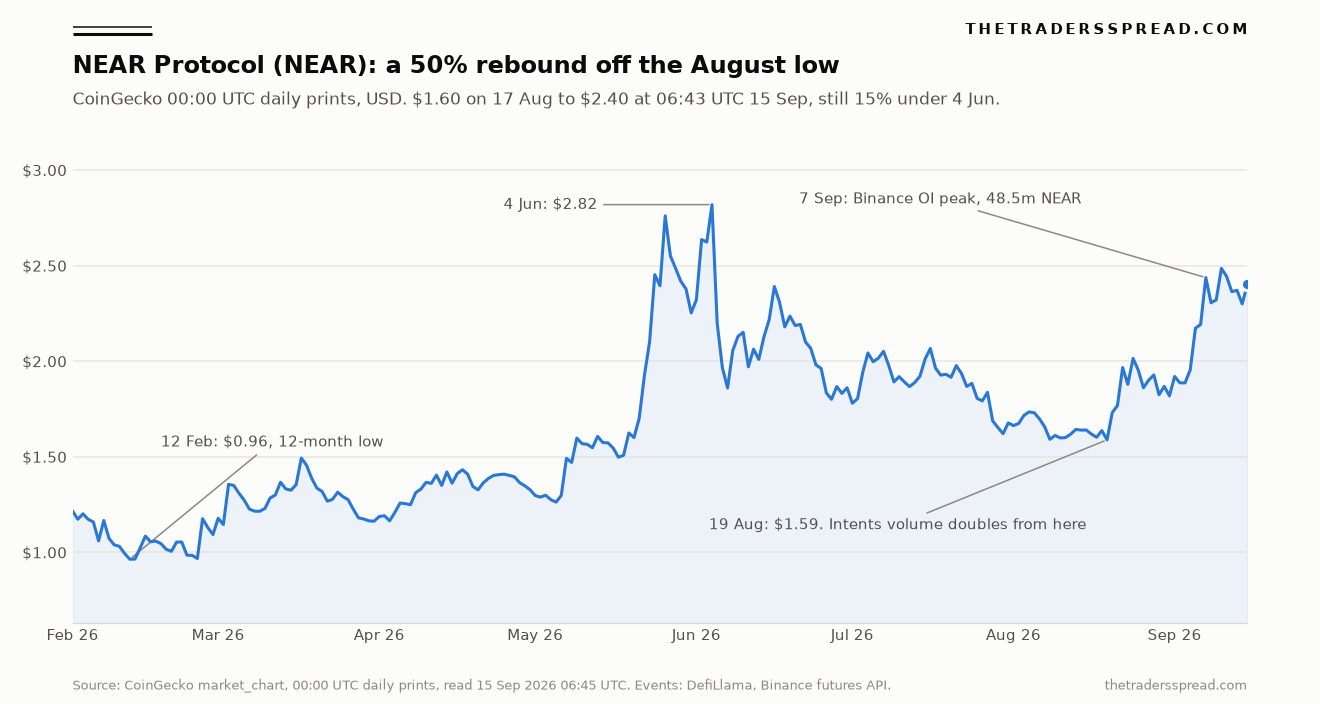
The chart puts the move in a longer frame, and the frame is less flattering. NEAR's 2026 high print was $2.819 on 4 June, and the token is still 14.8% below it. Measured from 18 June's $2.179, the gain shrinks to 10.3%. On a one-year view NEAR is 8.5% lower than the $2.627 print of 16 September 2025. CoinGecko's own one-year percentage field shows −13.3%, which does not reconcile with its price series, so we have not used it. The all-time high of $20.44 from January 2022 is 88% away.
Most of the 50% is recovery. NEAR fell 43.7% from the 4 June print to the 19 August low, then won back about two thirds of that loss. Against the 12 February low of $0.964, the token is up 149%.
Was it leverage? Count the coins, not the dollars
On 14 September our Filecoin analysis traced that rally to Binance perpetuals, with perp volume running at 9.6 times spot. NEAR looks different. Binance's NEARUSDT perpetual traded between 3.4 and 6.4 times the spot pair's dollar volume every day from 7 August to 15 September, with no spike when the price broke out. The lowest ratio of the window, 3.4, came on 22 August, the day after the first break above $1.90, when Binance spot volume reached $99.6m, seven times the $14.0m of 17 August.
Open interest measured in coins is the cleaner leverage gauge, because a rising price inflates the dollar figure by itself. On Binance, NEARUSDT open interest was 45.0 million NEAR on 17 August and 40.7 million on 15 September, down 9.6%, even as its dollar value climbed from $72.0m to $100.4m. Bybit's linear contract moved from 43.7 million to 45.2 million NEAR, up 3.4%. Add the two and the biggest books we checked hold about 3% fewer coins than when the rally began. OKX publishes only a dollar figure, which rose 62% to $33.4m. Strip out the 50% price gain and that implies roughly 8% more coins. Funding on Binance stayed pinned near its 0.01% per eight hours baseline and turned negative on 12 September.
There was one leveraged burst. Between 4 and 7 September Binance open interest jumped 27%, from 38.2 million to 48.5 million NEAR, and OKX's dollar figure rose from $25.7m to $38.5m by 6 September, as the price ran from $1.954 to $2.437. That second leg did carry leverage. It has since been unwound: Binance is back to 40.7 million coins, yet the price is only 1.4% below its 7 September print. Positions closed without the price giving the move back.
Korea was the other obvious suspect. Upbit's KRW-NEAR market did wake up, with daily turnover going from 0.90bn won on 17 August to 21.13bn won on 22 August and 27.14bn won on 9 September. Converted at the Frankfurter reference rate, the busiest days came to about $20m, and Upbit's share of CoinGecko's global NEAR volume peaked at 3.4% on 5 September. The local premium stayed between −1.4% and +3.0%. Korean traders joined the move. They did not lead it.
The ETF file that kept moving
The fundamental news in the window came from an SEC filing, not from the chain. On 28 August Bitwise filed Amendment No. 5 to the registration statement for the Bitwise NEAR ETF, the fourth amendment it has filed since 2 July. The prospectus says the shares are expected to list on NYSE Arca under the ticker NRR, with Coinbase Custody holding the coins and the trust intending to stake all of its NEAR. Several blanks from the 3 August draft are now filled. Cumberland DRW LLC and Nonco, LLC are named as approved NEAR trading counterparties as of 28 August, and the trust agreement is dated 30 July 2026. The sponsor fee is still printed as 0.__%, and the EDGAR filing list shows no notice of effectiveness.
The tax language changed as well. The 3 August draft discussed the IRS staking safe harbour in Revenue Procedure 2025-31. The 28 August draft says the trust will not be managed to qualify for it and will rely instead on general grantor-trust principles. That is a sponsor choosing operational flexibility over the certainty of the safe harbour.
Grayscale is running a parallel track. Its Grayscale Near Trust, quoted on OTCQB as GSNR, filed an S-1 on 20 January and an amendment on 12 June 2026. It says it intends to list on NYSE Arca under the same ticker and rename itself Grayscale Near Trust ETF once the registration is effective. It is small: Form 144 notices filed in August list 438,900 shares outstanding. US-listed spot funds already exist for larger coins, as our Solana ETF coverage showed when those products passed $1.06bn in assets.
The rule that could matter most is not in either filing. On 17 September 2025 the SEC approved generic listing standards that let exchanges list commodity-based trust shares without a separate rule filing. One route is for the commodity to underlie a futures contract that has been available on a CFTC-regulated designated contract market for at least six months, provided the exchange has a surveillance-sharing agreement with that market (SEC Release 34-103995). Bitwise's prospectus states that Coinbase Derivatives launched NEAR futures in March 2026. Six months from any day in March lands in September 2026. We cannot confirm the launch day, or whether NYSE Arca would list NRR on that route, and none of this is an approval. On Bitwise's own dating, though, the futures condition falls due this month.
The market did not trade the filing. NEAR's print fell from $1.928 at 00:00 UTC on 28 August to $1.824 a day later, down 5.4%, and the second rally leg started a week afterwards. The ETF story is a background condition for this move, not its trigger.
What this changes
Three things are different after this month, and one is not.
First, NEAR now has a usage series that moves with its price and can be checked daily. Intents volume at $130.6m a day is the number to hold the rally against. If it slips back toward the $64.6m baseline while the price holds up, the market would be paying for flow that is no longer there.
RelatedHow Ondo Finance Works When Treasuries Become Tokens
Second, the positioning is cleaner than the chart suggests. Coin-denominated open interest on Binance and Bybit is lower than when the move began, funding sits at its baseline, and the one leveraged burst has already washed out. A rally built this way is less exposed to a liquidation cascade than the Filecoin perp move was. It is not immune to one.
Third, the ETF paperwork has moved from placeholders to named counterparties, and the six-month futures condition in the SEC's generic standard falls due in September on Bitwise's own dating. A fee disclosure or a notice of effectiveness would be the next concrete signal. Neither has appeared.
What has not changed is the June precedent. The last time Intents volume ran this hot, with $224m on 5 June, NEAR had printed its 2026 high of $2.819 a day earlier and then fell 43.7% over the next eleven weeks. Heavy settlement volume has marked a top for this token before, not only a breakout.
Macro risk sits on top of all of it. The Federal Open Market Committee meets on 15 and 16 September (Federal Reserve calendar), and at 07:09 UTC on 15 September Polymarket's September decision market priced a 25 basis point rise at 87.5%, a shift our Fed decision market analysis has tracked.
What would change my mind about the spot-and-flow reading: daily Intents volume below $80m for a week while NEAR holds above $2.20, or Binance open interest back above 48.5 million coins with funding well above baseline. Either would say the move has lost the flow that built it.
FAQ
Why did NEAR Protocol rise in September 2026?
NEAR rose 50% between 17 August and 15 September as daily NEAR Intents volume doubled to an average of $130.6m and spot volume led on Binance. Perpetual futures leverage was not the main driver: coin-denominated open interest on Binance fell 9.6% over the period. A leveraged burst between 4 and 7 September has since unwound without the price giving back the gain.
What is NEAR Intents?
NEAR Intents is a multichain transaction protocol. A user or AI agent states an outcome, such as swapping one token for another, off-chain market makers compete to quote it, and the accepted trade settles through a Verifier smart contract on NEAR Protocol. DefiLlama counts $28.96bn of cumulative volume, including $3.75bn in the 30 days to 14 September 2026.
Is there a spot NEAR ETF in the US?
Not yet. Bitwise filed Amendment No. 5 for its Bitwise NEAR ETF on 28 August 2026, with the ticker NRR on NYSE Arca, but the fee is still blank and EDGAR shows no notice of effectiveness. Grayscale's OTC-quoted Near Trust (GSNR) has also filed to list on NYSE Arca. Neither trades as an exchange-listed ETF as of 15 September.
Did Korean exchanges drive the NEAR rally?
The data says no. Upbit's KRW-NEAR turnover rose sharply, from 0.90bn won on 17 August to 27.14bn won on 9 September, but its share of global NEAR volume peaked at 3.4%. The Korean price premium stayed between −1.4% and +3.0%, too narrow to suggest local demand was setting the price.
How far is NEAR below its all-time high?
At $2.403 on 15 September, NEAR was 88% below its all-time high of $20.44, set in January 2022, according to CoinGecko. It was also 14.8% below its 2026 high print of $2.819 on 4 June and 8.5% below its level a year earlier, so the latest gain is largely a recovery rather than new ground.
Disclaimer
This article is market analysis for information only. It is not investment advice or a recommendation. Crypto assets are highly volatile and can be hit by leverage, regulation and exchange outages, and capital put at risk can be lost in full. All figures are as of the timestamps stated and will change.