

The misconception is that Euler posts one borrow rate the way a currency board posts a peg, and the Interest Rate Models page takes that picture apart. Borrowers pay interest on outstanding debt, lenders receive yield from that interest, and each vault uses its configured interest-rate model to decide the current borrow rate. The Interest Rate Models page, retrieved 11 November 2026, names utilization, how much of the supplied liquidity is currently borrowed, as the usual input. When utilization rises, liquidity is scarcer, and borrowing normally becomes more expensive.
The Annual Percentage Yield page writes the conversion in closed form. An interest-rate model returns a per-second compounded borrow rate called SPY, scaled by 1e27, and the unscaled SPY is what enters the annualization. Euler's Utils lens uses an average Gregorian year of 365.2425 times 86,400 seconds, which comes to 31,556,952 seconds. Borrow APY equals one plus that unscaled SPY, raised to 31,556,952, minus one. Utilization equals borrows divided by cash plus borrows. Supply APY equals borrow APY times utilization times one minus the vault's interestFee, which the page calls the normalized fee fraction.
Collateral still sits in the position, and it sits beside the rate. The Markets page says the liability vault, acting as controller, decides which vault shares it accepts as collateral and applies the oracle route, loan-to-value settings, caps, and account checks for debt in that vault. EUL, the governance token, sits outside that function. The EUL overview gives the token three jobs, votes, rewards, and payment in Fee Flow, and the same docs record Fee Flow as turned off, with protocol fees at 0 percent.
Updated 11 November 2026.
Key facts
- Euler's documented EUL supply is 27,182,818 tokens, chosen in homage to Euler's number, e. Source: Euler docs, EUL overview, retrieved 11 November 2026.
- Borrow APY compounds an unscaled per-second SPY over 31,556,952 seconds, the docs' average Gregorian year of 365.2425 times 86,400. Source: Euler docs, Annual Percentage Yield, retrieved 11 November 2026.
- Protocol fees are recorded at 0 percent, and Fee Flow is turned off, from April 2026. Source: Euler docs, Fee Flow, retrieved 11 November 2026.
- Reward EUL vests 20 percent at the start of a lock and the remaining 80 percent linearly over six months. Source: Euler docs, Reward EUL, retrieved 11 November 2026.
- On the standard path, the liquidation discount starts at zero at the health threshold and rises with the shortfall, up to the vault's configured maximum. Source: Euler docs, Liquidations, retrieved 11 November 2026.
- CoinGecko listed EUL at $0.884745 at 06:49:50 UTC on 11 November 2026, with circulating supply of 24,034,753 and a market cap of $21,264,619. Source: CoinGecko coin id euler, retrieved 11 November 2026.
1) The liability vault quotes the rate
A market on Euler is a set of explicit vault relationships. The liability vault, as controller, chooses the collateral shares, the oracle route, the loan-to-value settings, the caps, and the account checks, and the borrow rate is the interest-rate model on that same vault, read against its own cash and borrows. The Ethereum Vault Connector batches the calls and leaves solvency to the controller, so a combined deposit and borrow still prices the debt on that curve.
The Vaults page describes an EVK vault as one underlying asset under its own configuration. Suppliers receive ERC-4626 shares, borrower interest accrues subject to the vault's fees, and the core yield is borrowing from the vault rather than an outside strategy. Two USDC vaults can accept different collateral and run different curves. A governor can later change collateral, caps, and the pricing model. A finalized vault has that governor revoked, though a governed oracle router, a connected collateral vault, or an upgradeable beacon can still move. The page refuses to stretch "finalized" over every connected contract.
Euler Labs posted a walk-through of how those vault checks are grouped, including oracles and collateral.
A closer look at how Euler vaults are configured.
— Euler Labs (@eulerfinance) October 16, 2026
Open Vault checks to inspect individual results, grouped by category, including oracles and collateral. Each finding names the relevant assets and contracts. pic.twitter.com/vDrUWKdOAe
2) Utilization is the number the curve reads
"The most important input is usually utilization: how much of the supplied liquidity is currently borrowed." That sentence is the Interest Rate Models page, retrieved 11 November 2026. Cash is what the vault still holds, borrows are what is already lent, and utilization is borrows divided by the sum.
Euler Labs writes the same ratio in IRMLinearKink.sol, retrieved 11 November 2026. An empty pool is "arbitrarily given utilization of 0." Otherwise utilization is borrows times the full scale of a uint32, 4,294,967,295, divided by cash plus borrows, and the kink lives on that scale. The contract starts from baseRate, adds utilization times slope1 up to the kink, and past the kink adds slope2 on the remainder. The file calls this a rate that "grows linearly with utilization, and spikes after reaching kink." Only the vault may call computeInterestRate, and any other caller hits E_IRMUpdateUnauthorized.
The page then walks the loop in one sequence: utilization increases, interest rates rise, borrowers face higher costs, lenders earn higher yields, and a configured vault-level fee accrues more to the receiver, until supply or borrowing finds a resting point. A high supply APY can mean high utilization and thin withdrawal liquidity, two readings of one ratio. A lending token's price can travel while that ratio barely moves, which is the split the Compound borrow-rate piece draws for another protocol.
3) Four models, and a governor is who swaps them
The curate guide to interest-rate models, retrieved 11 November 2026, lists four families as examples, so the address, source, factory, and inputs still need a check. Linear Kink takes baseRate, slope1, slope2, and kink, and it moves only when someone replaces it. A governed vault can take a new model. A finalized vault keeps the one it has. Linear Kinky adds shape and cutoff, so the rate bends near full utilization and then stops at the cap. Adaptive Curve moves the rate over time when utilization stays off a target, up or down inside bounds, which means today's borrow cost depends on the path utilization has already taken.
Fixed Cyclical Binary alternates primaryRate and secondaryRate on primaryDuration, secondaryDuration, and startTimestamp. The borrow cost changes with the clock even while utilization sits still. That schedule belongs to one vault, and the vault beside it can run a kink. A protocol-wide peg would match everywhere at the same moment. The docs describe a curve per vault.
In the Toolbox the operator enters yearly percentages, and the tool converts them to per-second units before deployment, as a governed change. The stableswap explainer walks through Curve, where the pool invariant, rather than borrow utilization, is the state variable.
4) Collateral sets capacity and the liquidation line
Collateral is the shares a liability vault accepts, the oracle that prices them, and the loan-to-value settings that turn those prices into a borrowing limit and a liquidation line. The Markets page sorts the shapes. A simple pair, a two-way pair, or a cluster of vaults are all the same idea at different widths, and capital efficiency rises as risk has more paths to travel. Beside any quoted borrow APY, the page asks for the collateral links, the caps, the oracle, and who can change them.
Borrow LTV is the line for a new loan. Liquidation LTV is the line the health check uses once the position exists, and the gap is the buffer against a small price move. A governor phasing a collateral out can ramp the liquidation LTV down, which can make a position eligible while oracle prices hold still. The Liquidations page lists parameter changes beside price moves and interest accrual as ways health fails.
Euler Labs drew those collateral and borrow links as a market graph.
Euler’s interactive market diagrams show how collateral and borrow vaults connect.
— Euler Labs (@eulerfinance) September 14, 2026
In Explore, open a market’s graph and select an asset to highlight its connections and view the available lending and borrowing pairs. pic.twitter.com/Vl5K9T6USu
A different accepted collateral against the same debt vault leaves the borrow APY where it was. What changes is the oracle, the loan-to-value, the cap, and the liquidator's path. Two liability vaults can charge two rates even when the token name matches, while capacity and liquidation follow the collateral link.
5) The discount starts at zero and widens with health
The Liquidations page, retrieved 11 November 2026, defines health as risk-adjusted collateral value divided by liability value. The account is eligible once risk-adjusted collateral fails to exceed liability. A displayed 1 may be rounded, so raw values and a simulation matter near the line. Interest accrual is one path across it. A borrower who watches the oracle and ignores the curve can become eligible because the debt itself is growing.
"The discount starts at zero at the threshold and rises linearly with the health shortfall until a liquidator executes or the configured maximum is reached." A shallow shortfall can clear near the line. A deep one pays more, up to the vault's cap. The page calls this a reverse Dutch auction, and the zero start is the point of it: competition is meant to take the lowest bonus the market will accept.
The liquidator chooses a liability and an enabled collateral, takes over some or all of the debt, and receives collateral at that discount. Debt and collateral move together, and the liquidator then manages the inherited debt. The size is capped by what the account holds, and the liquidator's own account has to pass its checks. A position still past the line can be liquidated again. Cool-off, when configured, delays the action after the last successful status check. If collateral is exhausted and debt remains, the loss can be socialized across depositors only when that behavior is enabled. Oracle prices, gas, and slippage decide whether the liquidation is practical.
6) Vault fees remain while the protocol take is zero
Euler Labs put the fee question to the DAO on 29 April 2026, in a post authored as Euler Labs and titled [Proposal] Reduce Euler Protocol Fees to Zero. The summary asks for protocol fees at 0 percent across live and future deployments until scale and curator adoption justify a later proposal. The strategy line is short enough to quote whole: "Growth should come before monetization." Once fees are lowered, existing vaults sit outside any minimum the DAO can impose, and Euler Labs said a scoped upgrade would be a separate discussion.
The Fee Flow page, retrieved 11 November 2026, records the outcome. In April 2026 Fee Flow was turned off and protocol fees were set to 0 percent. The DAO can bring them back later. Governors can still set interestFee, the normalized fee fraction on the Annual Percentage Yield page. Suppliers earn borrow APY times utilization times one minus that fraction. A zero protocol fee leaves the vault fraction in place wherever a governor set one.
The old auction remains on the page: a buyer pays EUL, receives the fee assets named in the call, and the EUL goes to the payment receiver rather than into a burn. Anyone reading a live vault still checks that vault's interestFee. A fee that belongs to one pool, rather than a peg for every market, is also how the Raydium swap-fee piece treats a Solana exchange.
RelatedMeteora (MET) Rises 17% Against a Flat Large-Cap Tape
7) EUL votes, rewards, and a paused auction
"EUL is an ERC20 token that acts as the native governance token of the Euler protocol." The EUL overview, retrieved 11 November 2026, gives it votes on protocol changes and the treasury, payment in Fee Flow while that auction is active, and rewards. A vote and an execution from a Safe are separate steps, and the linked contract is 0xd9Fcd98c322942075A5C3860693e9f4f03AAE07b. Documented supply is 27,182,818, in homage to Euler's number, e. The borrow rate sits with the vault governor or the deployed configuration, outside those three jobs.
The allocation is as of 31 January 2025, and the page says the balances move as rewards go out. Around 34 percent had gone to the DAO, users, or ecosystem work, including about 3.7 percent later granted to the Foundation. Inside that, 271,828 EUL went to the 2021 soft launch, 48,100 went to Uniswap v3 after a February 2024 proposal, and 1,712,517 had been paid as rewards from 2021 to 2025. On the January date, 6,236,107 EUL sat in 0xcAD001c30E96765aC90307669d578219D4fb1DCe. In November 2025 the Foundation recategorised that address as the operational multisig and moved treasury assets, excluding protocol revenue kept in the transition, to 0xC7C5aFDB61e08BE3e2FB09098412b5706EB5c550.
Five thousand EUL was a December 2023 operating budget, and one million followed a May 2024 proposal, of which 906,200 had gone to Balancer v2, Aera, and Arrakis, with 80,598 left in the Foundation multisig on the January date. Strategic partners hold around 39.5 percent: 1,087,313 to Encode, 2,718,282 to Cohort A, 4,308,477 to Cohort B, and 2,628,170 to Cohort C. Euler Labs contributors hold around 26.5 percent, 7,203,446 EUL, including 1.6 million from a March 2024 services proposal, with founder vesting linear from 1 January 2022, and the buckets are historical.
Reward EUL converts one for one into EUL over six months: 20 percent at once, 80 percent across the rest of the term. An early redemption closes the lock and sends the unvested part to remainderReceiver. The wrapper burn cuts rEUL supply, and EUL totalSupply stays intact because the forfeited tokens move. The page's example, with made-up amounts, locks 300 rEUL and shows 60 available at once, with 240 sent to the receiver if the holder redeems early, against 300 after six months. Lending APY, intrinsic yield, reward APR, and borrow APY stay separate streams, and a combined headline is a display convention on the Annual Percentage Yield page.
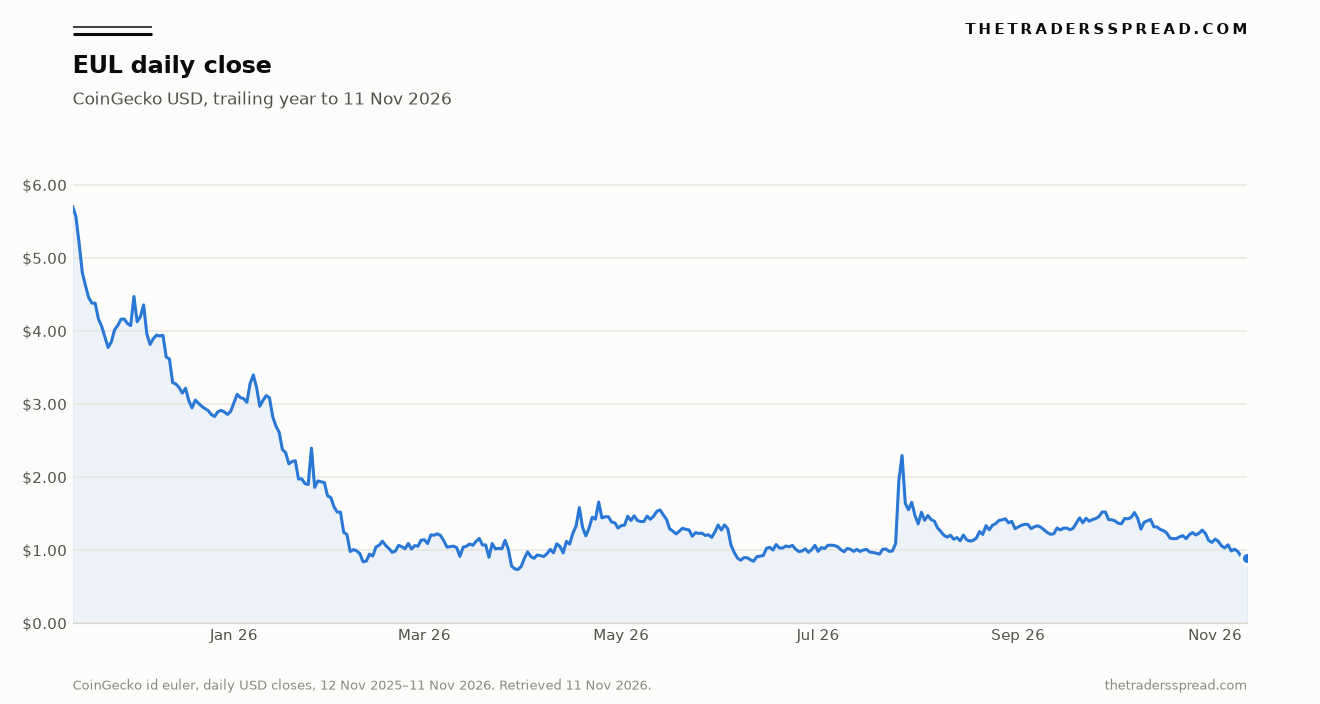
The daily series opens at $5.70716 on 12 November 2025 and closes at $0.886774 on 11 November 2026, a fall of 84.46 percent, with a low of $0.73317 on 30 March 2026. The coin record, updated 06:49:50 UTC on 11 November 2026, lists an intraday all-time low of $0.719702 at 22:44 UTC on 29 March 2026 and an all-time high of $15.81 at 21:56 UTC on 10 July 2025, before this window. Spot was $0.884745, market cap $21,264,619, circulating supply 24,034,753.02 against a max of 27,182,818, or 88.42 percent. The chart is token history, and the vault's borrow rate is another series.
Frequently asked questions
How does Euler turn utilization into a borrow APY?
The Annual Percentage Yield page, retrieved 11 November 2026, says the model returns a per-second SPY scaled by 1e27. After dividing by that scale, borrow APY equals one plus the unscaled SPY, raised to 31,556,952, minus one. The exponent is 365.2425 times 86,400 seconds. On the kink contract the SPY is a base rate plus slope1 up to the kink and slope2 beyond it. Other models fill the same slot with their own rule, and the annualization step stays common.
Why can two vaults of the same asset charge different borrow rates?
Each EVK vault holds one asset and its own model, cash, and borrows, which the Vaults page treats as the lending market. A governed vault can receive a new model later, and a finalized vault keeps the one it has. Utilization on that vault alone means two USDC vaults on different curves produce two borrow APYs at the same moment.
Where does collateral sit relative to the interest a borrower pays?
The Markets page places collateral on the liability vault's list of accepted shares, together with the oracle, the loan-to-value settings, and the caps. Those decide how large the loan can be and when health fails. Borrow APY remains the cost from the liability vault's rate model. Two borrowers of one vault can share that APY while posting different collateral and facing different liquidation prices. A second rate appears when the debt comes from a second vault.
What happens when a position reaches the liquidation line?
Health is risk-adjusted collateral divided by liability. The Liquidations page says the account is eligible once collateral fails to exceed liability, and a displayed 1 may be rounded. The discount starts at zero and rises with the shortfall, up to the vault's maximum. A liquidator takes the debt and discounted collateral together, then has to pass checks on the resulting account. Interest accrual by itself can cross the line.
What does holding EUL change about a borrower's rate?
The EUL overview assigns votes, Fee Flow payment while the auction runs, and rewards, including rEUL that vests 20 percent immediately and 80 percent over six months. On the docs retrieved 11 November 2026, Fee Flow is off and protocol fees are at 0 percent. The borrow rate remains the liability vault's interest-rate model, under a governor or the configuration already deployed. A holding changes a vote and a reward balance. The curve on the vault is a separate control.
The docs show how a governor replaces a curve, how a finalized vault keeps the curve it was given, and how a connected oracle router can keep a governor of its own. Which of those designs should a borrower trust when utilization spends a long stretch past the kink, and the oracle route beside the vault can still be changed?
Lending on an Euler vault can consume supplied assets through price moves, interest accrual, liquidation, or a parameter change by a governor. The figures above are reference data from the sources named beside them, and the decision to use a vault stays with the reader.