

Meteora (MET) did not rise 17% because Bitcoin, ether or Solana rose with it. At 20:51 UTC on 7 November 2026, CoinGecko's page for the token showed $0.3220, and the unrounded 24-hour field was plus 17.02%. The same timestamp put Bitcoin at $75,606, down 0.30%. A pull one minute later put ether at $2,225.48, down 0.25%, and Solana at $89.05, down 0.95%. The meteora price advanced on a session in which the three assets it is usually filed beside finished fractionally lower.
A same-hour announcement spike is a poor fit for the candle. Meteora's account published two notes at 14:57 UTC on 6 November, one naming Wave as DLMM Pro's fourth preset and one pointing readers at a waitlist. CoinGecko's daily series, one print per date plus a live final point, shows $0.2939 on 5 November and $0.2675 on 6 November, a 9.0% decline on the day the notes went out. The 17.02% reading belongs to the following session.
The neighbouring windows disagree with each other. CoinGecko's rolling seven-day field at 20:51 UTC was plus 13.26% for MET and minus 2.49% for Bitcoin. The rolling 30-day field flips the relationship: MET minus 26.71%, Bitcoin minus 7.53%, Solana minus 18.45%. A strong day inside a deeper month is the shape of the record.
Key facts
- MET last price $0.3220, 24-hour change plus 17.02%, session range $0.2741 to $0.3287. Source: CoinGecko meteora endpoint, 7 November 2026, 20:51 UTC.
- Bitcoin $75,606, down 0.30% in 24 hours; ether $2,225.48, down 0.25%; Solana $89.05, down 0.95%. Source: CoinGecko, 7 November 2026, 20:51 to 20:53 UTC.
- MET rolling changes: 7-day plus 13.26%, 14-day plus 4.39%, 30-day minus 26.71%, 200-day plus 100.8%, one-year minus 15.9%. Source: CoinGecko, 7 November 2026, 20:51 UTC.
- Market value $182.0 million on 565.0 million tokens circulating, against a 1 billion maximum and a fully diluted value of $321.4 million, per CoinGecko on 7 November 2026.
- All-time high $0.6869 on 23 October 2025; all-time low $0.0944 on 6 June 2026. Spot is 53.1% under the high and 241% above the low. Source: CoinGecko, retrieved 7 November 2026.
- On 6 November 2026 the project account said Wave had joined Spot, Curve and Bid-Ask as DLMM Pro's fourth preset. Source: Meteora on X, status 2118719478322389034, oEmbed checked 7 November 2026.
Ninety days of prints, then one live point
The chart is CoinGecko's meteora market_chart in dollars, retrieved at 20:52 UTC on 7 November 2026, one print per date from 10 August through 7 November. Figures below are those prints rounded to four decimals, and turnover is the endpoint's reported volume rounded to a tenth of a million dollars. The final point is the live reading.
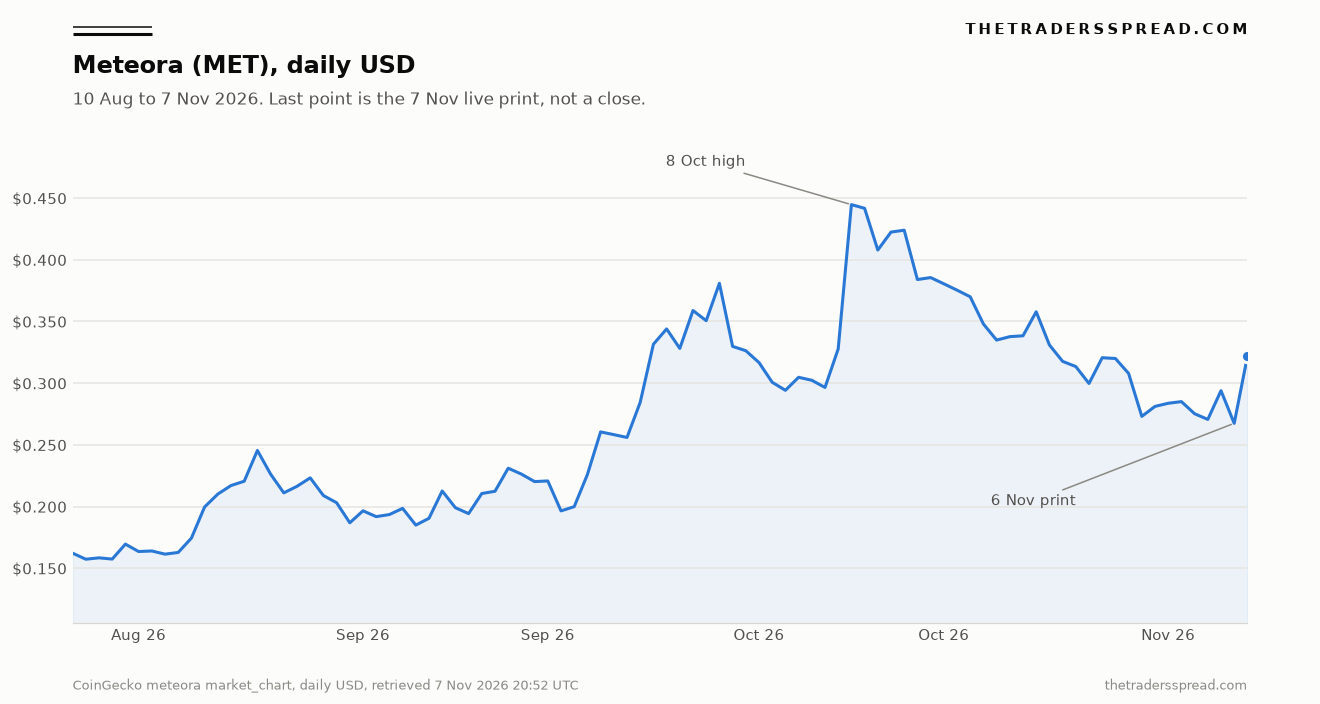
The series opens at $0.1622 on 10 August and prints its low the next day at $0.1573. Late August clears $0.20, with $0.2455 on 24 August and a give-back to $0.1868 on 31 August. September changes the range: the 12 September print is $0.2311 on about $118.9 million of reported turnover, the first nine-figure day in the window, and 28 September reaches $0.3809 before the next print falls to $0.3298.
October holds the chart high and most of the slide that 7 November only partly retraces. The 6 October print, the day the account said DLMM Pro was coming, is an ordinary $0.2965. The 8 October print is $0.4447 on about $156.8 million, the high of the window, followed by $0.4417 on about $183.9 million and by $0.4079 on about $243.3 million, the heaviest turnover day in the series. Those three dates stay unlabeled in the pages opened for this timeline, so the spike remains a price-and-volume fact, and the prints that sit beside posts come later: $0.3700 on 17 October, $0.3310 on 23 October, and $0.2731 on 30 October. From $0.4447 on 8 October to $0.2675 on 6 November, the series fell 39.9%.
Early November is a narrow grind, $0.2706 on 4 November and $0.2939 on 5 November, before the 6 November print of $0.2675 on about $9.3 million, 9.0% under the day before. The 7 November chart point at 20:52 UTC is $0.3216, and the coin endpoint a minute earlier is $0.3220, 20.4% above that 6 November print. The headline's 17.02% uses a rolling base near $0.2752, above the 24-hour low of $0.2741 and above the prior daily print, which is why the two gaps differ.
What the project actually posted
The oldest primary note is a governance post from 14 May 2026 under the forum name zhen. It says the project would revise the DLMM protocol fee from 5% to 10%, so liquidity providers would keep 90% of generated fees where they had kept 95%, and it pledges $500,000 of growth spending split evenly between a team fund and a community fund. Referral staking is described there as a first link between MET and usage. A reply on 16 May from the same account treats the 10% cut as the ongoing plan after that $500,000 is funded. The post sits on Meteora's governance forum. Five months separate it from the 7 November print.
On 6 October the account posted that DLMM Pro was coming and linked a waitlist. The oEmbed text is those two sentences, and the daily print was $0.2965, two days before the spike, which makes the post a weak caption for the heavy-turnover days that followed. On 17 October the forum account Miir called DLMM Pro the first product push of the quarter and wrote that Dann unveiled it at Solana Summit Singapore. The same note reports more than 128 million MET staked across three referral cycles, more than $39 million in fees from referred users, and more than $1.9 million in USDC rewards including an estimate for cycle 3. It keeps the programme going, adds a bonus of about $150,000 for the top 100 referrers, and from cycle 4 requires at least $10 of fees on positions opened in that cycle before the cycle's staking rewards can be claimed. The daily print was $0.3700, and the note is on the governance forum.
The name Wave arrives by a public vote. On 23 October the account asked followers to name the fourth preset inside DLMM Pro, and the shortlist in the post is Halfpipe, Castle and Wave.
We asked you to name the 4th preset strategy in DLMM Pro.
— Meteora (@MeteoraAG) October 23, 2026
The LP Army came through with some suggestions, and we've narrowed it down to three:
- Halfpipe 🛹
- Castle 🏰
- Wave 🌊
Now it's time to pick a winner.
Halfpipe, Castle, or Wave? Let us know your vote in the replies! pic.twitter.com/NDREQ4m2WT
The daily print that day was $0.3310, about 26% under the 8 October high. The post carries a label, a shortlist and a request for replies, with the chart supplying the price beside it.
The preset named on the down day
Meteora's official account posted the result on 6 November, the session whose daily print was $0.2675, a day before the 17% reading.
Introducing DLMM Pro’s 4th preset strategy.
— Meteora (@MeteoraAG) November 6, 2026
Wave joins Spot, Curve, and Bid-Ask, giving LPs another way to shape their liquidity strategies.
Thank you to everyone in the LP Army who submitted suggestions and voted! pic.twitter.com/oPEG23bnlb
A second post in the same minute, also checked by oEmbed, says Wave goes live with the launch of DLMM Pro and links the waitlist at the project account's waitlist note. Opening that waitlist address on 7 November returned the site's home shell, a title where a reader would have wanted bins, weights or fee settings. The wording available for Wave is the wording of the posts. Spot, Curve and Bid-Ask are the three names it says Wave joins, and the distinction among the four is still a later document.
Three shapes on the docs page
The strategy page, DLMM strategies and use cases, was opened on 7 November 2026. It says the programme supports Spot, Curve and BidAsk, in one-sided, balanced and imbalanced variants, and that layouts such as Spot-Concentrated are presets built on those families. Spot spreads liquidity evenly across the chosen bins. Curve concentrates it near the middle, for fee capture if price stays put, with a higher chance of going out of range. Bid-Ask places more liquidity toward the edges, which the page ties to volatile markets and to gradual entry or exit.
Bin step on that page is the gap between neighbouring bins, and the base fee is tied to it while a variable fee can rise with volatility. Wave's name is absent from the page. The account calls it a fourth preset, the docs still organise the product as three families, and the posts leave open whether Wave is a new distribution or a package of an existing one.
Uniswap's rise and later drop sat next to a fee series, covered in Uniswap (UNI) Rose 128% on Robinhood Chain Fees, Then Fell 18%. Meteora's week has the preset posts and the price, while the $39 million referral figure is a multi-cycle total from 17 October. The same caution about reading a venue token off a fee story ahead of the pool rows is in Aerodrome (AERO): myths on fees, bribes, and locks. Of the May fee revision, the October staking update and the November preset name, only the last shares a week with the 17.02% day.
Where the day sits against the month
These rolling fields are CoinGecko's own 24-hour, 7-day and 30-day changes, taken with the prices at 20:51 to 20:53 UTC on 7 November 2026.
| Asset | Price | 24 hours | 7 days | 30 days |
|---|---|---|---|---|
| Meteora (MET) | $0.3220 | +17.02% | +13.26% | −26.71% |
| Bitcoin | $75,606 | −0.30% | −2.49% | −7.53% |
| Ether | $2,225.48 | −0.25% | −1.20% | −9.74% |
| Solana | $89.05 | −0.95% | −7.01% | −18.45% |
MET is the only positive sign in the 24-hour column, about 17 percentage points clear of Bitcoin, and the seven-day column keeps that pattern, with Solana the weakest of the large three at minus 7.01%. Over 30 days the relationship reverses. MET fell further than Bitcoin and further than Solana, the chain whose mint hosts the token. CoinGecko lists the Solana address METvsvVRapdj9cFLzq4Tr43xK4tAjQfwX76z3n6mWQL. Short-window outperformance and a harsher month are both on these fields.
A Solana session that did line up with a broad tape is Solana (SOL) Jumps 13% to $109 as ETF Assets Hit $1.06bn. That report's day had Bitcoin higher as well. Borrowing its caption for 7 November would require the 24-hour column above to share a sign, and the signs split. Longer MET fields keep the split from becoming a career story: plus 4.39% over 14 days, plus 100.8% over 200 days, and minus 15.9% over one year. Against the all-time high of $0.6869 on 23 October 2025 and the all-time low of $0.0944 on 6 June 2026, $0.3220 is 53.1% under the high and 241% above the low. Inside the chart it is 104.7% above the 11 August low of $0.1573 and 27.6% under the 8 October high.
Supply, cap, and the unlabeled remainder
Circulating supply is 565.0 million MET against a 1.00 billion maximum, while total supply is 997.7 million, close to the cap. About 56.5% of the maximum is marked circulating, leaving a gap of about 432.7 million MET between total and circulating supply, and the pages retrieved on 7 November leave that remainder unlabeled. Fully diluted value of $321.4 million is 1.77 times the $182.0 million market value.
| Measure | Figure | Basis |
|---|---|---|
| Spot | $0.3220 | CoinGecko, 20:51 UTC, 7 Nov 2026 |
| 24-hour high / low | $0.3287 / $0.2741 | Same payload |
| Market value | $182.0 million | Same payload |
| Fully diluted value | $321.4 million | Same payload |
| Circulating / maximum | 565.0 million / 1.00 billion | 56.5% of the maximum |
| Reported 24-hour turnover | $42.1 million | 23.1% of market value |
| Versus 8 Oct 2026 chart high | 27.6% below $0.4447 | market_chart daily print |
Turnover of $42.1 million is 23.1% of market value, ordinary beside October, when the 10 October print carried about $243 million, nearly six times as much, on a day the price was already off the high. The 17% rise is a large percentage on a smaller aggregated tape than the days that set the level MET is still under.
RelatedLighter (LIT) Rises 8.7 Percent on Asia Equity Feeds
What this changes
The 7 November print changes the peer comparison for a day and attaches a product name to the prior session. MET's 24-hour and seven-day signs separated from Bitcoin, ether and Solana. For a token minted on Solana, whose usual caption is the chain, that separation is the new fact in the price, and a later session can close it. As measured, it is dated to this pull.
The account asked followers to name a fourth preset on 23 October, announced Wave on 6 November beside Spot, Curve and Bid-Ask, and pointed a second post at a waitlist. The strategy page opened the same evening still organises the protocol as three families. The posts state a name, a vote and a link, and the bin weights wait on a page that states them.
The month is still a decline. At $0.3220 the token is 20.4% above the 6 November print and 27.6% below the 8 October print, and the rolling 30-day change remains minus 26.71%, steeper than Bitcoin and steeper than Solana. Treating the day as a repaired October slide would require that column to change sign, and on the 20:51 UTC pull it still shows a loss. What changed is a Solana pool token diverging upward from a flat-to-softer large-cap tape, on the session after its issuer named a fourth liquidity preset and on the session after a down day. The May fee revision and the October staking totals remain the longer economic context, and a weak caption for 17.02%.
Frequently asked questions
What was the Meteora price at the 7 November print?
CoinGecko showed Meteora (MET) at $0.3220 at 20:51 UTC on 7 November 2026, up 17.02% over the prior 24 hours. The same payload put the high at $0.3287 and the low at $0.2741. Market value was $182.0 million, with $42.1 million of reported turnover. Those figures are the aggregated feed at one clock time, rather than a single exchange's order book.
How did Bitcoin, ether and Solana trade over that same day?
Bitcoin was $75,606, lower by 0.30% over 24 hours at 20:51 UTC, and lower by 2.49% over seven days. Ether was $2,225.48, lower by 0.25% on the day and by 1.20% on the week. Solana was $89.05, lower by 0.95% on the day and by 7.01% on the week. MET was the only one of the four with a gain on both the day and the week.
What did the project post on 6 November?
Meteora's account posted at 14:57 UTC that Wave was DLMM Pro's fourth preset and that it joined Spot, Curve and Bid-Ask. A second post in the same minute said the launch was live and linked a waitlist. Both were checked through X's oEmbed endpoint on 7 November. The daily print on 6 November was $0.2675, 9.0% under the $0.2939 print of 5 November.
Does the 30-day move match the day?
The rolling 30-day change for MET was minus 26.71% at the same timestamp as the 17.02% day. Bitcoin was lower by 7.53% over 30 days and Solana by 18.45%. On the daily chart the high inside the window was $0.4447 on 8 October, and $0.3220 sits 27.6% under that print. The day is an advance from 6 November, while the month on the rolling field is still a decline.
What are the DLMM shapes named on the docs page?
The strategies page, opened 7 November 2026, describes three families. Spot spreads liquidity evenly across the chosen bins. Curve concentrates it near the middle of the range, where fee capture is higher if price stays put. Bid-Ask places more toward the edges, which the page ties to volatile markets and to gradual entry or exit. Narrower Spot layouts are treated there as presets on those families.
Where does this print sit against the token's own extremes?
CoinGecko records an all-time high of $0.6869 on 23 October 2025 and an all-time low of $0.0944 on 6 June 2026. The $0.3220 print is 53.1% under that high and 241% above that low. Inside the 90-day chart the low was $0.1573 on 11 August and the high was $0.4447 on 8 October, so the live price sits between those chart extremes and still clearly under the October high.
Prices and percentages move, and a later pull will differ. This record uses CoinGecko fields and project pages retrieved on 7 November 2026. It is a description of those sources, and it leaves any decision to buy or sell with the reader.