

On a Drift perpetual, funding can move the account while the mark sits still. The pages Drift still links as documentation walk an illustrative book: 10,000 dollars of collateral, SOL at an illustrative 100 dollars, and a long of 20 SOL worth 2,000 dollars. At the page's illustrative rate of 0.00125 percent an hour against that long, a day costs about 60 cents. The same rate on a 5 million dollar position costs about 300 dollars a day.
The page that opened from docs.drift.trade on 9 November 2026 is Velocity's funding-rates page, and Velocity's migration guide calls that program a fork of Drift taken at SDK v2.163.0-beta.0, with a new program id, the older Drift program described as paused, and user balances left behind. On the same illustrative prices, the last package published as @drift-labs/sdk, version 2.163.0-beta.13 on 11 May 2026, keeps the full premium once price leaves a 5 basis-point band, while the page the Drift docs domain now serves shrinks the excess first and then applies a ramp. That gap is the part a drift protocol funding print hides.
Updated 9 November 2026 from the Velocity funding page, the migration guide, Drift's recovery posts, and the npm tarball of @drift-labs/sdk 2.163.0-beta.13.
Key facts
- Funding is an hourly payment between longs and shorts, scaled to position size, after a noise band and a floor. Source: Velocity funding-rates page, opened 9 November 2026.
- The floor is the oracle time-weighted average divided by 3,333, which the page calls 10.95 percent annualized. On a 100 dollar oracle that floor is about 3 cents before the split into an hour. Source: Velocity funding-rates page, opened 9 November 2026.
- With the page's illustrative 5 basis-point band and a 1.0 ramp, a market average of 100.03 dollars pays 0.00125 percent an hour, and a market average of 100.20 dollars pays 0.0075 percent an hour. Source: Velocity funding-rates page, opened 9 November 2026.
- In @drift-labs/sdk 2.163.0-beta.13 the noise threshold is the oracle divided by 2,000, the offset denominator is 3,333, and a premium outside the band is added in full. Source: npm package @drift-labs/sdk, version published 11 May 2026, file src/math/funding.ts.
- CoinGecko priced DRIFT at 0.01184 dollars at 06:58 UTC on 9 November 2026, with circulating supply of about 734.09 million against a max supply of 1 billion. Source: CoinGecko coin id drift-protocol, retrieved 9 November 2026.
- Drift Foundation's 30 September 2026 post put the 1 April taking at about 295.4 million dollars, and Drift's 1 October 2026 claims post put the recovery pool at about 3.1 million USDT. Source: Drift Foundation on X, 30 September 2026, and drift.trade DFX claims post, 1 October 2026.
Which book prints the rate
A funding percentage is useful once the program behind it is named. Velocity's migration page, opened 9 November 2026, lists Drift mainnet as dRiftyHA39MWEi3m9aunc5MzRF1JYuBsbn6VPcn33UH and Velocity as vELoC1audYbSYVRXn1vPaV8Axoa9oU6BYmNGZZBDZ1P, with every program-derived address changed. Drift quoted USDC at mint EPjFWdd5AufqSSqeM2qN1xzybapC8G4wEGGkZwyTDt1v, and Velocity mainnet-beta settles in USDT at mint Es9vMFrzaCERmJfrF4H2FYD4KCoNkY11McCe8BenwNYB, so collateral, withdrawals, and settlement follow the new mint.
On 9 November 2026 a Solana mainnet query returned the Drift program as an executable account on the upgradeable loader, holding 49,155,476 lamports, which places the binary on the chain. Drift's 5 May 2026 recovery plan says trading and borrowing were suspended after the 1 April exploit, a loss the post puts at about 295 million dollars, and the migration page calls the program paused. The 4 June 2026 note, under a 3 June dateline, says in Drift's own wording that the relaunch is meant to be the largest USDT-quoted perpetual exchange on Solana. Noah Prince, previously Head of Protocol Engineering at Helium, is described as joining as Head of Protocol, with former Gauntlet members named for the liquidation engine, funding-rate parameters, launch configuration, and risk monitoring.
Drift Foundation posted the recovery figure the claims portal later used.
Drift Recovery Update
— Drift Foundation (@DriftFDN) September 30, 2026
An update on the ~$295.4M taken from Drift users on 1 April, and where recovery efforts stand.
Drift Foundation will continue pursuing efforts to track, trace, and recover stolen funds. Recovered funds, whether they come back through a freeze, bounty, or…
The 1 October 2026 claims post puts the pool at about 3.1 million USDT, filled daily at 00:00 UTC from Velocity's net protocol revenue and recovered funds, with Tether up to 127.5 million USDT and other partners up to 20 million. DFX is one token per verified USDT of loss, the post says no new DFX will be minted, and claims close at 00:00 UTC on 1 January 2028. DFX is a claim on that pool, and it is a different token from DRIFT.
How the two averages are built
With no expiry, funding is what pulls the contract toward the oracle. Before the band and the floor, the hourly rate equals one twenty-fourth of the gap between the market time-weighted average and the oracle time-weighted average, divided by the oracle average. Both inputs are averages, so one print cannot set the payment by itself. The market average is the midpoint of the bid average and the ask average, an exponential moving average with a one-hour span.
In @drift-labs/sdk 2.163.0-beta.13 the live mark average blends the stored average with the current bid-ask midpoint across the funding period. A new oracle sample is clamped to within one third of the stored oracle average before the blend, and a stale series is pulled toward the fresh one, capped by that period. An update inside the first 20 minutes rounds onto the hour, a later update waits for the next period, and between them the sum sits in unrealized profit and loss until the next trade, deposit, withdrawal, or settle. Lido's daily stETH rebase accrues on a schedule rather than on a click.
Where the noise band and the floor enter
The page names two failures of charging the whole gap. A few basis points of midpoint versus oracle is tick size, spread, and sampling. A market pinned to the oracle pays zero under the plain rule. The dead zone answers the noise and the floor answers the peg. The band is an admin value in basis points of the oracle average, illustrated at 5 basis points, or 5 cents either side of a 100 dollar oracle. Inside the band the premium drops, and past it the excess is shrunk by the threshold and multiplied by a ramp the illustration sets at 1.0.
The floor is the oracle average divided by 3,333, added before dividing by 24. The page calls that 10.95 percent annualized. Its APR definition, hourly rate times 24 times 365.25, turns 1/3333 into 10.96 percent, so the label tracks a 365-day year more closely than the page's own factor. On a 100 dollar oracle the offset is about 3 cents. At a market average of 100.03 dollars the premium drops, and the hour is the floor alone, 0.00125 percent.
Turning a dollar gap into an hourly percent
At a market average of 100.20 dollars against a 100 dollar oracle, the page shrinks 0.20 by the 0.05 band to 0.15, leaves 0.15 after the 1.0 ramp, adds the 0.03 floor to reach 0.18, and divides by 100 and by 24 to reach 0.0075 percent an hour. The raw gap is 0.00833 percent. The what-a-perpetual page sets out those day counts and labels the margin ratios illustrative.
APR is the hourly rate times 24 times 365.25, and APY compounds one plus the hourly rate across 24 times 365.25 hours before subtracting one. calculateFormattedLiveFundingRate in the SDK prints only the simple APR. The protocol introduction keeps fees separate: takers pay 4 basis points, then 3 above 5 million dollars of trailing 30-day volume and 2 above 80 million, makers receive 0.25 basis points from that fee, and a market may add up to 10 basis points. Raydium's swap fee is a charge the venue sets and routes. Funding here is a transfer between the two sides of the book, not a fee the protocol keeps.
The cap, the hour, and a market that sits quiet
The funding page caps premium at 3 percent of the oracle average for tier A or B, 5 percent for tier C, and 10 percent below. The SDK divides that oracle average by 33 for A and B (3.03 percent), by 20 for C (5 percent), and by 10 otherwise (10 percent), after the offset is added and on both sides of zero. The insurance-fund page sets lifetime draws of 100 million dollars, 1 million, and 100,000 for tiers A, B, and C, and zero for Speculative, Highly Speculative, and Isolated. A new market defaults to Highly Speculative, outside the shared fund until an admin promotes it.
A market that neither trades nor gets cranked leaves cumulative funding where it stood, because the rate updates on an open or a close and again once enough time has passed, with extreme oracle divergence able to delay it. Curve's stableswap price can be recomputed from pool balances alone.
When the two sides differ in size
Longs and shorts share one rate on a balanced book. The AMM takes the leftover, short the excess longs or long the excess shorts, and pays the gap from retained equity, meaning fees and trading profit and loss net of payouts already made. Each period it may spend at most one third of that equity. Beyond that the page caps the paying side so equity stays non-negative and caps receipts to what is on hand. The funding page states that the insurance fund is never drawn on to cover a funding shortfall.
calculateFundingPool reserves half of total exchange fees, subtracts that from fees minus distributions, and keeps a third of a positive remainder. When the larger side would pay, both sides get the interpolated rate. When the larger side would receive, its receipt is capped by the smaller side's payment plus that top-up, and the paying side keeps the interpolated rate. Read a historical Drift print against the SDK, and a print from the documented program against the page plus the live account. A per-market sensitivity can widen the AMM quote while the AMM is paying, and zero leaves the quote unchanged.
Olaf Carlson-Wee, founder at Polychain Capital, described an earlier version of this design on the 22 May 2023 Series A post, a 23.5 million dollar round that took funding then to 27.3 million. "Drift continues to push the bounds on innovation as they introduce new liquidity mechanism to DeFi," he said. Anatoly Yakovenko and Raj Gokal are named there as participating Solana founders, beside cumulative volume the post put above 6 billion dollars.
What the last Drift SDK still computes
The 100.20 dollar example through the SDK lands on another hour, because the dead zone in that file is a switch. The clamp denominator 2,000 is the 5 basis-point band and the offset denominator 3,333 is the floor. Inside the band only the offset remains. Outside it the full premium is added to the offset, with no ramp in the file, so 0.20 plus 0.03 is 0.23 dollars and 0.23 divided by 100 divided by 24 is 0.00958 percent an hour. The docs page produced 0.0075 percent. The raw gap was 0.00833 percent.
The lower-bound estimate prorates by time since the last update, and a positive long rate means longs pay when the mark average sits above the oracle. Drift's perpetual-futures primer reads the sign from the mark against the oracle and calls a headcount of longs versus shorts a misconception.
RelatedImmutable (IMX) Fee Switch, Unlocks and Listed Supply
Where the DRIFT token sits beside that print
The funding rate is a cashflow on a perpetual position, while DRIFT is the governance token, and the chart is a one-year daily close of that token ending at the last print.
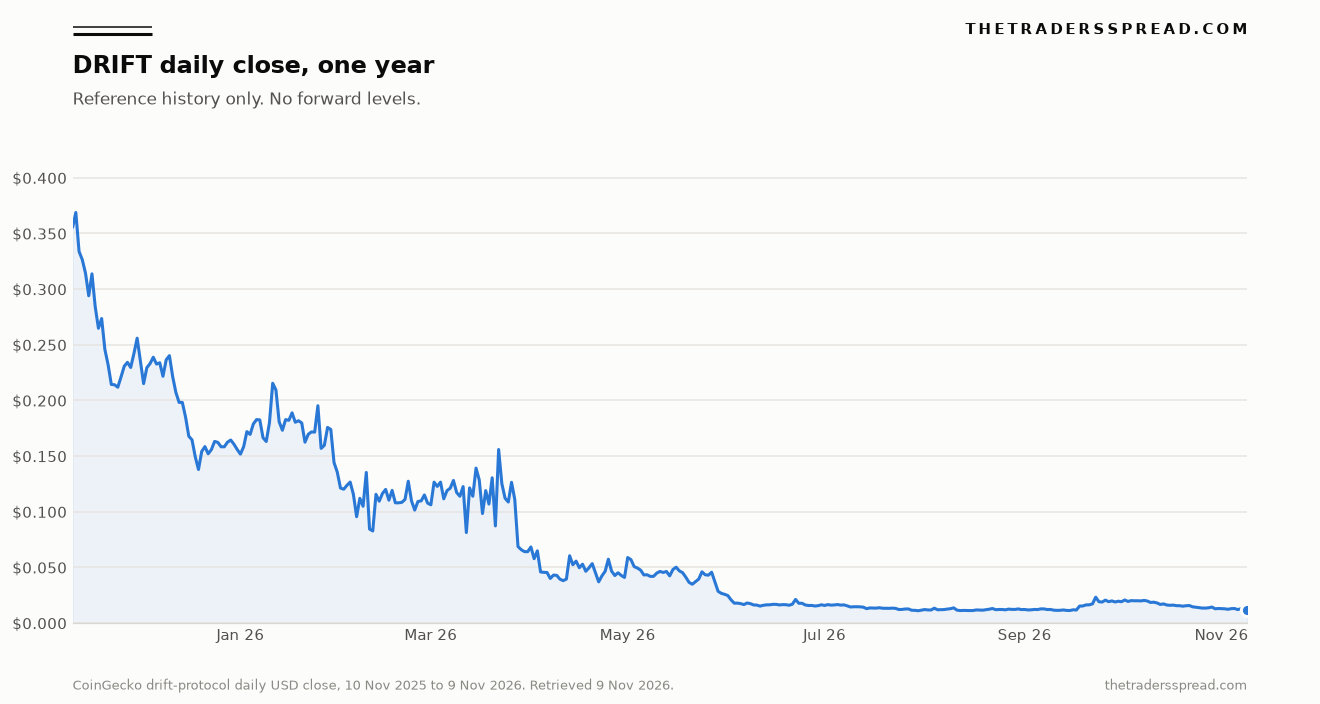
CoinGecko id drift-protocol, at 06:58 UTC on 9 November 2026, showed 0.01184 dollars, a market cap of about 8.69 million dollars and about 1.82 million dollars of 24-hour volume. Change on that pull was about minus 2.69 percent on the day and minus 96.57 percent over the year. The record high is 2.60 dollars on 8 November 2024 and the record low is 0.01067 dollars on 29 July 2026. The series runs from 0.3555 dollars on 10 November 2025 to 0.01182 on 9 November 2026, high 0.3688 on 11 November 2025 and low 0.01105 on 30 July 2026, with about 734.09 million circulating against a 1 billion max.
The 18 November 2025 tokenomics post had 555,713,264 DRIFT circulating, a 750 million circulating cap, and a 1 billion max, split into ecosystem and trading at 43 percent (430 million), an airdrop of 10 percent (100 million, fully distributed in 2024), protocol development at 25 percent (250 million, half unlocked after an 18-month lock and an 18-month vest), and strategic participants at 22 percent (220 million). It recorded more than 120 billion dollars of volume, 1.4 billion of deposits, and strategy vaults at 298 million, November 2025 readings from before the April 2026 exploit.
Spencer Applebaum, Investment Partner at Multicoin Capital, said this on the Series B post of 19 September 2024, when Drift said it had raised 25 million dollars. "We believe Drift is having its Binance moment in DeFi. Over the last three years, Drift has proven themselves to be one of the most resilient teams in DeFi. They shipped relentlessly through the bear market and emerged as the strongest DeFi platform this year," he said. The line describes the shipping record as it stood in September 2024.
What the print changes for the reader
A Drift funding print hides which formula produced it. A historical number from the paused program follows the SDK switch, floor only inside five basis points and the full premium plus the floor outside. A number from the program the docs domain now documents shrinks the excess and then applies a ramp, illustrated at 1.0 and stored per market. Using one formula on the other book produces a tidy percent and the wrong cashflow. Outside the band, the tier cap is what keeps the excess from becoming the whole trade, and a Speculative market keeps later bad debt outside the shared fund.
Balance decides whether one rate can clear. A symmetric print means both sides, plus the AMM's one-third fee slice, can settle the hour. A split print means the larger receiving side was trimmed, in the last SDK, to what the smaller side and that slice can pay, or, on the docs page, that the paying side itself was capped. AMM equity absorbs the gap, and the insurance fund is reserved for what remains after liquidation fails to cover a winner. The 60 cent day and the 300 dollar day are that financing on a mark that has gone nowhere.
FAQ
How often does a Drift perpetual funding rate update?
The funding page opened from docs.drift.trade on 9 November 2026 uses a one-hour period. The rate updates when someone opens or closes, and again when enough time has passed, so a keeper can miss the exact hour. An update later than 20 minutes past the hour pushes the next one into the following period. Between updates the amount owed sits in unrealized profit and loss and settles on the next trade, deposit, withdrawal, or explicit settle in that market.
What does dividing the oracle by 3333 change?
The page adds that quotient to the premium before dividing by 24. On a 100 dollar oracle it is about 3 cents, and the page calls the result 10.95 percent annualized. The page's own APR, the hourly rate times 24 times 365.25, turns one divided by 3,333 into 10.96 percent. Inside the noise band the premium drops away and this floor is the hourly rate that remains, 0.00125 percent in the worked example.
Does a positive Drift funding print mean there are more longs?
Drift's perpetual-futures primer reads a positive rate from the mark against the oracle, and it calls a headcount of longs a misconception. Mark above the oracle means longs pay shorts. How many contracts sit on each side is a separate input, and that comparison decides whether both sides share one rate or the larger receiving side is capped by the smaller side plus a third of the fee surplus.
This is analysis of how a funding rate is calculated, and it is not a recommendation to trade DRIFT or any perpetual. Perpetual positions can lose more than the funding line shows, and the token path in the chart is a record of closes rather than a forecast. Capital is at risk.