

The payout on hot rolled coil futures is the Floating Price in COMEX Rule 920103, not the last futures trade of the month. Delivery under that rule shall be by cash settlement, and the final settlement price is the Floating Price for the contract month, rounded to the nearest $1.00 per short ton. Rule 920101 sets that price equal to the average of all available assessments the U.S. Midwest Domestic Hot-Rolled Coil Steel (CRU) Index publishes for the month.
We read chapter 920 from the Internet Archive capture of the CME PDF dated 22 January 2026, the latest capture the archive index returned, after the live CME host timed out in this session. The contract-specs page, shell-stamped 28 November 2026 at 02:02:56 am CT, repeats the cash settlement, the twenty-short-ton unit and the termination rule.
Key facts from the chapter, the specs page, the settlement procedure and the 27 November 2026 file.
- Chapter 920 covers the Midwest domestic hot-rolled coil steel future on the CRU index, Globex code HRC, ClearPort and clearing code HR.
- Final payout is the month's CRU assessment average, rounded to the nearest $1.00 per short ton.
- Trading ceases on the business day before the last Wednesday of the contract month, under Rule 920102.E.
- The client-systems page retrieved on 28 November 2026 sets the daily window at 11:30:00 to 12:00:00 ET under the heading HDG / HRC.
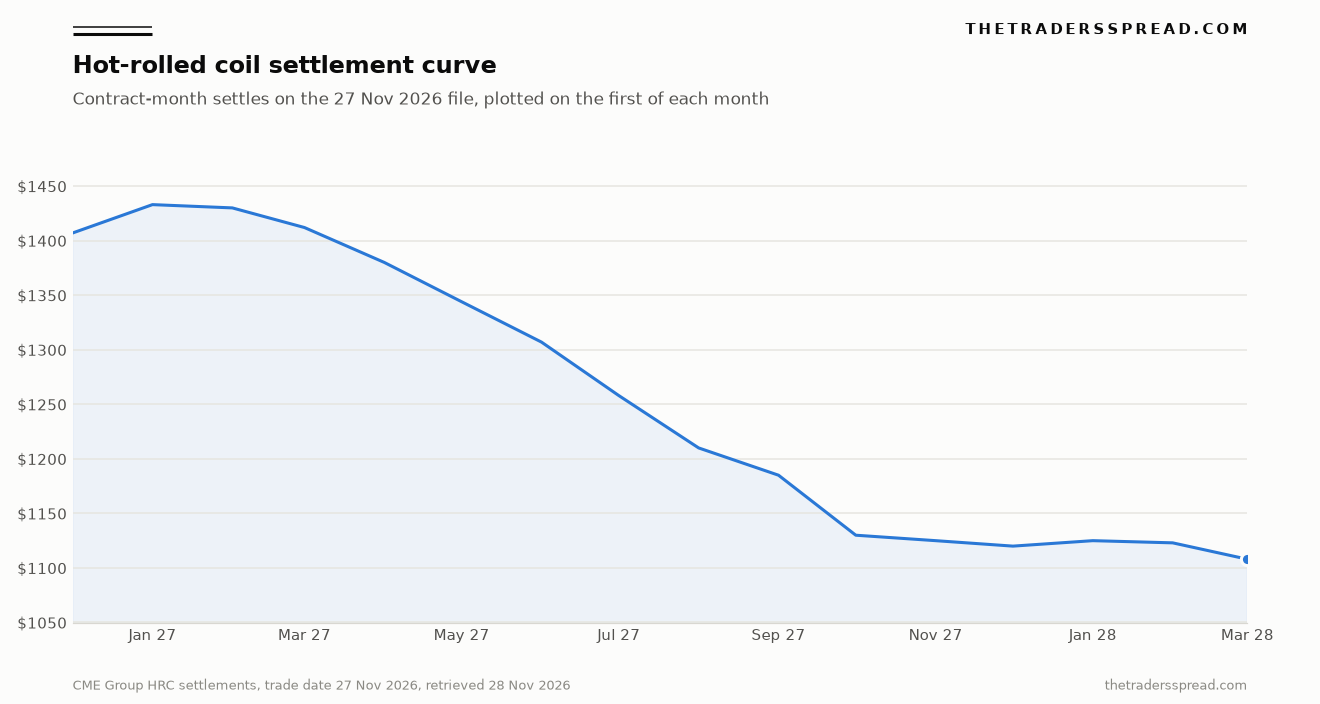
- On the Friday 27 November 2026 file, December 2026 settled at 1,407.00 and December 2027 at 1,120.00, a gap of $5,740 a contract.
- Estimated volume on that file is 343 and prior-day open interest is 44,982, each total matching its column.
How the contract is settled, in order
-
The chapter is a cash contract on one named index. Rule 920100 applies these rules to contracts bought or sold for cash settlement on the Floating Price, and it sends anything the chapter leaves untouched to the general rules of the Exchange. The specs page calls the method financially settled. Rule 920101 names the index, the U.S. Midwest Domestic Hot-Rolled Coil Steel (CRU) Index, and the specs page calls it the CRU US Midwest Domestic Hot-Rolled Coil Steel Index. Both versions average every available assessment published for the contract month. The specs page lists the current year plus the next three calendar years, and it prints "contractof" as one word where it describes adding the next December.
-
One contract is twenty short tons, and one dollar a ton is twenty dollars. Between Rule 920102.A and Rule 920102.C the PDF prints the trading-unit label as 108102.B, and the sentence under it says the contract unit shall be twenty (20) short tons. Rule 920102.C quotes prices in multiples of $1.00 per short ton. The specs page states the minimum fluctuation as 1.00 per short ton, equal to $20.00, the $1.00 quote times the 20-ton unit. Globex uses HRC, and ClearPort and clearing use HR, the same pair the steel futures settlement procedure prints as CME Globex HRC and CME ClearPort/Clearing HR. The visible stamp shows Jun 25 and leaves the year off that label, while the history object in the same fetch dates version 6 to 25 June 2026.
Term What the opened document prints Contract Midwest domestic hot-rolled coil steel (CRU) index futures, COMEX chapter 920 Codes Globex HRC, ClearPort HR, clearing HR Unit Twenty (20) short tons, under the PDF label 108102.B Quote Multiples of $1.00 per short ton, in dollars and cents Minimum move 1.00 per short ton, equal to $20.00, on the specs page Last trade The business day immediately preceding the last Wednesday of the contract month Final settlement Cash settlement on the Floating Price, rounded to the nearest $1.00 per short ton Listing Monthly for the current year and the next three calendar years Method Financially settled, the words on the specs page -
Trading stops on the business day before the last Wednesday. Rule 920102.E says trading shall cease on the last business day immediately preceding the last Wednesday of the contract month, and the specs page shortens that to the business day prior to the last Wednesday. In November 2026 that Wednesday is 25 November, so the preceding business day is Tuesday 24 November. The file's date menu lists 23, 24 and 25 November and skips 26 November, and the trade date below, Friday 27 November, is three sessions later. December 2026 is still open: its last Wednesday is 30 December and the preceding weekday is 29 December. The holiday calendar stayed unopened, so a holiday that Tuesday would move the last trade earlier. The same afternoon's quotes board opens on December 2026, code HRCZ6, with prior settle as a dash, and that board is the afternoon tape.
-
Final settlement is the index average, and the daily settle is a different job. Rule 920103 says delivery shall be by cash settlement, that final settlement after trading ends is based on the Floating Price, and that the final price is that Floating Price rounded to the nearest $1.00 per short ton. The ordinary daily clock lives on the client-systems page, which sends HRC's final settlement back to chapter 920 by name. A futures price sitting beside a cash print that records a different sale is also the subject of why butter futures split from the cash butter print, where the futures price, the USDA survey average, the Friday auction and Class III milk each keep their own number. Position limits sit in a different place. Rule 920102.D points at the chapter 5 position-limit table, the specs page links to the COMEX position-limit page, and that table stayed unopened, so the limit figure stays off this account.
-
The spot month has three tiers inside a half-hour at midday New York. On the procedure page, staff settle HRC with the Midwest domestic steel premium (HDG), North European hot-rolled coil (EHR), HMS 80/20 scrap into Turkey (FSF), the Platts Midwest hot-rolled coil (HRP) and Midwest shredded scrap (SHR), from outright trades on Globex and ClearPort between 11:30:00 and 12:00:00 ET. Those six codes are the product list. Under Spot Month the page groups HDG / HRC and writes three tiers for the front month. VWAP, the volume-weighted average price, weights each trade by its contract count, so a 50-lot print pulls harder than a one-lot print.
Tier What the page does with HDG / HRC in the front month Window Outright trades on Globex and ClearPort from 11:30:00 to 12:00:00 ET Tier 1 Front-month outrights inside the window settle the month to their VWAP Tier 2 With the window empty of a front-month outright, the month takes the last Globex outright or strip, or the last ClearPort outright, calendar or strip, from 05:00:00 to 12:00:00 ET, and a last trade outside the closing bid or ask moves to that bid or ask Tier 3 With that longer stretch also empty of a front-month trade, the month takes the prior settlement, kept inside the closing bid and ask, or moved to the bid or the ask when it sits outside Later months add a fourth tier under All Other Months: after the window VWAP and the last trade back to 05:00:00 ET, the month takes the previous listed month's net change, alone if the book is empty. EHR, FSF, HRP and SHR use four tiers in the spot month, while HRC stays paired with HDG.
-
The 27 November file is a curve, and last is a different cell from settle. The settlements page for Friday 27 November 2026, file-stamped 11:55:00 pm CT and shell-stamped 02:02:27 am CT the next morning, still prints November at 1,352.00, with estimated volume of 0 and prior-day open interest of 6,039, three sessions after the 24 November last-trade date. The rows below keep November and every later month with prior-day open interest above 0. From April 2028 through December 2029 every settle is 1,108.00, every change is .00, and volume and open interest are 0. The report places those zero-activity prices on the website for readers, off the Market Data Platform, and outside market activity, so the flat tail stays off the chart.
Month Settle Change Estimated volume Prior-day open interest Nov 2026 1,352.00 .00 0 6,039 Dec 2026 1,407.00 +4.00 28 6,494 Jan 2027 1,433.00 +3.00 50 6,714 Feb 2027 1,430.00 +3.00 201 6,057 Mar 2027 1,412.00 +1.00 22 4,433 Apr 2027 1,380.00 +1.00 1 2,603 May 2027 1,344.00 +1.00 0 2,403 Jun 2027 1,307.00 +1.00 11 2,071 Jul 2027 1,258.00 +1.00 0 1,798 Aug 2027 1,210.00 +1.00 0 1,515 Sep 2027 1,185.00 +1.00 0 1,463 Oct 2027 1,130.00 .00 10 1,336 Nov 2027 1,125.00 -1.00 10 1,055 Dec 2027 1,120.00 .00 10 992 Jan 2028 1,125.00 .00 0 6 Feb 2028 1,123.00 .00 0 1 Mar 2028 1,108.00 .00 0 2 December 2026 at 1,407.00 minus December 2027 at 1,120.00 is 287.00 dollars per short ton, and 287 times 20 short tons is 5,740 dollars a contract. December 2026 is the open front month, and December 2027 still shows prior-day open interest of 992. The chart plots each settle on the first of its month, from December 2026 through March 2028.
February's last is 1,435.00A against a settle of 1,430.00, and June's last is 1,300.00 against a settle of 1,307.00. The report prints the letter A with a legend of zero words, so the letter stays as printed. June's change of +1.00 implies a prior settle of 1,306.00, since 1,307.00 minus 1.00 equals 1,306.00. Volume sums to 343, February's 201 is 58.6 percent of it, and prior-day open interest sums to 44,982. Specs-page hours run Sunday to Friday, 5:00 pm to 4:00 pm, with 6:00 pm to 5:00 pm ET in parentheses and a 60-minute break from 4:00 pm, and the first of those clocks is unlabeled on the page. A trade after the 11:30:00 to 12:00:00 ET window can move the last cell and leave the settle where the tiers already put it.
Questions the file still leaves open
What does the Floating Price average, and what does the rule leave beside it?
Rule 920101 averages every available assessment the named CRU index publishes for the contract month, and Rule 920103 rounds that average to the nearest $1.00 per short ton. Day counts, mill specs and the geographic cut stay in CRU's own methodology. The 1,352.00 beside Nov 2026 is the futures settle on that row, and the file leaves the CRU average unnamed.
RelatedPeanut Prices Rise to 24.6 Cents as Runner Type Falls
Why can the settle sit above the last price on the same row?
The daily settle is built in the 11:30:00 to 12:00:00 ET window, then from trades back to 05:00:00 ET, then from the prior settlement. The Last column can record a later trade. June's 1,307.00 settle sits seven dollars above its 1,300.00 last, and February's last sits five dollars above its settle.
Is this the same market as the Shanghai steel rebar future?
Shanghai steel rebar is a separate future on a separate exchange. What moves the Shanghai steel rebar price each month follows coking coal, iron ore, mill run-rates, China housing starts and SHFE stocks. The same care with unit and origin shows up in how a polysilicon price actually gets quoted, where a yuan index and a dollar print are separate cargos.
What would change this reading
A later chapter 920 would change this reading if the final figure followed the last trade, or if cash settlement became delivery of coil. The reading would also change if HRC left the 11:30:00 to 12:00:00 ET window or the HDG / HRC spot tiers. The $5,740 gap is December 2026 against December 2027 on this file alone, and a later pair of December settles would replace the gap and the chart. Until the chapter moves, Rule 920103 keeps the Floating Price apart from the last trade.
Data as of 28 November 2026, taken from the chapter, the procedure page and the settlement file.
This is analysis of the rulebook, the settlement procedure and one settlement file, not advice, and capital is at risk.