

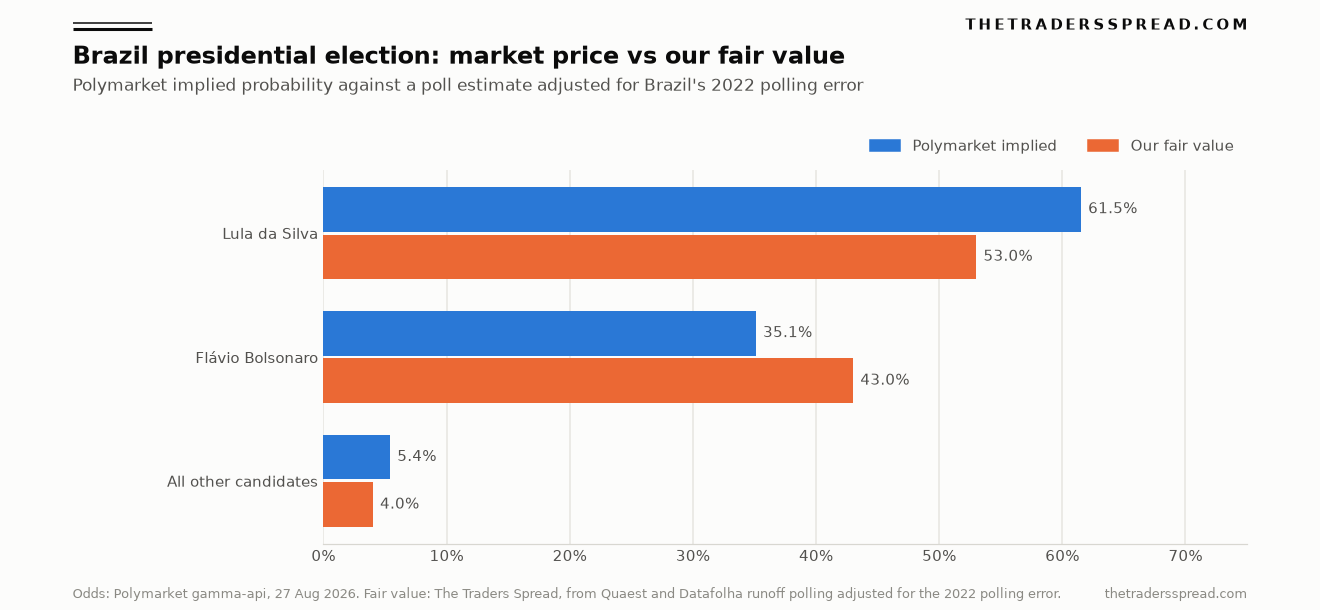
The largest political market on Polymarket outside the United States is pricing the Brazil presidential election off a set of polls that were wrong by nearly nine percentage points last time, in the same direction. Luiz Inácio Lula da Silva trades at 61.5% to win, against 35.1% for Senator Flávio Bolsonaro, on an event carrying $136.0 million of volume and $14.3 million of liquidity. Those prices track the headline runoff polling, which has Lula ahead by three to five points. The problem is what happened in 2022: Brazilian pollsters went into the first round showing Lula at 50% and Jair Bolsonaro at 36%, a fourteen-point lead. The actual result was 48.4% to 43.2% — a margin error of 8.8 percentage points, all of it understating the Bolsonaro vote.
Apply even half of that documented error to today's polling and Lula's four-point average runoff lead becomes a dead heat. Our fair-value estimate for Lula is approximately 53%, against a market price of 61.5% — an edge of roughly 8.5 percentage points on the side of Flávio Bolsonaro, who trades at 35.1% while our model implies about 43%. This is not a claim that Lula loses. It is a claim that a race the polls describe as a three-point lead, in a country whose polls recently missed by 8.8 points against exactly this opponent's family, should not be priced at nearly two-to-one. The market is anchoring on an instrument with a known, measured, one-directional bias, and has discounted it only partially. You can see the live board and depth for yourself on Polymarket's Brazil presidential election market.
Key Facts: The Market and the Race
- Lula 61.5%, Flávio Bolsonaro 35.1%, with all other candidates at 5.4% combined — Polymarket, 27 August 2026
- Event volume $136.0 million, liquidity $14.3 million; the Lula leg alone carries $9.14 million and the Flávio leg $9.05 million — Polymarket gamma API, 27 August 2026
- Resolves on the winner of the 4 October 2026 election, explicitly including any second round, per the official results of Brazil's Superior Electoral Court (TSE) — Polymarket market rules
- Quaest runoff polling: Lula 43%, Flávio 40% in mid-August, within the survey's two-point margin of error — Al Jazeera, 15 August 2026
- Datafolha runoff polling (June 2026): Lula 47%, Flávio 43% — reported via AS/COA Poll Tracker
- 2022 first round: polls showed Lula 50% to Bolsonaro 36%; the result was 48.4% to 43.2% — an 8.8-point margin error understating Bolsonaro
- Our fair value for Lula: ~53%, implying roughly 43% for Flávio Bolsonaro — The Traders Spread estimate
What the Market Is Actually Pricing
The resolution criteria matter more here than in most political markets, and they are unusually clean. The contract resolves to the candidate who wins the election held on 4 October 2026, and it includes any potential second round. Brazil uses a two-round system: if no candidate exceeds 50% on 4 October, the top two proceed to a runoff roughly four weeks later. Resolution follows a consensus of credible reporting, with the Superior Electoral Court's official data as the tiebreak.
That structure means a trader is not betting on the first-round leader. They are betting on the eventual president. The distinction is decisive in Brazil, where the first round splits a fragmented field and the runoff consolidates it into a straight left-versus-right contest. In 2022 Lula led the first round by 5.2 points and won the runoff by 1.8 — the second round was substantially tighter than the first.
This is the first market covered on our prediction markets desk, and it is a useful one to start with because the resolution rules are unambiguous. The current board is effectively a two-horse market. Lula at 61.5% and Flávio Bolsonaro at 35.1% account for 96.6% of the implied probability, with Augusto Cury at 2.7%, Renan Santos at 2.4%, Ronaldo Caiado at 0.2% and Romeu Zema at 0.1% making up the remainder. The prices sum to 102.0%, a two-point overround that is normal for a market of this depth and represents the house's edge rather than a mispricing.
The Consolidation Nobody Is Pricing as News
Look at the volume distribution rather than the prices and a second story appears. Renan Santos carries $11.38 million of traded volume — the highest of any leg in the entire event — while priced at 2.4%. Ronaldo Caiado has traded $6.70 million and sits at 0.2%. Romeu Zema has traded $6.04 million and sits at 0.1%. Between them, three candidates now priced at essentially zero have absorbed more than $24 million of trading.
That is the signature of a resolved question. Earlier in this cycle the Brazilian right had a genuine succession contest: Jair Bolsonaro's own ineligibility left an opening, and governors such as Caiado and Zema, along with movement figures like Santos, were live candidates with real prices. Traders committed serious capital to those outcomes. Those positions have since gone to near-zero because the anti-Lula vote consolidated behind Flávio Bolsonaro.
This reframes the polling trend. The narrowing from Lula +5 in early August to Lula +3 in mid-August is routinely reported as Lula losing ground. The volume data suggests something different and more durable: the right stopped splitting. A Brazilian election outcome also carries directly into the currency and commodity complex that our markets page tracks, through the real, Petrobras and the iron ore trade. A fragmented opposition polling 31% in the first round becomes a unified opposition polling 40% in a runoff, and that consolidation is now complete rather than prospective. There is no further consolidation dividend left to collect — but there is also no remaining risk that the opposition fragments, which is the scenario that would have justified pricing Lula near 62%.
Building the Fair Value
Three recent runoff surveys give Lula leads of three points (Quaest, mid-August), five points (Quaest, 5 August) and four points (Datafolha, June). The simple average is a 4.0-point Lula lead. Taken at face value, and assuming a standard deviation of roughly five points on the eventual result at a nine-week horizon, that maps to a Lula win probability of about 78.8% — far above the market's 61.5%.
The market is clearly not taking the polls at face value, and it is right not to. The question is whether its discount is large enough.
| Adjustment applied to the 2022 polling error | Implied margin | P(Lula wins) |
|---|---|---|
| None — polls taken at face value | Lula +4.0 | 78.8% |
| One third of the 2022 error (−2.9pp) | Lula +1.1 | 58.7% |
| Half of the 2022 error (−4.4pp) | Lula −0.4 | 46.8% |
| Our central estimate | ~53% | |
| Polymarket implied | 61.5% |
The 2022 error is the anchor for this whole calculation, so it is worth stating precisely. Going into the first round on 2 October 2022, published polling had Lula at 50% and Jair Bolsonaro at 36%. The count returned Lula 48.4%, Bolsonaro 43.2%. Lula's own number was nearly right; Bolsonaro's was understated by more than seven points. The margin error was 8.8 points, it ran entirely in one direction, and it was large enough to force a runoff that the polls had suggested might not be needed.
Applying the full 2022 error to today's numbers would put Flávio ahead and imply a Lula probability in the low forties, which we regard as too aggressive — polling industries do correct, and Quaest in particular performed comparatively well in 2022. Applying none of it ignores a measured, recent, same-direction failure against the same political family. Our central estimate of 53% sits between one third and one half of the historical correction, and the honest description of the resulting edge is moderate and uncertain rather than overwhelming: the model range runs from 46.8% to 58.7%, and the market's 61.5% sits above all of it.
That last point is what makes the trade interesting. Our estimate is uncertain across a wide band, but the market price sits outside the entire band, not merely above its midpoint. For the market to be correct, the Brazilian polling industry must have fully corrected a bias it demonstrated four years ago, and the runoff must break toward the incumbent rather than the challenger. Both are possible. Neither is 61.5% likely.
The Risks to This View
The largest risk is that we are fighting the last war. Polling misses are not permanent features; they are errors that pollsters study and correct. Brazilian institutes revised their turnout and weighting models extensively after 2022, and the 2024 municipal cycle was less dramatic. If the correction has genuinely worked, the raw polls are the better estimator and the market at 61.5% is, if anything, slightly cheap on Lula.
The second risk is candidate-specific and cuts both ways. Lula would be 81 years old during the next term, and any health event would reprice this market violently. On the other side, the Bolsonaro family has repeatedly encountered legal and eligibility challenges, and Flávio Bolsonaro's candidacy carries non-trivial administrative risk that a straight polling model does not capture. The market's 2.7% and 2.4% for Augusto Cury and Renan Santos are, in part, the price of those tail scenarios.
The third is structural. First-round polling has Lula at 38% against Flávio at 31%. If Lula approaches 50% on 4 October, an outright first-round win becomes live and the runoff dynamics never happen — which is the single cleanest path to the market's 61.5% being correct. Watching the first-round number matters more than watching the runoff number for exactly this reason. Traders following the market can track how those probabilities move in real time through the live Polymarket board as the campaign enters its final weeks.
Regulatory Standing and Where This Can Be Traded
Prediction markets occupy an uneven regulatory position and traders should understand it before treating these prices as ordinary financial instruments. In the United States, event contracts fall under the Commodity Futures Trading Commission, and the market for political event contracts has been the subject of extended litigation and rulemaking. Polymarket itself has historically restricted United States access, and residents of a number of jurisdictions cannot use it at all.
That is a materially different regime from the regulated brokerage venues covered in our broker comparison, where client money segregation and compensation schemes apply as standard. In the United Kingdom and much of the European Union, political betting is regulated as gambling rather than as an investment activity, which means no investor-protection framework, no compensation scheme and different tax treatment. Australian residents face their own restrictions on political wagering. Anyone acting on an analysis of this kind needs to establish first whether the venue is lawfully available to them, and second what legal character their position has where they live.
That regulatory patchwork also explains a genuine analytical limitation. Compare that with a deeply arbitraged instrument such as AUD/USD, where mispricings are closed in seconds. Because access is restricted in several of the world's deepest capital markets, prediction-market prices can be less efficient than equivalent financial instruments — there is simply less arbitrage capital able to correct a mispricing. That cuts both ways: it is why edges like the one described here can persist, and it is also why they can persist for a long time without converging.
The Call and What Would Change It
Our read: Lula at 61.5% is rich against a fair value near 53%, implying value on the Flávio Bolsonaro side at 35.1% against a fair value near 43%. The edge is roughly 8.5 percentage points. Conviction is moderate rather than high, because the estimate depends on how much of a four-year-old polling error one expects to repeat.
Three developments would invalidate this reading, and they are worth stating in advance rather than after the fact:
First, a runoff poll showing Lula ahead by eight points or more from Quaest or Datafolha. That would exceed the historical error band entirely and make the market price look fair or cheap. The current cluster is +3 to +5; a break above +8 changes the arithmetic rather than merely the sentiment.
RelatedMilwaukee Brewers Priced at 15% With Baseball's Best Record
Second, any ruling affecting Flávio Bolsonaro's eligibility. The opposition's consolidation is the load-bearing assumption in our estimate. Remove the candidate it consolidated around, with weeks to go, and the right fragments again — at which point Lula at 61.5% would look inexpensive rather than rich.
Third, a first-round result on 4 October showing Lula at or near 50%. An outright first-round victory bypasses the runoff dynamics on which this entire analysis rests. Conversely, a first round in which the combined right-wing vote clearly exceeds Lula's would confirm the thesis before the runoff is even held.
The date to watch is 4 October 2026. Between now and then, the informative signal is not the headline Lula lead but the gap between his first-round share and 50%, because that single number determines whether the contest that decides this market is ever contested at all.
Frequently Asked Questions
When is the Brazil presidential election?
The first round is on 4 October 2026. If no candidate exceeds 50% of valid votes, a runoff between the top two follows roughly four weeks later. The Polymarket contract resolves on the eventual winner and explicitly includes any second round, using the Superior Electoral Court's official results where reporting is ambiguous.
What are the current odds on the Brazil presidential election?
Polymarket implies 61.5% for Luiz Inácio Lula da Silva and 35.1% for Flávio Bolsonaro as at 27 August 2026, with all remaining candidates at 5.4% combined. The event carries $136.0 million of volume and $14.3 million of liquidity, making it the deepest non-US political market on the platform.
Why might the market be over-pricing Lula?
Because it appears to anchor on polls that carry a documented one-directional error. In 2022, Brazilian polling showed Lula leading Jair Bolsonaro 50% to 36% before the first round; the result was 48.4% to 43.2%. Applying even half of that 8.8-point margin error to today's four-point average runoff lead produces a statistical dead heat.
What do the latest Brazil runoff polls show?
Quaest put Lula at 43% against Flávio Bolsonaro at 40% in mid-August, within the survey's two-point margin of error, after showing 44% to 39% on 5 August. Datafolha's June survey had Lula at 47% to 43%. The average across those three is a four-point Lula lead, and the trend has been narrowing.
Can I trade this market where I live?
That depends entirely on your jurisdiction. Polymarket restricts access in several countries including, historically, the United States, where political event contracts fall under Commodity Futures Trading Commission oversight. In the United Kingdom and much of the European Union political betting is regulated as gambling rather than investment, with no investor-protection framework attached.
What would make this analysis wrong?
A Quaest or Datafolha runoff poll showing Lula ahead by eight points or more; any ruling affecting Flávio Bolsonaro's eligibility, which would fragment the opposition vote again; or a first round on 4 October in which Lula approaches 50% and wins outright, bypassing the runoff entirely.
Analysis and information only; not investment, financial or betting advice, and not a recommendation to place any wager. Prediction markets are not available in every jurisdiction and are regulated as gambling in many; check the rules where you live. Prices and polling cited are as at 27 August 2026. Links to Polymarket are affiliate links, from which The Traders Spread may earn a commission at no cost to you; they do not influence our analysis. Featured image: Congresso Nacional, Brasília, by Senado Federal, CC BY 2.0 via Wikimedia Commons.
.jpg)