

A 3.09% decline in one regular session left Texas Instruments at $294.21 on Monday, 16 November 2026, a smaller fall than the semiconductor basket and a sharp contrast with an analog business that had just grown 32%. The close is the Nasdaq print on the StockAnalysis quote page for Texas Instruments, timestamped 4:00 pm Eastern and retrieved on 17 November 2026, against a previous close of $303.60. Subtract $294.21 from $303.60 and the difference is $9.39. Divide $9.39 by $303.60 and the result is 3.0929%, which rounds to the 3.09% printed beside the price. That comparison, Monday's close against Friday's close, is the whole of the headline figure for Texas Instruments stock under the ticker TXN.
Most of the damage was a gap, which is easy to miss if a down close is read as a steady bleed through the day. Texas Instruments opened at $294.47, already $9.13 under Friday's $303.60, or 3.01%. Cash hours then ran from $289.59 to $298.35, a range of $8.76, and the high stayed $5.25, or 1.73%, under the prior close. The low sat 4.61% under that same prior close, and the final print of $294.21 was only $0.26, or 0.09%, under the open. Volume on the quote page is 6,761,876 shares, and an after-hours print of $294.15 at 7:59 pm Eastern took off another $0.06, or 0.02%.
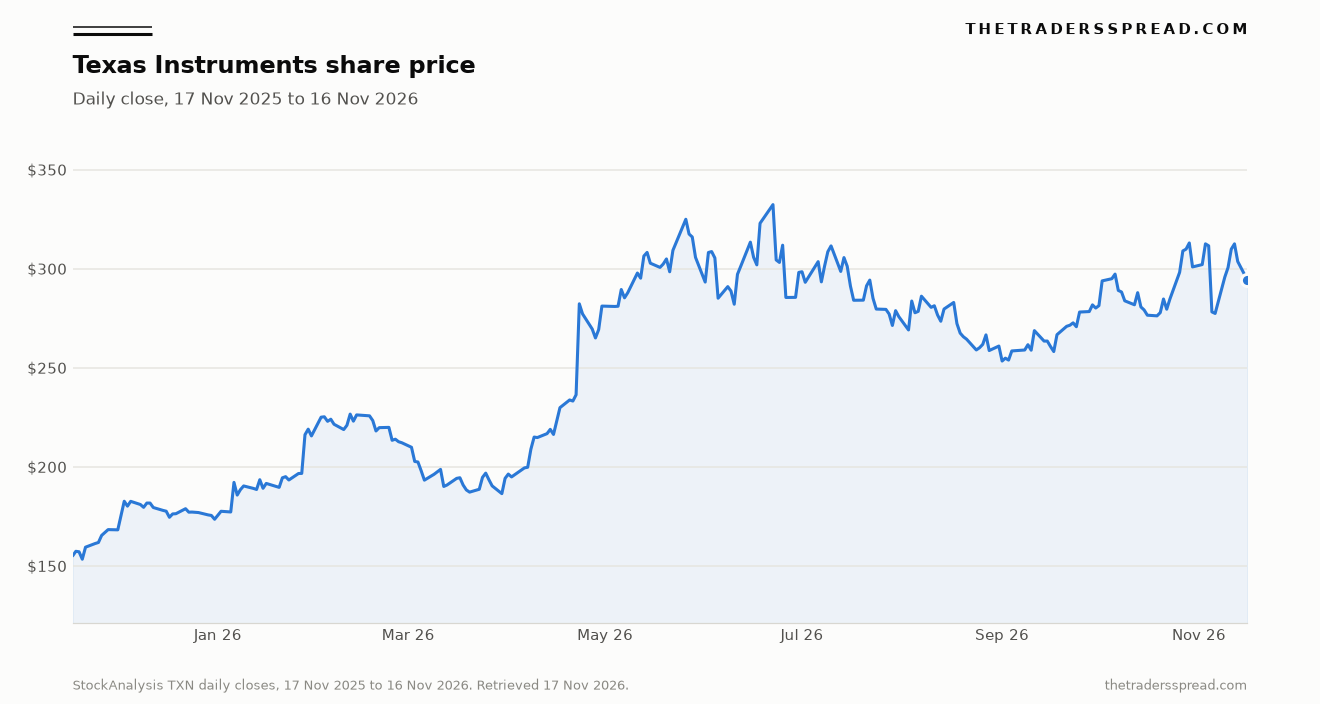
A daily-close series from the StockAnalysis history endpoint, downloaded the same morning, puts Friday 13 November at $303.60 and Monday at $294.21, so the percent matches on both feeds. The closes just before Monday read $277.36 on 6 November, $295.73 on 9 November, $300.52 on 10 November, $309.81 on 11 November and $312.48 on 12 November. From 6 November to 12 November is a rise of $35.12, or 12.7%. Friday gave back $8.88, or 2.84%, and Monday's $294.21 finished $1.52, or 0.51%, under the 9 November close. The mid-week sprint was handed back, and the share ended near where that sprint had started.
The sector yardstick is the iShares Semiconductor ETF, ticker SOXX. The StockAnalysis page for SOXX, retrieved 17 November 2026, shows a Monday close of $141.22 against $149.30. The change is $8.08, and $8.08 divided by $149.30 is 5.41%. The fund opened at $143.07, traded from $140.88 to $144.50, and turned over 37,178,534 shares. The page lists 33 holdings and assets of $42.76 billion, so one share is a claim on a group of semiconductor companies. Texas Instruments fell 3.09% while that basket fell 5.41%, a gap of 2.32 percentage points, with the basket the steeper print.
Set beside a year of closes, the Monday drop is a giveback inside a much larger rise. The series in the chart runs from $154.99 on 17 November 2025 to $294.21, up $139.22, or 89.8%. The highest close in the series is $332.28 on 22 June 2026, and Monday sits $38.07, or 11.5%, under that peak. The quote page's 52-week range of $152.73 to $334.03 includes intraday trades, so those bounds can sit past any closing print. Monday is 11.9% under the $334.03 high and 92.6% above the $152.73 low. The two highs differ by $1.75 because one is a close and the other is an intraday extreme.
The same quote page prints a market value of $268.84 billion and 913.77 million shares at the Monday close. The quarterly-report cover counts 913,770,316 shares as of 14 October 2026. Multiply that count by the $9.39 decline and the equity value between the two closes is about $8.58 billion, a scale check that uses a share count about a month older than the session.
The analog book in the filing
The business behind the tape is in the Form 10-Q for the quarter ended 30 September 2026, filed with the US Securities and Exchange Commission on 23 October 2026. Analog semiconductors, in the company's note, change real-world signals such as sound, temperature, pressure or light by conditioning them, amplifying them, and often turning them into digital data. They also manage power, converting, distributing, storing, discharging, isolating and measuring electrical energy. That is the analog book: one segment, two product lines, Power and Signal Chain. The figures below stay with that filing and with the 21 October earnings release.
Analog revenue in the quarter was $4.911 billion, up from $3.729 billion, a rise of 32%, with both product lines higher on demand and Signal Chain in the lead. Analog operating profit was $2.505 billion against $1.486 billion, a margin of 51.0% against 39.8%. Analog was 81.1% of company revenue of $6.055 billion. Company revenue rose $1.31 billion, or 28%, from $4.742 billion, and management also describes an 11% sequential increase. Gross profit was $3.887 billion, or 64.2% of revenue, against 57.4%. Operating expenses were $1.01 billion against $975 million, of which research and development was $530 million and selling, general and administrative cost was $476 million, so revenue jumped while those costs barely moved. Operating profit was $2.874 billion, or 47.5% of revenue, against 35.1% a year earlier. Net income was $2.425 billion against $1.364 billion, and diluted earnings per share were $2.62 against $1.48.
The Exhibit 99 earnings release says the $2.62 included a one-cent reduction relative to the original guidance. Haviv Ilan, chairman, president and chief executive, said in that release: "Revenue increased 11% sequentially and 28% from the same quarter a year ago with continued broad growth in industrial, automotive and data center." The 10-Q describes the same quarter as broad demand across end markets and regions, with semiconductor content growing alongside a cyclical recovery. The end markets named are industrial, automotive, data center, personal electronics and communications equipment.
Embedded Processing revenue was $858 million, up 21% from $709 million, with operating profit of $227 million against $108 million and a margin of 26.5% against 15.2%, equal to 14.2% of company revenue. Other revenue, DLP products and calculators, was $286 million, down 6% from $304 million. For the first nine months, company revenue was $16.343 billion, up 23%, and Analog revenue was $13.200 billion, up 27% from $10.391 billion. On geography, the filing uses the headquarters of the end customer. The United States was $2.348 billion, or 39%. China was $1.392 billion, or 23%, up from $1.019 billion, an increase of $373 million, or 36.6%. Europe, the Middle East and Africa were 20%, the rest of Asia 10%, Japan 6%, and customers headquartered in Germany were 9% on their own.
Inventory at 30 September was $4.67 billion, down $132 million from the end of 2025, and days of inventory were 194 against 222. Days sales outstanding were 39 against 40. The company builds broad, low-obsolescence products ahead of demand and then changes factory loadings. Fewer days means shipments have been absorbing that stock. Because much of the manufacturing is owned, a large share of cost is fixed, which is why a gross margin moving from 57.4% to 64.2% with nearly flat operating expenses belongs in the same paragraph as the demand increase. A 300-millimetre wafer, the filing says, costs about 40% less per chip than a 200-millimetre wafer.
The 10-Q also says sequential growth has historically been weaker in the first and fourth quarters than in the second and third. The 21 October outlook is fourth-quarter revenue of $5.80 billion to $6.30 billion and earnings per share of $2.45 to $2.79. The revenue midpoint is $6.05 billion, about $5 million under the $6.055 billion just reported. The low end is 4.2% under that print and the high end is 4.0% above it, a band around a roughly flat sequential result. Trailing twelve-month operating cash flow was $9.896 billion, and free cash flow, operating cash flow minus capital expenditure plus CHIPS Act proceeds, was $8.422 billion, or 40.6% of $20.766 billion of revenue. In the quarter, operating cash flow was $3.419 billion and free cash flow was $2.956 billion.
In September 2026 the quarterly dividend was raised 7%, to $1.52 a share, the 23rd consecutive annual increase. The release shows $1.42 declared in the third quarter, and a 7% step from $1.42 lands on $1.52. The quote page lists a $6.08 annual dividend and an ex-dividend date of 30 October 2026, four quarters at the new rate. Full-year 2026 capital spending is expected at $2 billion to $3 billion, with $1.65 billion already used, and direct CHIPS Act funding of up to $1.6 billion is tied to 300-millimetre fabs in Sherman, Texas, and Lehi, Utah, of which $630 million had been received. The planned Silicon Labs purchase, announced 4 February 2026, is $231.00 a share in cash, about $7.5 billion of enterprise value, expected to close in the first half of 2027, with a delayed-draw loan of up to $5 billion still undrawn at 30 September and $7 million of acquisition charges in the quarter. The cash price stays where the agreement put it.
| Measure | Figure | Comparison | Source |
|---|---|---|---|
| Monday close | $294.21 | Down $9.39, or 3.09%, from $303.60 | StockAnalysis TXN quote, 16 Nov 2026, 4:00 pm ET |
| Session range | $289.59 to $298.35 | Open $294.47, close $0.26 under the open | Same quote page, retrieved 17 Nov 2026 |
| Semiconductor ETF | $141.22 | Down $8.08, or 5.41%, from $149.30 | StockAnalysis SOXX quote, same close |
| Analog revenue | $4.911 billion | Up 32% from $3.729 billion | TI Form 10-Q, quarter ended 30 Sep 2026 |
| Fourth-quarter outlook | $5.80 billion to $6.30 billion | Earnings per share $2.45 to $2.79 | Exhibit 99, Form 8-K, 21 Oct 2026 |
Prices from one afternoon and company figures from October belong in separate columns, which is the habit in a line-by-line reading of Lam Research earnings and in a guide to parsing an earnings report. A down share after a strong reported period shows up elsewhere too: Jabil shares fell after a fiscal fourth-quarter beat, a different company and a different percent. The income statement answers what shipped. The close answers what buyers paid that afternoon. Texas Instruments on 16 November is that split again, a 32% analog increase filed in October and a 3.09% decline on a day the basket fell 5.41%.
Key facts
- Texas Instruments closed at $294.21 on 16 November 2026, down $9.39, or 3.09%, from $303.60, according to the StockAnalysis TXN quote at 4:00 pm Eastern, retrieved 17 November 2026.
- The session opened at $294.47, traded from $289.59 to $298.35, and printed volume of 6,761,876 shares, with an after-hours price of $294.15, on that same quote page for 16 November 2026.
- The iShares Semiconductor ETF closed at $141.22, down $8.08, or 5.41%, from $149.30, a decline 2.32 percentage points larger than TXN, on the StockAnalysis SOXX quote for 16 November 2026, retrieved 17 November 2026.
- Analog revenue was $4.911 billion in the quarter ended 30 September 2026, up 32% from $3.729 billion, and 81.1% of company revenue of $6.055 billion, in the Form 10-Q filed 23 October 2026.
- The fourth-quarter outlook still on the record for the session is revenue of $5.80 billion to $6.30 billion and earnings per share of $2.45 to $2.79, in Exhibit 99 to the Form 8-K dated 21 October 2026.
- Days of inventory were 194 at 30 September 2026, against 222 at the end of 2025, on inventory of $4.67 billion, in the same Form 10-Q filed 23 October 2026.
- Customers headquartered in China accounted for $1.392 billion, or 23% of third-quarter revenue, up from 21% a year earlier, in the geographic note of that Form 10-Q.
What this changes
Two clocks are now sitting side by side, and they answer different questions. Quarterly shipments say analog revenue is 32% higher than a year ago, gross margin is 64.2%, inventory days are lower, and the chief executive described broad growth in industrial, automotive and data center on 21 October. The closing auction says Texas Instruments stock fell 3.09% on 16 November because the open gapped down with a basket that fell 5.41%, after a four-day climb of 12.7% into 12 November. Monday's close rewrites a quarter that ended on 30 September only in the mind of a reader who forces the two clocks together. Reading the 32% as a promise that the shares stay up on a basket day skips the way an index fund sells the group in one order.
The 2.32 percentage-point gap versus SOXX is the second consequence. The shares were repriced with the group, and by less than the group, which fits a firm whose last filing is 81.1% analog, with plants it owns and customers spread across industrial and automotive work as well as data center. Fund mechanics point the same way: a basket of 33 holdings and $42.76 billion of assets can fall 5.41% and pull every name inside it, including one whose last quarter was strong. The milder decline distinguished the analog book from the basket, and basket membership was still enough to open the stock $9.13 lower.
The test already written down is a revenue band, $5.80 billion to $6.30 billion, with a midpoint of $6.05 billion that sits about $5 million under the quarter just reported. Inside the band, the result would match the seasonal comment in the 10-Q. Under $5.80 billion, shipments would have cooled faster than the 21 October outlook. Over $6.30 billion, they would have run hotter. Because a large share of cost is fixed, that revenue result reaches factory loadings and only then the gross margin. Days of inventory at 194, on a $4.67 billion stockpile, confirm that the upturn has been shipping, and they are also the cushion that becomes a cost if loadings slow. Silicon Labs remains an all-cash purchase at $231 a share, about $7.5 billion, with the $5 billion facility undrawn at 30 September, so the Monday move changes the buyer's market value and leaves the cash price of the target where the contract put it. China at 23% of revenue by customer headquarters, up 36.6% in dollars, is the mix a later shipment report can still revise. The October filing attributes the quarter's increase to demand and stops at 30 September.
RelatedHoneywell HON vs Emerson on the Segment Margin Line
Common questions
What does the 3.09% figure in the Texas Instruments headline actually measure?
The 3.09% is the move from the Friday 13 November 2026 close of $303.60 to the Monday 16 November close of $294.21. The dollar change is $9.39, and $9.39 divided by $303.60 rounds to 3.09%. The window is one regular Nasdaq session, separate from the after-hours print of $294.15 and from the one-year rise since the 17 November 2025 close of $154.99. StockAnalysis timestamped the close at 4:00 pm Eastern on a page retrieved 17 November 2026.
What is the analog chip book at Texas Instruments, in ordinary language?
The Form 10-Q describes analog semiconductors as chips that condition real-world signals such as sound, temperature, pressure or light, often turn them into digital data, and manage electrical power inside equipment. Texas Instruments reports that work as one Analog segment with two lines, Power and Signal Chain. In the quarter ended 30 September 2026, Analog revenue was $4.911 billion, or 81.1% of company revenue, up 32% from a year earlier on higher demand, led by Signal Chain.
Did Monday's decline erase the 32% increase in analog revenue?
The 32% compares analog revenue of $4.911 billion in the quarter ended 30 September 2026 with $3.729 billion a year earlier, in the 10-Q filed on 23 October. The 3.09% is one equity session on 16 November, mostly a gap at the open, on a day the semiconductor ETF fell 5.41%. A down close can reprice the shares while the last completed quarter still shows higher shipments. The fourth-quarter revenue range already published is $5.80 billion to $6.30 billion.
How does the fourth-quarter outlook compare with the quarter just reported?
The 21 October release sets fourth-quarter revenue at $5.80 billion to $6.30 billion and earnings per share at $2.45 to $2.79. The midpoint is $6.05 billion, about $5 million under third-quarter revenue of $6.055 billion. The low end is 4.2% under that print and the high end is 4.0% above it. The 10-Q says sequential growth has historically been weaker in the fourth quarter than in the second and third, and the band sits around a flat sequential result.
Why can the shares fall while the filing still describes higher demand?
Demand in the filing is a quarter of shipments, and the share price is one closing auction. On 16 November the semiconductor basket fell by more than Texas Instruments, and index funds sell that basket as a group, so a member can gap down after a quarter that showed analog revenue up 32% and inventory days down to 194 from 222. Both records stand, and a single session leaves the October filing as it was filed.
What is worth watching next, short of any share-price call?
The published figure to watch is the fourth-quarter revenue band of $5.80 billion to $6.30 billion, set on 21 October 2026, with earnings per share of $2.45 to $2.79. A result inside the band would fit the seasonal pattern in the 10-Q. A result outside it would mean shipments missed or exceeded that outlook, which then feeds factory loadings and the fixed cost of owned plants. The watch is a revenue watch, separate from any destination for the share price.
This article is for information and education only. It is not investment advice, and one session does not determine the next price.