

Note 13C of the Pfizer Inc. Form 10-Q for the quarter ended 27 September 2026 is headed Significant Revenues by Product, and it sits on page 31 of that filing. The sentence under the heading says the table provides additional revenue information for several of the company's major products. On the Comirnaty row, active immunization to prevent COVID-19, the column for the three months ended 27 September 2026 prints $808 million. Data as of 3 November 2026 come from that Form 10-Q, filed the same day, and from Exhibit 99 to the Form 8-K filed with it.
We took worldwide Comirnaty and Paxlovid revenue from that table for the three months ended 27 September 2026, added the $808 million row to the $449 million Paxlovid row, and divided the $1,257 million sum by total revenues of $16,583 million on the same table. The result is 7.58 percent, against 14.27 percent a year earlier, when the rows were $1,151 million and $1,225 million out of $16,654 million. On the nine-month columns the two products are $1,957 million of $46,067 million, or 4.25 percent, against $4,241 million of $45,022 million, or 9.42 percent. Reading one product line before the total is the audit in how a product-revenue line gets audited in a filing.
Comirnaty and Paxlovid
A common description of Pfizer stock, the NYSE listing under the ticker PFE, still treats the shares as a wager on the COVID vaccine and the antiviral. Those two rows are a minority of the quarter, and they are smaller than the Vyndaqel family at $1,773 million. Eliquis, at $2,523 million, was 2.01 times the two COVID rows combined. Primary Care, the portfolio that holds both, was $6,971 million against $7,642 million. Remove the COVID rows and Primary Care is $5,714 million against $5,266 million, up $448 million.
The drivers are narrower than a vanished franchise. Comirnaty was down 30 percent on the total column and 29 percent operationally. Pfizer says that came mainly from a smaller favorable adjustment to the US returns provision, lower US utilization after a narrower vaccination recommendation, and lower contractual deliveries in some international markets. Paxlovid was down 63 percent on both the total and the operational columns, tied mainly to lower COVID-19 infections, partly offset by the timing of government purchases in some emerging markets. United States Paxlovid revenue was $373 million against $1,122 million.
Contracted supply is still on the page. Remaining performance obligations on long-term firm orders for Comirnaty and Paxlovid were about $1.7 billion and $943 million as of 27 September 2026, with delivery terms running primarily through 2028 and with the timing open to renegotiation. Contracts expected to last less than a year are excluded. Deferred revenue on the two products was $1.3 billion, against $1.5 billion at 31 December 2025, of which $441 million was current. The 7.58 percent counts revenue already recognized, and the contracted amounts stay on their own lines.
The revenue outside those two rows
The paired claim is that the rest of Pfizer shrinks once Comirnaty and Paxlovid are removed. The management discussion says excluding those contributions, total revenues increased 7 percent operationally, in the quarter and in the first nine months. Operational there means the change with foreign exchange taken out. On the reported dollars, which still include foreign exchange, revenue outside the two rows was $15,326 million against $14,278 million, up $1,048 million, or 7.34 percent. Total revenue itself was $71 million lower. The filing calls that move relatively flat, an operational decrease from the COVID products and the Prevnar family largely offset by Eliquis, Padcev, Vyndaqel and others.
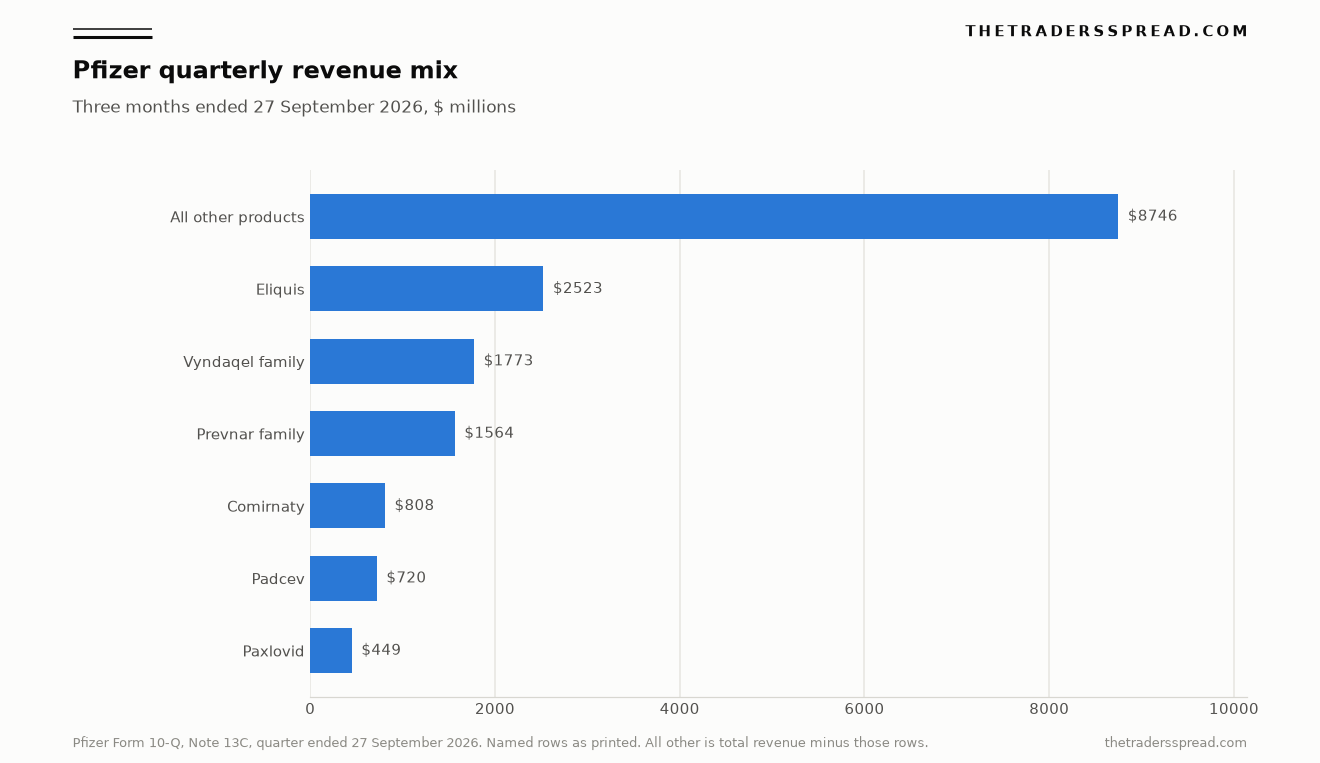
Oncology was $4,327 million against $3,938 million, Specialty Care $3,349 million against $3,130 million, and Hospital and Biosimilars $1,635 million against $1,600 million. That hospital portfolio was carved inside Biopharma in the first quarter of 2026 from off-patent sterile injectables and biosimilars, with prior periods reclassified. Pfizer CentreOne was $300 million against $344 million. Padcev, inside oncology, was $720 million against $464 million, up 55 percent operationally.
Eliquis
A third claim treats Eliquis as a drug already past the patent cliff. Worldwide revenue was $2,523 million against $2,015 million, up 25 percent on the total column and the operational column. United States revenue was $1,808 million against $1,292 million, up 40 percent. International revenue was $715 million against $723 million, down 1 percent, with the operational column flat. Footnote (b) says the line reflects alliance revenues and product revenues, the amount Pfizer recorded.
The commentary credits higher US net price, including lower rebates and channel mix, and higher global demand, partially offset by generic entry and price erosion in certain international markets. Nine-month Eliquis revenue was $7,114 million against $5,941 million, up 18 percent operationally. For patent expiration years, the 10-Q points to the 2025 Form 10-K.
Dividend cash and the share count
The cash claim is that the dividend has outrun the cash the business produces. For the nine months ended 27 September 2026, operating cash flow was $8,825 million and cash dividends paid were $7,347 million, a ratio of 1.20. A year earlier those lines were $6,356 million and $7,326 million, a ratio of 0.87.
Declared and paid are different lines. Nine-month dividends declared were $0.86 a share, a $4,902 million charge to retained earnings. The third-quarter equity roll shows a blank per-share declaration, and the year-ago third quarter shows a blank as well. Cash paid of $7,347 million equals the $4,902 million declared plus the $2,445 million of dividends payable on the 31 December 2025 balance sheet. Dividends payable at 27 September 2026 were zero. Exhibit 99 to the 3 November Form 8-K describes the cash that went out as $7.3 billion, or $1.29 per share.
Diluted earnings per share were $0.56 against $0.62. Weighted-average diluted shares were 5,751 million against 5,714 million, so the lower per-share figure arrived with a larger share count. Pretax income was $3,385 million against $3,334 million. Tax moved from a $216 million benefit to a $134 million provision, and the effective rate on continuing operations moved from negative 6.5 percent to 3.9 percent. Net income attributable to Pfizer common shareholders was $3,242 million against $3,541 million. The nine-month treasury movement sits on the share-based payment row, 7 million shares at a cost of $181 million. Exhibit 99 calls repurchases a later step, "the potential to resume the return of capital to shareholders through value-enhancing share repurchases after de-levering our balance sheet."
Nine-month net income attributable to Pfizer shareholders was $5,681 million against $9,419 million, while total revenue rose by $1,045 million to $46,067 million. Pretax income was $5,902 million against $9,162 million. Management ties that decline mainly to impairments, legal matters and higher contingent consideration, plus higher research and development, cost of sales and restructuring, offset in part by the ViiV gain and by higher revenue. The cash-flow statement prints asset write-offs and impairments of $4,487 million against $864 million, and a $1,870 million ViiV gain. Separating the tax line, the impairment line and the product rows is the job in a line-by-line reading of Lam Research earnings.
| Line | Three months ended 27 Sept 2026 | Three months ended 28 Sept 2025 | Where it sits |
|---|---|---|---|
| Comirnaty | $808 million | $1,151 million | Note 13C, as printed |
| Paxlovid | $449 million | $1,225 million | Same table, as printed |
| Combined COVID rows | $1,257 million, 7.58% of revenue | $2,376 million, 14.27% of revenue | Sum of the two rows, divided by total revenue |
| Eliquis | $2,523 million | $2,015 million | Same table; footnote (b) |
| Vyndaqel family | $1,773 million | $1,591 million | Same table, as printed |
| Oncology | $4,327 million | $3,938 million | Portfolio total |
| Total revenues | $16,583 million | $16,654 million | Income statement and Note 13C |
| Item | Figure | Comparison | Source |
|---|---|---|---|
| Operating cash flow | $8,825 million | $6,356 million a year earlier | Cash-flow statement, nine months to 27 Sept 2026 |
| Cash dividends paid | $7,347 million | $7,326 million; cover 1.20 times, then 0.87 times | Same statement; ratios divide the two lines |
| Dividends declared | $0.86 a share, $4,902 million | Third-quarter per-share line blank in both years | Equity statement |
| Cash and short-term investments | $14,272 million | $1,824 million cash plus $12,448 million of investments | Balance sheet, 27 Sept 2026 |
| Long-term debt | $59,997 million | $61,641 million at 31 Dec 2025; $1,250 million repaid | Balance sheet and cash-flow statement |
| Diluted earnings per share | $0.56 | $0.62; diluted shares 5,751 million vs 5,714 million | Income statement, quarter ended 27 Sept 2026 |
Key facts
- Comirnaty plus Paxlovid was 7.58 percent of quarterly revenue, against 14.27 percent a year earlier. Source: Note 13C, Form 10-Q filed 3 November 2026.
- Excluding those products, operational revenue rose 7 percent. Reported revenue outside the rows was $15,326 million against $14,278 million. Source: MD&A and the same table.
- Eliquis revenue was $2,523 million against $2,015 million. US revenue was $1,808 million against $1,292 million. Source: selected-product discussion, same 10-Q.
- Nine-month operating cash flow was $8,825 million. Cash dividends paid were $7,347 million. Source: cash-flow statement.
- Dividends declared were $0.86 a share. Exhibit 99 puts cash paid at $7.3 billion, or $1.29 a share. Source: equity statement and Exhibit 99.
- Diluted earnings per share were $0.56 against $0.62. Pretax income was $3,385 million against $3,334 million. Source: income statement.
Verdict
Comirnaty and Paxlovid were 7.58 percent of quarterly total revenue, down from 14.27 percent, with the contracted remainder kept off revenue already recognized. Excluding those rows, Pfizer reports a 7 percent operational increase, and reported revenue outside them was $1,048 million higher. Eliquis revenue was higher worldwide and in the United States, while the same discussion records international generic entry and points patent-expiration years to the 2025 Form 10-K. Nine-month operating cash flow covered dividends paid, 1.20 times against 0.87 times a year earlier. The lower quarterly earnings per share arrived with more diluted shares and higher pretax income. Sorting lines this way is the same job as how to parse a Shopify earnings report.
RelatedDeutsche Bank stock falls 6.01% after leaked documents
Common questions
What share of Pfizer revenue did Comirnaty and Paxlovid produce?
Comirnaty was $808 million and Paxlovid was $449 million in the quarter ended 27 September 2026, together $1,257 million, or 7.58 percent of $16,583 million. A year earlier the share was 14.27 percent, and for the nine months it was 4.25 percent against 9.42 percent. The inputs are in Note 13C of the Form 10-Q filed on 3 November 2026.
Did the third-quarter equity roll show a dividend declaration?
The third-quarter roll shows a blank per-share declaration, matching the year-ago third quarter. Nine-month declarations were $0.86 a share, or $4,902 million. Cash dividends paid were $7,347 million, equal to those declarations plus $2,445 million of dividends payable at 31 December 2025. Dividends payable at 27 September 2026 were zero. Exhibit 99 rounds the cash paid to $7.3 billion, or $1.29 a share.
What does the product table show for Eliquis?
Worldwide Eliquis revenue was $2,523 million against $2,015 million, up 25 percent operationally. United States revenue was $1,808 million against $1,292 million. International revenue was $715 million against $723 million. Footnote (b) says the line is alliance revenue and product revenue. The commentary cites higher US net price and global demand, offset in part by generic entry abroad, and points patent years to the 2025 Form 10-K.
Why did diluted earnings per share fall in a quarter when pretax income rose?
Diluted earnings per share were $0.56 against $0.62, on 5,751 million diluted shares against 5,714 million. Pretax income was $3,385 million against $3,334 million. Tax was a $134 million provision against a $216 million benefit, and the effective rate moved from negative 6.5 percent to 3.9 percent. Nine-month net income fell to $5,681 million from $9,419 million beside higher revenue and beside $4,487 million of asset write-offs and impairments.
This is analysis of Pfizer's filings, with capital at risk. Nothing on this page recommends buying or selling Pfizer stock or any other security.