

Booking Holdings reported $9,793 million of adjusted revenue on $54.5 billion of gross bookings for the quarter ended 30 September 2026, which works out to 17.97 cents of adjusted revenue for each dollar customers booked. That ratio is the cleanest single comparison with Expedia Group, because it asks what share of the trip the platform records as its own. A take rate is that share: revenue divided by gross bookings for the same period. Gross bookings are the retail value of the trips customers reserve, not the revenue the company keeps. Booking's own summary, filed on 3 November 2026, rounds the quarter to 345 million room nights, $54.5 billion of gross bookings and $9.8 billion of adjusted revenue.
Expedia publishes the same idea under another name. In its release dated 4 November 2026, revenue margin is defined as revenue as a percentage of gross bookings, and the figure for the quarter ended 30 September 2026 is 14.5%. On Booking's rounded gross bookings, GAAP revenue of $8,893 million is 16.32%, because the company reduced revenue by $900 million for a Federal Trade Commission matter and then added that $900 million back to reach adjusted revenue of $9,793 million. The gap versus Expedia's 14.5% survives either Booking figure. Marketing tells a related story in the same two releases: Booking's marketing expense was 4.8% of gross bookings, while Expedia's direct selling and marketing was 6.4%.
Updated 19 November 2026 from those two quarterly releases, which remain the source for every operating figure below.
Two releases, one set of axes
Room nights at Booking, in the statistical table of the 3 November 2026 earnings exhibit, are the units-sold line: 345 million, up 6.7%, which the summary box rounds to 7%. Expedia's 4 November 2026 release reports 115.7 million booked room nights, up 7% from 108.2 million, defined as hotel room nights plus alternative-accommodation property nights. Booking.com's alternative-accommodation room nights rose 7%. The two counts are each firm's own tape for the quarter ended 30 September 2026.
Gross bookings need the same care. Booking defines them as the total dollar value, generally inclusive of taxes and fees, of all travel services booked by customers, net of cancellations, and says the FTC matter stays out of that line. Expedia uses the total retail value of transactions booked, including taxes, fees and other charges, adjusted for cancellations and refunds. A two-company margin page such as the Honeywell and Emerson segment-margin comparison follows the same habit: both firms on one set of axes, with a note where an axis bends. The list-price versus net-sales gap at Novo Nordisk is a cousin of gross bookings versus revenue.
The comparison matrix
Every row uses the quarter ended 30 September 2026. Booking figures come from the 3 November exhibit. Expedia figures come from the 4 November release. Where a ratio is our division of two printed numbers, the cell says so.
| Axis | Booking Holdings (BKNG) | Expedia Group (EXPE) |
|---|---|---|
| Room nights, each firm's own unit | 345 million, up 6.7% (summary rounds the growth to 7%) | 115.7 million booked room nights, up 7% from 108.2 million |
| Gross bookings | $54.5 billion, up 9.6% (summary rounds the growth to 10%; constant currency about 11%) | $34,008 million, up 11% |
| Take rate | 17.97% on adjusted revenue of $9,793 million; 16.32% on GAAP revenue of $8,893 million. Both use $54.5 billion of gross bookings | 14.5% revenue margin, the company's name for revenue divided by gross bookings, up 16 basis points |
| Marketing as a share of gross bookings | 4.8%, marketing expense of $2,588 million (4.7% in the year-ago quarter) | 6.4%, direct selling and marketing of $2,184 million (about unchanged, down 1 basis point) |
| Merchant versus agency gross bookings | Merchant $40.7 billion, up 13.9%; agency $13.7 billion, down 1.3% | Merchant $21,653 million, up 15%; agency $12,355 million, up 4%. Merchant is 63.7% of the $34,008 million total |
| Adjusted EBITDA margin | 47.0% of adjusted revenue, on adjusted EBITDA of $4,607 million | 34.2% of revenue, on adjusted EBITDA of $1,689 million |
A higher take rate can be a richer mix, a merchant shift, or a one-off in the revenue line, and a lower marketing ratio can mean repeat visits or a quieter bid. Visa and Mastercard pose the same kind of problem on client incentives, where the headline rate and the rate after partner payments are different objects. A walk through a Shopify earnings report is a useful warm-up when a reconciliation page is dense.
How the take rate is built
The FTC item is the piece a glance at Booking's summary box will miss. Merchant revenues were $6,998 million, agency revenues $2,463 million and advertising $332 million. Those lines sum to $9,793 million, and a $900 million revenue reduction takes GAAP revenue to $8,893 million, down 1.3% in the statistical table. Adjusted revenue adds the $900 million back and rises 8.7%, about 10% in constant currency. On $54.5 billion of gross bookings the adjusted take rate is 17.97% and the GAAP take rate is 16.32%. Expedia's own division, $4,938 million over $34,008 million, is 14.52%, which the release rounds to 14.5%.
Booking also accrued a $100 million loss. Both that loss and the revenue reduction sit outside adjusted revenue, adjusted net income and adjusted EBITDA, and the reconciliation adds back $1,000 million. Adjusted EBITDA is $4,607 million, up from $4,231 million, still 47.0% of adjusted revenue. Glenn Fogel, chief executive of Booking Holdings, said in that exhibit that resilient travel demand and disciplined execution drove double-digit gross bookings growth, margin expansion, and 17% adjusted earnings per share growth, with GAAP earnings per share growth of 7%. A 25-for-1 split took effect on 2 April 2026, and the release adjusts share figures for it.
Ariane Gorin, chief executive of Expedia Group, said in the 4 November release that the company exceeded the high end of its guidance, reflecting resilient travel demand and strong execution. Revenue rose 12% to $4,938 million and adjusted EBITDA rose 17% to $1,689 million. Booking's 47.0% is a share of adjusted revenue, while Expedia's 34.2% is a share of GAAP revenue.
What each company sells
Booking's about paragraph names Booking.com, Priceline, Agoda, KAYAK and OpenTable, offered in more than 220 countries and territories. The quarter was more than hotel nights. Flight tickets were 21 million, up 19.4%. Rental-car days were 23 million, down 0.7%. Constant-currency accommodation average daily rates rose by about 3%. Over the trailing four quarters, the mix of total room nights booked through the direct channel was a mid-fifties percentage, similar to the year before. Direct means the traveler booked on Booking's own path rather than through an intermediary.
Expedia names its shelves in the same release. Consumer brands run from Expedia, Hotels.com and Vrbo through Orbitz, Travelocity and Hotwire. The business-to-business segment sells technology and supply to airlines, agents and corporate managers, and trivago earns advertising fees on hotel referrals. Consumer gross bookings were $22,862 million, up 7%. Business-to-business gross bookings were $11,146 million, up 19%, or 32.8% of the total. Lodging revenue of $3,991 million was 80.8% of revenue, and lodging gross bookings of $24,875 million divided by 115.7 million room nights equal the printed average daily rate of $215.0.
Booking prints the constant-currency ADR increase of about 3% and withholds a dollar room rate. Dividing $54.5 billion of gross bookings by 345 million room nights would mix flights and cars into a fake room rate, so that quotient stays off this page. The scale comparison that survives is the matrix: Booking's room-night count is about three times Expedia's, and its gross bookings are about 1.6 times Expedia's, on each firm's definitions for this quarter.
On 18 November 2026 the company's own account described a partner organisation that sits beside those consumer brands. The post names Booking.com and Rocket Travel by Agoda as the pieces being brought together.
A new chapter for B2B travel starts today. Introducing Booking Partner Division, Booking Holdings’ new global B2B organization bringing together the products and innovation of @Bookingcom and Rocket Travel by @Agoda to unlock new partner opportunities. https://t.co/3jrC6wDSxI
— Booking Holdings (@BookingHoldings) November 18, 2026
That post describes the partner customer, while the room-night and take-rate figures still come from the 3 November exhibit. Expedia's 32.8% business-to-business share of gross bookings can sit beside Booking's mid-fifties direct-channel mix because one counts a consumer path in room nights and the other counts a partner path in gross bookings.
Merchant dollars and agency dollars
Merchant gross bookings are the stays and tickets where the platform is the merchant of record. Agency gross bookings are the ones where the platform is the agent. Revenue follows with a lag and a different rate, which is why the second table keeps the two mixes on separate rows for the quarter ended 30 September 2026.
| Line | Booking Holdings | Expedia Group |
|---|---|---|
| Merchant gross bookings | $40.7 billion, up 13.9% | $21,653 million, up 15% |
| Agency gross bookings | $13.7 billion, down 1.3% | $12,355 million, up 4% |
| Total gross bookings | $54.5 billion, up 9.6% | $34,008 million, up 11% |
| Revenue from the merchant model | $6,998 million | Left unsplit as a revenue line in this release |
| Revenue from the agency model | $2,463 million | Left unsplit as a revenue line in this release |
| Advertising and other revenue | $332 million, before the $900 million FTC reduction | Brand advertising $206 million; trivago $165 million; other products $483 million |
$40.7 billion plus $13.7 billion is $54.4 billion, a tenth short of Booking's $54.5 billion total because the parts are rounded to one decimal. The merchant line is on the order of three quarters of those bookings, and Expedia's millions add exactly, so its merchant share is 63.7%. Before the FTC reduction, Booking's merchant revenue is 71.5% of $9,793 million, agency revenue 25.1% and advertising 3.4%. Expedia's stand-in is the product cut: lodging is 80.8% of revenue, and advertising, trivago and other products together are $854 million, or 17.3%.
Marketing against the booking dollar
Booking reports one marketing line of $2,588 million, against $2,340 million a year earlier, stated as 4.8% of gross bookings versus 4.7%. Dividing those dollars by $54.5 billion gives 4.75%, which rounds to the printed 4.8%. Expedia's direct selling and marketing was $2,184 million, stated as 6.4% of gross bookings. Inside it, consumer marketing was $1,028 million, or 4.5% of consumer gross bookings, down 34 basis points. Indirect costs were another $209 million. Direct plus indirect is 7.0% of gross bookings. That 7.0% is our sum, not a ratio Expedia prints, so the pair with Booking's single line is 4.8% against 6.4%.
After that marketing line, Booking's adjusted revenue leaves $7,205 million, or 13.22% of gross bookings. Expedia's revenue leaves $2,754 million, or 8.10%, once direct selling and marketing is removed, and 7.48% once the indirect line comes off too. The baskets of cost differ, so the percentages are a translation onto one page. Against each firm's own room-night count the marketing dollars are $7.50 at Booking and $18.88 at Expedia.
RelatedTexas Instruments stock TXN fell 3.09% in the chip session
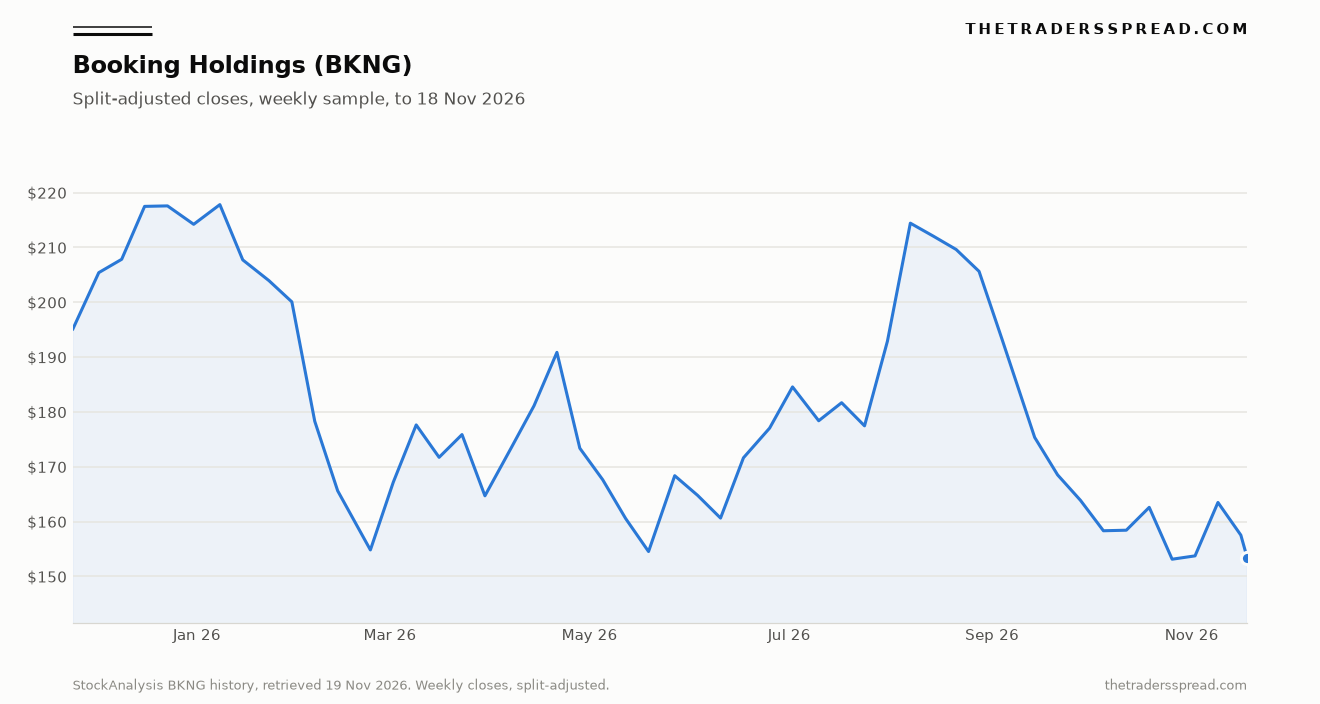
The share price is a separate series
The chart is Booking Holdings' split-adjusted share price, sampled weekly from StockAnalysis history retrieved on 19 November 2026. The sample starts at a $195.01 close on 24 November 2025 and ends at a $153.28 close on 18 November 2026. Closes around the 2 April 2026 split sit in a continuous band, in line with the 25-for-1 adjustment in the earnings exhibit.
What would change this comparison
A later filing moves the comparison when it changes an axis. A restatement of the $900 million revenue reduction, or a different classification of the $100 million accrued loss, would move 16.32% against 17.97%, and it would move adjusted EBITDA. A dollar accommodation ADR next to Expedia's $215.0, or a shared room-night definition, would change the scale reading of 345 million versus 115.7 million. Until then the growth rates are the fairer pair.
Booking's own guide puts fourth-quarter room-night growth at 1% to 3%. Expedia's outlook puts fourth-quarter gross bookings at $27.9 billion to $28.4 billion, growth of 3.3% to 5.2%. A result outside either range would change the picture of a September quarter in which both room-night lines grew about 7%. So would a direct-channel share that leaves Booking's mid-fifties, a business-to-business share that leaves Expedia's 32.8%, or marketing ratios that cross 4.8% and 6.4%.
Questions readers ask next
What is a take rate, in one calculation?
A take rate is the share of the customer's booking that the platform records as its own revenue. Divide revenue by gross bookings for the same period. Expedia publishes this ratio as revenue margin and printed 14.5% for the quarter ended 30 September 2026, on revenue of $4,938 million and gross bookings of $34,008 million. Booking's 3 November exhibit skips that label. Dividing adjusted revenue of $9,793 million by gross bookings of $54.5 billion gives 17.97%.
Why can revenue fall while room nights rise?
Booking sold 345 million room nights in the quarter ended 30 September 2026, up 6.7% in its statistical table, and gross bookings were $54.5 billion. GAAP revenue still fell 1.3% to $8,893 million because the company reduced revenue by $900 million for an FTC matter. Adjusted revenue, which adds that $900 million back, was $9,793 million, up 8.7% in the same table. The room-night count and the GAAP revenue line answer different questions.
Are the room-night counts interchangeable?
Both summary lines show growth of about 7% for the quarter ended 30 September 2026, on 345 million room nights at Booking and 115.7 million booked room nights at Expedia. Expedia defines the unit as hotel room nights, merchant and agency, plus property nights from alternative accommodations. Booking reports room nights as units sold and says alternative-accommodation nights at Booking.com rose 7%. Compare the growth rates, and keep each raw count on its own definition.
What is the difference between merchant and agency?
In a merchant booking the platform sits in the payment flow and the retail value lands in merchant gross bookings. In an agency booking the platform records a commission while the supplier is the merchant. For the quarter ended 30 September 2026, Booking's merchant gross bookings were $40.7 billion and agency gross bookings were $13.7 billion. Expedia's were $21,653 million and $12,355 million. Booking also splits revenue: merchant $6,998 million, agency $2,463 million.
Does a lower marketing ratio settle the comparison?
Booking's marketing expense was 4.8% of gross bookings in the quarter ended 30 September 2026, against 4.7% a year earlier. Expedia's direct selling and marketing was 6.4% of gross bookings, about flat. A lower ratio can mean travelers return without a fresh paid click, and it can also mean a lighter bid for new demand. Read it beside the take rate and beside Booking's direct-channel mix, a mid-fifties share of room nights over the trailing four quarters.
Figures in this comparison are company-reported reference data from the quarterly releases named above, plus arithmetic on those figures. They are not a recommendation to buy or sell BKNG, EXPE or any other security, and capital put to work in markets can be lost.