

When does volume on an ISM Manufacturing PMI bracket book print, against the 10:00 US Eastern release the rules name? On the two settled books we taped, 86.1 percent of September contracts and 73.0 percent of October contracts printed before that clock, while the hour immediately in front of 10:00 held zero September fills and four October fills worth $40.11. The dollars bunch less evenly than the share count, and the cluster a reader can see is the first minute after the release, much of it in tokens the number has already sorted. Data as of 26 November 2026.
That split is the whole of the claim. It is a description of two finished tapes, not a timetable for the next release. The November book is open on the same rule and appears below as a specimen of prices and volume, with the release still ahead. Anyone who wants a bucket set beside the previous official index, on a different release, can open the Core CPI year-over-year note. The job there is a price against a last print. The job here is the clock.
What the three books say on the page
Each month is its own event, a ladder of brackets on one ISM Manufacturing PMI reading, each bracket a Yes outcome and its complement. September listed ten brackets, from below 50.0 through at least 58.0. October listed ten, from below 51.0 through at least 59.0. November lists nine, from below 52.0 through at least 59.0. The floor of the ladder moved up with the months, which is how the questions were written, and that move stays separate from the timing split.
| Book | Release named in the rules | Event volume, shares | Tape notional | Taker fills | State of the book |
|---|---|---|---|---|---|
| September 2026 | 1 October 2026, 10:00 AM ET | 21,130.747413 | $12,119.01 | 718 | Yes closed at 1 on 54.0 to 54.9 |
| October 2026 | 2 November 2026, 10:00 AM ET | 55,311.575325 | $33,516.34 | 1,435 | Yes closed at 1 on 55.0 to 55.9 |
| November 2026 | 1 December 2026, 10:00 AM ET | 19,767.544133 | $8,537.20 | 619 | Open at the 26 November read |
Event volume is the figure Polymarket prints on the event. On each of these three books it equals the sum of taker share sizes on the Data API v2 tape, to the last digit we stored. Notional is that size multiplied by the fill price, the cash side of the same prints. September's 21,130.747413 shares are $12,119.01 of notional, about 57.4 cents of cash per share. October's 55,311.575325 shares are $33,516.34, about 60.6 cents per share. November's 19,767.544133 shares, all of them still ahead of the release, are $8,537.20, about 43.2 cents per share.
Where the settled tapes sit on the clock
We took every taker fill on the September and October events from Polymarket Data API v2, with taker-only left on so each fill is stored once, and we kept the block timestamp, the share size and the price. Notional is size times price, the window is every fill strictly before 10:00:00 US Eastern on the release morning named in that event's rules, and the share is the window sum divided by the sum over that event's whole tape.
The September rules put 10:00 AM ET on 1 October 2026, which was 14:00 UTC while daylight time was still in force. The October rules put 10:00 AM ET on 2 November 2026, the day after the clocks changed, which was 15:00 UTC. A fill timestamped on the exact second of 10:00:00 goes in the after-print bucket, and September has one of those. Dollar cells below are rounded to the cent: the September before and after cells add to $12,119.02, one cent above the unrounded total of $12,119.01, while October's rounded cells add to the October total.
| Window | September shares | September notional | October shares | October notional |
|---|---|---|---|---|
| Strictly before 10:00:00 ET | 18,195.68 (86.1%) | $9,544.78 (78.8%) | 40,379.53 (73.0%) | $19,538.20 (58.3%) |
| The clock hour before 10:00 | 0 (0.0%) | $0.00 (0.0%) | 49.86 (0.1%) | $40.11 (0.1%) |
| Release morning, midnight to 10:00 | 340.12 (1.6%) | $319.49 (2.6%) | 1,095.88 (2.0%) | $473.63 (1.4%) |
| First 15 minutes at or after 10:00 | 2,935.07 (13.9%) | $2,574.24 (21.2%) | 14,915.09 (27.0%) | $13,961.20 (41.7%) |
| After that 15-minute mark | 0 | $0.00 | 16.96 | $16.94 |
-
Most of the contracts print across the open weeks
The before-the-print share is large because the book is open for weeks and the after-print life is short. September's first stored fill is 2 September 2026 at 01:18 UTC, and the last is 1 October at 10:08:59 ET. October's first is 2 October at 09:07 UTC, and the last is 2 November at 10:32:27 ET. A high share before 10:00 is what a month-long book looks like when trading stops within the hour after the number.
They arrive as scattered days, and the cash on those days often exceeds the whole release morning. On the September tape, 4 September printed $1,274.61, 10.5 percent of life notional, in nine fills, while 9 September printed $1,314.79, 10.8 percent, in 29 fills. The 17 September printed $1,109.19, 9.2 percent, in 41 fills, and 25 September printed $1,235.05, 10.2 percent, in 63 fills. The 6 September is the contrast inside that list: 100 fills and only $914.87, 7.5 percent, so fill count and cash move apart. The median September fill is $4.89 of notional.
October repeats the scatter on a larger book. The 7 October printed $2,182.26, 6.5 percent of life notional, across 74 fills. The 20 October printed $2,791.90, 8.3 percent, across 183 fills. The 28 October printed $3,349.04, 10.0 percent, across 136 fills. The median October fill is $5.81. Release day, 2 November, printed $14,451.77, 43.1 percent of the book's notional, and almost all of that day's cash is the after-print cluster below. The release morning itself, midnight ET to 10:00, is thin on both books: September recorded 54 fills, 340.12 shares and $319.49, or 2.6 percent of life notional, and October recorded 65 fills, 1,095.88 shares and $473.63, or 1.4 percent. The 86.1 percent and the 73.0 percent were already on the tape before that morning began.
-
The clock hour before 10:00 is empty
If the popular picture is a crowd leaning in during the final hour, these two tapes refuse it. September's clock hour, 09:00 to 10:00 ET on 1 October, holds zero fills, zero shares and $0.00. October's clock hour holds four fills, 49.86 shares and $40.11, which is 0.1 percent of that book's shares and 0.1 percent of its notional. Two of those four October fills sit inside the last 15 minutes and add $1.18 between them. The hour a screen-watcher is most tempted to call the event is, on this evidence, the quiet part of the month.
October's 55,311.575325 shares look busy next to September's 21,130.747413, and both figures are real share counts summed across every bracket over the whole life. They stay silent on the hour: October's final hour is a $40.11 print in total, and the event total stacks ten brackets in September and October, nine in November, so a fill on 57.0 to 57.9 and a fill on 54.0 to 54.9 both increment one field while remaining different questions.
Block timestamps are the exchange clock, to the second, and the window is strict. A 09:59:59 ET fill would have sat inside the hour. September's hour contributes zero fills to the count. The first September print at or after the release is stamped 10:00:00 ET, so it falls outside the pre-print share by that one second of definition, and it belongs with the burst.
-
The burst is the first minute after the release
September's entire after-print tape is 28 fills, 2,935.07 shares and $2,574.24, equal to 13.9 percent of contracts and 21.2 percent of notional. All 28 sit inside the first nine minutes, and the last is 10:08:59 ET. Twenty of the 28 sit inside the first minute: 2,538.06 shares and $2,343.78. That minute is 91.0 percent of September's after-print notional and 19.3 percent of the book's life notional. The release-day total of $2,893.72, 23.9 percent of life, looks like a big session only because this minute sits inside it. The portion of that day before 10:00 is the $319.49 already counted.
October's after-print tape is 52 fills, 14,932.05 shares and $13,978.14, equal to 27.0 percent of contracts once the two fills past minute 15 are included, and 41.7 percent of notional. Fifty of the 52 fills, 14,915.09 shares and $13,961.20, land inside the first 15 minutes. Forty-three of them land inside the first minute: 14,502.48 shares and $13,694.38. That minute is 98.0 percent of October's after-print notional and 40.9 percent of the book's life notional. The two fills after minute 15 are 16.96 shares and $16.94, and the last of them is 10:32:27 ET, after which the book stops.
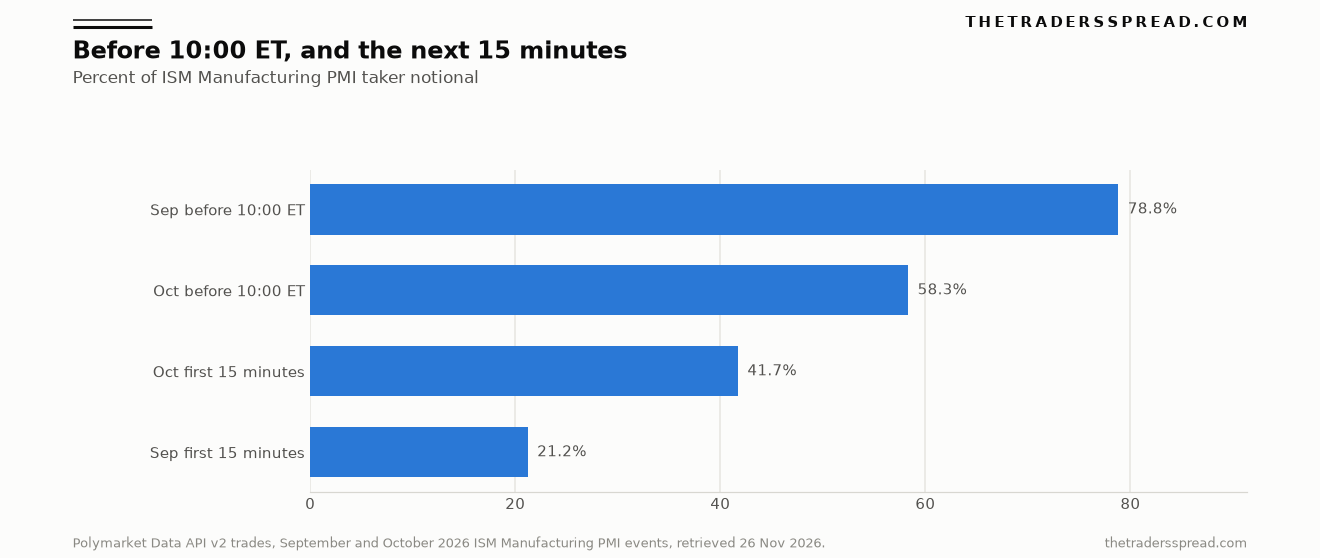
The chart puts the two windows side by side as shares of notional, because notional is where October's after-print weight shows. September's before-print bar is 78.8 percent and its 15-minute bar is 21.2 percent. October's before-print bar is 58.3 percent and its 15-minute bar is 41.7 percent. Contract shares tell the milder version of the same clock, 86.1 against 13.9 in September and 73.0 against 27.0 in October's first 15 minutes, and the count uses timestamp, size, price, outcome and bracket, leaving the wallet field on the raw feed unused.
-
Those after-print dollars buy tokens the release has already sorted
The minute after 10:00 is large, and it is a poor place to learn which bracket the market favoured beforehand, because much of the cash is paying up for an outcome the release has just settled. On the September book the Yes token on 54.0 to 54.9 closed at 1 and the other Yes tokens closed at 0, which is the settlement on the gamma prices from the same payload as the volume. Of the $2,574.24 printed at or after 10:00, $2,054.75 was the complementary outcome on brackets other than 54.0 to 54.9, at a price of 0.95 or higher. That is 79.8 percent of the after-print notional. The winning Yes token contributed $375.39 after the print, 14.6 percent of the after-print cash. Inside that sum, one fill is 426.48 shares at 0.763, worth $325.44, stamped 10:00:03 ET, and another is 50 shares at 0.999, worth $49.95.
October's after-print cash leans the other way, which is why two months will carry a description and will buckle under a standing rule. The Yes token on 55.0 to 55.9 closed at 1. After 10:00, that winning Yes token printed $10,420.93, 74.6 percent of the $13,978.14 after-print notional. Of that, $8,339.43 was at 0.95 or higher, 59.7 percent of all after-print notional, across 13 fills. Two further winning-Yes fills sat under 0.95: 110 shares at 0.741 for $81.50, and 2,418.53 shares at 0.827 for $2,000.00, both stamped 10:00:03 ET. The complementary outcome on the other brackets, at 0.95 or higher, added $2,617.81. September's burst was mostly an expensive complement on the brackets the print had missed. October's burst was mostly expensive Yes on the bracket the print had hit, plus a smaller block of expensive complement elsewhere. The clock matches, and the token differs.
Related2 of 6 rulebook tests are true for the AI downturn
A price of 0.99 after the figure is public is settlement traffic, the book cleaning up a result it can already read. On the September event the rules say the resolution source is the ISM Manufacturing PMI Report On Business for that month, "currently scheduled to be released on October 1, 2026, at 10:00 AM ET," and that "Resolution of this market will take place upon release of the aforementioned data." October and November carry the same sentence with their own month and their own morning. The source page in the text is the ISM Report On Business, and the rules also point at the ROB report calendar for a missed date: the book can stay open until the next report's scheduled release, and settlement can then use the most recent prior month that has figures. That delay clause is a cousin of the problem in the US GDP growth buckets, which pay the advance estimate even when a later estimate rewrites the quarter. On the two months we taped, the delay clause stayed idle, and both books had stopped printing within about half an hour of 10:00.
-
The bracket that later paid held a minority of the pre-print cash
Inside the pre-print window the cash was spread across the ladder, and the bracket that later closed at 1 was a minority of it. Before 10:00 on the September book, 54.0 to 54.9 held $2,114.02, 22.1 percent of the $9,544.78 printed before the release. Before 10:00 on the October book, 55.0 to 55.9 held $2,303.05, 11.8 percent of the $19,538.20 printed before the release. October's winning bracket did its heavy cash printing after the number: the $10,420.93 of winning Yes after 10:00 is 4.5 times the pre-print notional on that same bracket. A ranking of brackets by lifetime volume, read after the fact, mixes positioning from the open month with cleanup from the first minute, and the event volume field adds those activities together.
The ladder makes the mix easy to miss. China's inflation bands, in the band-market note, turn one official print into nine priced buckets. These ISM books are the same shape, a ladder on one release, and the timing question is separate from which rung is busiest on a given afternoon. A busy rung on 20 October is a fact about that session. It becomes a fact about the print only if the later settlement is carried back onto it. The rules fix the grain at one decimal and treat the index as a plain number even where ISM's wording uses "percent," and we used the gamma settlement, Yes at 1 on one bracket and at 0 on the others, only as a label for the after-print cash. A reader who wants a clause built on a different clock can use the price-hit rule note, where settlement is a candle extreme inside a window, while these two ISM tapes put their obvious cash cluster in the minute the named release was due.
-
November is an open book with the release still ahead
The November event, ISM Manufacturing PMI for November 2026, uses the same resolution sentence, with the release named as 1 December 2026 at 10:00 AM ET. At the gamma read on 26 November 2026 at 06:59 UTC the event volume was 19,767.544133 shares, matching the 619 taker fills on the tape, and the event liquidity field read 7,861.52674. The tape's cash total is $8,537.20. The first stored fill is 3 November 2026 at 16:53 UTC, 52 minutes after the event start of 16:00:32 UTC, and the last stored fill is 25 November at 22:02 UTC. Every stored fill sits ahead of 1 December, so a pre-print share of the whole tape is only the fact that the release morning is still ahead, and the two settled months are the evidence for what that minute has looked like.
The open prices are a snapshot, recorded so a later reader can see what the ladder showed on this date, and they go stale as soon as the book trades again. The three brackets with the most shares at that read were 54.0 to 54.9 at 5,426.98 shares with a Yes price of 0.35, 55.0 to 55.9 at 5,055.01 shares with a Yes price of 0.27, and 56.0 to 56.9 at 3,884.18 shares with a Yes price of 0.125. Together those three hold 14,366.17 shares, 72.7 percent of the event volume. The other six rungs hold the rest, and several of them show a Yes price under 0.10. Quoting the prices locates where size has already printed. The prices locate size, and the sentence stops before a side.
November also shows the share-versus-cash gap at its widest of the three months, 43.2 cents per share against 57.4 cents in September and 60.6 cents in October. Setting November's 19,767.544133 shares against October's finished 55,311.575325, and calling the open book about a third as active, imports the share unit into a sentence about attention: the share ratio is 35.7 percent. On cash, $8,537.20 against October's finished $33,516.34 is 25.5 percent, and October's figure includes a $13,694.38 first minute that November's calendar has yet to reach. The fairer cash comparison is October's pre-print $19,538.20 against November's $8,537.20 so far, with days still left before 1 December. Smoothing that gap into a forecast would ignore the two final hours already counted, both of them quiet after much larger mid-month sessions. The sample is two scheduled mornings in 2026 on this one family of brackets, with the delay clause idle both times, and a morning on which the figure is public before 10:00 would be a different tape.
Checklist
- Read the release morning off the rules sentence for that month, and convert 10:00 US Eastern with the daylight rule that actually applied.
- Sum taker share size and size times price as two columns, and check the share sum against the event volume field.
- Put the pre-print share over the whole life of the tape, then look at the clock hour and the release morning before trusting the headline percentage.
- Keep the first minute after 10:00 in its own row, and split that row into winning Yes and the expensive complement on the other brackets.
- Treat a lifetime bracket ranking as a blend of the open month and the cleanup minute.
- Leave the November Yes prices as a 26 November 2026 snapshot, with 1 December still ahead.
- Require a third settled morning before promoting the empty hour from a description of these two books into a habit of the family.
This is analysis, not advice, and capital is at risk.