

Okta did not re-rate 28.6% in a single session because it started growing faster. Okta (NASDAQ: OKTA) is the independent identity provider that decides who — and increasingly what — is allowed to log into a company's systems. It reported second-quarter fiscal 2027 revenue of $805 million on 26 August 2026, up 11% year on year. Eleven per cent is also, almost exactly, what the company guides for: 10% to 11% for the full year and 10% for the current quarter. The shares still closed at $172.91 on 27 August, up $38.49 on the day, on volume of 16.3 million shares against a 60-day average of 3.2 million.
Here is the detail almost nobody has connected. During the very quarter it just reported, Okta repurchased 1,542,442 of its own shares at an average cost basis of $81.06. The stock now trades at $172.91 — 113% above the price management paid. That is a good problem, until you look at what is left: $555 million of the $1 billion authorisation remains, and at $81.06 that money bought 6.85 million shares, or 3.7% of the diluted count. At $172.91 it buys 3.21 million, or 1.7%. The company's remaining defence against stock-based dilution has been cut by more than half — by its own rally. Meanwhile the consensus 12-month price target across 44 analysts sits at $177.16, roughly 2.5% above spot. In one session, the stock consumed the entire year of upside Wall Street had budgeted for it.
Key facts
- Q2 FY27 revenue $805m, up 11% year on year; subscription revenue $793m, up 12% and 99% of the total — Okta Q2 FY27 results, 26 August 2026
- Consensus was $0.97 adjusted EPS on $795m of revenue; Okta delivered $1.05 on $805m — CNBC, 26 August 2026
- Remaining performance obligations $4.858bn, up 17%, against the $4.70bn analysts expected; current RPO $2.585bn, up 14% — Okta and CNBC, 26 August 2026
- Free cash flow $227m, a 28% margin, versus $162m and 22% a year earlier — Okta Q2 FY27 results, 26 August 2026
- Dollar-based net retention 107%; $1m-plus ACV customers up 22% to 605 — Okta posted commentary, 26 August 2026
- 1,542,442 shares repurchased in the quarter at an average $81.06, leaving $555m of the $1bn authorisation approved 5 January 2026 — Okta posted commentary, 26 August 2026
- Closed $172.91 on 27 August 2026, up 28.63%, against a 52-week range of $62.66 to $174.85 — stockanalysis.com, pulled 28 August 2026
- FY27 revenue guidance raised to $3.216bn–$3.226bn from $3.19bn–$3.21bn; adjusted EPS guidance to $3.90–$3.94 from $3.79–$3.87 — Okta, 26 August 2026
What actually happened in the quarter
The beat was real but narrow. Revenue of $805 million came in $10 million ahead of the $795 million consensus, and adjusted earnings of $1.05 beat the $0.97 the street had modelled, according to CNBC's coverage of the print. Neither margin of victory is unusual for enterprise software. What moved the stock was the backlog.
Remaining performance obligations — the contracted revenue Okta has not yet recognised — grew 17% to $4.858 billion, against roughly $4.70 billion expected. The average contract term is about 2.5 years, so RPO is the closest thing the company publishes to a forward order book. Current RPO, the slice expected to convert inside twelve months, grew 14% to $2.585 billion. That is an acceleration against the low-teens prints of recent quarters, and it is the number the buy side treats as the leading indicator for revenue two to three quarters out.
The mechanism behind it is a product cycle, not a pricing change. Okta for AI Agents reached general availability on 30 April 2026, and the company shipped an Agent Gateway, agent-to-agent connection controls and resource access certifications for agents in July. The pitch is straightforward: enterprises deploying autonomous software agents discover they have created thousands of unmanaged accounts with standing credentials, and the identity layer they already run for employees is the natural place to govern them. Okta's own quarterly commentary describes an appliance manufacturer buying the product to "discover unmanaged shadow AI, neutralize rogue agents, and safely integrate hundreds of autonomous entities," and a commercial insurer buying it to enforce short-lived permissions and separate human from agent actions in its audit trail.
Profitability came along for the ride. Non-GAAP operating income was $226 million on a 28% margin — flat year on year, because the company spent the revenue upside — while free cash flow rose to $227 million, a 28% margin against 22% a year earlier. GAAP operating income more than doubled to $107 million. As chief financial officer Brett Tighe put it in the results release, "Our Q2 performance was highlighted by accelerating cRPO, success with our largest customers, and strong profitability and cash flow." For a comparison of how the market has been paying for AI-adjacent guidance beats this season, our note on Nvidia's 9.3% jump on $108 billion of Q3 guidance is the useful reference point: Nvidia moved a third as far on a far larger absolute beat.
Who is responding, and how
The sell side moved almost in unison on 27 August. Morgan Stanley lifted its price target from $115 to $180 while maintaining an Overweight rating, arguing that Okta is first to market with the most comprehensive platform for agentic identity security and that growth from Okta for AI Agents is underappreciated. Targets were also raised at BMO, Cantor, Stifel, Jefferies, Truist, Wells Fargo and KeyBanc. The highest of them, at $180, is roughly 4% above where the stock already trades.
That is the tell. A wave of upgrades that lands beneath the spot price is not a bullish signal; it is a signal that the market front-ran the analysts. The average target across 44 covering analysts is $177.16. The stock closed at $172.91. Whatever the sell side thinks the next twelve months are worth, the market has already paid for roughly all of it in one afternoon.
The customer evidence is more durable than the ratings. Okta's commentary details a US Department of Defense organisation adopting Okta Customer Identity to meet zero-trust mandates, a large US federal agency expanding into Okta Workflows, a North American bank deploying Auth0 on dedicated private cloud for digital banking, and a Fortune 500 retailer consolidating onto Okta Identity Governance. The $1 million-plus ACV cohort grew 22% to 605 customers and now represents more than $1 billion of annual contract value on its own. The $100,000-plus cohort grew 6% to 5,255 and accounts for about 85% of total ACV.
The product logic is being validated outside the company too. In Okta's July 2026 product announcement, Ely Kahn, chief product officer at Okta, framed the problem as one of scope creep: "Enterprises are deploying AI agents in higher-value, but more complex workflows that require deeper access to sensitive resources and collaboration with other agents." Shawn Fogarty, director of IT at LogicMonitor, described the customer-side principle more bluntly: "Our AI Fabric is built on the principle that every AI agent should have a trusted identity, just like every employee." That framing — an agent as a headcount-equivalent identity to be licensed and governed — is the entire bull case for the seat-based economics.
What $172.91 is actually paying for
Combining the reported balance sheet with Thursday's close produces a picture the headlines skip. On approximately 184.4 million non-GAAP diluted shares, Okta's market capitalisation is about $31.9 billion. Against $2.299 billion of cash and short-term investments and — since the $350 million 2026 convertible notes were repaid in cash in June — no debt at all, enterprise value is roughly $29.6 billion.
| FY27 guidance (midpoint) | Amount | Implied multiple at $172.91 |
|---|---|---|
| Revenue | $3.221bn | 9.2× EV/sales |
| Non-GAAP operating income | $835m | 35.4× EV/EBIT |
| Non-GAAP free cash flow | $920m | 32.2× EV/FCF |
| Non-GAAP diluted EPS | $3.92 | 44.1× earnings |
| Growth plus FCF margin | 10.5% + 28.5% | Rule of 40 score: 39.0 |
A Rule of 40 score of 39.0 is respectable and unspectacular; it is the profile of a durable cash compounder, not a hypergrowth asset. Yet the multiple attached to it — 9.2 times sales, 32 times free cash flow — is a hypergrowth multiple. That gap is the whole argument, and it rests entirely on the market believing FY28 growth will be materially better than the 10–11% guided for FY27.
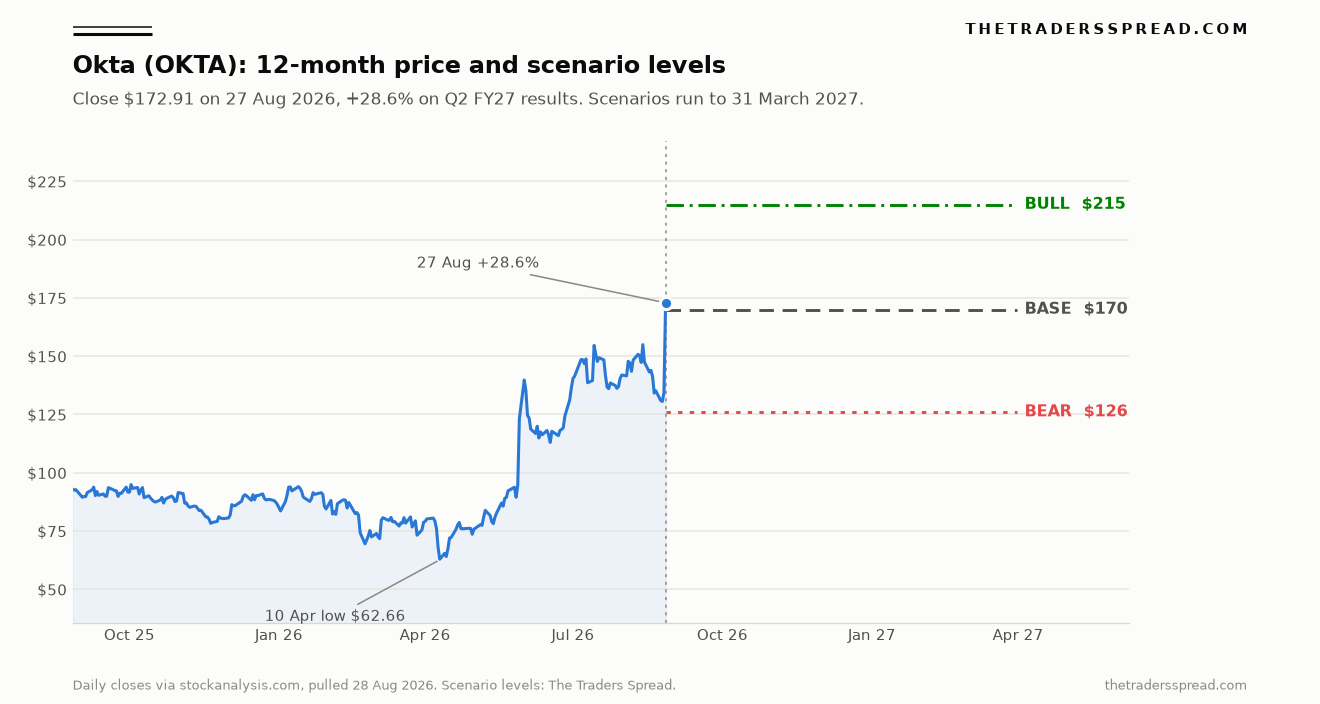
The guidance itself argues the other way. Okta's own Q3 outlook calls for current RPO growth of 11% to 12%, down from the 14% just reported. Management is guiding the leading indicator to decelerate in the very quarter after the market repriced the stock for acceleration. The company describes this as a "prudent approach to forward guidance," and it has beaten its own conservative cRPO guidance before. But the honest reading is that investors have paid a re-rating in advance of evidence, on the strength of a product that went generally available four months ago and whose contribution the company has not yet separately quantified. The one-year chart above shows how compressed that repricing was: the stock is up 175.9% from its 10 April low of $62.66 and 106.7% year to date, with almost all of it delivered in two sessions — a 30.1% jump on 29 May and 28.6% on 27 August.
The structural and regulatory backdrop
Two regulatory currents are pushing in Okta's favour, and one structural risk cuts against it.
The first current is federal. The US Office of Management and Budget's Memorandum M-22-09, the Federal Zero Trust Architecture Strategy issued in January 2022, requires agencies to move to phishing-resistant multi-factor authentication and enterprise-wide identity management, and the Cybersecurity and Infrastructure Security Agency's Zero Trust Maturity Model makes identity the first of its five pillars. That mandate is why a Department of Defense organisation and a federal agency both appear in Okta's Q2 customer list rather than in a competitor's. Government procurement is slow, but it is also sticky and long-dated, which flatters RPO.
The second is European. The NIS2 Directive (Directive (EU) 2022/2555), applicable from October 2024, and the Digital Operational Resilience Act (Regulation (EU) 2022/2554), which applied from January 2025, both place explicit access-control and third-party-risk obligations on regulated firms and their critical technology suppliers. Okta's Q2 wins include a North American bank deploying Auth0 for digital banking and a Global 2000 pharmaceutical company isolating a third-party fulfilment network — both classic compliance-driven identity spends. International revenue grew 12% and represents 21% of the total, so the European channel is real but still secondary.
The structural risk is competitive and it is not small. Identity is the layer every platform vendor wants to own. Microsoft bundles Entra ID into agreements enterprises are already signing, and the security platform consolidation trend that has lifted Palo Alto Networks and SailPoint into the same agentic-identity conversation means Okta's independence — the thing chief executive Todd McKinnon markets hardest — is also its exposure. "As the leading independent and neutral identity provider," McKinnon said in the results release, "Okta helps organizations discover agents, secure their connections, govern their actions, and respond when something goes wrong." Neutrality is a genuine differentiator for customers running multi-cloud estates. It is a weaker one against a bundled price. With net retention at 107%, Okta is expanding within its base at a modest clip; that number, more than any product announcement, is where competitive pressure will show up first.
The call: base $170, bull $215, bear $126
Horizon is to 31 March 2027, which covers the two prints that resolve this thesis: Q3 FY27, due around early December 2026 on the company's recent cadence, and the Q4 and full-year FY27 report that follows roughly three months later.
Base case, $170 (roughly flat, 45% probability). Okta delivers against guidance, cRPO lands in the guided 11–12% range, and the multiple holds at about 9 times sales while the company grows into it. This is not a satisfying answer, but it is what the arithmetic supports: the stock has already been repriced for the good news.
Bull case, $215 (+24.3%, 30% probability). Okta for AI Agents attaches faster than modelled, cRPO growth re-accelerates through 15% by the Q4 print, and management guides FY28 revenue growth to 12–13% with free cash flow margin stepping to 30%. On $3.61 billion of FY28 revenue and $1.08 billion of free cash flow, $215 is 10.4 times sales and 34.5 times free cash flow — a premium, but not a wider one than today's.
Bear case, $126 (−27.1%, 25% probability). Agent attach proves to be a replacement for existing seats rather than an addition, cRPO growth slips below 11%, and the market reprices Okta as the low-double-digit compounder its guidance describes. At 6.5 times FY27 sales and 22.8 times free cash flow, $126 sits below the pre-earnings close of $134.42 — the entire pop given back, plus a little. Note what this is not: at its 10 April low of $62.66 the stock traded near 3 times sales. The bear case here is multiple normalisation, not distress.
RelatedMaxLinear (MXL) Falls 12.7% in the 8 October Session
Weighting those outcomes gives $172.50 against a spot of $172.91. That is a roundabout way of saying the market has the middle about right, and that any edge in Okta now sits in the tails rather than the central case.
What would change my mind. On the bull side: a Q3 print with cRPO growth above 14% despite guidance of 11–12%, or management quantifying Okta for AI Agents ACV for the first time at a number above $100 million. On the bear side: net retention slipping below 105%, growth in the $100,000-plus customer cohort decelerating below 5%, or a buyback that stalls — because if management will not repurchase stock at $172.91 with $555 million authorised, that is a considered opinion about value from the people with the best information. For readers tracking the same setup across asset classes, our AUD/USD forecast applies the same scenario framework to a rate-driven market, and the live markets page carries the reference prices behind these notes. Further equity work sits on the stocks desk.
Frequently asked questions
Why did Okta stock jump 28% in August 2026?
Okta closed up 28.63% at $172.91 on 27 August 2026 after reporting Q2 FY27 results. Revenue of $805 million beat the $795 million consensus and adjusted EPS of $1.05 beat $0.97, but the decisive number was backlog: remaining performance obligations grew 17% to $4.858 billion against roughly $4.70 billion expected, with current RPO accelerating to 14% growth.
What is the analyst price target for Okta stock?
The average 12-month target across 44 analysts is $177.16, about 2.5% above the 27 August close of $172.91. Morgan Stanley raised its target to $180 from $115 on 27 August while keeping an Overweight rating, and that $180 is among the highest on the street. In effect, the shares have already reached the level the sell side had pencilled in for a year out.
Is Okta profitable?
Yes, on both measures. Okta reported GAAP operating income of $107 million in Q2 FY27, or 13% of revenue, up from $41 million a year earlier, and GAAP net income of $116 million. Non-GAAP operating income was $226 million at a 28% margin. Free cash flow was $227 million, a 28% margin, and the company holds $2.299 billion in cash with no remaining convertible debt.
What is Okta for AI Agents?
It is Okta's product for giving autonomous software agents managed identities. Generally available since 30 April 2026, it discovers unmanaged agents, issues short-lived credentials, enforces least-privilege access, and can revoke a misbehaving agent's tokens without rotating human credentials. July 2026 additions included an Agent Gateway, agent-to-agent connection controls and access certifications covering both humans and agents.
What is Okta's guidance for fiscal 2027?
Okta raised full-year FY27 guidance to revenue of $3.216 billion to $3.226 billion, growth of 10% to 11%, from a prior $3.19 billion to $3.21 billion. Adjusted EPS guidance went to $3.90–$3.94 from $3.79–$3.87, with non-GAAP operating income of $830–840 million and free cash flow of $910–930 million, a 28% to 29% margin.
What is the biggest risk to the Okta bull case?
Deceleration in current RPO. Okta guided Q3 cRPO growth to 11–12%, down from the 14% just delivered, so the leading indicator is set to slow in the quarter immediately after the re-rating. Alongside that, dollar-based net retention of 107% leaves limited room if bundled competition from platform vendors pressures renewal pricing.
Analysis and information only. This article is not investment advice, and nothing in it is a recommendation to buy or sell any security. Prices and company data were verified on 28 August 2026 and will move. Capital is at risk. Price data via stockanalysis.com; financial results from Okta's Q2 FY27 disclosures filed with the SEC on 26 August 2026.