

EUR/PLN is pricing a narrow question: can a zloty that still carries a higher real policy rate than the euro pull the cross back from a twelve-month high, or has the market already assigned the next rate move to the ECB?
The ECB reference for 23 October 2026, retrieved from Frankfurter at 08:01 UTC on 24 October, was 4.3945. That print is the high of the daily series back to 24 October 2025, when the same fixing was 4.2408. The low in the window was 4.2023 on 27 January 2026. Narodowy Bank Polski's Table A mid for 23 October, table 207/A/NBP/2026, was 4.3917. A higher print means a weaker zloty.
The awkward fact is in the rates. The NBP reference rate is 3.75 percent and the ECB deposit facility rate is 2.50 percent, still the warehouse reading on 24 October and the level since 16 September. The nominal gap is 1.25 percentage points in the zloty's favour. Polish CPI was 4.1 percent in September and euro area HICP was 3.8 percent, so the real gap on those headlines is about 0.95 points, also in Poland's favour. We subtracted the inflation rates from the policy rates. The market is pricing the next change in a gap that still leans Polish.
That session fell on 23 October. EUR/PLN rose from 4.3695 on the 22nd to 4.3945. EUR/USD moved from 1.1205 to 1.1193. Divide the euro-zloty fixing by the euro-dollar fixing and implied zlotys per dollar go from 3.899 to 3.926. Friday's jump was a zloty move, not a euro move. From the January low the euro cross is up 4.57 percent, the euro against the dollar is down 6.17 percent, and the implied dollar cross is up 11.45 percent. Any bull case above 4.3945 has to be a further zloty move, because the euro's decline against the dollar is already in the price.
Key facts
- EUR/PLN on the ECB reference was 4.3945 on 23 October 2026, the high since 24 October 2025 (4.2408), with the low at 4.2023 on 27 January 2026. Frankfurter, retrieved 24 October 2026, 08:01 UTC.
- The NBP reference rate is 3.75 percent, the lombard rate 4.25 percent and the deposit rate 3.25 percent, left unchanged on 6-7 October. getsix account of the Monetary Policy Council release, 8 October 2026.
- The ECB deposit facility rate is 2.50 percent from 16 September 2026, after 2.25 percent from 17 June. The 10 September decision set main refinancing at 2.65 percent and marginal lending at 2.90 percent. ECB Data Portal and the monetary policy decision, read 24 October 2026.
- Polish CPI rose 4.1 percent year on year in September, services 5.3 percent and goods 3.6 percent, a tenth above the 4.0 percent flash (Statistics Poland, 14 October 2026).
- Euro area HICP was 3.8 percent in September, from 3.2 percent in August. Energy was 18.9 percent and contributed 1.71 points. Core excluding energy, food, alcohol and tobacco was 2.5 percent (Eurostat, 16 October 2026).
- Poland's current account deficit was PLN 15.4 billion in August, and the goods deficit PLN 13.1 billion. NBP balance of payments, 14 October 2026.
1) The rate gap still pays the zloty
Poland's operational rate is the NBP reference rate at 3.75 percent. The euro area's is the deposit facility at 2.50 percent, so a zloty deposit still yields more than a euro deposit by a point and a quarter. The narrowing this year has been on the euro side: the warehouse shows 2.00 percent on 1 January, 2.25 percent from 17 June, and 2.50 percent from 16 September. The NBP's last cut left the reference rate at 3.75 percent in March, and the council held again on 6-7 October.
| Measure | Poland | Euro area |
|---|---|---|
| Policy rate | NBP reference 3.75% | ECB deposit facility 2.50% |
| Headline, September 2026 | CPI 4.1% | HICP 3.8% |
| Underlying inflation | 3.1% ex food and energy | 2.5% ex energy, food, alcohol, tobacco |
| Policy rate minus headline | −0.35 points | −1.30 points |
| Policy rate minus underlying | +0.65 points | 0.00 points |
The two underlying baskets differ, so the last rows are desk arithmetic on official prints. On that basis the zloty is the currency with the less negative real policy rate, and on the ex-food-and-energy measure the real reference rate is positive. The table updated on 15 October put that rate at 3.1 percent in September, down from 3.3 percent in August, with a monthly change of zero, while headline CPI rose 0.7 percent on the month.
The 2026 guidelines set the target at 2.5 percent with a one-point band, so the upper edge is 3.5 and September's 4.1 percent sits 0.6 points through it. August, at 3.4 percent, was still inside the band, which makes the overshoot only a month old. The real-rate ranking still favours the zloty at a cross that is already at its twelve-month high.
2) The twelve-month high was a zloty session
EUR/PLN is the product of the euro-dollar fixing and the dollar-zloty fixing. A rising euro-zloty cross can come from a stronger euro, a weaker zloty, or both. Since the January low it has come mostly from the zloty against the dollar, while the euro's own fall against the dollar hid part of the move.
| 27 January 2026 | 23 October 2026 | Change | |
|---|---|---|---|
| EUR/PLN | 4.2023 | 4.3945 | +4.57% |
| EUR/USD | 1.1929 | 1.1193 | −6.17% |
| USD/PLN, implied | 3.5228 | 3.9261 | +11.45% |
NBP's Table A dollar mid on 23 October was 3.9247, against an implied 3.9261 from the two ECB fixings. The euro mid at the NBP, 4.3917, sits 0.0028 under the ECB reference. Two fixings told the same story of a high.
From 12 October at 4.3850 the cross drifted down to 4.3635 on the 21st, then jumped to the high in two sessions. The second session did almost all of the work while EUR/USD fell about a tenth of a percent. Back to 1 September the cross is up 1.46 percent, from 4.3313, EUR/USD is down 3.43 percent, and the implied dollar cross is up 5.06 percent, from 3.737 to 3.926.
The USD/PLN forecast put a bull case at 4.15, and the EUR/USD forecast put a bear case at 1.1250, with the euro already through it at 1.1193. The product of 4.15 and 1.1193 is about 4.65, and we stay inside that product rather than stacking the two bulls. At an unchanged euro, 4.48 implies a dollar-zloty rate near 4.00, 4.58 implies one near 4.09, and 4.22 implies one near 3.77. The USD/HUF forecast used the zloty as the control for that same dollar.
The pace sets the base at 4.48. From the 1 April fixing of 4.2793 to 23 October the cross rose 2.69 percent in 205 days. Carry that pace across the 159 days to 31 March 2027 and the arithmetic lands near 4.49, which we round to 4.48. Reaching 4.58 takes a fresh impulse the slope lacks.
3) September inflation, on both sides, was an energy number
Statistics Poland's 14 October release put September CPI at 4.1 percent year on year. Goods were up 3.6 percent and services 5.3 percent. On the month, prices rose 0.7 percent, goods rose 1.2 percent, and services prices fell 0.5 percent. A single monthly dip leaves the 5.3 percent services rate in place and puts the September shock in goods. Meeting on 6-7 October with the 4.0 percent flash, the council said the rise was mainly fuels for personal transport, and that inflation net of food and energy had eased.
Eurostat on 16 October put euro area HICP at 3.8 percent, from 3.2 percent in August, with energy at 18.9 percent contributing 1.71 points and services contributing a further 1.52 points. The September staff round, beside the 10 September decision, averages headline inflation at 3.0 percent in 2026, 2.5 percent in 2027 and 2.1 percent in 2028. The six prints from April through September average 3.15 percent. We took that mean off the Eurostat rows, and September alone sits 0.8 points above the staff figure for the full year.
The 10 September decision raised the three key rates by 25 basis points, tied the move to Middle East inflation pressure, and left the future path uncommitted, with risks up for inflation and down for growth. Christine Lagarde, President of the European Central Bank, told the International Monetary and Financial Committee on 17 October that the energy shock was too large to look through, while a measured response remained appropriate, and that higher long-term rates would slow pass-through by more than the September exercise assumed.
What do consumers in the euro area expect will happen to inflation, their incomes, their spending, and the value of their homes 12 months from now?
— European Central Bank (@ecb) October 23, 2026
We’ve published the latest results of our Consumer Expectations Survey.
Press release https://t.co/s6xRU1g378 pic.twitter.com/M1xdXA4C9k
The European Central Bank posted that survey on 23 October, the day EUR/PLN printed the high. Fieldwork ran from 27 August to 28 September, ahead of the 2 October flash. Median expectations for inflation over the next 12 months rose to 3.1 percent from 3.0. Three-year expectations stayed at 2.9 percent and five-year expectations stayed at 2.5 percent. Expected growth over the next year fell to minus 1.5 percent from minus 1.2.
4) The ECB sits down first, and then the order flips
The ECB calendar puts the decision and the press conference on 29 October, then on 16-17 December, 3-4 February 2027 and 17-18 March 2027. The NBP calendar puts the next decision meeting on 3-4 November and the following one on 1-2 December. In October the Frankfurt meeting comes first. In December the Warsaw meeting comes first.
One 25 basis point ECB hike on 29 October, with the NBP on hold, cuts the nominal gap from 1.25 points to 1.00. A second hike on 17 December cuts it to 0.75, and that second step is the policy leg of the bull case. The account of the 9-10 September meeting, out on 8 October, said markets had priced 84 basis points of hikes by the end of 2027, while the median analyst looked for September to be the last, and the account left the path open for the meetings still ahead. Where the October contract sits is in our note on the October ECB decision.
On the Polish side, the 6-7 October release kept every administered rate where it was. The council had the 4.0 percent flash, and it listed risks from activity and inflation abroad, commodity prices, geopolitics, fiscal policy, regulated energy prices, Polish growth and wages. The minutes of the 9 September meeting, published on 9 October, record a view that the level of rates was too low, beside a majority that treated the inflation rise as external and supply-side while wage growth slowed. The vote went to the hold.
A process point sits beside the economics. On 12 October the NBP restated that the governor convenes the council, that a designated member may stand in only briefly, and that the council and the management board require the governor's attendance. The text answered what the bank called confusing information.
Pilny komunikat Narodowego Banku Polskiego: NBP i Rada Polityki Pieniężnej (RPP) nie mogą działać bez Prezesa!
— Narodowy Bank Polski (@nbppl) October 16, 2026
W związku z prowadzonymi za pośrednictwem mediów działaniami dezinformacyjnymi, wypaczającymi obraz sytuacji opinii publicznej w Polsce i na arenie międzynarodowej,… pic.twitter.com/oyoEuwwxDB
Narodowy Bank Polski posted that notice again on 16 October. November is the first decision meeting after a CPI print above the band, and the bank has told the market who has to be in the room for a vote. A meeting that spends itself on procedure would leave the gap to be set in Frankfurt.
RelatedEUR/NZD Bull Case at 2.06 Sits Above a 1.89 Bear Case
5) The external bill sits outside the rate gap
A positive real-rate gap is a reason to bid the zloty. The import bill is a separate flow. The NBP's preliminary balance of payments for August, published on 14 October, put the current account at a deficit of PLN 15.4 billion, against PLN 11.3 billion a year earlier. Goods were in deficit by PLN 13.1 billion. Primary income was in deficit by PLN 16.3 billion, of which income to foreign direct investors was PLN 14.2 billion, while services stayed in surplus at PLN 12.9 billion.
Exports rose 14.4 percent, to PLN 123.1 billion, and imports rose 16.7 percent, to PLN 136.3 billion, with fuel prices lifting crude and petroleum products. The bank called the goods deficit one of the largest on record. Reserves rose PLN 4.4 billion on the month's transactions. Poland pays for energy in foreign currency, so a wider fuel bill is a flow against the zloty even while the real policy rate still favours it. September CPI is that flow showing up in prices, which is how a Polish rate gap and a twelve-month high in EUR/PLN can share the same week.
Verdict
The base case is 4.48 by 31 March 2027. That is 1.9 percent above the 4.3945 reference, and it is the April-to-October pace carried forward. It needs the euro near 1.12, so most of the move is a dollar-zloty rate drifting toward 4.00, and it needs the nominal gap to narrow once, to 1.00 percentage point. An ECB hike on 29 October and an NBP hold on 3-4 November would do that. The real-rate gap argues against a sprint and the calendar argues against a full reversal, so the weight sits on that middle path.
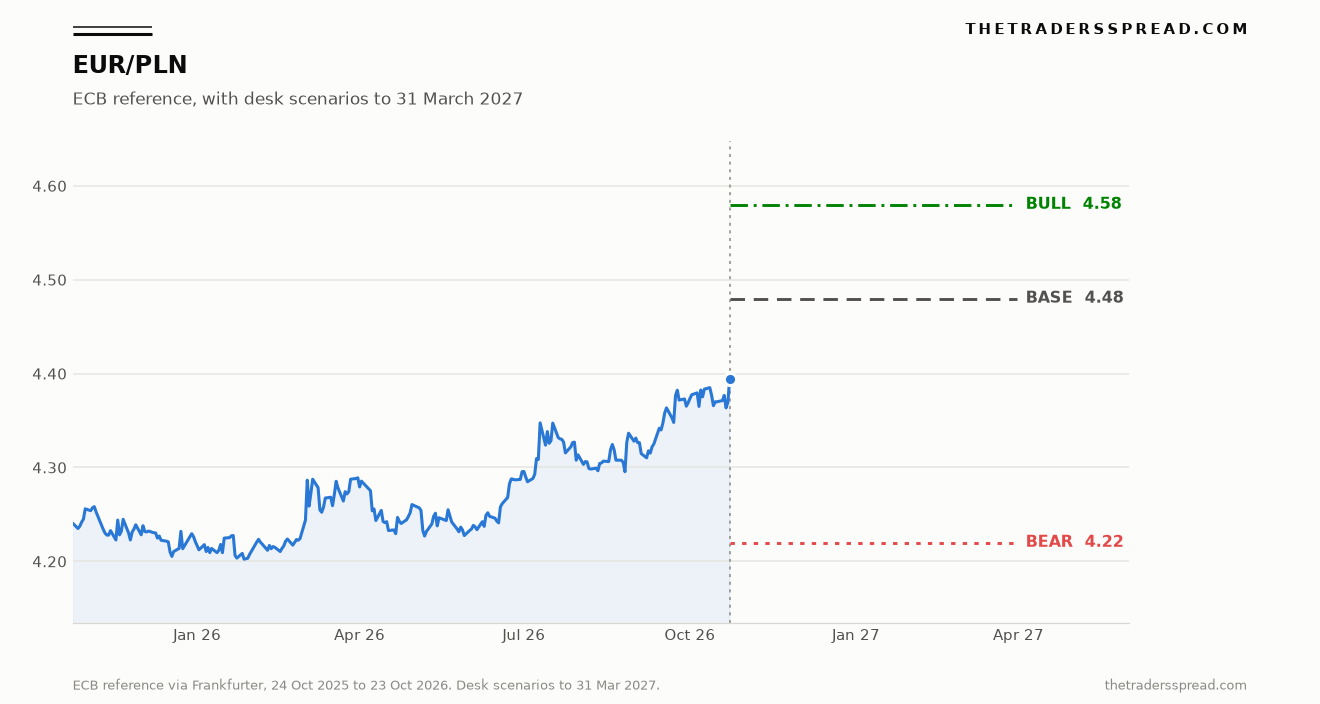
| Path | Level | Versus 4.3945 | What has to happen |
|---|---|---|---|
| Bull | 4.58 | +4.2% | The gap narrows by 50 basis points and a session like 23 October repeats. Implied USD/PLN near 4.09 if the euro stays at 1.1193. |
| Base | 4.48 | +1.9% | The post-April pace continues, with one ECB step, an NBP hold, the euro near 1.12, and implied USD/PLN near 4.00. |
| Bear | 4.22 | −4.0% | The ECB holds through December, energy inflation fades, and the 2026 rise in the euro cross is given back, with implied USD/PLN near 3.77. |
The bull case at 4.58 follows if Frankfurt hikes on 29 October and again on 17 December, the NBP is still at 3.75 percent in March, and a session like 23 October repeats while the goods deficit stays wide.
The bear case at 4.22 sits just above the 27 January low of 4.2023 and beside the 2 February fixing of 4.2173. It needs an ECB hold on 29 October and on 17 December, energy's 1.71-point contribution fading, and an NBP that leaves 3.75 percent in place or lifts it. The euro cross would give back the 2026 rise.
The level that retires the base is 4.30, under the live print and in line with the 3 August fixing of 4.3033. Through 4.30 the rise from late summer is already handed back. A second ECB hike plus another session like 23 October would pull the description up toward 4.58. An ECB hold across October and December, or an NBP hike on 3-4 November while energy inflation fades, would pull it down toward 4.22.
Frequently asked questions
Where is the EUR/PLN base case by the end of March 2027?
The base case is 4.48, about 1.9 percent above the ECB reference of 4.3945 on 23 October 2026. The bull case is 4.58 and the bear case is 4.22. The base extends the April-to-October pace, with the euro near 1.12, so most of the move is a slightly weaker zloty against the dollar. A fixing under 4.30 would retire that base, because it would give back the rise since early August.
Why is the zloty weaker against the euro when Polish rates are higher?
The nominal gap is still 1.25 percentage points, a 3.75 percent NBP reference rate against a 2.50 percent ECB deposit rate, and the real gap from September's headlines also leans toward Poland. The cross is at a high because the zloty has fallen harder against the dollar than the euro has, and because 23 October was a zloty session. The market is pricing the next narrowing of the gap, plus the energy import bill.
What would make 4.22 the better description?
An ECB hold on 29 October and again on 17 December, a fade in the energy contribution to euro area inflation, and an NBP that keeps the reference rate at 3.75 percent or lifts it. That mix gives back the 2026 rise in the euro cross and lands near the late-January cluster around 4.20 to 4.22. With the euro at 1.1193 the implied dollar-zloty rate would be near 3.77, still far above January.
Scenarios are research judgements based on the rates and prices cited above. They are not a recommendation to transact in EUR/PLN or any other instrument, and they can be wrong.