

Having traced a minipool through the commission split in Rocket Pool's node guides, from the Atlas arithmetic to the fee-distributor page and the rewards tree that closed on 22 October 2026, the shorthand that fails is the one that says the operator simply collects Ethereum's staking rate.
A minipool is one 32 ETH beacon validator. The operator bonds 8 or 16 ETH and borrows the rest from rETH holders. Commission is a cut of the rewards on the borrowed ETH only. It is not a sweetener on the bond. An 8 ETH bond at the 14% rate Atlas wrote onto new minipools keeps 35.5% of that validator's rewards from 25% of the ETH. That is 1.42 times the rate the validator itself earned. rETH keeps 64.5% of the rewards from 75% of the ETH, which is 86% of the same rate.
Consensus rewards are skimmed to the minipool, and priority fees and MEV go to a fee recipient. Opting out does not hand the operator those execution rewards intact. The fee distributor still carves out rETH's share. The node also loses proposal-luck pooling and attestation weighting. A bonus commission lived only inside the pool, last paid in June 2026.
This is not a daily rebase. Lido increases the stETH balance, which this desk set out in How Lido (LDO) Sets Each Daily stETH Reward Rebase. Rocket Pool leaves the rETH count alone and moves an exchange rate when the oracle DAO posts balances. On 22 October 2026 that rate was 1.174256 ETH per rETH.
Updated 22 October 2026
Key facts
- RocketTokenRETH.getExchangeRate returned 1.174256 ETH per rETH at block 26,246,795, 07:54 UTC. Source: eth.drpc.org eth_call, 22 October 2026.
- RPL printed at $1.54 and rETH at 1.174439 ETH, both at 08:15 UTC. Source: CoinGecko, 22 October 2026.
- Staking minipools were 11,199 and megapool validators 5,507, equal to 534,592 ETH, with node commission at 5%. Source: api.rocketpool.net, 22 October 2026.
- Interval 54 moved 17.404 ETH from the smoothing pool: 11.094 to pool stakers, 6.176 to operators and 0.134 of voter share. Source: rocket-pool/rewards-trees, 22 October 2026.
- Minipools created after 28 October 2024 carry a 5% contract commission, and the smoothing-pool bonus last paid in June 2026. Source: Rocket Pool fee-distributor guide, 22 October 2026.
- A direct mint takes a 0.05% deposit fee on top of the exchange rate. Source: Rocket Pool staking guide, 22 October 2026.
1. One validator, two claims on the ETH
To the beacon chain a minipool validator is ordinary. It attests, it sometimes proposes, and it can be penalised. The oddity is the minipool contract, which holds the withdrawal credentials and remembers the bond.
The Atlas guide describes the bonds on minipools that are already running. A 16 ETH bond borrows 16 ETH. An 8 ETH bond, the LEB8, borrows 24 ETH. New validators in the liquid-staking overview are 4 ETH megapool bonds with 28 ETH borrowed, and the minipool overview says deposits are disabled. This page is the legacy split.
The payload also counted 5,507 megapool validators. At 32 ETH each, minipools plus megapools are the 534,592 ETH reported as staked. At 08:15 UTC the deposit pool held 360.64 ETH and rETH collateral was 3,633.38 ETH, so part of the ETH behind rETH was idle. A staking-rate comparison that skips that balance is already wrong.
The validator still does Ethereum's job. How much of the asset one buyer had gathered is a different question, filed as Ethereum (ETH) Rose 26% in August as Bitmine Hit 4.9% of Supply. That supply note does not set a commission.
2. Commission cuts the borrowed ETH, not the bond
How Rocket Pool staking rewards work, on the Atlas page, is a split applied to 1 ETH of rewards. The operator's share is the bond divided by 32, plus commission times borrowed ETH divided by 32. rETH gets the rest. Commission never touches the operator's own ETH.
| Bond | Commission on borrowed ETH | Operator share of 1 ETH | rETH share | Multiple on the operator's ETH |
|---|---|---|---|---|
| 16 ETH | 14%, Atlas fixed rate | 0.570 | 0.430 | 1.14 |
| 8 ETH | 14% | 0.355 | 0.645 | 1.42 |
| 16 ETH | 5%, Saturn 0 contract | 0.525 | 0.475 | 1.05 |
| 8 ETH | 5% | 0.2875 | 0.7125 | 1.15 |
The multiple is the operator share times 32, divided by the bond. It is not an annual percentage. The 14% rows are Atlas. The 5% rows are Saturn 0 after the boost ended. At the old 10% no-RPL boost, an 8 ETH minipool kept 0.325 of each 1 ETH, a 1.30 multiple.
A 16 ETH minipool at 20%, the top of the guide's old example, keeps 0.6 of each 1 ETH for the operator. Two 8 ETH minipools at 14% keep 0.71 of 2 ETH. At 14%, rETH receives 86% of the validator's rate on the ETH it supplied. At 5%, 95%. On 22 October 2026 the payload's beacon-chain APR was 2.58%, a reference print, not either side's rate.
3. Consensus rewards wait in the minipool
Attestations, the consensus piece of a proposal, sync committees and slashing income accrue on the beacon balance. Ethereum skims the excess over 32 ETH to the withdrawal address. For a minipool, that address is the minipool contract. The ETH sits until someone distributes it.
The skimming guide says the Smart Node distributes a minipool, by default, once the balance reaches 1 ETH. A threshold of zero turns that call off. Past 8 ETH of skimmed balance, distribute stops working and the validator has to be exited. After a long wait, anyone may distribute a minipool in that state, and the Smart Node is written to exit it first.
The split on that call is the bond and the commission. A refund in the guide's sample is not shared. It is ETH the operator was already owed, from cutting a 16 ETH bond to 8 ETH or from rewards already on a solo validator that was converted. That ETH goes to the withdrawal address in full.
The guide's timing example, a skim every two or three days, was written against about 500,000 validators. The payload on 22 October 2026 counted 824,063. A larger set takes longer to sweep. The two-to-three-day line is an old illustration, not a current timetable. Missed attestations leave a smaller balance to split.
4. Execution rewards go to a fee recipient
Priority fees and MEV skip the skim. They pay the fee recipient on the validator client. Opted in, every validator on the node points at the smoothing pool. Opted out, minipools point at the node's fee distributor. A node with both, opted out, is set per validator: megapools to the megapool, minipools to the distributor.
The pool is one balance, snapshotted every 28 days. rETH is due the borrowed fraction minus commission: 50% on a 16 ETH minipool, 75% on an 8 ETH one. The operator's remainder scales with time opted in and with attestations. On 13 February 2026 the Rocket Pool account framed that pool as the alternative to betting on who proposes.
Whether markets are up or down, the smoothing pool keeps earning.
— Rocket Pool (@Rocket_Pool) February 13, 2026
The most recent period was 51 ETH, paid out proportionally among eligible Rocket Pool node operators.
No need to gamble on volatile EL rewards.
It's free to join and there are no fees! pic.twitter.com/dlptZ5IFwO
That 51 ETH is one period's operator payout, not a standing sum. Interval 54 ran from 05:36 UTC on 24 September 2026 to 05:36 UTC on 22 October 2026. The file paid 17.404 ETH from the pool: 11.094 to stakers, 6.176 to operators and 0.134 of voter share. Interval-wide voter share was 8.543 ETH, so most of it was not this pool's 0.134, and the pDAO line is zero.
The switch is per node. Join any time, wait a full 28-day interval to leave, and another to rejoin, so a proposal cannot be pocketed and walked away from. Thirty percent of an interval pays 30% of the share.
5. Not smoothing still pays rETH
A node outside the pool does not keep every tip. The fee distributor holds execution rewards until distribute is called, by anyone, including at a minipool close. The operator's piece uses the node's average commission and its mix of 8 ETH minipools, 16 ETH minipools and 4 ETH megapool validators.
The rewards guide's example is 1.143599 ETH at a 15% average commission: 0.657569 ETH to the withdrawal address and 0.486030 ETH to rETH. That 57.5% is the 16 ETH formula at 15%, the guide's arithmetic rather than a live balance from 22 October. Since Saturn 1, a caller who is not the node or the withdrawal address parks the operator's share as unclaimed rewards. They do not expire.
Staying out drops the smoothing, not the split. An empty proposal month leaves the distributor empty. A large MEV block stays with that node after rETH's cut. Missed attestations do not reweight that balance. An invalid fee recipient can be penalised. Opted in, the valid address is the smoothing pool. Opted out, it is rETH, the smoothing pool, the fee distributor or the megapool.
6. The rate was frozen when the minipool was made
Commission is fixed when the minipool is created. Atlas set new ones at 14%. On 28 October 2024, Saturn 0 put 5% in the contract and paid a smoothing-pool boost of 5 points with no RPL, up to 9 points when staked RPL was worth at least 10% of borrowed ETH. The fee-distributor guide says that RPIP-62 boost ended four intervals after Saturn 1, last paid in June 2026. Those minipools now earn 5%. A 14% Atlas minipool keeps 14%.
RelatedPump.fun (PUMP) Forecast: $0.007 Bull vs $0.0025 Bear
RPL's price is not in the formula. CoinGecko showed $1.54 at 08:15 UTC on 22 October 2026. The payload at 08:15 UTC, 61 seconds old, showed $1.588 from its own RPL-per-ETH figure. Neither print changes a minipool's cut. Interval 54 recorded 42,882.86 RPL of inflation for collateral stakers. Saturn 1's 9% voter share of protocol ETH goes to megapool-staked RPL, not legacy minipool RPL, which keeps inflation and a vote, capped at 150% of bonded ETH.
7. rETH records the cut as an exchange rate
A distribution does not mint rETH into the wallet. The guide's ratio uses supply, staked ETH, the contract balance, and rETH's share of tips and MEV. The token count stays put. The guide says the rate moves about every 24 hours, and RPIP-35 defaults that to 86,400 seconds. RPIP-61 blocks an update before 95% of the frequency and a jump past a delta that starts at 2% and cannot go under 1%. I did not read the live parameter.
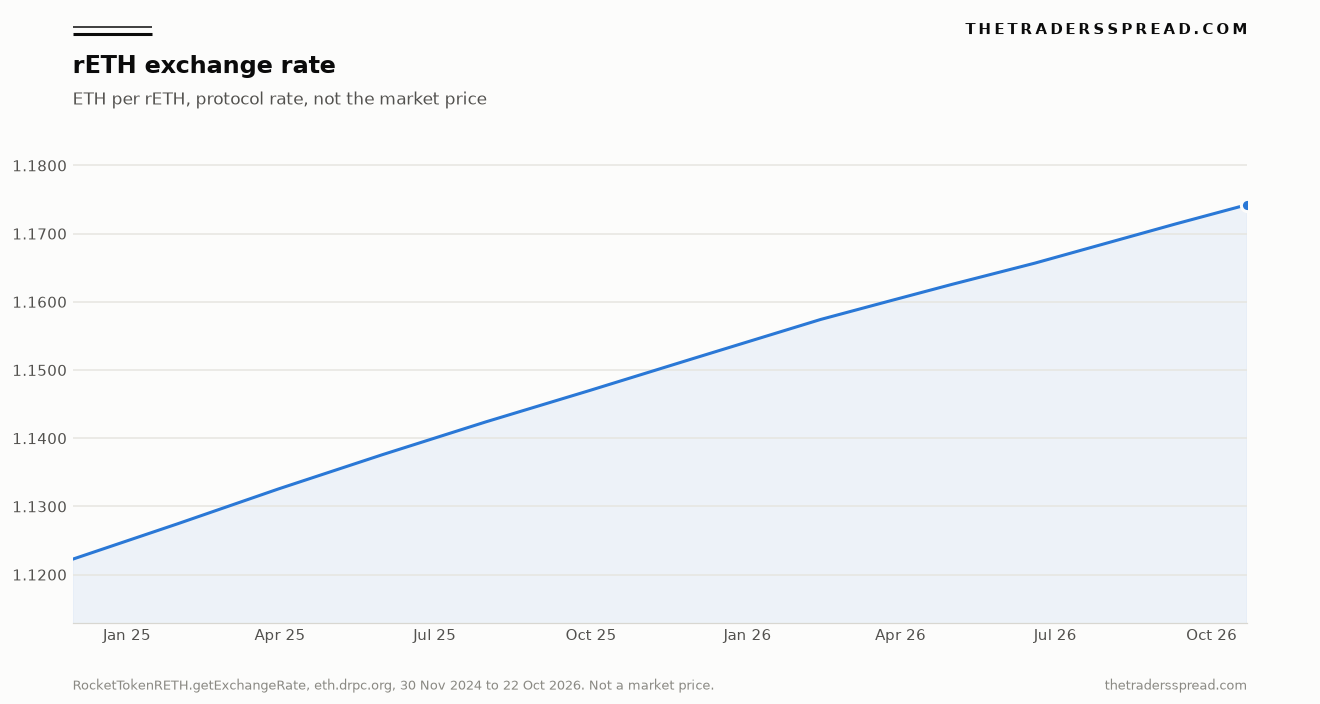
getExchangeRate on RocketTokenRETH, 0xae78736Cd615f374D3085123A210448E74Fc6393, read 1.122260 ETH on 30 November 2024 and 1.174256 ETH at block 26,246,795 on 22 October 2026, both via eth.drpc.org. CoinGecko's rETH-in-ETH print at 08:15 UTC was 1.174439. The protocol rate does not dip when the market price does. A direct mint adds a 0.05% deposit fee. An empty deposit pool leaves a burn waiting on a market.
Rocket Pool's integrations page names Aave as a lending venue for rETH. See Aave (AAVE) Climbs 50% in 30 Days as Deposits Top $31bn. That volume does not change the split. Saturn 1's megapool bonds 4 ETH and borrows 28, under a split called UARS: 5% to the operator, 9% voter share to megapool RPL, and the rest to rETH. A 4 ETH bond at 5% is a different multiple from an 8 ETH minipool at 5%.
FAQ
Does a Rocket Pool minipool pay the operator Ethereum's staking rate?
No. The bond earns the validator's rate, and commission is only a cut of the borrowed ETH. An 8 ETH minipool at 5% keeps 28.75% of rewards from 25% of the capital, 1.15 times that validator's rate, before penalties. At Atlas's 14% the same bond is 1.42 times. Neither number promises a proposal, or that the beacon rate holds still.
What happens to tips and MEV if the node is not smoothing?
They sit in the node's fee distributor until someone distributes them. The split uses average commission and the mix of bonds. Since Saturn 1, an outside caller leaves the operator's piece as unclaimed rewards, which do not expire. rETH still receives its side. The node loses the 28-day pool and the attestation weighting, not rETH's claim.
Is the commission the same on every minipool?
No. It is fixed at creation. Atlas set new minipools at 14%. From 28 October 2024 the contract rate on new ones is 5%, with a smoothing-pool bonus of 5 to 9 points that last paid in June 2026. Older minipools keep their own rate. The 5% on the 22 October payload is the current parameter, not a rewrite.
Why does rETH not grow the token balance the way stETH does?
The exchange rate moves and the token count does not. The guide builds that rate from supply and from rETH's share of beacon ETH, contract ETH, tips and MEV. On 22 October 2026 getExchangeRate read 1.174256 ETH per rETH. A direct mint also takes 0.05%. RPIP-61 limits how far and how often one oracle update can move the rate.
Can a new operator still open a minipool?
The minipool overview says deposits are disabled. New validators in the current guides are megapools, 4 ETH bonded and 28 ETH borrowed, with 5% to the operator, 9% voter share to megapool RPL, and the rest to rETH. The 11,199 minipools in the 22 October payload still use the older split. This page describes that book.
Does staking RPL change a legacy minipool's ETH commission?
Not via the price, and not via the bonus that ended in June 2026. The ETH rate is the one stored on the minipool. Legacy RPL still earns inflation. Interval 54 recorded 42,882.86 RPL for collateral stakers. The 9% voter share goes to megapool-staked RPL, which the Saturn 1 guide withholds from legacy stake. CoinGecko's $1.54 is a market print, not an input.
What the split does not guarantee
The split guarantees a formula. The operator receives the bond's fraction plus commission on the borrowed fraction. rETH receives the rest. Consensus ETH is split when the minipool is distributed. Execution ETH is split in the smoothing pool or the fee distributor. The formula does not assign the beacon rate, a proposal, the boost last paid in June 2026, or a role for RPL's price.
rETH holders are not assigned the full staking rate either. They receive the borrowed share after commission, posted into the exchange rate inside the RPIP-61 limits. Idle deposit-pool ETH, a frozen high commission, missed attestations, a penalty or a bad fee recipient all move the number. "The staking rate" drops the borrowed ETH. "The operator's yield" drops rETH's claim, including on a node that never joined the pool.