

$2.37 billion was the TVL label on USDY when we opened the Ondo Finance product page on 25 October 2026. The same pass put a $319.38 million current-value label on OUSG. Those two readings are the Treasury book, and they are two different claims.
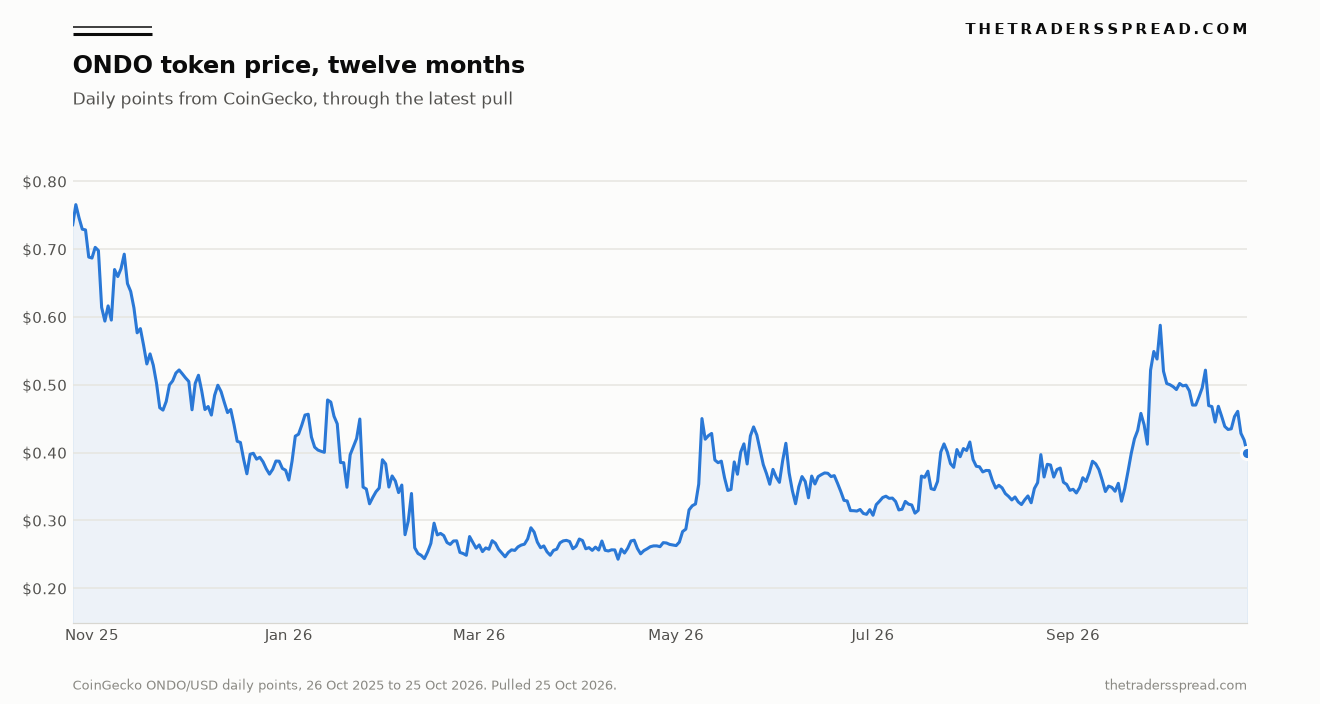
The ONDO token is a third instrument. CoinGecko, pulled at 09:06:59 UTC, put it at $0.398762, a $1.94 billion market cap and rank 49, and described DAO and Flux Finance rights. That text is silent on the Treasury portfolios. A Treasury NAV can accrue while this chart falls.
The official pages disagree about the inside of OUSG. The product-page FAQ still calls BUIDL the significant majority and names BlackRock's FedFund, ticker TFDXX, in the remainder. The holdings table, timestamped 23 October 2026 at 4:00:00pm EDT, puts the State Street Galaxy Onchain Liquidity Sweep Fund, ticker SWEEP, at 47.49 percent and BUIDL at 31.96 percent. TFDXX is absent from the rows. The trust-and-security page, undated in the section we read, still calls BUIDL the majority and names WisdomTree, also missing from that table.
Updated 25 October 2026
Key facts
- USDY TVL was labeled $2.37 billion, with $2.06 billion outstanding and $2.40 billion of underlying assets as of 22 October 2026, 7:59:59pm EDT. Source: ondo.finance/usdy, opened 25 October 2026.
- USDY position value was $2,404,341,313, maturity 177.48 days, yield to maturity 4.06 percent, with Treasuries at 87.11 percent and SHVon at 12.87 percent. Source: ondo.finance/usdy, opened 25 October 2026.
- OUSG current value was $319,376,537 as of 23 October 2026, 4:00:00pm EDT. SWEEP was $151,670,274 and BUIDL was $102,060,642. Footnote 3 leaves book-entry interests outside that total. Source: ondo.finance/ousg, opened 25 October 2026.
- OUSG's management fee is 0.15 percent, waived until 1 January 2027, with fund expenses capped at 0.15 percent a year. Instant mint and redeem show a $5,000 minimum and a 0 percent fee. Source: ondo.finance/ousg and the fees page, opened 25 October 2026.
- Instant OUSG mints and redemptions each have a $50 million global cap and a $25 million per-investor cap per 24 hours. Source: Ondo Finance instant-limits page, opened 25 October 2026.
- The ONDO token was $0.398762 at 09:06:59 UTC on 25 October 2026, market cap $1.94 billion, 24-hour turnover $78.3 million, circulating supply 4,869,330,647 of a 10 billion maximum. Source: CoinGecko id ondo-finance, pulled 25 October 2026.
Two Treasury products sit beside a third token
OUSG, Ondo Short-Term US Government Treasuries, is the qualified-access fund. The overview describes exposure through funds from BlackRock, Franklin Templeton, WisdomTree and Fidelity, plus bank deposits and USDC for liquidity. Direct bills are written as a later possibility, so the token in circulation is a share of that fund-of-funds and its cash sleeve.
The issuer is Ondo I LP. The trust page calls each token a unitized limited-partnership interest. Ondo I GP LLC is general partner, Ondo Capital Management LLC, a registered adviser, is manager, and Ondo Finance Inc is sole member of both. Buyers enter under Rule 506(c) and Section 3(c)(7) as accredited qualified purchasers. On the eligibility page a common individual test is a $1 million net worth excluding a primary home, or income above $200,000, together with $5 million of investments, and a common institution needs $25 million at discretion. The docs place OUSG with private funds, apart from Rule 2a-7 money-market funds.
The basics page traces the USDY note to Ondo USDY LLC until 15 December 2025, when the product folded into the Ondo Stocks umbrella. Collateral can be short-term Treasuries, iShares Short Treasury Bond ETF shares, or bank deposits. The product footer names Ondo Global Markets (BVI) Limited as the current issuer, and the trust page still describes the older LLC as the borrower.
The product-page FAQ limits the USDY offer and the redemption to non-US persons under Regulation S. The footer grants economic exposure to short-term US Treasuries and withholds any right to hold or receive the securities.
A dollar of stablecoin becomes a share of NAV
An instant OUSG deposit treats one USDC as one dollar and divides by NAV per token. The overview's illustration, a hypothetical $100 NAV, turns 100,000 USDC into 1,000 OUSG, and the live per-token price rendered blank on the page we opened. USDC moves to the fund's Coinbase account, and the trust page says Coinbase or Circle exchanges it into dollars. Instant delivery, in USDC or PYUSD, returns to the same wallet on Ethereum mainnet only. The token also sits on Polygon, Solana and the XRP Ledger.
Each business day, a New York Stock Exchange session, the fund resets NAV after fees, divides by the token count, and writes the result to the oracle between 4pm and 6pm Eastern. Income is reinvested and belongs to whoever holds the token at the print. The day opens on a conservative estimate and the next session corrects it. Friday's print carries Friday and Saturday, Monday carries Sunday and Monday, and a redemption filed before the print skips that day's income.
After onboarding, a qualifying USDY investor mints with USDC at any time, with dollar wires from $100,000. On Sui, Aptos, Stellar, XRP and Noble the minimum is $5,000 and the path is support. Wire redemptions in dollars go to non-US bank accounts. USDC redemption routes through Ondo Global Markets (BVI) Limited.
Accumulating USDY lets the reference price rise. Rebasing rUSDY holds that price at one dollar and increases the token count. The basics page's illustration wraps 1,000 USDY at $10 into 10,000 rUSDY and warns that adding both supplies double-counts the wrapped piece. The daily print has a cousin in the way Lido sets each daily stETH reward.
The legal paper behind the token
An OUSG holder owns a limited-partnership unit in Ondo I LP. The fund owns the fund shares, the USDC and the bank deposit, and the fees page says partners receive a Schedule K-1. The token is a claim on that structure, not a Treasury bill titled in the holder's own name.
A USDY holder owns a note. The stablecoin comparison gives holders a security interest and names Ankura Trust Company as verification and collateral agent. A late redemption is an event of default on that table, and Ankura's liquidation still waits on holder approval. The product page calls this debt of a bankruptcy-remote entity, and Ondo Finance Inc holds equity in the BVI issuer.
| OUSG | USDY | |
|---|---|---|
| Issuer | Ondo I LP, a Delaware limited partnership | Ondo Global Markets (BVI) Limited on the product footer. The trust page still describes Ondo USDY LLC |
| The token | A unitized limited-partnership interest | A tokenized note |
| Who may subscribe | Onboarded accredited investors who are also qualified purchasers | Non-US persons, on the product-page FAQ under Regulation S |
| How yield appears | Net income raises NAV per token on business days | Accumulating USDY raises the reference price. rUSDY adds tokens and holds the reference at $1 |
| Minimum we could verify | $5,000 instant, $100,000 non-instant subscription, $50,000 non-instant redemption | $5,000 on Sui, Aptos, Stellar, XRP or Noble, and wires from $100,000 |
| Fee we could verify | 0.15 percent management fee, waived until 1 January 2027. Fund expenses capped at 0.15 percent a year | Yield is described net of fees, obligations and expenses. A separate management-fee percent is absent from the pages opened |
Ondo Finance posted on X on 13 October 2026 that Treasury tokens had reached a $3 billion RWA.xyz mark, with USDY ahead of BUIDL. The pages we opened on 25 October show a later pair, $2.37 billion of USDY TVL and $319.38 million of OUSG current value. The post also counts tokenized Treasury ETFs.
New milestone: $3 billion in tokenized U.S. Treasuries.
— Ondo Finance (@Ondo) October 13, 2026
Ondo ranks #1 among tokenized U.S. Treasury platforms on RWA․xyz, with $3 billion across USDY, OUSG and tokenized Treasury ETFs.
Leading that growth is USDY, with over $2.3 billion in TVL, larger than BlackRock’s BUIDL.… pic.twitter.com/pnzPzjbTa1
A business-day print, then an onchain oracle
The quoted price stays near the underlying because the issuer writes it. A stablecoin goes in, a token comes out at that print, and that sequence is how Ondo Finance works. An instant OUSG redemption multiplies tokens by NAV and pays USDC at one dollar, and the redeeming page calls that step atomic. Accumulating USDY redeems at a rising reference price. rUSDY adds supply so the price, TVL over token count, stays at one dollar. USDY can also trade wallet to wallet, so the transfer print and the redemption print are two markets.
Nights, weekends and holidays keep the last print. NAV Consulting's pack, on the transparency page, can lag the oracle by up to three days. EigenLayer versus native staking and Rocket Pool's minipool split trace the same question of who keeps the yield.
Where the tracking can slip
The stablecoin is taken at one dollar. Mint and instant redemption on OUSG clear USDC at that rate while instant inventory lasts, and the limits page ties redemptions to USDC that Circle will support. On 23 October the table showed $3,017,273 of USDC, 0.94 percent of the book, against a $50 million daily instant cap. Circle, Coinbase and the underlying funds have to cover the gap, because a separate redemption reserve is unpublished.
Caps turn a same-day exit into a queue. The instant window has a $5,000 floor, a $25 million individual cap and a $50 million global cap, and the smaller remainder binds. Above it, tokens in before 4pm Eastern are typically paid the next business day, and a 4:30pm request slides one day further.
The allowlist is part of the price. OUSG moves only between onboarded qualified-access investors. USDY can move to a wallet that has never onboarded, while the FAQ reserves redemption for non-US persons. A secondary holder who fails that test keeps the token, and the primary window stays shut.
RelatedEigenLayer (EIGEN) vs Native Staking: Where the Yield Splits
The FAQ and the dated table describe different books. The second table sums to the published OUSG value, while the FAQ still describes a BUIDL majority and a FedFund line. If those funds slow their own redemptions, instant cash is the sleeve in front of them. Headline APY was 3.70 percent, the 7-day yield 3.76 percent and the 30-day yield 3.7 percent. The waived 0.15 percent management fee returns after 1 January 2027, and underlying-fund expenses already reduce the NAV.
The USDY ratio and the two headlines diverge. Outstanding of $2.06 billion divided into $2.40 billion of assets is about 117 percent, against a printed collateralization ratio of 153.73 percent. Footnote 5 excludes Treasuries used for structured financing under the Ondo USDY LLC credit agreement, and that excluded amount is unpublished. Yield to maturity is 4.06 percent beside a 3.75 percent monthly APY. Treasuries show 203.6 days and 4.13 percent. SHVon, an ETF of longer bills, shows a one-day maturity and 3.60 percent.
| Book | Line | Value | Share | As of |
|---|---|---|---|---|
| OUSG | SWEEP | $151,670,274 | 47.49% | 23 Oct 2026, 4:00pm EDT |
| OUSG | BUIDL | $102,060,642 | 31.96% | same OUSG print |
| OUSG | BENJI | $38,899,665 | 12.18% | same OUSG print |
| OUSG | FYOXX | $23,566,488 | 7.38% | same OUSG print |
| OUSG | USDC at Coinbase | $3,017,273 | 0.94% | same OUSG print |
| USDY | US Treasuries | $2,094,366,236 | 87.11% | 22 Oct 2026, 7:59pm EDT |
| USDY | SHVon, tokenized short Treasury ETF | $309,364,703 | 12.87% | same USDY print |
| USDY | Silicon Valley Bank deposits | $599,553 | 0.02% | same USDY print |
The ONDO token chart is a different market
The chart is the ONDO token on CoinGecko, and OUSG and USDY net asset values are absent from it. Daily points run from $0.735 on 26 October 2025 to $0.399 on 25 October 2026, with a high of $0.766 and a low of $0.243 inside the window. Related mechanics sit on the crypto desk.
Questions that follow from the documents
What does a holder of an Ondo Finance Treasury token actually own?
An OUSG holder owns a limited-partnership unit in Ondo I LP, a fund that holds other Treasury funds and a cash sleeve. A USDY holder owns a note. The current footer names Ondo Global Markets (BVI) Limited, and the trust page still describes Ondo USDY LLC. The footer gives economic exposure to short-term Treasuries and withholds delivery of any bill. The CUSIP stays with the fund or the issuer.
Who is allowed to mint OUSG, and who is allowed to mint USDY?
OUSG asks for someone who has onboarded and who is both an accredited investor and a qualified purchaser. Common individual paths on the eligibility page are a $1 million net worth excluding a primary home, and $5 million of investments. USDY, on the product-page FAQ, is offered and redeemed only for non-US persons under Regulation S. Receiving a transfer is a different test from minting.
Why can the token price rise while a Treasury bill stays near par?
OUSG and accumulating USDY fold interest into the redemption value, so the quoted price rises when net income is recognized. Rebasing rUSDY keeps a one-dollar reference and increases the token count. A bill pays cash or accretes toward par. These tokens accrete inside the token record, on the issuer's print, so the quoted price and par part company on purpose.
Where does the ONDO token fit beside OUSG and USDY?
CoinGecko's description, pulled on 25 October 2026, ties the ONDO token to the Ondo DAO and to Flux Finance, at about $1.94 billion and $0.398762. It assigns those rights and stays silent on any claim to the OUSG portfolio or the USDY collateral, so the chart can move while a Treasury NAV is accruing.
What limits an instant redemption when the cap is hit?
OUSG instant redemptions have a $5,000 minimum, a $50 million global cap and a $25 million per-investor cap, each resetting over 24 hours. Circle's USDC can tighten that further, and the 23 October table showed about $3.0 million of USDC against the $50 million cap. Above the cap, the order becomes a non-instant queue with a 4pm Eastern cutoff, and USDY wire redemptions go to non-US bank accounts.
Which document would a redeem queue actually open?
If a large redeem queue hit while the Treasury funds inside OUSG were slow to pay, which document would a holder open first: the limited-partnership agreement of Ondo I LP, the USDY terms of Ondo Global Markets (BVI) Limited, or the older credit agreement of Ondo USDY LLC? The oracle would keep printing a figure, and the cash would depend on which of those documents still had a working window.
Figures above are reference readings from the pages and the CoinGecko pull named in the text, those readings move, and product terms can change. The text describes published terms and carries no instruction on a position.