

What is the Class III milk curve actually pricing: a farm milk cheque, a block of cheddar, or a formula the U.S. Department of Agriculture will announce only after that contract month has stopped trading?
We read it as the third. CME Rule 5201 values each futures contract at 2,000 times the USDA Class III price for milk. Rule 5203.A says there is no delivery. Open contracts cash-settle to that USDA price for the month, as first released. The price on the announcement USDA published on 30 September 2026 is not a plant-gate quote. It is the Class III skim milk price times 0.965, plus the butterfat price times 3.5. Skim is the protein price times 3.3, plus the other solids price times 6.0. Protein comes from cheddar and from butterfat. Other solids come from dry whey. Butterfat comes from butter. A deferred month is mostly product that has not been surveyed. A month already inside the National Dairy Products Sales Report is mostly arithmetic the market can finish before USDA prints the line.
Seven readings of that split keep coming back, and each one is answered from the pages below. The exchange website refused a direct request on 21 October 2026, so Chapter 52 is CME’s own PDF as captured on 11 August 2025, checked against the 12 October 2024 capture, which matched. The dairy fact card is the exchange PDF captured on 11 July 2026. The card says the rules supersede it.
Updated 21 October 2026
Key facts
- One Class III milk futures contract is 200,000 pounds, written as 2,000 hundredweight, and it cash-settles. There is no delivery of milk. Source: CME Rulebook Chapter 52, Rules 5201, 5202.B and 5203.A, read 21 October 2026.
- The futures minimum move is $0.01 per hundredweight, equal to $20 a contract. The daily limit is $0.75 per hundredweight, expandable to $1.50. Source: CME Rules 5202.C and 5202.D, and dairy fact card PM21AG012/0226, read 21 October 2026.
- Final settlement is the USDA Class III price as first released. Trading stops the business day before that announcement. The fact card puts the last trade at 12:10 p.m. Chicago time. Source: CME Rules 5202.H and 5203.A, and the dairy fact card, read 21 October 2026.
- The announced price uses a standard 3.5 pounds of butterfat per 100 pounds of milk, not a farm’s fat test. Source: USDA AMS, Calculating Class III Price worksheet, December 2025, read 21 October 2026.
- For September 2026 the announced Class III price was $16.04 per hundredweight, from cheese at $1.5577 a pound, dry whey at $0.6694, and butter at $1.4462. Source: USDA AMS CLS-0926, 30 September 2026.
- The same announcement put Class IV at $18.94 per hundredweight. Weekly product surveys can be revised for four weeks. The monthly class announcement is not revised. Source: USDA AMS CLS-0926, 30 September 2026.
The cheese price is an input, not the contract
Call Class III “cheese milk” and you are half right about the plant and wrong about the price. The contract settles to a formula that consumes three wholesale averages: cheddar in 40-pound blocks, dry whey, and butter. On the 30 September 2026 methodology, butterfat equals the butter price minus $0.2272, times 1.211. Other solids equal the dry whey price minus $0.2668, times 1.03. Protein starts with the cheese price minus $0.2519, times 1.383, then adds a second term: the same net cheese price times 1.589, minus butterfat times 0.91, times 1.17. The December 2025 Class III worksheet uses those same make allowances and yields. The formula index sits on the USDA price-formulas page.
September 2026 is a clean worked example because every input and every output is on one release. Butter in the Class III column was $1.4462 a pound, cheese $1.5577, dry whey $0.6694. Those become butterfat of $1.4762, protein of $2.6619, and other solids of $0.4147. Class III skim is $11.27. The headline is $16.04. We recomputed the chain from the printed product prices. It lands on the printed $16.04.
Split that $16.04 and the cheese-only story fails in public. Butterfat, $1.4762 times 3.5, contributes $5.1667 per hundredweight. Protein, $2.6619 times 3.3 times 0.965, contributes $8.4768. Other solids, $0.4147 times 6.0 times 0.965, contribute $2.4011. The legs sum to $16.0446, which the announcement rounds to $16.04. Fat is already about a third of the headline. Whey is smaller and it is not a rounding error. Protein is the large leg, and it is not raw cheese: the second term subtracts a butterfat credit. A one-cent move in cheese cannot become a one-cent move in Class III.
The same release prints a second cheese number. The left-hand block feeds Class I and Class II skim. The right-hand block feeds Class III. For September 2026 those cheese averages are $1.6216 and $1.5577. Footnote 3 says the Class III figure is a volume-weighted average of 40-pound blocks over four or five weeks. The release does not print the pounds, and we do not invent them. A single week is a different object, which is why a note on one cheddar week cannot stand in for the monthly input.
The 3.5 percent figure is a standard, not a farm test
The 3.5 percent butterfat figure is real, and it is not a bulk-tank test. The December 2025 worksheet says 3.5 equals the pounds of butterfat in 100 pounds of milk. The price line uses it directly: Class III equals skim times 0.965, plus the butterfat price times 3.5. Every announced Class III price is a 3.5-pound fat price. A herd at 4.2 percent fat does not get a different headline. The headline was never their test.
The worksheet is plain about the 1.17 factor inside protein. On a standard hundredweight of 3.5 pounds of butterfat and 2.99 pounds of protein, 1.17 pounds of butterfat go with one pound of protein. That 2.99 is an assumption inside a yield, not a farm test and not a second published price. The skim line uses another standard: 3.3 pounds of protein and 6.0 pounds of other solids per hundredweight of skim, with 0.965 for the skim share of milk. Both sets of figures are in the method. Neither is a silo test.
Component prices sit beside the class price for that reason. On 30 September 2026 butterfat was $1.4762 a pound, protein $2.6619, other solids $0.4147, and the somatic cell adjustment rate 0.00078 per 1,000 cells. A cheque on actual components uses those per-pound prices. The future does not. Rule 5203.A names the USDA Class III price, and a farm’s fat test is not a separate grade on it. A component surprise reaches the curve only if it later shows up in surveyed butter, cheese, or whey.
A settle and an announcement are different prints
Until the end, the screen is a futures settlement: a price for a USDA number that is not final. Rule 5203.A then cash-settles whatever is still open to the USDA Class III price as first released. Rule 5202.H stops trading on the business day before the announcement. The fact card puts that last trade at 12:10 p.m. Chicago time. The chart under this is the announced price from January 2025 through September 2026. It is not a futures strip, and nothing on it runs past the last print.
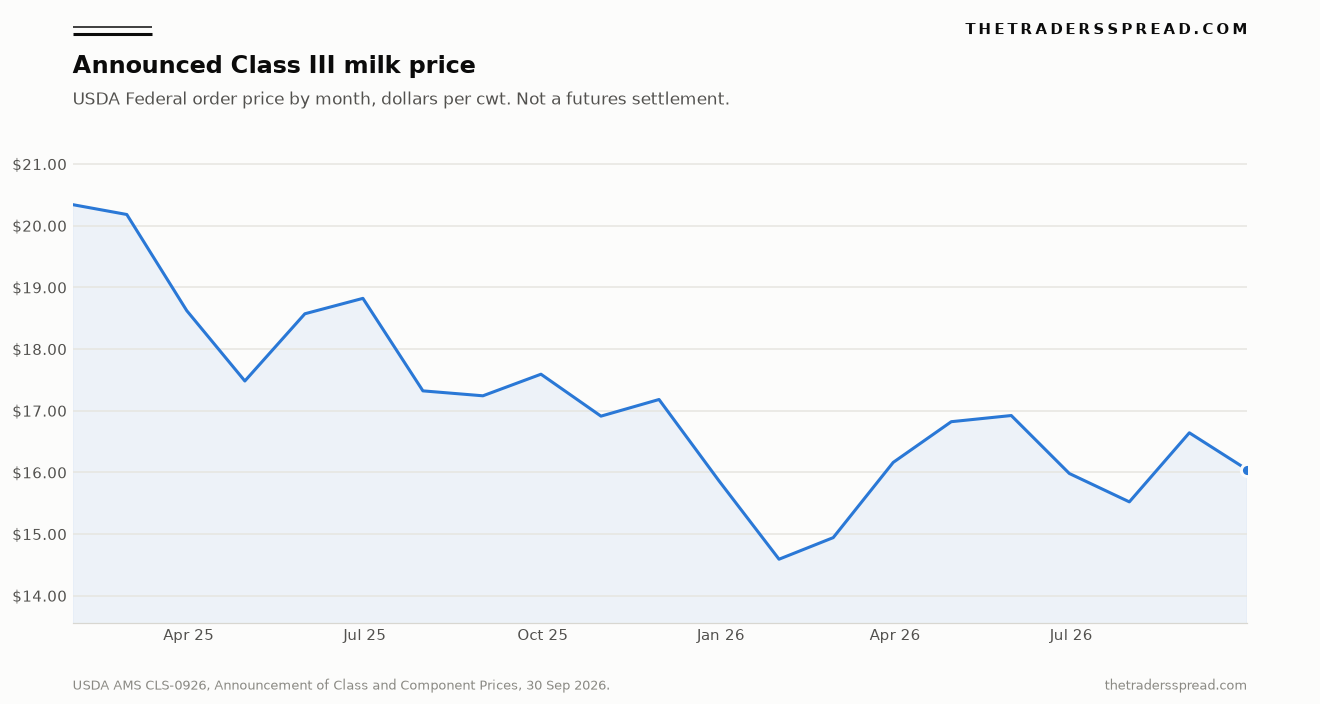
The high in that window is January 2025 at $20.34 per hundredweight. The low is January 2026 at $14.59. The 2025 average printed on the table is $18.01. The nine announced months of 2026 through September average $15.96 if you take a simple mean of those nine prints. USDA did not publish that 2026 mean. It is our arithmetic on their figures, and it describes announcements, not the futures settle on those days.
By the last trade, the expiring month is a claim on weekly inputs that are largely public. The next month still has surveys ahead of it. A settle near the eventual announcement is convergence. The same figure weeks earlier is an opinion about cheese, whey, and butter not yet averaged. The fact card lists 24 calendar months and separates Globex code DC from clearing code DA. Chapter 52 prints neither, and says the exchange sets the months. The desk has had to separate cash from futures where a cash quote and the futures market beside it moved as neighbours. At Class III expiry the official price replaces the future.
Weekly revisions do not rewrite the month
The survey under the formula is allowed to change. The class price is not. CLS-0926 says the National Dairy Products Sales Report can be revised for four weeks after the initial weekly report, and that AMS can verify sales records for up to two years. The next point is the one that binds the future: monthly announcements of class and component prices are not subject to revision. Rule 5203.A settles to the USDA price as first released. A cheese week corrected later does not, on those two texts, reopen an expired Class III month.
The average uses the most recent four or five weeks since the prior announcement, weighted by pounds, and the week count depends on the publication date. The September release does not list each week. We read “as first released” as a closing rule: USDA can judge a week wrong and still leave the class price where it first stood.
Which report can still move a deferred month?
The monthly announcement is a poor candidate for the shock. It adds up surveys already published, and it binds a contract that has stopped. What can still move a deferred month is a weekly butter, cheese, or whey survey that changes an open window, or a change in how many weeks that window will hold.
The 30 September 2026 layout shows it. September is filled in on both sides of the product table. October is filled in only on the left, the block used for advanced Class I and Class II skim prices: butter $1.4678, nonfat dry milk $1.7731, cheese $1.5598, dry whey $0.6657. The Class III columns for October are blank. That October cheese figure is a real USDA number. It is not the cheese price that will settle the October Class III contract. The blank is the reminder. October’s Class III averages did not yet exist as a completed monthly input.
A USDA logo is not one kind of news. A weekly survey that will enter an open month is new information. A monthly class price that adds up weeks already out is a determination. A crop estimate the trade had not been averaging under a fixed make allowance is a third document, which is why the desk’s note on a USDA soybean crop figure does not travel into Class III announcement day. A quiet settlement there is often the formula closing, not a report that failed to matter.
Limits are separate from the announcement. Rule 5202.D sets a $0.75 band around the previous settlement, widening to $1.50 the next day if any Class III month settles at limit, then reverting if nobody repeats it. The expiring month leaves that regime at the close on the business day before the contract month begins. The wider band also covers cash-settled cheese, block cheese, and dry whey. Butter is not on the list, so a butter limit day does not, on this sentence, widen Class III.
Nothing is delivered, and a cent is twenty dollars
The trading unit is 200,000 pounds, or 2,000 hundredweight. The fact card calls that about 90 metric tons. Rule 5203.A is the whole delivery clause: there shall be no delivery of milk. Rule 5201 values the contract at 2,000 times the USDA price, so the September 2026 announcement of $16.04 is a $32,080 reference value. That is the rule applied to the announcement. It is not a futures settlement. The live quote board did not open on 21 October 2026.
One cent per hundredweight is $20 a contract. The fact card also lists a half tick of $0.005, worth $10, on the options only. The futures minimum in the chapter is $0.01. A half-cent futures order is borrowing the option increment. On the same multiplier the $0.75 limit is $1,500 a contract and the expanded $1.50 band is $3,000. That is the width of the band, not a statement about how often it is reached.
RelatedUrea fell 42.4% from the second to the third quarter
Position limits are the line we will not pretend to have finished. The fact card says 1,500 contracts in any month, and the same futures-equivalent figure on the options, and points at Rule 5202.E. The chapter at 5202.E does not print 1,500. It points at the Chapter 5 table and at exemptions under Rule 559. That table did not load from the exchange host. Until it does, 1,500 is a fact-card citation, and the card says the rules win if the summary differs. What the chapter itself does state is the unit, the one-cent increment, the limit regime, the last-trade rule, and cash settlement to the first-released price.
Class IV uses the same fat and a different skim
Class IV is announced in the same PDF and uses the same butterfat price. It is not the same construction. In September 2026 Class III was $16.04 and Class IV was $18.94, a gap of $2.90. Butterfat was $1.4762 a pound in both, multiplied by 3.5 in both. The gap is the skim.
Class IV skim equals the nonfat solids price times 9.3. Nonfat solids equal the nonfat dry milk price minus $0.2393, times 0.99. September’s Class IV powder average was $1.7891, nonfat solids were $1.5343, and Class IV skim was $14.27. Class III skim was $11.27, from protein and whey, with no powder term. Powder can rally while cheese is dull. From August to September 2026 the table shows the split in the headlines themselves: Class III went from $16.64 to $16.04, down $0.60, and Class IV went from $17.36 to $18.94, up $1.58. Opposite signs, one release. A book that is long one against the other is cheese and whey against powder, with the butterfat largely cancelling if the weights match.
Butter is still the whole butterfat leg of Class III, and it enters protein through the 0.91 credit. Powder is not in Class III at all. Between January 2025 and January 2026 the announced price fell from $20.34 to $14.59. That $5.75 had to come through some mix of butter, cheese, and whey. Calling the whole move “cheese” requires the other two legs to have been quiet. September’s $5.17 butterfat contribution says they often are not.
Verdict
Class III milk futures are not a cheque, not a cheddar print, and not Class IV. They are a strip of upcoming USDA announcements: a standardized 3.5-pound fat price, built from surveyed cheddar, dry whey, and butter, published once, and left alone if a weekly survey is later corrected. Before the last trade, the settle is an opinion about surveys still open. After it, the settle is a claim on arithmetic. We read a deferred month for the surveys it lacks, and the expiring month for whether the market’s formula matches the one USDA is about to lock.
FAQ
Does a Class III milk futures contract deliver milk?
No. CME Rule 5203.A says there is no delivery of milk. Open contracts cash-settle to the USDA Class III price for that month, as first released. The 200,000-pound unit, or 2,000 hundredweight, is the multiplier in Rule 5201, not a load that changes hands. The dairy fact card describes the same contract as cash settled, with no delivery window attached.
Which commodities are actually in the Class III price?
Three wholesale averages. Butter, minus a make allowance of $0.2272 and times 1.211, becomes butterfat. Cheddar, minus $0.2519, enters protein, which also adjusts for butterfat. Dry whey, minus $0.2668 and times 1.03, becomes other solids. USDA states those steps in the 30 September 2026 methodology and on the December 2025 worksheet. Cheese is the large leg, not the whole price.
Why does the formula use 3.5 percent butterfat?
The announced price is defined on a standard hundredweight. The December 2025 worksheet sets 3.5 as the pounds of butterfat in 100 pounds of milk, and the price line multiplies the butterfat price by 3.5. Its 1.17 factor assumes 3.5 pounds of fat and 2.99 pounds of protein in that standard. A herd on another test does not get another headline. The future settles to the headline.
Can a revised weekly cheese price restate Class III?
The weekly National Dairy Products Sales Report can be revised for four weeks. The monthly class announcement cannot. The 30 September 2026 methodology says class and component announcements are not subject to revision. CME Rule 5203.A settles the future to the USDA price as first released. A later weekly correction does not, on those two texts, rewrite an expired Class III settlement.
When does the front Class III month stop trading?
On the business day before USDA announces that month’s Class III price. That is CME Rule 5202.H. The dairy fact card puts the last trade at 12:10 p.m. Chicago time and lists 24 calendar months. Chapter 52 prints neither the hour nor the 24-month count. It leaves hours and listed months to the exchange, and the card says the rules control if the two differ.
Is the Class III price the same thing as Class IV?
No. Both multiply one butterfat price by 3.5 and weight skim by 0.965. The skim differs. Class III skim is protein and other solids, from cheese, butterfat, and dry whey. Class IV skim is nonfat solids times 9.3, from nonfat dry milk. On 30 September 2026 the announcements were $16.04 and $18.94 per hundredweight. The $2.90 gap is skim, not fat.