

$107.09 is where Blackstone (BX) closed on 19 October 2026. That print sits 6.70% under the $114.78 close on 12 October, a drop of $7.69 across five sessions. The same close is 34.50% below the 16 January close of $163.50, and 35.15% below the $165.14 intraday high struck that day. It is also 5.27% above the 12 March intraday low of $101.73. From the 31 December 2025 close of $154.14, the year-to-date decline is 30.52%. From the 21 September close of $126.41, the twenty-session decline is 15.28%. A share that traded in the mid-$160s in January is back in the neighbourhood of its low for the rolling year, and the last week did a visible share of the new damage. These are unadjusted New York Stock Exchange closes from StockAnalysis, retrieved 20 October 2026. They record a completed move, measured before the 22 October call.
On 13 October the stock fell 4.18%, to $109.98, on the Tuesday a Bloomberg Opinion column identified as the day news broke of a delay to a Singapore listing tied to AirTrunk, the data-centre operator Blackstone acquired in 2024. On 19 October, the session that produced the $107.09 close, the firm announced an $8.7 billion final close for Blackstone Energy Transition Partners V and said the fund had reached its hard cap. Capital was still being raised. A data-centre exit, on the account in that column, was not clearing. Over the same five sessions the 10-year Treasury yield eased, from 5.21% on 13 October to 5.15% on 19 October, on the Treasury Department’s daily par curve. This was not a yield spike wearing an alternative-asset label. It was a mark on exit timing, taken while the risk-free rate was already above 5% and drifting down.
Third-quarter figures have not been published. The investor call is set for 22 October at 9:00 a.m. Eastern.
Key facts
- Blackstone closed at $107.09 on 19 October 2026, down 6.70% from $114.78 on 12 October — StockAnalysis daily closes, retrieved 20 October 2026
- The 16 January close was $163.50 and that day’s intraday high was $165.14, leaving the latest close 34.50% and 35.15% below those prints — StockAnalysis history, retrieved 20 October 2026
- The 12 March intraday low was $101.73, so the 19 October close is 5.27% above it — StockAnalysis history, retrieved 20 October 2026
- The 10-year Treasury par yield was 5.21% on 13 October and 5.15% on 19 October — U.S. Department of the Treasury daily yield curve, October 2026
- Energy Transition Partners V held a final close at $8.7 billion on 19 October, more than 50% above its predecessor and at the hard cap — Blackstone press release, 19 October 2026
- Second-quarter total assets under management were $1.346 trillion and distributable earnings were $1.977 billion, in a supplemental the firm marked preliminary — Blackstone, 23 July 2026
- Average volume over the five sessions was 6.55 million shares, against 4.71 million in the twenty sessions before 13 October — StockAnalysis, retrieved 20 October 2026
Five sessions, and the closes inside them
The headline window runs from the 12 October close to the 19 October close. Five trading sessions, unadjusted. It is not the year-to-date figure, and it says nothing about the shares after the 22 October call.
The path was not a straight line.
12 October was quiet: $114.78, up 0.43%, on 2.54 million shares, inside $113.47 to $114.85. 13 October did the largest cut. The stock opened at $114.96, touched $115.24, and closed at $109.98, down 4.18%, on 5.53 million shares. The low was $109.84. The close sat on it. 14 October went to $106.21, down another 3.43%, on 7.53 million shares. The intraday low, $105.44, is 3.6% above the March floor of $101.73. Not a new 52-week low. A stress print all the same.
15 October bounced to $109.20, up 2.82%, on 8.63 million shares, the heaviest day of the window, with a low of $105.69 and a high of $110.04. That was the day of the Form 8-K on Joseph Baratta’s planned board resignation. The filing did not extend the selloff. The session that carried it was the rebound. 16 October gave most of the bounce back: $106.61, down 2.37%, on 7.02 million shares, low $105.97, high $110.94.
19 October was smaller. The close was $107.09, up $0.48, or 0.45%, from $106.61, inside $106.71 to $107.94, on 4.03 million shares. StockAnalysis timestamped the regular-session quote at 4:00 p.m. Eastern and marked the market closed. From 13 to 19 October the stock traded 32.75 million shares, 6.55 million a day, against 4.71 million in the twenty sessions before 13 October. About 39% busier, and the extra volume sat on the 13th, the 14th and the 16th.
A 6% REIT yield against a 5.15% Treasury
Shuli Ren, a Bloomberg Opinion columnist who previously reported on markets at Barron’s, wrote in a column carried by Livemint on 14 October that public investors were pushing back on AI data-centre equity. “Public investors are now pushing back, asking whether AI data center developers can generate much shareholder value at all.” She is not a Blackstone executive. The column is opinion, and it is the fullest account this desk could open of why 13 October mattered for the stock.
On AirTrunk, Ren wrote that the Australian operator, acquired in 2024 in what she described as Blackstone’s biggest investment in Asia, was delaying a Singapore REIT listing. “AirTrunk had considered offering a roughly 6% yield for its REIT, up from a previously envisaged 5.5%.” She added that the higher coupon was still unattractive while global investors could earn more than 5% in US Treasuries. The column put a public listing in 2027, and put Lambda, another late-stage company Blackstone has invested in, on a similar timetable.
The Treasury half does not depend on the column. On the daily par yield curve, the 10-year was 5.31% on 5 October, 5.24% on 9 October, 5.21% on 13 October, 5.19% on 14 October and 5.15% on 19 October. There is no 12 October row in that file. The stock market did close that day, at $114.78. From 5.21% to 5.15% is 6 basis points of easing, against a 6.70% decline in the common stock from the prior close. Our explainer on a 5.31% US 10-year uses the 5 October print, not the 19 October print.
Ren also wrote that Blackstone owns 6.7% of Firmus Grid, that the firm joined an August round of $2 billion at a valuation above $10.5 billion, and that this followed a $10 billion debt facility Blackstone had led. She described a failed $30 billion Firmus listing the week before, with 46 megawatts built out of a 912-megawatt pipeline. Those are column figures, not lines from a Blackstone filing.
Reuters, credited elsewhere with the 13 October AirTrunk report, returned a captcha rather than the story. In hand is Ren’s account of a delayed Singapore REIT, a discussed yield near 6%, and a 2027 timetable, next to a share price from StockAnalysis. The 19 October Blackstone release did not mention AirTrunk. The CoreWeave tape on this desk is a separate name in the same financing argument. Ren used it as the public neocloud benchmark. This article does not repeat her operating figures for that company. A sponsor’s stock and an operator’s stock were both being asked whether data-centre equity still clears a hurdle credit had already funded.
Where the peer tape went
Blackstone did not fall alone. The same StockAnalysis closes, retrieved the same day, put the five sessions from 12 October to 19 October in a group.
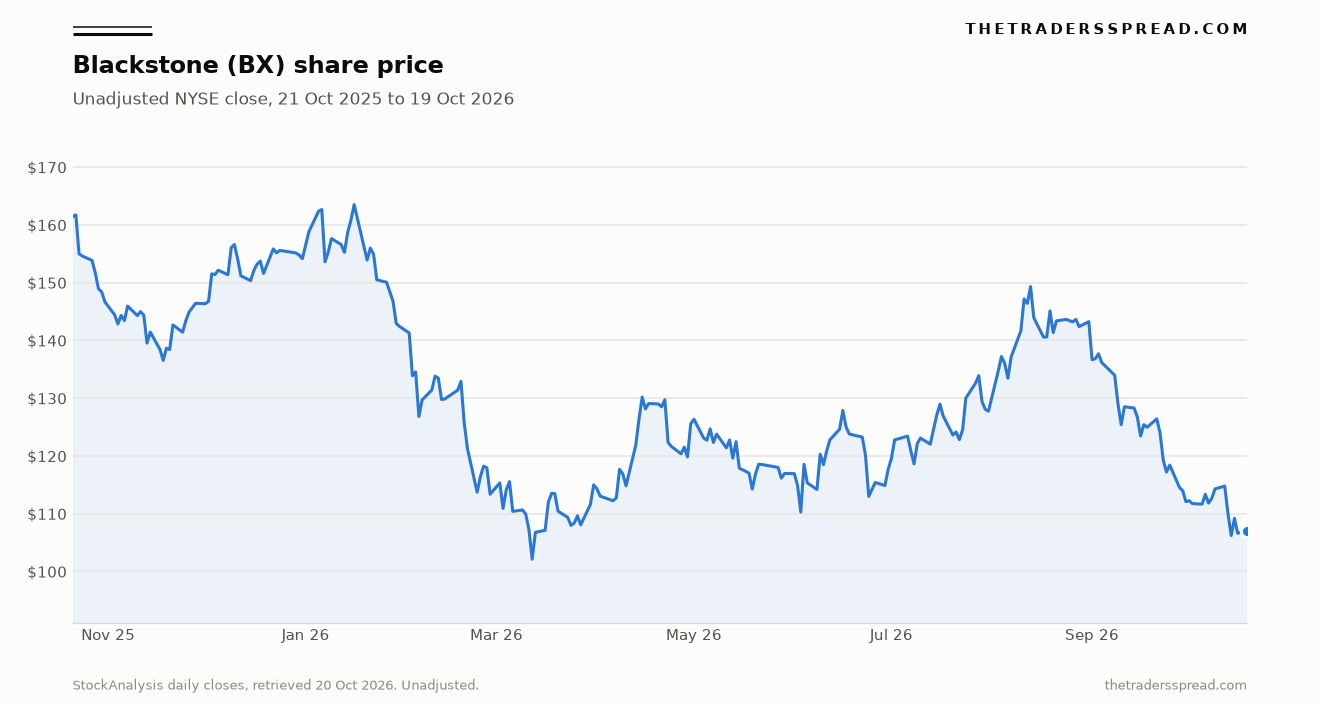
History only, from the 21 October 2025 close of $161.43 to $107.09 on 19 October 2026, a 33.66% decline. Unadjusted closes, so dividends are not added back. No projected path, and no level marked as a destination.
| Name | Close, 19 Oct 2026 | Five sessions from 12 Oct | Twenty sessions from 21 Sep | From 31 Dec 2025 |
|---|---|---|---|---|
| Blackstone (BX) | $107.09 | -6.7% | -15.3% | -30.5% |
| KKR | $87.00 | -4.9% | -13.7% | -31.8% |
| Apollo (APO) | $110.95 | -6.9% | -13.3% | -23.4% |
| Ares (ARES) | $113.00 | -4.4% | -10.8% | -30.1% |
| Carlyle (CG) | $36.56 | -4.4% | -10.5% | -38.2% |
| Brookfield (BN) | $36.46 | -1.6% | -4.0% | -20.6% |
| SPDR S&P 500 (SPY) | $766.48 | -1.5% | -0.9% | +12.4% |
Every figure in that table is an unadjusted close from StockAnalysis, retrieved 20 October 2026. SPY is the SPDR S&P 500 ETF, not the index itself. The percentages are rounded to one decimal in the table. Blackstone’s five-session figure unrounded is 6.70%. Apollo’s is 6.94%. The twenty-session Blackstone figure unrounded is 15.28%.
Over five sessions Apollo fell slightly more than Blackstone. KKR, Ares and Carlyle fell about 4.4% to 4.9%. Brookfield’s 1.6% sat next to SPY’s 1.5%. Over twenty sessions the order flips: Blackstone’s 15.3% is the largest decline, then KKR at 13.7% and Apollo at 13.3%, with Ares and Carlyle near 11%, Brookfield at 4.0% and SPY at 0.9%.
Year to date, Carlyle is weakest at 38.2%. KKR, Ares and Blackstone cluster between roughly 30% and 32%. SPY rose 12.4%, from $681.92 on 31 December 2025 to $766.48. Blackstone’s 30.5% decline is severe beside that fund, and ordinary beside KKR and Ares. The specific pace is the one since 21 September. BlackRock’s forecast page covers a different fee contract. None of its figures are reused here. The contrast is the business, not a shared multiple: an alternatives manager trading realisation timing, and a broad equity fund up on the year.
The June books, and a board seat with an end date
The last full set of figures Blackstone has published for the whole firm is the second quarter, not the third. On 23 July 2026 the firm posted supplemental financial data and labelled the current-period amounts preliminary and unaudited. A Form 10-Q was filed on 7 August. This article uses the 23 July supplemental, which we opened, and does not re-cut the 10-Q. Treat the quarter as the company’s own preliminary scorecard.
Total assets under management at 30 June were $1.346 trillion. Fee-earning assets were $961.6 billion. Inflows in the quarter were $68.3 billion. Realisations were $31.8 billion. Fee-related earnings were $1.783 billion. Distributable earnings were $1.977 billion. Total segment revenues were $3.802 billion. On the GAAP page of the same supplemental, total revenues were $5.044 billion and net income attributable to Blackstone Inc. was $1.229 billion. Base management fees were $1.961 billion.
Private equity assets were $454.2 billion. Credit and insurance were $469.3 billion, and base management fees on that book were $493.6 million in the second quarter, down from $509.8 million in the first. Real estate was $314.1 billion, against $315.3 billion at the end of March. Multi-asset investing was $108.6 billion.
Connor Hart, writing for Dow Jones on 15 October and carried by Morningstar, reported that Joseph Baratta had led private equity since 2012 and that those assets had grown to $454 billion as of June from roughly $50 billion. The $454 billion matches the supplemental. The starting point is Hart’s, not a line we found there. He also wrote that the Wall Street Journal had reported in September that Nadeem Meghji, global head of real estate, was leaving. That is a press report of a press report.
The filing we opened is the 8-K of 15 October 2026. On 9 October, in connection with his planned retirement, Joseph Baratta notified the board that he intended to resign as a director effective 31 December 2026. He continues until that date. The board then goes from eight members to seven. Victoria Portnoy, managing director and assistant secretary, signed. The cover lists 345 Park Avenue, New York. The form does not give a departure date from the private-equity job. Hart described him as the firm’s top private-equity executive stepping down from the board. The legal text is the board seat.
Set that beside the release that hit on the day of the $107.09 close. Blackstone said Energy Transition Partners V had a final close at $8.7 billion, more than 50% larger than the predecessor vehicle, significantly oversubscribed, and at its hard cap. The strategy’s investments had generated a 34% net IRR since 1997, as of 30 June, on the firm’s own accounting of that record. Since January 2025 the strategy had committed over $11 billion of new equity. David Foley, global head of Blackstone Energy Transition Partners, said in the release: “We believe there is a generational opportunity for experienced investors in the energy transition to provide solutions to the challenges posed by growing demand for electricity.”
Foley was talking about power, meters, cooling components and inspection services, including liquid cooling for data centres. Not about the common stock. Limited partners were told an energy fund had hit its cap in the same week the listed share fell 6.70%, because a different exit, in Ren’s telling, could not clear a yield barely above the Treasury. Two customers. One locks capital up. The other prices the wait.
RelatedApplied Materials (AMAT) Falls 19.3% in the Week to 16 Oct
On 24 September the firm set the third-quarter call as a public webcast for 22 October at 9:00 a.m. Eastern, and repeated the boilerplate of over $1.3 trillion in assets. It did not publish fee-related earnings, realisations or inflows for the quarter ending 30 September. A consensus guess is not a printed result.
What this changes
At $107.09 the stock is down 30.52% from the last close of 2025, 15.28% over twenty sessions and 6.70% over five. The share is not marking a broken fundraising print from the week of 19 October. It is marking the gap between money that can still be raised and assets that public investors, on Ren’s account, would not take at a 6% REIT yield.
The 22 October call can change the evidence, not a destination this article sets. June’s preliminary scorecard showed $31.8 billion of realisations, $1.783 billion of fee-related earnings and $68.3 billion of inflows. Slower realisations in the third quarter would make the five-session decline look early. Steady fees, with still no date on data-centre monetisation, would make it look like a multiple on waiting. Both are possible. Neither is in a filing. The call is 9:00 a.m. Eastern on Thursday. Until the release is up, the quarter has not printed.
The 8-K does not rearrange the firm on 20 October. It rearranges the board on 31 December, from eight seats to seven, if the resignation takes effect as filed. Baratta remains a director until then. The 6.70% move happened after the 9 October notice and the 15 October filing, and the filing session itself closed higher.
The close is 5.27% above the March intraday low and 35.15% below the January intraday high. Over five sessions Apollo fell slightly more. Over twenty sessions Blackstone was the weakest of KKR, Apollo, Ares, Carlyle and Brookfield. SPY is up 12.4% from the last close of 2025, so the group, not a single name, is the divergence from the equity fund. JPMorgan’s separate forecast is a large-bank tape. The link is there so the two businesses are not folded into one financials move.
FAQ
Why did Blackstone stock fall into 19 October?
From the 12 October close of $114.78 to the 19 October close of $107.09, Blackstone fell 6.70% over five sessions. The largest down day was 13 October, at 4.18%. That session lines up with reporting, in Shuli Ren’s Bloomberg Opinion column, of a delay to an AirTrunk Singapore REIT. The 10-year Treasury eased from 5.21% to 5.15% across the window, so the week was not a fresh spike in yields. Third-quarter results had not been released.
Has Blackstone reported third-quarter 2026 earnings?
No. On 24 September the firm said it would hold its third-quarter 2026 investor call on 22 October at 9:00 a.m. Eastern, by public webcast. The last full scorecard this article uses is the second-quarter supplemental dated 23 July, which the company marked preliminary and unaudited. That document showed $1.346 trillion of assets under management and $1.977 billion of distributable earnings. Those are June figures, not September figures.
How far is the share from its 52-week high and low?
StockAnalysis history puts the intraday high at $165.14 on 16 January 2026 and the intraday low at $101.73 on 12 March 2026. The 19 October close of $107.09 is 35.15% below that high and 5.27% above that low. The lowest print inside the five-session window was $105.44 on 14 October, which did not take out the March low. The January closing high in the same history was $163.50, and the latest close is 34.50% under that.
What was announced on the day of the $107.09 close?
Blackstone announced the final close of Energy Transition Partners V at $8.7 billion. The firm said the fund was more than 50% larger than its predecessor, oversubscribed, and at its hard cap. David Foley, global head of that strategy at Blackstone, described a generational opportunity in electricity demand. The release also restated assets under management of over $1.3 trillion. It did not publish third-quarter earnings, and it did not discuss the AirTrunk listing.
What did the Baratta 8-K actually say?
The 8-K, filed 15 October 2026, says that on 9 October Joseph Baratta notified the board he intended to resign as a director effective 31 December 2026, in connection with his planned retirement. He stays on the board until then. The board is to shrink from eight members to seven. Victoria Portnoy signed the form. It does not state a departure date from the private-equity role. Dow Jones reported that context the same day.
Did peers fall by the same amount?
Not exactly. Over the five sessions, Apollo fell 6.9%, Blackstone 6.7%, KKR 4.9%, Ares 4.4%, Carlyle 4.4%, Brookfield 1.6% and the SPDR S&P 500 ETF 1.5%, on StockAnalysis closes retrieved 20 October 2026. Over twenty sessions back to 21 September, Blackstone’s 15.3% decline was the largest of that group. Year to date, Carlyle was weaker than Blackstone, and the equity ETF was up 12.4%.
This is analysis, not advice. Share prices, yields and fund totals move, and capital is at risk.