

A single negative quarter of GDP does not settle the US recession contract, and it is not what a 6.5-cent price is paying for. The shorthand that a recession is two down quarters of output is only one gate on this market, and even that gate needs the minus signs in neighbouring quarters. A stall, a soft month of hiring, or one quarter that scrapes below zero leaves the contract open. It pays only if the Bureau of Economic Analysis reports two consecutive negative quarters of real GDP, at a seasonally adjusted annual rate, from the second quarter of 2025 through the fourth quarter of 2026, or if the National Bureau of Economic Research announces that a recession occurred in 2025 or 2026 before the advance estimate of fourth-quarter GDP. Advance estimates count, and the test uses the latest figure. On 20 October the Yes price was 6.5 cents.
The price is paying for a timetable. Every quarter from the second quarter of 2025 through the second quarter of 2026 printed positive real GDP on the tables revised on 30 September 2026, so the only consecutive pair that can still trip the output gate is the third and fourth quarters of 2026. The third-quarter advance is due on 29 October. The Atlanta Fed's GDPNow model, a mechanical nowcast and not an official forecast, stood at 3.6 percent on 15 October. A negative third quarter would mean that tracker missed by the whole of those 3.6 points, and the fourth quarter would then have to follow it below zero. The NBER gate does not rescue the sum: the dating page says the committee waits until it is confident, and a November downturn would have to be announced before the fourth-quarter advance. That is collapse speed, not ordinary late-year slowing.
Key facts
- The Yes leg is priced at 6.5 cents, on $2,325,037 of volume and $61,229 of liquidity, with the book at 6 cents bid and 7 cents offered — Polymarket gamma API, 20 October 2026
- Real GDP rose at a 2.2 percent annual rate in the second quarter of 2026 and at 2.5 percent in the first, the second-quarter figure revised up 0.7 point — BEA third estimate, 30 September 2026
- Every printed quarter inside the contract window was positive: 4.0, 3.9, 0.2, 2.5 and 2.2 percent from the second quarter of 2025 through the second quarter of 2026 — BEA NIPA Table 1.1.1, revised 30 September 2026
- Unemployment was 4.2 percent in September and payrolls rose 29,000, with the jobless rate between 4.1 and 4.3 percent since March — BLS Employment Situation, 2 October 2026
- GDPNow put third-quarter real GDP growth at 3.6 percent on 15 October, and the BEA advance is scheduled for 29 October — Atlanta Fed commentary, 15 October 2026
- The NBER chronology still shows a peak in February 2020 and a trough in April 2020 — NBER Business Cycle Dating page, read 20 October 2026
- Profits from current production rose $384.0 billion in the second quarter, and real final sales to private domestic purchasers rose 4.6 percent — BEA third estimate, 30 September 2026
Two gates, and a single minus sign is neither
The US recession market writes both tests into the rules, and either one is enough for Yes. Links to Polymarket are affiliate links, from which The Traders Spread may earn a commission at no cost to you. The output test is two consecutive quarters below zero on the BEA's seasonally adjusted annual rate, inside that 2025-to-2026 window. The announcement test is a public NBER statement that a recession occurred during 2025 or 2026, delivered before the fourth-quarter advance. Miss both, and the market resolves No.
Advance estimates count. If the advance for one quarter is negative and the latest estimate for the quarter before it is negative, the pair qualifies, and a later upward revision does not unwind it. The latest estimate is also what can create a pair after the fact: a quarter that first printed positive can be revised through zero.
One negative quarter does not do it.
The event record is dated 31 December 2026. That is the economic window, not a settlement clock. The market record lists 31 January 2027, and the rules stay open until a gate is met or the fourth-quarter advance is published. If that advance is missing on 30 June 2027 at 11:59 p.m. Eastern, resolution uses the releases then in hand.
The NBER half is not the two-quarter rule under another name. The committee's business-cycle page describes a significant decline, spread across the economy, lasting more than a few months. Depth, diffusion and duration each have to be met to some degree, and an extreme reading on one can offset a weaker reading on another. The page's own illustration is 2020, when the drop was so deep and so wide that a very short episode still counted. In ordinary times the committee waits until it is confident, usually a number of months after the peak. The measures it has weighted most recently are real personal income less transfers and nonfarm payrolls, with GDP and GDI used for the quarterly date. There is no fixed formula.
Five positive quarters, and the only pair left
BEA's third estimate on 30 September 2026 put second-quarter real GDP at 2.2 percent, revised up 0.7 point, and the first quarter at 2.5 percent, revised up 0.4. The same day's NIPA Table 1.1.1 puts the rest of the window at 4.0 percent, 3.9 percent and 0.2 percent from the second quarter of 2025 through the fourth.
The 0.2 percent quarter is the stall, not a contraction, and its neighbours are 3.9 percent and 2.5 percent. Revising 0.2 through zero would still leave both adjacent quarters positive. The second quarter of 2026 moved the other way, from a 1.5 percent advance up to 2.2 percent.
| Quarter | Real GDP, annual rate | Can it still form the paying pair? |
|---|---|---|
| 2025 Q2 to 2026 Q1 | +4.0, +3.9, +0.2, +2.5% | No. Each step is positive on the latest estimates. |
| 2026 Q2 | +2.2% | Only if revised below zero and Q3 is negative too. |
| 2026 Q3 | Unpublished. GDPNow +3.6% on 15 Oct. | Yes, if this print and Q4 are both below zero. |
| 2026 Q4 | Unpublished. | Only with Q3. A negative Q4 on its own does not pay. |
Printed quarters: BEA NIPA Table 1.1.1, revised 30 September 2026. Tracker: Atlanta Fed GDPNow, 15 October 2026. Advance estimate: 29 October.
Inside the second quarter, consumer spending contributed 2.51 percentage points and private investment 0.82. Inventories took off 0.53 and net exports 1.10. Real final sales to private domestic purchasers rose 4.6 percent. The price index for gross domestic purchases rose 5.6 percent at an annual rate, PCE prices 5.0 percent, core PCE prices 3.3 percent. Growth and inflation arrived in the same quarter, which is why policy is not easing into a slowdown.
Real GDP rose in 44 states and the District of Columbia, from 4.0 percent in New York to a 2.3 percent decline in West Virginia. The NBER wants a decline spread across the economy. Most of the map went the other way.
Where 6.5 cents sits against 4 percent
On the gamma payload of 20 October 2026, outcome prices were 0.065 and 0.935. The last trade was 0.07, the bid 0.06, the ask 0.07. So 6.5 cents is the midpoint of a one-cent book. Volume was $2,325,037 in total, $330,924 on the month, $25,985 on the week and $1,179 on the day. Liquidity was $61,229. The Yes price is down 1.5 cents on the month, 1 cent on the week and 30.5 cents on the year.
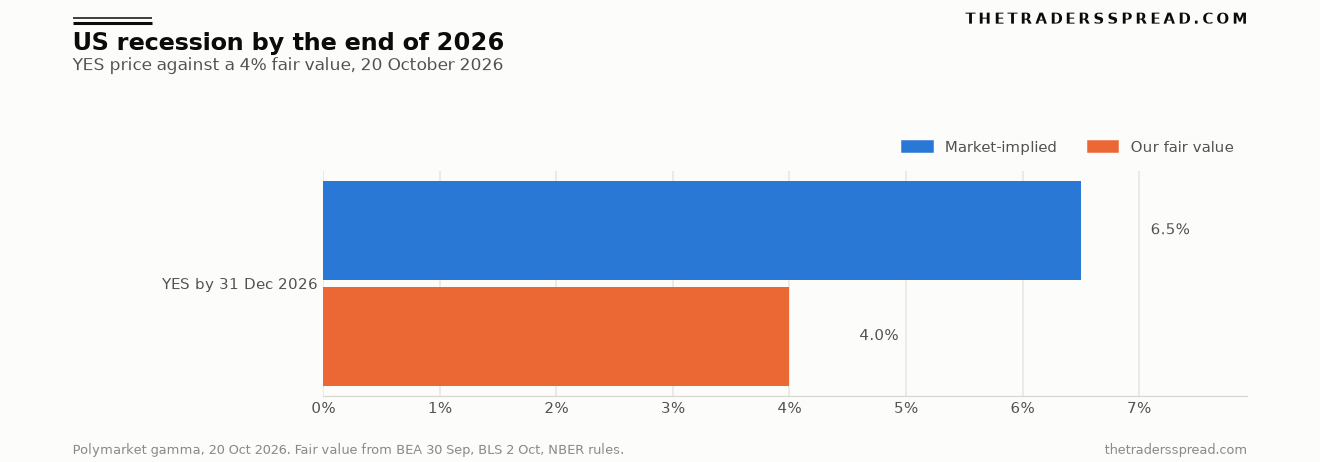
| Market Yes | Our fair value | |
|---|---|---|
| Probability | 6.5% | 4.0% |
| In cents | 6.5 | 4.0 |
| Book on 20 October | Bid 6, ask 7, last 7 | Below the bid |
| How the gap reads | Above fair |
Market column: Polymarket gamma API, 20 October 2026. The fair-value column is our judgment, set out below, not a BEA print. Polymarket is the venue.
About $61,000 of liquidity against $2.33 million of lifetime volume is a thin book. The one-cent spread is the minimum tick, about 15 percent of a 6.5 cent price, and the gap from 6.5 to 4 is wider than that spread.
GDPNow's recent errors were not three-point swings through zero. On 30 April the Atlanta Fed said the first-quarter advance was 2.0 percent, 0.8 points above the model's final nowcast. On 30 July the second-quarter advance matched the nowcast at 1.5 percent, and the BEA later revised that advance up to 2.2. The miss anyone is being asked to underwrite, from 3.6 percent on 15 October to a negative number on 29 October, is a different species.
Jefferson, Waller, and the October Beige Book
Philip N. Jefferson, Vice Chair of the Federal Reserve, said at the Darden School on 1 October 2026 that he saw the economy showing resilience, "by adding jobs and extending a six-and-a-half-year-long expansion." He said inflation had exceeded the 2 percent target for more than five years, put the twelve-month PCE price index at 3.4 percent in August, and expected unemployment to stay near August's 4.1 percent through year-end. The speech is on the Board's site. The next morning the unemployment rate printed 4.2 percent, inside the band the BLS has described since March.
Christopher J. Waller, a Governor of the Federal Reserve Board, addressed that report on 8 October in Istanbul: "While the number of jobs created was down overall, the employment report indicated that the labor market continued to be solid and stable in September." He put twelve-month core PCE inflation at 3 percent in August. The sentence that bears on this contract is the one about policy: "With evidence that economic activity is strengthening in the second half of this year, I am not greatly concerned that tighter monetary policy threatens a damaging slowdown in the economy." Both passages are in the 8 October speech.
Both men described September's decision as a quarter-point rise in the funds-rate target, to 3.75 to 4 percent. Waller said sixteen of eighteen September projections looked for at least one further increase at the two meetings left this year. Tighter policy is how a recession could still be produced. It is also the path both speakers refused to call the base case. A separate board on whether 2026 brings any rate cut is the cross-check on the same venue, and a high long-term yield already does some of the slowing in cash markets.
The October Beige Book, prepared at the Philadelphia Fed from information collected on or before 5 October, sits under those speeches. Two districts reported moderate growth, three modest, four slight, and three no significant change. Most saw little or no net change in employment, and most said the outlook was still positive, tilted to slight growth. The text is the October national summary. Soft. Not the committee's test of a significant, economy-wide decline.
Why a fatter price is not crazy
The labour argument for a higher Yes price is how close hiring sits to zero, not the unemployment rate itself.
The BLS on 2 October put September payrolls at plus 29,000, against a twelve-month average of 45,000. July was revised from plus 21,000 to minus 10,000, and August from 162,000 to 133,000, a combined 60,000 fewer jobs than first reported. Health care added 17,000, half its recent pace. Financial activities are down 129,000 since May 2025. Long-term unemployment was 1.9 million. Part-time work for economic reasons covered 4.5 million people.
Payrolls are one of the two series the NBER says it weights most. Three soft months would change the conversation. September was not that sequence. August was still plus 133,000 after the revision. One negative month is variance. It is not a peak.
Inflation is the other argument for a fatter Yes price. Jefferson put inflation risks on the upside, and said Middle East tension could still weigh on activity. A 5.0 percent annual rate on second-quarter PCE prices sits beside a 2 percent target, with twelve-month headline PCE at 3.4 percent and core PCE, on Waller's August reading, at 3. If faster tightening lands, the fourth quarter is where it would show. It still has to clear a 3.6 percent nowcast and then print two negatives or draw a fast NBER announcement. Those filters are why 6.5 cents looks rich, and why 4 percent is not 1.
A downturn that starts in November is unlikely to be announced by late January. The committee would rather be late than revise the chronology, and the quick 2020 call is its example of an extreme drop. The December decision can change the fourth-quarter story. It cannot rewrite the five positive quarters already in the window.
RelatedKharg Island: December Control at 7.5 Cents, Fair Lower
A 4 percent fair value, and what would move it
Our fair value is 4 percent. The Yes price of 6.5 cents sits above it, and above a bid of 6 cents. That reading is how the price sits against the evidence in hand. It is not an instruction to take a side. A thin book can hold a quote away from a model for as long as the size lasts.
On the output gate we allow a 3 percent chance the 29 October advance is negative, several times the 0.8-point first-quarter miss, so a trade or inventory surprise still has room. Even odds on a negative fourth quarter after that puts the living pair at 1.5 percent. The NBER gate gets 3 percent. About half overlaps that GDP path, because a collapse violent enough to force an announcement before 31 January 2027 would usually print two negative quarters as well. The slice that does not overlap is about 1.5 percent. One more point covers a November or December shock dated inside 2026 and announced on a 2020-style clock. The sum is 4 percent.
The contract is where that sum gets confirmed or embarrassed. A third-quarter advance below zero would make 4 percent too low, because the output gate would become a bet on the fourth quarter alone. An advance above 2 percent would push fair value down: the GDP gate would then need a collapse from a strong base, and a revision of the third quarter back through zero. On jobs, the test is a run. July at minus 10,000 sat between August at plus 133,000 and September at plus 29,000. A sequence of declines, or unemployment well outside the 4.1 to 4.3 percent band, would lift the NBER slice. The October employment report is due on 6 November.
Until one of those prints, 6.5 cents says the nowcast is about to miss by more than three points and the next quarter will follow it down, or that a committee which prefers to wait will announce inside a few months. Against a bid of 6 cents, that is the expensive claim.
Questions the contract actually answers
Does one negative GDP quarter settle this US recession market?
No. The BEA gate needs two consecutive quarters below zero, at a seasonally adjusted annual rate, from the second quarter of 2025 through the fourth quarter of 2026. One minus sign does not pay, and revising a single quarter through zero fails unless a neighbour is negative too. Advance estimates count. The NBER route is an announcement, not a GDP print.
Is the NBER definition the two-quarter rule?
No. The dating page describes a significant decline, spread across the economy and lasting more than a few months. Depth, diffusion and duration each have to be met to some degree. The committee leans on income less transfers and on payrolls, and it uses GDP and GDI for the quarterly date. Two down quarters can pass this contract without the committee agreeing, and the committee can announce without them.
When does the contract resolve?
The question is a recession by the end of 2026, and the event date is 31 December 2026. Settlement is slower. The market record lists 31 January 2027, and the rules stay open until a gate is met or the fourth-quarter advance appears. If that advance is missing on 30 June 2027 at 11:59 p.m. Eastern, the releases then in hand decide it. A lone negative at year-end does not pay.
Why is fair value 4 percent, not 6.5 cents?
Only the third and fourth quarters of 2026 can still form a negative pair, GDPNow was 3.6 percent on 15 October, and the NBER says it waits. We put 1.5 percent on both quarters printing negative, about 1.5 percent on an NBER call that does not overlap that path, and 1 percent on a shock severe enough to force a fast announcement. That sums to 4 percent, below the market's 6.5 cents.
What would make 6.5 cents look cheap?
A negative third-quarter advance on 29 October. The output gate would become a bet on the fourth quarter alone, and the chance of a follow-through quarter would rise. A run of payroll declines, or unemployment well outside the 4.1 to 4.3 percent band held since March, would lift the NBER gate. July at minus 10,000 was one month, not that run.
Does 4 percent mean the expansion is safe?
No. Hiring is thin, July was revised to a small loss, financial-activities employment is down 129,000 since May 2025, and second-quarter PCE prices rose at a 5.0 percent annual rate. Policy has just been tightened. Those facts are why fair value is 4 percent rather than near zero. On these rules, they are not a recession that has already qualified.
This is analysis, not advice. The contract can settle on a stricter test than the headline "US recession", and a price can sit away from a fair value for as long as the book holds it. Capital is at risk, including on a 6.5 cent claim that pays a dollar only if one of two specific tests is met.