

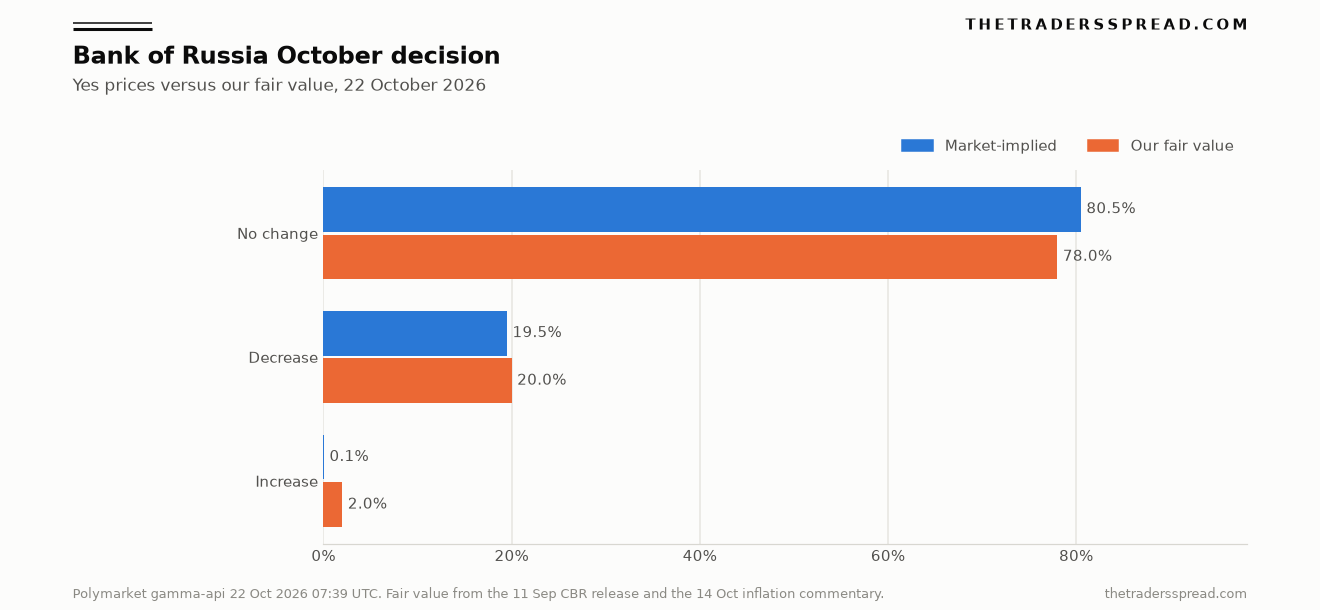
The Bank of Russia calendar sets the next key-rate meeting for 23 October 2026, with the press release due at 13:30 Moscow time, and the Polymarket no-change leg on that decision was marked at 80.5 cents in the gamma-api book updated at 07:39 UTC on 22 October.
The same snapshot priced a decrease at 19.5 cents and an increase at 0.05 cents. Added together, the three yes prices come to about one dollar, so this is one decision split three ways, not three separate questions. Event volume stood at $286,191, with $117,107 of that turning over in the prior 24 hours, against $35,308 of posted liquidity. The contract is the Bank of Russia decision in October on Polymarket. Links to Polymarket are affiliate links, from which The Traders Spread may earn a commission at no cost to you.
An 80.5 cent hold is not the same thing as a forecast that pins the Board to 14 percent. On 24 July the Bank of Russia set a baseline in which the key rate averages 14.5 to 14.6 percent for the whole of 2026. Run the daily key-rate database forward and a hold through 31 December lands near 14.59 percent. A 25 basis-point cut taking effect on 26 October, the same three-day lag as the July cut, lands near 14.55 percent. Both sit inside that band. A 25 basis-point hike would push the average to about 14.64 percent, which sits above it. The contract does not care about the size. Any cut resolves the decrease leg, and any increase resolves the increase leg. Into this snapshot the decrease leg had risen 8.5 percentage points in a day, and none of the inflation pages opened for this note was published inside that window.
Key facts
- Polymarket marked no change at 80.5 percent, a decrease at 19.5 percent and an increase at 0.05 percent, on $286,191 of event volume and $35,308 of liquidity. Polymarket gamma-api, updated 22 October 2026, 07:39 UTC.
- The key rate is 14.00 percent, in place since 27 July 2026, after a 25 basis-point cut decided on 24 July. Bank of Russia monetary policy page, last updated 21 October 2026, and the 24 July press release.
- Annual inflation was 6.35 percent in September 2026, up 0.02 percentage points from August, against a 4 percent target. Bank of Russia, Inflation in Russia No. 9, 14 October 2026.
- Seasonally adjusted price growth slowed to 6.5 percent in annualised terms in September, from 7.5 percent in August. Same commentary, 14 October 2026.
- The Board meets on 23 October 2026. The press release and the medium-term forecast are due at 13:30 Moscow time, and the Governor's press conference at 15:00. Bank of Russia calendar, page opened 22 October 2026.
- The July baseline puts the 2026 average key rate at 14.5 to 14.6 percent and annual inflation at 6.0 to 7.0 percent. Bank of Russia press release, 24 July 2026.
- In the day to the 22 October snapshot, the decrease leg rose 8.5 percentage points and the no-change leg fell 8.0. Polymarket gamma-api, oneDayPriceChange, 22 October 2026.
What does the Polymarket book actually show?
Gamma returns one event with three markets. Each is a yes or no on the sign of the change from the key rate in force before the meeting. The payload names the Bank of Russia release after the 23 October meeting as the source, and it can resolve as soon as that release is out. If no decision is issued by the end of the next scheduled meeting, it says the event resolves to no change. The market end stamp is 24 October 2026 at 03:59 UTC.
The marks below are outcomePrices, not a search-page screenshot. No change was "0.805". Decrease was "0.195". Increase was "0.0005". Bids and asks were still wide enough to matter.
| Leg | Yes price | Bid / ask | Last trade | Volume | Liquidity | 24h volume | One-day change | Our fair value |
|---|---|---|---|---|---|---|---|---|
| No change | 80.5% | 79 / 82 | 84 | $91,269 | $6,624 | $44,875 | down 8.0 pp | 78% |
| Decrease | 19.5% | 18 / 21 | 22 | $100,044 | $10,437 | $38,821 | up 8.5 pp | 20% |
| Increase | 0.05% | no bid / 0.1 | 0.1 | $94,878 | $20,055 | $33,411 | down 0.2 pp | 2% |
Prices are in cents on a one-dollar contract, except the increase ask and last trade, which gamma reported as 0.001. Volumes are volumeNum and liquidityNum, rounded to the dollar. The one-day changes are oneDayPriceChange. All of them are from the gamma-api response updated at 07:38 to 07:39 UTC on 22 October 2026.
Over the prior week the decrease leg rose 11.5 percentage points and the no-change leg fell 10, so most of that shift was the last day. In the hour before the snapshot the decrease leg was still up 4 points. Open interest was $89,639.
The no-change market is the quote a reader hits: 79 bid, 82 ask, last trade 84. Liquidity on that leg is $6,624, the thinnest of the three. The increase leg holds $20,055 against a yes price of 0.05 cents, which is size sitting on a tenth-of-a-cent ask. The three-cent spread on the hold is what a fair-value point has to clear.
Where does the key rate sit after the cuts this year?
The rate in force is 14.00 percent. The monetary policy page, updated 21 October 2026, dates that level from 27 July 2026 and links the September hold. The daily key-rate database, pulled for 1 January through 22 October 2026, prints 14.00 on every listed day from 27 July onward, including 22 October.
The decisions list records the way down: 50 basis points to 16.00 percent on 19 December 2025, then to 15.50 on 13 February 2026, 15.00 on 20 March, 14.50 on 24 April, 14.25 on 19 June, and 14.00 on 24 July. The 11 September meeting kept 14.00. Steps got smaller, then stopped. On the daily database the July cut prints from 27 July, not from the Friday of the decision. The average further down uses those effective dates, and it carries 1 to 4 January at 16.00 percent because 5 January, the first listed day, is still 16.00 and the rate applies on the holidays the table skips.
The 24 July release did not call the cut the last one. It asked for a smoother decrease, citing fuel's second-round effects and a fiscal path that was easier than the April projection. The baseline averages the key rate at 14.5 to 14.6 percent in 2026 and 10.5 to 12.5 percent in 2027, with inflation at 6.0 to 7.0 percent this year and on target after that. The 2027 range is still a cutting path. October is about the pace.
Elvira Nabiullina, Governor of the Bank of Russia, put the September choice in plainer words on the day. In her statement after the 11 September meeting she said: "All of the above factors have provided grounds for making a pause in cutting the key rate at today's meeting." The factors she named were a high current rate of price growth in July and August, elevated credit, fuel passing into a wider set of prices, and fiscal parameters that were due to be updated by the end of September. She also said the Bank of Russia would need more data before judging how large and how long those effects would be.
Did the September inflation print clear the test for another cut?
The test is in that statement. The decline in underlying inflation should resume as the capacity loss fades, she said, if demand growth stays modest. The condition follows: "However, the Bank of Russia needs to be sure that this is happening to cut the key rate." She also said the key rate cannot be cut automatically.
What arrived after that sentence is a September inflation print that cooled on the month and did not cool on the year. The Bank of Russia's commentary Inflation in Russia, No. 9, dated 14 October 2026, says annual inflation was 6.35 percent, up 0.02 percentage points from August. The monetary policy dashboard, updated 21 October, rounds the same month to 6.4 percent, against a 4.0 percent target. The 11 September press release had put annual inflation at 6.3 percent as of 7 September. The full month did not deliver a lower annual rate than the figure the Board had in front of it when it paused.
The month did cool. Seasonally adjusted price growth slowed to 6.5 percent annualised, from 7.5 percent in August, mostly on a normal September drop in fruit and vegetables. The stable part of the basket eased only slightly. Fuel's indirect effects diminished without going away. A 16 October regional note says food prices nationwide were unchanged and that education rose by more than a typical September.
In July the Board still had underlying inflation inside 4 to 5 percent annualised. On 11 September it raised that range to 5 to 6 percent, with July's seasonally adjusted price growth at 11.6 percent and core at 7.0 percent. The summary of that discussion, dated 29 September, records a broad consensus to hold at 14.00 percent, a demand for more data on fuel, and a choice to give no signal on the next step. The 14 October commentary then said the stable component had eased only slightly. "Be sure the decline is happening" is a higher bar than "the worst month is over." September fits the second phrase more easily than the first.
Both the release and the summary say proinflationary risks had risen and still outweighed the disinflationary ones. The disinflationary risk they name is a sharper slowdown in demand. The longer list runs through a reopened output gap, sticky expectations, a fiscal impulse above the forecast, and a worse external setting. Household expectations had fallen in August and were still well above the first half of the year. Business and market expectations had edged up.
Why is 23 October a forecast meeting, not only a rate meeting?
The calendar marks 23 October as a meeting that publishes the press release, the medium-term forecast, and a press conference by the Governor. The following summary of the discussion, and the commentary on the forecast, are dated 5 November. The next rate decision after that is 18 December, without a new forecast. October is one of the four meetings a year at which the path itself is rewritten.
July and September both postponed the fiscal numbers to this forecast. The baseline assumes the structural primary deficit falls to zero in 2029, with the path filled in once the government has sent new projections to the State Duma. A higher deficit than that baseline, the releases say, may require a tighter stance. The discussion summary puts the 2026 deficit in the July forecast at 2 percent of GDP, and notes that heavy second-half spending could push it above 2 percent. A larger impulse, other things equal, would mean tighter policy.
Corporate lending in July and August was fast even after one-off factors. Most participants still called conditions moderately tight. A minority called them close to neutral. That split is why 19.5 cents on a cut is a real price: the published consensus was a hold with no signal, and the argument under it was about how tight policy already is. This note did not open a new budget law.
RelatedNetanyahu Out by December: 40.5 Cents, Fair Value 32
The press-conference notice, dated 20 October, says Nabiullina will speak at 15:00 Moscow time on monetary policy and the medium-term forecast, from the Bank's press centre, with a broadcast on the Bank's site. Accreditation for reporters ran to 17:00 on 21 October. The rate release is at 13:30. The hour and a half between the two is when the forecast tables exist and the Governor has not yet walked through them.
Does the 14.5 to 14.6 percent average still leave room for a cut?
Yes. The band does not pick the winner between a hold and a 25 basis-point cut. It does lean against a hike. The arithmetic is ours, built from the daily key-rate database, not a figure the Bank has published as a year-to-date average.
From 1 January through 22 October is 295 calendar days. Weekends and the New Year holidays are filled at the rate in force. The average is 14.73 percent, because the year opened at 16 percent and only reached 14 percent on 27 July. Hold 14 percent through 31 December and the 365-day average is 14.59 percent, inside the band and near the top. A cut to 13.75 percent from 26 October, leaving 23 to 25 October at 14, produces 14.55 percent. The same cut from 23 October itself produces 14.54. A cut to 13.50 percent from 26 October produces 14.50, the floor of the range. A hike to 14.25 percent from 26 October produces 14.64, above the top.
The decrease leg pays on any cut, so 25 and 50 basis points are the same yes. The July band can absorb a 25 basis-point cut without a revision. A 50 basis-point cut only lands on the floor. A 25 basis-point hike would leave the average above the band the Board is about to replace. Our fair value is 20 percent on a decrease, 2 percent on an increase, and 78 percent on no change. The 2 percent is the chance that the new budget numbers are bad enough to reverse the July cut at this meeting, rather than only rewriting the path. It is a tail, and it is larger than the 0.05 percent the book prints, because the September text bothered to write the tighter-stance sentence.
Seventy-eight percent against an 80.5 mark is the comparison that decides the call. The live quote is 79 to 82. A reading of 78 sits one cent under the bid, which is not a gap the posted book will let a new order cross. The price is in line with the reading. The one-day jump in the cut, from about 11 percent to 19.5, closed most of the distance to 20 rather than opening a new one.
How does this sit next to the Fed, the ECB and the Bank of England?
The September discussion already had other central banks in the room. Participants said inflation was above target in the United States and the euro area, and that markets expected the federal funds rate and ECB rates onto a higher path. They also judged the direct effect of higher foreign yields on Russia to be limited.
Our own pages, read here as published headlines and not re-priced today, do not show one foreign path. The Fed December decision note is a hike. The ECB October note is a hold, not the rise the September room had been told to expect. The Bank of England November note is a 25 basis-point hike. The Bank of Russia book is the one that still carries a live cut, because its last easing step was a pause inside a cutting cycle.
The levels are not the same conversation. A 14 percent key rate with September inflation at 6.35 percent is a different real-rate question from a Fed book priced for a hike off a much lower nominal rate. If the new Russian forecast still assumes foreign rates are rising, the ECB hold in our October note is the sentence to check it against. Nothing opened here says the Board has swapped its reaction function for the Fed's.
What would move the price before 13:30 Moscow time?
The list is a checklist of releases and phrases, not a side to take. The fair value above is a reading of the 11 September decision and the 14 October inflation commentary. It is in line with the 80.5 cent hold. Something on this list would have to change the sign of the story, or the budget number, before the cents had a reason to leave the 79 to 82 quote.
- A budget figure, in the forecast or ahead of it, that puts the 2026 structural primary deficit above the 2 percent of GDP used in July. The September summary already tied a larger impulse to tighter policy. Any overshoot was not opened here, so its size is unknown.
- A new key-rate path that no longer averages 14.5 to 14.6 percent for 2026. A hold and a 25 basis-point cut both fit the old band. Repeating the band does not, by itself, choose between them.
- Whether the press release still calls this a pause in cutting, or says the Board is now sure underlying inflation is declining. Those are the September words. Dropping either one is the sentence the decrease leg is waiting on.
- The 15:00 press conference, once the tables are public. A remark that the fuel effects have faded enough to resume cuts, or that they have not, is the spoken version of the same test.
- A fuel headline before 13:30 that reopens the second-round story. The 14 October commentary said those effects had diminished and that petrol was still rising quickly.
- The lending-conditions survey listed at 19:16 on 21 October. It was not opened for this note, so it is not evidence here. It does sit inside the day when the cut leg was repricing.
- The book itself. Event liquidity is $35,308, the no-change leg has $6,624 and a three-cent spread, and the decrease leg was still moving in the hour before 07:39 UTC. The decrease market is where a modest order would show first.
The next hard times after the release are the 15:00 press conference on the same day, the discussion summary on 5 November, and the following rate meeting on 18 December, which does not bring a new forecast. Until 13:30 on 23 October, the published record is still a pause at 14.00 percent, a September inflation rate of 6.35 percent, and a book that prices the pause at 80.5 cents.