
Spreadex tells visitors to its indices page that it quotes the Germany 40 "from 1pt"; the firm's own market information table, two clicks from that sentence, prices the Germany 40 daily at 1.4 points. Both pages were live on 19 September 2026. Neither is a typo, because the same landing page manages a second mismatch in the space of four paragraphs: it opens by advertising Wall Street at 2.4 points and then, in a tile lower down, offers the same market at 1.7. The table says 2.4. For a firm that has spent twenty-five years selling the idea that a spread bet is simpler than a commission-and-spread account, the advertised number being the wrong one is an odd place to be casual. This review works from the tables rather than the taglines, and from the audited accounts rather than the awards strip.
Pull the tables apart and something stranger appears. Spreadex's published minimums are, instrument for instrument, the same numbers IG publishes on its charges page: EUR/USD 0.6, GBP/USD 0.9, USD/JPY 0.7, EUR/GBP 0.9, FTSE 100 and UK 100 at 1, S&P 500 and SPX 500 at 0.4, US Tech 100 at 1, Germany 40 at 1.4. Seven instruments, seven identical figures, both retrieved on 19 September 2026. Spreadex is not undercutting the UK market on its headline prices. It is sitting exactly on top of the largest firm in it, and the marketing copy that claims otherwise is contradicted by the firm's own price sheet. What actually separates Spreadex from IG, and from everyone else in this comparison, is not the spread at all. It is on page 25 of the accounts.
Key facts
- Germany 40 daily spread quoted at 1.4 points, against advertising copy on the same site claiming 1pt — Spreadex Indices Market Information and Indices landing page, retrieved 19 September 2026
- Group turnover £104,583,723 for the year to 31 May 2025, up 1.3% on £103,269,976 — Spreadex Limited group accounts, filed at Companies House 23 February 2026
- Note 4 of those accounts discloses no split between sports betting and financial trading revenue: "The whole of the turnover is attributable to the principal business activity of the Group"
- Overnight funding on index positions runs at the Adjusted ARR plus 3.5% a year, trebled on a Friday — Spreadex Indices Market Information, retrieved 19 September 2026
- Dividends paid rose 61% to £25,473,739 while profit after tax fell 2% to £31,652,860 — group accounts, year to 31 May 2025
- 61% of Spreadex retail clients lose money, the lowest of the five UK firms checked for this review — each firm's own risk warning, retrieved 19 September 2026
- The Court of Appeal refused Spreadex permission to appeal the forced sale of Sporting Index on 5 June 2026 — CMA case page, last updated 12 June 2026
The price sheet, read properly
Spreadex publishes a full market information table for every asset class, in two versions: one for spread bets, one for CFDs. The numbers in them are identical. That is worth stating plainly, because it is the single most useful thing on the site and the marketing never says it: a Spreadex CFD costs exactly what a Spreadex spread bet costs, with no commission layer on either. The firm is a pure spread-earner. There is no per-lot charge to hunt for, no currency conversion trap of the sort that has turned up elsewhere on this desk, and nothing that behaves differently depending on which platform you log into.
The tables themselves are specific. UK 100 daily at 1 point, SPX 500 at 0.4, US Tech 100 at 1, Germany 40 at 1.4, Wall Street at 2.4. On the currency side, EUR/USD at 0.6 and GBP/USD at 0.9. Those are floors, not fixed prices: the footnote under every table says spreads "are subject to variation, especially in volatile market conditions", and that larger trades "may be subject to wider spreads". The tile on the indices landing page that describes these same spreads as "Fixed" is therefore wrong twice over — wrong on the Germany 40 number, and wrong about the pricing model.
Step away from the dailies and the gap widens sharply. The December Germany 40 future is quoted at 7.6 points against 1.4 on the daily, the December UK 100 at 4 against 1, and the December Wall Street at 8 against 2.4. A quarterly contract carries its financing inside the spread, so some of that is arithmetic rather than mark-up. But a trader comparing Spreadex to a rolling-cash-only competitor is comparing two different products, and the site does not make the distinction loudly.
Where Spreadex sits against its peers
The Germany 40 is the cleanest instrument for a like-for-like check, because every UK retail firm quotes it, every one of them publishes a minimum, and it is liquid enough that the published floor means something. Each figure below came from that firm's own live pricing page on 19 September 2026.
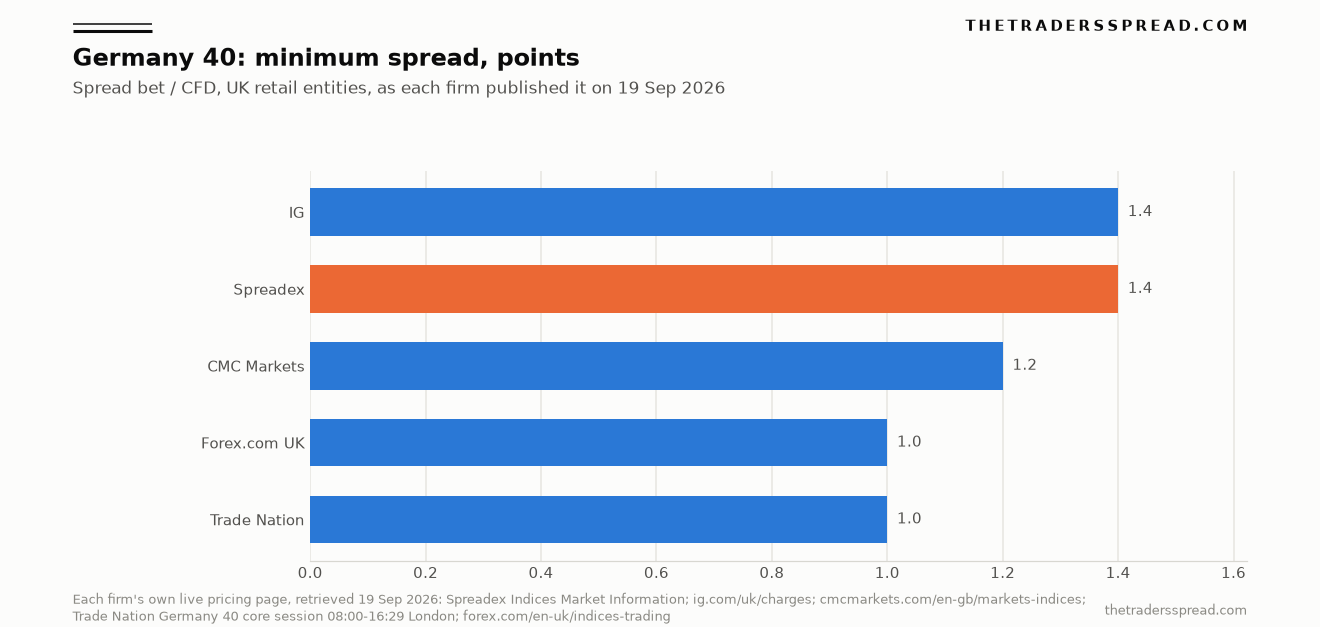
| Firm | Germany 40 minimum | Retail clients losing money | Source, retrieved 19 Sep 2026 |
|---|---|---|---|
| Spreadex | 1.4 pts | 61% | Indices Market Information |
| IG | 1.4 pts | 69% | ig.com/uk/charges |
| CMC Markets | 1.2 pts | 68% | cmcmarkets.com indices |
| Trade Nation | 1.0 pt core session | — | tradenation.com Germany 40 |
| Forex.com UK | 1.0 pt | 74% | forex.com/en-uk indices |
Spreadex is joint-widest, tied with IG, and 40% above the two firms at the bottom of the table. The Trade Nation figure carries a caveat that matters more than the headline: its 1.0 applies between 08:00 and 16:29 London, widens to 2 either side of that window, and goes to 6 overnight, which is the pattern this desk documented in its Trade Nation review. Spreadex's 1.4 does not carry a published time-of-day schedule at all, which cuts both ways: no advertised overnight blow-out, and no published commitment either. For context on the instrument itself, the Germany 40 sits close to the levels examined in our DAX forecast, and the UK 100 in our FTSE 100 forecast.
The charge that does the work
Spread comparisons flatter Spreadex more than they should, because the spread is not where a position of any duration bleeds. Hold an index daily overnight and Spreadex charges the Adjusted ARR plus 3.5% a year on the full notional. The firm publishes the arithmetic itself: a £1 stake on the UK 100 at 9200, with the reference rate at 4%, costs £1.89 a night. Friday's charge is trebled to cover the weekend.
With Bank Rate held at 3.75% on 17 September, that 3.5% mark-up roughly doubles the financing cost of a long index position relative to the underlying rate. A £10-a-point position on the UK 100 at 9200 is £92,000 of notional; at 7.25% all-in that is a little over £18 a night, £126 across a week including the Friday treble. The 0.4 points Spreadex charges on the SPX 500 is recovered by the funding charge inside three sessions. Short positions run the other way and can be credited, which is the part traders forget: at a 4% reference rate a short index holder receives 0.5% a year rather than paying.
This is the same structural point that made the Capital.com review uncomfortable reading. A no-commission broker has to earn its money somewhere, and with the Bank of England holding above 3.5%, the overnight charge has quietly become the largest line item for anyone who holds past the close. Spreadex at least publishes the formula and a worked example, which more of its competitors should.
One company, two regulators, one undivided number
Here is the thing the price tables cannot tell you. Spreadex Limited holds Financial Conduct Authority authorisation under firm reference numbers 190941 and 150404, and a Gambling Commission licence, and it runs both books inside the same legal entity. The strategic report puts it without embarrassment: Spreadex "remains the only group that offers both sports and financial spread betting services", and the two products are "available from one account".
Then Note 4 arrives and says: "The whole of the turnover is attributable to the principal business activity of the Group. All turnover arose within the United Kingdom." That is the entire segmental disclosure for £104,583,723 of revenue. A prospective client cannot establish from the audited accounts whether financial trading is 15% of this business or 60% of it, whether the trading desk subsidises the sports book or the reverse, or which side absorbed the 1.3% revenue growth. The accounts are FRS 102 and the disclosure is lawful. It is also, for a firm asking retail traders to post margin with it, remarkably thin.
What the accounts do disclose is a balance sheet that removes most solvency questions. Net assets of £134,242,955 at 31 May 2025, up from £128,063,834. Cash of £97,480,612, nearly double the prior year's £49,413,504. Profit before tax of £43,218,930 on that £104.6m of turnover — a 41% pre-tax margin, which tells you a great deal about the economics of market-making against retail flow even if it tells you nothing about which retail flow. Average headcount was 202. The audit is signed by Hillier Hopkins LLP for a fee of £78,930, and the accounts were signed on 27 August 2025 by director D R MacKenzie before being filed on 23 February 2026.
One number in that set deserves attention. Dividends paid jumped 61% to £25,473,739, or £2.21 a share against £1.37, in a year when profit after tax fell 2% to £31,652,860. The group paid out roughly four-fifths of its post-tax earnings to shareholders. That is entirely within a private company's gift, and the net asset position still rose. It is nonetheless a distribution pattern that sits oddly next to a strategic report describing continued investment in marketing, sponsorship and systems.
The Sporting Index overhang, now resolved against them
Spreadex bought the B2C business of Sporting Index in 2023. The Competition and Markets Authority opened a merger inquiry on 28 December 2023, concluded that the deal substantially lessened competition in UK licensed online sports spread betting, and in November 2024 required Spreadex to sell it.
The FY2025 strategic report, written in August 2025, described the outcome as uncertain and noted that any divestiture "would not be expected to conclude for at least 18 months from the date of the conclusion of the appeal". Spreadex appealed. The CMA case page, last updated on 12 June 2026, records how that went: the Competition Appeal Tribunal dismissed all grounds on 19 March 2026, refused permission to appeal on 28 April 2026, and the Court of Appeal refused permission on an expedited basis on 5 June 2026. Final undertakings had already been accepted on 3 October 2025 and a remedy group appointed, with a revised panel effective 1 May 2026.
For a financial trading client the direct read-across is small: the CMA case concerns sports spread betting, not the FCA-regulated side, and the remedy is a disposal rather than a fine. The indirect read-across is not nothing. A forced sale removes a business Spreadex paid for, consumes senior management attention across three years of litigation, and lands on a group whose accounts already refuse to tell you how much of its revenue the sports side generates. Anyone sizing counterparty risk here is doing so with one eye covered.
What the 61% figure does and does not say
Spreadex's risk warning states that 61% of its retail investors lose money. Checked against the same disclosure on four competitors on the same day, that is the lowest of the group: CMC Markets 68%, IG 69%, Pepperstone 72.9%, Forex.com UK 74%. The instinct is to read it as evidence of better execution or a gentler product mix.
Resist that. The FCA-mandated figure is a four-quarter count of accounts that ended in loss, and it is powerfully sensitive to client mix rather than broker quality. A book weighted toward lower-leverage, lower-frequency positions will print a lower number than a book of high-turnover FX scalpers, whatever the firm does. Spreadex's client base is old, British and, on the evidence of a minimum stake of 2p a point on Wall Street and 5p on the Germany 40, deliberately pitched at small positions. The 61% is consistent with that, and with the firm's own description of itself as a market maker in all markets in which it operates, taking the other side and hedging what it chooses to. It is not, on its own, evidence that clients do better here. Our IG review found the same statistic concealing an extreme revenue concentration, and Spreadex publishes nothing that would let anyone test whether the same is true of its book.
The verdict
Spreadex rates 3.5 out of 5 on this desk. The pricing is honest in structure even where the marketing is careless in detail: one spread, no commission, the same number on CFDs as on spread bets, a published funding formula with a worked example, and published minimum stakes low enough that a beginner can size a position sensibly. The balance sheet is strong, the FCA and Gambling Commission authorisations are held by the operating entity rather than an offshore affiliate, and client money is segregated under a policy the directors describe as conservative.
RelatedMarkets.com Review 2026: Safecap Holds the CFD Contract
Against that, the Germany 40 spread is joint-widest in this comparison, the advertised figures on the firm's own site do not match its own price table on at least two markets, the funding charge of ARR plus 3.5% is at the expensive end for anyone holding overnight, and the accounts disclose a single undivided revenue line for a group running two quite different books. The Sporting Index divestment is now certain after the Court of Appeal's June refusal, and its cost is unknown to outsiders.
It suits a UK-resident trader who wants spread betting's tax treatment, trades index and FX dailies in modest size, values a single account for sports and financial markets, and closes positions rather than holding them for weeks. It suits a systematic or high-frequency trader considerably less: there is no raw-spread commission account to fall back on, no published intraday spread schedule, and no MetaTrader ecosystem. Anyone whose decision rests on knowing how much of a counterparty's revenue comes from financial clients will not find that number in the filings, and should weigh the absence accordingly.
What would change this rating: a segmental revenue note in the FY2026 accounts, or a correction of the advertised spreads to match the price table, would move it up. Evidence that the Sporting Index disposal materially dented the capital position would move it down.
Frequently asked questions
Is Spreadex regulated in the UK?
Yes. Spreadex Limited is authorised and regulated by the Financial Conduct Authority, and its audited accounts for the year to 31 May 2025 name firm reference numbers 190941 and 150404 alongside a Gambling Commission licence for the sports side. The FCA's public register is served as a single-page application that cannot be retrieved programmatically, so the reference numbers here are taken from the company's own filed accounts rather than from the register directly.
Does Spreadex charge commission?
No. Both its spread betting and CFD market information tables carry identical spreads with no commission column, and the two tables quote the same numbers instrument for instrument. The cost sits entirely in the spread and, for positions held overnight, in the funding charge of the Adjusted ARR plus 3.5% a year on index positions, trebled on Fridays to cover the weekend.
Why do Spreadex's advertised spreads differ from its tables?
The firm does not explain this. On 19 September 2026 its indices landing page advertised "1pt on Germany 40" in two separate places while the linked market information table quoted 1.4, and the same page gave Wall Street as both 2.4 and 1.7 points. The market information tables are the contractual reference and should be treated as the real numbers.
How large is Spreadex?
Group turnover was £104,583,723 in the year to 31 May 2025, with profit before tax of £43,218,930 and net assets of £134,242,955. Average headcount was 202. The accounts do not separate sports betting revenue from financial trading revenue, so the size of the trading business specifically is not disclosed.
What happened with Sporting Index?
The Competition and Markets Authority required Spreadex to sell the Sporting Index B2C business it acquired in 2023. The Competition Appeal Tribunal dismissed Spreadex's appeal on 19 March 2026 and refused permission to appeal on 28 April 2026, and the Court of Appeal refused permission on an expedited basis on 5 June 2026. The case remained formally open on the CMA's register as of its last update on 12 June 2026.
Can non-UK residents use Spreadex?
The accounts state that all turnover arose within the United Kingdom, and the firm operates through a single UK entity rather than the offshore structures common elsewhere in this sector. Spread betting's tax treatment is a UK-specific feature and carries no benefit outside it.
This review is analysis, not advice. Spread bets and CFDs are leveraged products and capital is at risk. Spreadex's own risk warning states that 61% of its retail investor accounts lose money. All figures were retrieved from primary sources on 19 September 2026 and pricing changes without notice.