
Bonhill Street is a short cut-through behind Finsbury Square, and the sixth floor of number 14 is the registered office of Trade Nation Financial UK Ltd. At 22:00 London time, long after that floor goes dark, something happens on the firm's price feed that no marketing page mentions. The EUR/USD spread, advertised quite accurately as fixed, steps from 0.5 pips to 5.0. It holds there for exactly sixty minutes, then falls back to 0.6 and stays there until morning. None of this is hidden. It sits in the market-information table on Trade Nation's own EUR/USD page, retrieved 16 September 2026, in a row most visitors never expand.
That row is the entire fixed-spread argument compressed into one hour. Trade Nation is the only retail broker of real scale that prices its whole book this way, which makes it structurally unlike the thirty-odd variable-spread firms already reviewed on this desk. The useful question was never whether fixed beats raw-plus-commission. It is when, and by how much.
Here is the part the comparison sites miss. A Trade Nation fixed spread is not a constant at all; it is a step function with published steps, and the firm publishes every step for all 130 instruments on its UK schedule. Pull the same table from the South African and Australian sites and the spreads are byte-for-byte identical. The margin requirement is not. EUR/USD carries 3.33% margin in the UK and Australia and 0.2% through the South African entity, which is 30:1 against roughly 500:1 on the same price, in the same platform, for the same trade.
Key facts, each with its source
- EUR/USD fixed spread runs 0.5 pips from 07:00 to 21:59 UK, 5.0 from 22:00 to 22:59, and 0.6 overnight — tradenation.com market information, retrieved 16 September 2026.
- No commission, no deposit fee, no withdrawal fee and no dormancy or inactivity fee — Trade Nation Financial UK Ltd Rate Card, September 2026.
- Overnight funding carries an administration charge of 2.5% a year on FX, indices and shares, and 3% on commodities — same Rate Card, September 2026.
- Turnover of £25,285,025 in the year to 30 November 2025, of which £19,894,728 was management charges billed to group companies — Companies House, full accounts for 07073413, filed 30 March 2026.
- Authorised by the FCA since 09/05/2011 under firm reference 525164, with four separate clone-firm warnings attached to the record — FCA Financial Services Register, retrieved 16 September 2026.
- 73.7% of retail investor accounts lose money trading CFDs with the provider, against 69% at IG and 68% at CMC Markets — each firm's own UK risk warning, retrieved 16 September 2026.
- Minimum deposit ranges from £0.01 to £5 depending on payment method — Trade Nation deposits and withdrawals, retrieved 16 September 2026.
A fixed spread is a timetable, not a promise
Variable-spread brokers pass the interbank spread through and add a commission. Their cost to you is unknowable in advance and tends to blow out precisely when you most want to trade: data releases, gaps, the thin hours. Trade Nation inverts that. It quotes a number per instrument per time band, commits to it, and absorbs the widening itself. The cost of that commitment is that the firm has to price for the worst case inside each band, which is why the bands exist at all.
The 22:00 band is where the worst case lives. That hour is the daily rollover, when the underlying spot market rolls value dates and liquidity thins to almost nothing. Trade Nation does not widen dynamically, so it widens on a clock instead.
| Instrument | Best band | Worst band | Ratio |
|---|---|---|---|
| EUR/USD | 0.5 (07:00–21:59) | 5.0 (22:00–22:59) | 10.0x |
| GBP/USD | 0.8 (07:00–21:59) | 8.0 (22:00–22:59) | 10.0x |
| USD/JPY | 0.6 (07:00–21:59) | 6.0 (22:00–22:59) | 10.0x |
| UK 100 | 0.8 (08:00–16:29) | 5.0 (21:00–06:59) | 6.3x |
| Germany 40 | 1.0 (08:00–16:29) | 6.0 (21:00–06:59) | 6.0x |
| Wall Street 30 | 1.9 (14:30–20:59) | 4.0 (21:00–06:59) | 2.1x |
| Gold, per 0.1 | 4.0 (07:00–18:59) | 6.0 (19:00–06:59) | 1.5x |
Source: Trade Nation UK market-information tables for each instrument, tradenation.com, retrieved 16 September 2026. All UK time.
Read down the ratio column and the design becomes legible. Currencies are cheap when London and New York overlap and brutally expensive for one hour at the roll. Indices are cheap when their cash market is open. Gold barely moves at all, because gold barely stops trading.
The honest reading is that Trade Nation's headline numbers are real and its tail numbers are worse than a variable broker's would be at the same moment. A trader who only touches EUR/USD between breakfast and the New York close will never see the 5.0. Anyone running an overnight automated system across the roll will pay it every single night.
What one lot actually costs
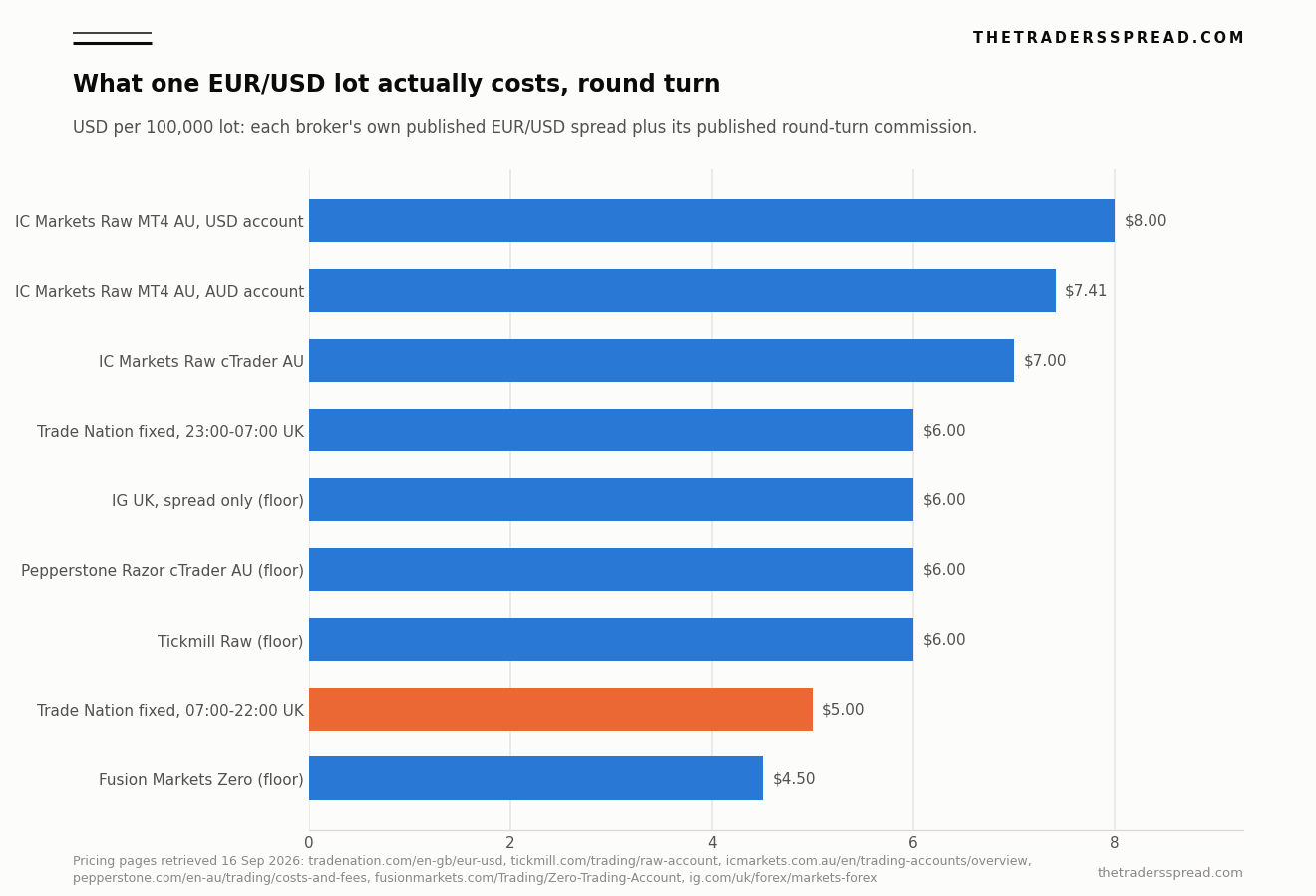
Every figure in that chart came from the broker's own live pricing page on 16 September 2026, and each one is labelled with the platform and entity it applies to, because those two things move the number more than the brand does. The all-in basis is simple: the broker's published EUR/USD spread multiplied by ten dollars a pip, plus its published round-turn commission, on one 100,000 lot.
| Broker, platform, entity | Published EUR/USD spread | Round-turn commission | All-in |
|---|---|---|---|
| Fusion Markets Zero | from 0.0 | $4.50 | $4.50 floor |
| Trade Nation, TN Trader, 07:00–22:00 UK | 0.5 fixed | none | $5.00 certain |
| Tickmill Raw | from 0.0 | $6.00 | $6.00 floor |
| Pepperstone Razor, cTrader, AU entity | min 0.0 | $6.00 | $6.00 floor |
| IG UK, spread only | from 0.6 | none | $6.00 floor |
| Trade Nation, TN Trader, 23:00–07:00 UK | 0.6 fixed | none | $6.00 certain |
| IC Markets Raw, cTrader, AU entity | 0.1 average | $6.00 | $7.00 |
| IC Markets Raw, MT4, AUD account | 0.1 average | AUD 9.00 = $6.41 | $7.41 |
| IC Markets Raw, MT4, USD account | 0.1 average | $7.00 | $8.00 |
| Trade Nation, TN Trader, 22:00–23:00 UK | 5.0 fixed | none | $50.00 certain |
Sources, all retrieved 16 September 2026: tickmill.com/trading/raw-account; icmarkets.com.au and ic.com spreads; pepperstone.com/en-au; fusionmarkets.com; ig.com/uk. AUD converted at the ECB reference rate for 15 September 2026 published by frankfurter.dev, 1 AUD = 0.71255 USD.
The word "floor" is doing heavy lifting in that table, and it is the crux of the comparison. Tickmill, Pepperstone and Fusion Markets publish a minimum EUR/USD spread of zero, which no account achieves on average across a day. Their real all-in cost sits above the floor by whatever their average raw spread happens to be. Trade Nation's $5.00 is not a floor. It is the number, every time, in that band.
So the crossover falls out cleanly. Against Tickmill's Raw account at $3.00 a side, Trade Nation is cheaper in the main session no matter what, because $6.00 of commission alone already exceeds the $5.00 fixed cost. The same holds against Pepperstone's Razor tier on cTrader and against IC Markets, whose $3.00 cTrader fee is $3.50 on MT4. Only Fusion Markets, at $4.50 round turn, starts below Trade Nation, and it overtakes as soon as its raw spread averages more than 0.05 pips.
Note the IC Markets rows. The same MT4 Raw trade costs AUD 9.00 round turn on an Australian-dollar account and USD 7.00 on a dollar one; converted, that is $6.41 against $7.00. Account currency alone moves a peer's commission by more than eight per cent, which is why a headline number from a comparison site is worthless.
Six entities, three registers that answered
Trade Nation discloses six regulated entities in its site footer. I checked each against the regulator's own record rather than the firm's description of it.
The FCA register confirms Trade Nation Financial UK Ltd, firm reference number 525164, authorised since 9 May 2011, registered company 07073413 at 14 Bonhill Street, permitted to hold and control client money, trading under four names. The record also carries four clone-firm notices: FXTrade777 added January 2019, hksvf in May 2019, a cluster of Tradenationltd variants in February 2023, and tradenaus.com plus two sibling domains in August 2023. Clone warnings mean criminals think a brand is worth impersonating, not that the firm erred, but anyone checking a domain should know four exist.
ASIC's own AFS Licensee dataset, September 2026 extract, lists AFSL 422661 as Trade Nation Australia Pty Ltd, ABN 93 158 065 635, licence start date 11 October 2012, authorised to deal in and make a market for derivatives and foreign exchange contracts to retail and wholesale clients in Sydney. That confirms the website exactly.
The Securities Commission of The Bahamas lists Trade Nation Ltd. in its registrants schedule as at 31 August 2026, with four permitted categories including advising on capital market instruments and trading CFDs. Two things differ from the firm's own disclosure. The register does not print a licence number, so SIA-F216 remains the company's claim rather than a figure I read on the regulator's page. And the address on the register is Office 2B, One Sandyport Plaza, West Bay Street, against the Bayside Executive Park address in the website footer.
Three I could not verify. The FSCA's public provider search returned nothing usable from this host on the day, so FSP 49846 for Trade Nation Financial (Pty) Ltd stands on the firm's own disclosure. So do the Portuguese CMVM licence 601 and, more importantly, Seychelles FSA licence SD150 held by Trade Nation Financial Markets Ltd. A Seychelles securities dealer sits several rungs below an FCA or ASIC permission in every respect that matters to a retail client, and the firm's own jurisdiction notice names Seychelles as one of five markets it addresses. Which entity a given client onboards to is determined by the country domain they land on, and it changes the compensation scheme, the leverage cap and the insolvency waterfall.
£25.3m of turnover, £5.4m of it from clients
The UK accounts filed at Companies House on 30 March 2026 are the most revealing document Trade Nation produces, and almost nobody reads them.
Turnover for the year to 30 November 2025 was £25,285,025, up 17% on £21,668,505. Operating profit went from £636,136 to £3,811,052, a sixfold jump, and profit after tax reached £3,788,759. Average monthly headcount was 92, up from 84. On those numbers the FCA-licensed entity looks like a healthy mid-sized broker.
The segment note complicates that picture. Of the £25.3m, £19,894,728 was management charges and only £5,390,297 was everything else. Geographically £5,352,195 arose in the United Kingdom and £14,762,269 in North America, with Africa contributing £4,953,182 against £2,076,577 the year before. The directors are candid about what the overseas line is: "The income derived from overseas is in relation to group management charges which are not regulated by the FCA," wrote Mr J Noble, Director, in the strategic report signed on 23 March 2026 and audited by Crowe U.K. LLP.
Read plainly, the entity holding the UK licence is a group back office with a UK trading book attached, and the trading book is the smaller part. That is not a scandal. It is a materially different thing from what "FCA-regulated broker with £25m of revenue" suggests, and the fastest-growing piece of the business by far is Africa, where the leverage cap is 500:1 rather than 30:1.
The same report contains the firm's own summary of its strategy: "transparent and fair client charges, fixed even when market volatility increases, that offer traders some of the best value to be found anywhere in the marketplace." The first half of that sentence is verifiable and true. The second half survives on EUR/USD in session and does not survive contact with the metals book.
Where the fixed spread loses, on Trade Nation's own price list
Fifteen instruments on the UK schedule carry a variable-spread alternative alongside the fixed one. On the fourteen where both numbers are published, the variable quote is the cheaper of the two at every hour of the day.
Gold is quoted at a fixed 4 in session and 6 outside it, against a flat 3.6 on the variable option — 10% cheaper by day and 40% cheaper overnight. Brent Crude is 4 fixed against 2.8 variable. Platinum is 3 and 5 fixed against 2.1 variable. Silver, palladium, copper, aluminium, lead and zinc all run the same way. The firm's signature product is the more expensive one on every commodity where it offers a choice, which is a strange thing for a price list to admit.
For scale outside the house, Pepperstone's Razor tier publishes a raw XAU/USD spread from 0.08 with commission from USD 3.50 per lot per side, retrieved 16 September 2026. Trade Nation's 40-cent fixed gold spread carries no commission at all, so the two are not directly interchangeable, but the gap is wide enough that an active gold trader is paying for certainty they may not want.
Related€15 Libertex EUR/USD same-day ticket, spread held at zero
Two other structural limits. There are 130 line items on the UK schedule, of which five are share buckets rather than individual equities, which is how a firm advertising "1,000+ markets" fits in one table. And the platform set is TN Trader, MT4 and a TradingView integration, with no MT5 — a real constraint for anyone whose strategy or expert advisor has already moved across.
The verdict: 3.6 out of 5
The base case is that Trade Nation is what it says it is for a specific trader and oversold for everyone else. Someone trading major FX or a cash index between 07:00 and 21:00 London, in retail size, without an overnight book, gets a cheaper and knowable cost than any raw-plus-commission account on this desk except Fusion Markets. Add the absence of inactivity, deposit and withdrawal fees, which Capital.com's no-commission model matches but many do not, and the retail proposition holds. I put that at roughly a 70% likelihood of being the right read for the average UK client.
The bull case, maybe 15%, is that the group keeps compounding the way the 2025 accounts suggest and the fixed model turns out to be the durable differentiator in a market where regulators keep tightening disclosure on variable pricing. Operating profit rising from £636k to £3.8m in twelve months is not a rounding error, and Africa nearly tripling its contribution shows the model travels.
The bear case, the remaining 15%, is that the 22:00 band and the commodity book are not edge cases but the business model showing through, and that a client who trades anything other than session-hours majors is systematically paying above market for certainty. The Seychelles and Bahamas entities sit awkwardly beside the FCA permission, and the UK entity's actual client-facing revenue of £5.4m is small enough that its bargaining power with liquidity providers deserves scrutiny.
What would change the rating. An MT5 offering or a published average-spread disclosure would push it up. So would independent confirmation of the FSCA and Seychelles licences on the regulators' own registers. It would come down if the 22:00 band widened further, if the variable option quietly replaced fixed pricing on more instruments, or if the next set of accounts showed UK client revenue flat while management charges grew again. On the evidence in front of me on 16 September 2026, 3.6 is where it lands.
Questions readers actually ask
Is Trade Nation's spread genuinely fixed?
Yes, within each published time band, and the bands are the catch. EUR/USD is contractually 0.5 pips from 07:00 to 21:59 UK and contractually 5.0 pips from 22:00 to 22:59. The firm commits to both numbers and does not widen dynamically in between, so the spread is fixed in the sense that matters legally and variable in the sense that matters to your fill at 22:15.
Which Trade Nation entity would I actually be a client of?
It depends on the country site you sign up through. UK visitors onboard to Trade Nation Financial UK Ltd under FCA firm reference 525164, Australians to Trade Nation Australia Pty Ltd under AFSL 422661, South Africans to Trade Nation Financial (Pty) Ltd. The footer also names Bahamian, Seychelles and Portuguese entities. Compensation cover, leverage caps and insolvency treatment all differ by entity.
What does Trade Nation charge beyond the spread?
Its September 2026 Rate Card lists no commission, no deposit fee, no withdrawal fee, no inactivity fee and no platform or market-data subscription. The real ongoing costs are overnight funding, which carries a 2.5% annual administration charge on FX, indices and shares and 3% on commodities, a nightly admin fee on rolling futures, and a 0.45% currency conversion mark-up on TN Trader.
Is client money protected?
For retail clients of the UK entity, yes. The Client Agreement dated September 2026 confirms segregation under CASS 7, negative balance protection under clause 3.3, FSCS eligibility and access to the Financial Ombudsman Service. Clause 14.7 is the one to read carefully: professional and elective professional clients may agree to title transfer, in which case funds are not segregated and rank as a general creditor claim on insolvency.
How does it compare with the big UK spread-betting names?
On cost, Trade Nation's 0.5 fixed EUR/USD undercuts the 0.6 minimum IG publishes on its UK forex page. On breadth it is far behind: 130 schedule line items against the tens of thousands IG and CMC Markets carry. The published loss rates run 73.7% at Trade Nation, 69% at IG and 68% at CMC, all retrieved 16 September 2026.
Is there a minimum deposit?
Effectively no. Trade Nation's deposits page puts the minimum between £0.01 and £5 depending on payment method, Deposits in GBP, USD and EUR are accepted; card funding is usually instant and bank transfers clear in two to five business days.
This review is analysis, not advice. Nothing here is a recommendation to open an account, deposit funds or place a trade. Spread bets and CFDs are leveraged products and carry a high risk of losing money rapidly; Trade Nation's own UK disclosure states that 73.7% of its retail investor accounts lose money. Figures were verified on 16 September 2026 from the sources linked above and can change without notice. Capital is at risk.