
IG Group calls itself a financial technology company serving more than 1.4 million customers, and that figure is often taken as proof that the London spread-betting firm founded in 1974 has turned into an investing app; its own half-year numbers say otherwise. In the six months to 30 June 2026, IG counted 843,600 active customers. Only 110,100 of them, about 13%, were active in OTC derivatives, the spread bets, CFDs and other leveraged contracts that IG Index Ltd and IG Markets Ltd write for UK clients. Those accounts produced £460.5 million of the group's £588.8 million net trading revenue, or 78%. The 638,600 customers active in stock trading and investments, most of them on Freetrade, produced £41.9 million. Every figure here comes from the H1 2026 results announcement published on 30 July. This review of IG's UK retail offer starts with that split, because it decides what the broker is built to do well.
Divide revenue by customers and the gap becomes the story. Each active OTC derivatives customer was worth roughly £4,183 of net trading revenue to IG in a single half-year. Each stock-trading and investing customer was worth about £66. That is a ratio of roughly 64 to one. In the UK and Ireland division the leveraged figure is higher: 36,700 active OTC customers generated £172.9 million, about £4,711 each. Now set that beside the risk warning on IG's UK homepage, read at 07:14 UTC on 14 September 2026, which says 69% of retail investor accounts lose money when trading spread bets and CFDs with this provider. A comparatively small group of active traders pays for the business, and on IG's own UK disclosure most retail accounts in that group finish the measurement year behind. None of this is hidden. It is simply split between a results PDF and a website footer.
- OTC derivatives produced £460.5m of £588.8m net trading revenue (78%) from 110,100 of 843,600 active customers (13%) — IG Group H1 2026 results, 30 Jul 2026
- 69% of retail investor accounts lose money with IG's UK spread betting and CFD business, while the footer of IG's UK help centre shows 68% — ig.com/uk and IG Help Centre UK, read 14 Sep 2026
- EUR/USD is priced from a 0.6 minimum spread on UK spread bets and CFDs, and UK share CFDs carry 0.10% commission — IG UK charges page, read 14 Sep 2026
- The CFD overnight admin fee is listed as 1% for FX on the charges page, but the funding help page calculates CFD FX at 0.3% (0.8% on mini contracts) — IG UK, both read 14 Sep 2026
- Currency conversion on spread bets and CFDs costs 0.8%; inactivity, deposit and withdrawal fees are listed as free — IG UK charges page, read 14 Sep 2026
- IG agreed to acquire Underdog, a US daily fantasy sports and prediction markets operator, for up to about $1.3 billion — IG Group announcement, 30 Jul 2026
Where IG's revenue actually comes from
The group grew fast in the first half. Total revenue rose 18% to £642.8 million, net trading revenue rose 21% to £588.8 million and EBITDA rose 4% to £282.0 million, a 44% margin. The customer count grew even faster, up 66%, because IG consolidated Freetrade from April 2025 and the crypto exchange Independent Reserve from 30 January 2026. On an organic basis, active customers rose 13%.
The leveraged book moved differently. Active OTC derivatives customers went from 108,200 to 110,100, a 2% rise, while OTC net trading revenue climbed 19%. More money from almost the same number of people means revenue per leveraged customer went up. IG attributes the OTC growth to 24/7 and pre-IPO markets and to elevated volatility in APAC, where OTC revenue rose 27% to £182.6 million.
The reporting calendar has also changed. IG's financial year used to end on 31 May; the group now reports on a calendar year, and its investor relations page lists an annual report for the period to 31 December 2025. The H1 statement describes 31 May as "IG's former financial year end" when it sets the interim dividend of 14.46 pence. No annual report exists for a year to 31 May 2026, so "FY26" figures on that basis deserve suspicion.
The strategic direction is also moving away from the UK leveraged trader, at least in emphasis. "The acquisition of Underdog establishes IG as a leader in US prediction markets, one of the most significant opportunities across trading and entertainment," said Breon Corcoran, Chief Executive Officer at IG Group, in the acquisition announcement of 30 July 2026. The price is up to about $1.3 billion, an enterprise value of about $1.1 billion plus a roughly $200 million earnout, with a separate incentive plan of up to $850 million tied to Underdog's 2028 and 2029 EBITDA. Completion is expected in late 2026 or early 2027.
A second change sits above the regulated companies. On 8 July IG proposed a new Jersey-incorporated holding company, to be introduced by a court-approved scheme and expected to take effect in the fourth quarter. Shares stay listed in London and IG Group Holdings plc remains head of the FCA-supervised regulatory group, so a UK client's counterparty does not change. Refreshed strategy and guidance follow on 22 October.
69%, 70% or 72%? Loss figures across IG's own sites
The FCA's COBS 22.5 rules require every UK CFD and spread-betting firm to publish the percentage of its retail client accounts that lost money, recalculated every three months over the preceding 12 months. Every UK broker prints it in the same wording, which makes it the fairest single peer comparison, though it reflects client mix as much as costs.
IG's UK homepage, charges page and MetaTrader 5 page all showed 69% on the morning of 14 September. The footer of the IG Help Centre UK, read minutes later, still showed 68%, most likely a figure left over from an earlier quarterly calculation. Other IG entities print their own numbers. IG Europe GmbH says 72% of retail accounts lose money trading CFDs, and IG International Limited says 70% for OTC leveraged products. Each figure is legitimate for its entity. A reader who sees "IG" and a single loss rate should check which company and which site it came from.
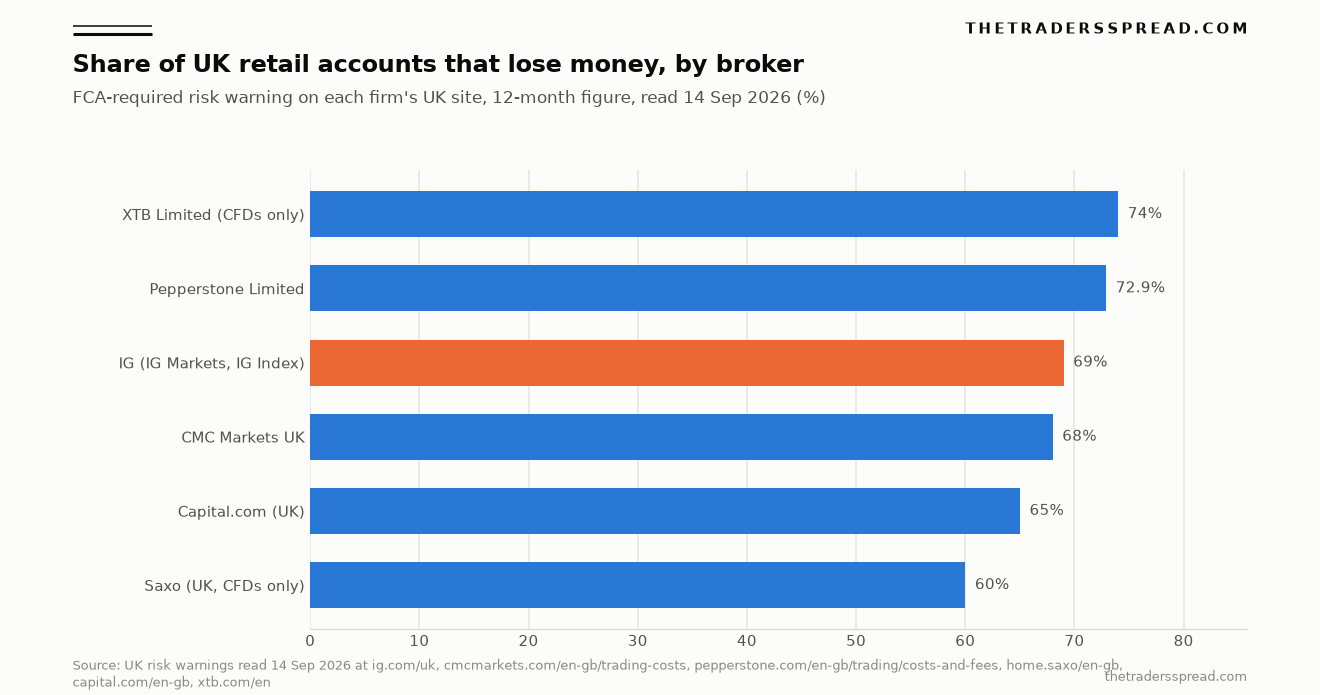
Against five UK peers read the same morning, IG sits in the middle. XTB Limited shows 74% for CFDs and Pepperstone Limited 72.9% for spread bets and CFDs. CMC Markets UK reports 68%, Capital Com (UK) Limited 65% and Saxo's UK site 60% for CFDs. Our reviews of Pepperstone, XTB and Capital.com cover each firm's pricing in detail.
| Firm (UK entity) | Register reference printed on the page | Accounts losing money | Products the figure covers |
|---|---|---|---|
| IG Markets Ltd / IG Index Ltd | FCA 195355 / 114059 | 69% | Spread bets and CFDs |
| XTB Limited | FCA 522157 | 74% | CFDs |
| Pepperstone Limited | FCA 684312 | 72.9% | Spread bets and CFDs |
| CMC Markets UK plc | FCA 173730 | 68% | Spread bets and/or CFDs |
| Capital Com (UK) Limited | Company no. 10506220 | 65% | Spread bets and CFDs |
| Saxo (UK) | FCA 551422 | 60% | CFDs |
All figures read from each firm's UK website on 14 September 2026 between 07:14 and 07:22 UTC.
Saxo and XTB state a CFD-only figure, while the other four fold spread betting in, so the comparison is close rather than exact. It still shows that IG's scale buys no better outcome for the typical retail account. Its figure is within a point of CMC's, the other London-listed spread-betting firm in the table.
What a UK account costs, line by line
IG publishes minimum spreads only. On the UK charges page, read on 14 September, both the spread betting and CFD tabs list EUR/USD from 0.6, EUR/GBP and GBP/USD from 0.9 and USD/JPY from 0.7. The FTSE 100 is quoted from 1, the S&P 500 from 0.4, the US Tech 100 from 1 and the Germany 40 from 1.4. Spot gold starts at 0.3 and Brent at 2.8. No average is published, so the number a trader actually pays during a busy London open cannot be checked in advance. Our ActivTrades review ran into the same problem when it set IG's floor against rivals that do publish averages.
For context, Pepperstone's UK costs page, read on 14 September, lists a 1.0 minimum on EUR/USD for its Standard account and 0.5 on spread bets, and its commission-based Razor account from 0.0 plus £2.25 per lot per side.
Share CFDs on IG carry commission of 0.10% on UK and European stocks and 2 cents a share in the US, built into the price shown at order entry. Currency conversion costs 0.8% on spread bets and CFDs, against 0.7% on IG's investing products. Deposits and withdrawals by bank transfer, debit card and credit card are free, with per-transaction deposit limits of £99,999 by debit card and £30,000 by credit card. Account opening, closing and maintenance are free, and the inactivity fee is listed as free. The optional stop that fixes an exact exit price carries a premium only if it is triggered. ProRealTime charts cost £30 a month, refunded in any month with four or more trades, according to IG's extra-services page.
Overnight funding is where the documentation frays. The charges page gives the spread betting admin fee as 1.5% for FX and 3.4% for other asset classes, and the CFD fee as 1% for FX and 3% for others. The overnight funding help page, updated this week, agrees on spread bets and on CFD indices, shares and commodities, but its CFD forex formula uses 0.3%, or 0.8% for mini contracts. On the help page's own example of one standard EUR/USD contract at 1.0650, the 0.3% rate sets the daily admin mark-up at about $0.89. The 1% on the charges page would make it about $2.96. One of the two pages is wrong, and IG does not say which.
Two of the worked examples on that help page also fail their own arithmetic. The FTSE 100 spread bet example states a SONIA rate of 4.4871% and then adds 0.48% to the 3.4% admin fee, producing a charge of £4.92; with the stated rate the same position costs about £10.01 a night. The US Tech 100 CFD example subtracts a 1.53% SOFR rate from 3% and writes the answer as 0.97% rather than 1.47%, so its $37.49 should be about $56.82. The formulas are right. The examples understate the cost by about a third and about a half respectively, which matters on a page designed to show clients what holding a position costs.
Who holds the licence, and who holds the cash
IG's UK footer names three FCA-authorised companies: IG Markets Ltd (register number 195355) for CFDs, IG Index Ltd (114059) for spread betting, and IG Trading and Investments Ltd (944492) for share dealing and ISAs. Crypto services sit with IG Digital Assets Ltd. The FCA register itself is a JavaScript application that returned a nine-word shell to our fetch, so we corroborated the core entity through Companies House: IG Markets Limited, company 04008957, incorporated on 1 June 2000, active, registered at 88 Wood Street in the City of London, with accounts last made up to 31 December 2025. The parent, IG Group Holdings plc, is registered at the same address.
Outside the UK, the structure is local. IG Europe GmbH, Frankfurt commercial register HRB 115624, appears in the BaFin company database as a securities institution and crypto-asset service provider. The ASIC licensee dataset for September 2026 lists IG Australia Pty Ltd under AFSL 515106, granted on 2 June 2020, and IG's Australian site adds a New Zealand derivatives issuer licence, FSP 684191. The legacy IG page this review replaces still describes Australian clients as dealing with IG Markets Ltd, which has not been the case since that licence was granted.
American clients meet a different brand. tastyfx, LLC is a CFTC-registered retail foreign exchange dealer and NFA member (NFA ID 0509630), linked to IG through common ownership of IG US Holdings, Inc. Its pricing page states that tastyfx "is compensated through a hedging arrangement with IG Markets Ltd", so the London company still stands behind the US forex flow.
On client money, IG's client funds page says retail cash is held in segregated trust accounts spread across several banks, naming Barclays and Lloyds, under the FCA's CASS rules, and that some may be placed in qualifying money market funds. The page does not give a total. One more housekeeping gap: IG International's site still calls the group a FTSE 250 constituent, while the July results describe IG Group as a FTSE 100 company.
Platforms, and the traders they are built for
The product range is where IG's scale shows most clearly. UK clients get IG's own web platform and app, plus MetaTrader 4 with FX Blue and Autochartist add-ons. The MetaTrader 5 page advertises 45 extra indicators and free VPS hosting, and TradingView connects for both spread bets and CFDs. ProRealTime is available for the £30 monthly fee noted above. L2 Dealer gives direct market access on share CFDs and share dealing, while Forex Direct on the same platform is limited to professional clients.
New accounts can trade at 25% of normal minimum deal sizes for 31 days under IG's reduced minimums offer. None of the pages we read stated a minimum deposit for spread betting or CFD accounts, so we have not quoted one.
RelatedTitan FX Commissions Contradict Zero Advertisement
That breadth fits the revenue data. A firm that earns about £4,183 per leveraged customer per half-year can afford to run six trading front ends, 24/7 markets and pre-IPO contracts. It has less reason to compete on published average spreads, because its best customers stay for tools and market access rather than a fraction of a pip. The broker comparison hub sets IG beside the firms we have reviewed on current data.
Verdict: built for the active minority, documented unevenly
We rate IG 4.1 out of 5. The strengths are the ones that matter most for a leveraged account. Three FCA-authorised UK companies sit under a London-listed, FTSE 100 parent that reports results twice a year. Separate BaFin and ASIC licensed entities serve Europe and Australia. Client cash sits in segregated trust accounts at named banks. Deposits, withdrawals and inactivity are free. The platform choice is wide, spanning spread betting, CFDs, share dealing, DMA, MT4, MT5, ProRealTime and TradingView.
The deductions are about transparency rather than solvency. IG quotes minimum spreads and no averages. Its own pages disagree on the CFD forex funding rate by a factor of more than three, two of its funding examples miscalculate the charge, and its help centre carried a different loss figure from its homepage on the day we checked. None of these would stop a well-informed trader, but each makes the true cost harder to know before the first statement.
The data says IG suits UK traders who hold positions for days or weeks across many markets, want spread betting and CFDs under one group alongside an ISA or share-dealing account, and use the professional platforms enough to clear the ProRealTime refund. It suits less well a high-frequency forex trader who judges brokers on verifiable per-trade cost, where firms that publish averages or commission-based raw pricing are easier to assess. It is also worth remembering that 69% of IG's UK retail accounts lost money over the latest 12-month measurement period.
What would change the rating: an average-spread disclosure, a single reconciled funding schedule, or a fall in the published loss rate would each push it higher. A rise in the loss rate after the Underdog deal closes, or any sign that the redomicile alters UK client protections, would push it lower.
IG review FAQ
Is IG regulated in the UK?
Yes. IG Markets Ltd (FCA 195355) provides CFDs, IG Index Ltd (FCA 114059) provides spread betting and IG Trading and Investments Ltd (FCA 944492) provides share dealing, according to IG's UK website. Companies House lists IG Markets Limited as active, company 04008957, registered at 88 Wood Street, London. The FCA register did not render for our automated check.
What percentage of IG clients lose money?
IG's UK homepage said on 14 September 2026 that 69% of retail investor accounts lose money when trading spread bets and CFDs with IG. IG Europe GmbH shows 72% for CFDs and IG International 70%. The UK figure is recalculated every three months over the previous 12 months under FCA rules, so it changes over time.
Does IG charge an inactivity fee?
Not according to its current UK charges page, which lists account opening, closing, maintenance and inactivity as free on spread betting and CFD accounts. Card and bank deposits and withdrawals are also free. Separate charges can apply for ProRealTime (£30 a month unless four trades are placed), live share data feeds and currency conversion at 0.8%.
How much does IG charge to hold a position overnight?
It charges the relevant interbank rate plus an admin fee. For spread bets that fee is 1.5% on FX and 3.4% on other markets. For CFDs the charges page says 1% on FX and 3% elsewhere, but IG's funding help page calculates CFD forex at 0.3%, or 0.8% for mini contracts, so the platform's swap rate is the figure to rely on.
Is tastyfx part of IG?
Yes, in effect. tastyfx, LLC is a CFTC-registered retail forex dealer and NFA member (ID 0509630) linked to IG through common ownership of IG US Holdings, Inc. Its pricing page says it is compensated through a hedging arrangement with IG Markets Ltd. US clients therefore deal with tastyfx, not IG's UK companies.
Disclaimer
This review is independent analysis for information only and is not investment advice or a recommendation to open an account with any broker. Spread bets and CFDs are complex instruments and carry a high risk of losing money rapidly due to leverage. Broker fees, licences and conditions change: check the provider's current documents before trading. Capital is at risk.