
Minus 0.01592 per cent a day. That is what Capital.com charges to hold a long gold CFD overnight, printed in the instrument table on the broker's own charges and fees page, where we read it on 1 September 2026. The number looks like a rounding error. Multiply it by 365 and it is 5.81 per cent of the position's full face value every year, and because the Financial Conduct Authority lets a retail client post 5 per cent margin against gold, that 5.81 per cent is levied on twenty times the cash in the account. A trader who puts up $1,000 and holds the resulting $20,000 of exposure for a year pays roughly $1,162 in funding. The fee is larger than the stake.
Nine lines above it, on the same page, sits the phrase "Trading commission — NO FEE".
Both statements are true, and that is the interesting part of this Capital.com review. It is not a gotcha about hidden charges, because nothing here is hidden. Capital.com publishes every rate with worked examples, and names its own revenue lines on its how we make money page: "our revenue comes from spreads, overnight funding", stop-loss premiums and regional fees, and "no commission is charged on positions". What the disclosure never does is convert a daily percentage of notional into an annual percentage of the money a retail client has at risk. That conversion is where the cost structure lives.
We did it, then went looking for who is legally charging it, and found two live Cyprus licences where the marketing implies one.
Key facts, all read on 1 September 2026
- Trading commission, account opening and closing, deposits and withdrawals: NO FEE on every count — Capital.com charges and fees
- No inactivity fee anywhere on the fee schedule; the word returns zero hits — Capital.com charges and fees
- Platform overnight fee: 4 per cent a year, netted against SOFR for USD markets and SONIA for GBP markets, divided by 360 or 365 by currency convention — Capital.com charges and fees
- Long gold: −0.01592 per cent a day = 5.81 per cent of notional a year = 116 per cent of the 5 per cent margin — The Traders Spread calculation
- Minimum deposit and withdrawal: £20 / €20 / $20 — Capital.com charges and fees
- Two live Cyprus licences at one Limassol address: CIF 319/17 (7 April 2017) and CIF 463/25 (10 November 2025) — CySEC register
- Disclosed retail loss rate: 65 per cent on capital.com/en-gb, 89 per cent on capital.com/en-eu — the respective risk warnings
The arithmetic the fee page stops one step short of
The overnight formula has two parts: an interest-rate benchmark tracking the currency of the underlying market, plus or minus the platform's own daily fee. "Our daily fee is 4% per year," the page says, and the worked examples show the day-count. A USD index example uses a daily fee of 0.01111 per cent, which is 4 per cent divided by 360. A GBP spread-bet example uses 0.01096 per cent, which is 4 per cent over 365.
Run that against the instrument rates and the structure decomposes cleanly. US Crude Oil and Brent both charge −0.01096 per cent a day in both directions: 4 per cent a year on the nose, futures basis netting to nothing. On crude, the published rate is the platform fee standing alone. Gold's −0.01592 per cent is that same 0.011111 per cent fee plus about 0.0048 per cent of commodity basis; the US Tech 100's −0.02157 per cent is the fee plus roughly 0.01046 per cent a day of SOFR, about 3.77 per cent annualised.
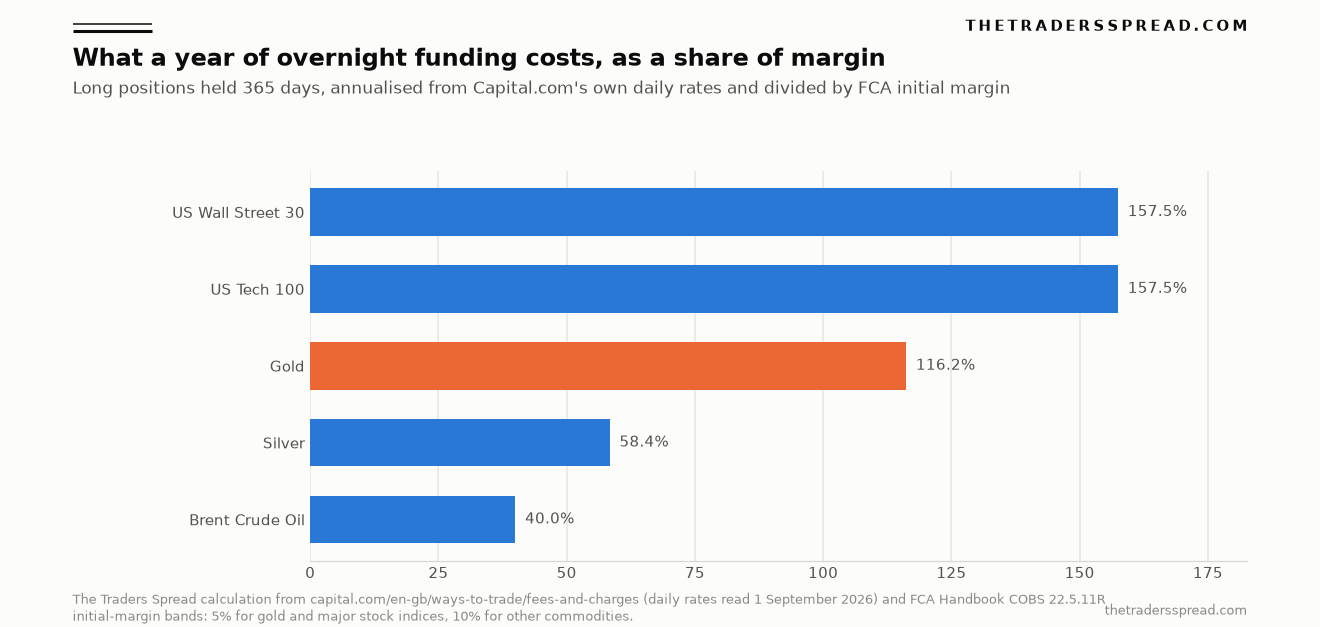
The step nobody takes is the last one. A daily percentage of notional, annualised then divided by the FCA's required initial margin, gives the number a leveraged retail client experiences. COBS 22.5.11R sets that margin: 5 per cent of exposure for a major stock market index or gold, 10 per cent for a commodity other than gold. Here is what falls out.
| Capital.com instrument | Long overnight, daily | Annualised, % of notional | FCA initial margin | Annual cost as % of margin |
|---|---|---|---|---|
| US Tech 100 | −0.02157% | 7.87% | 5% | 157.5% |
| US Wall Street 30 | −0.02157% | 7.87% | 5% | 157.5% |
| Gold | −0.01592% | 5.81% | 5% | 116.2% |
| Silver | −0.01600% | 5.84% | 10% | 58.4% |
| Brent Crude Oil | −0.01096% | 4.00% | 10% | 40.0% |
The Traders Spread calculation. Daily rates from Capital.com's charges and fees page, read 1 September 2026; margin bands from FCA Handbook COBS 22.5.11R. The daily rate is multiplied by 365, because the charge applies every calendar day a position is open.
Gold is the row that matters commercially. Capital.com's press release of 9 July 2026 says gold accounted for 42 per cent of its second-quarter trading volume. The instrument carrying the largest share of the book is also the one whose annual carry exceeds the margin behind it, and both facts come from the company.
Two caveats belong on this table rather than buried. Short gold and silver positions receive a small credit, because the basis runs the other way, so this is a cost of being long rather than of trading. And an intraday position pays none of it: unleveraged 1:1 CFD positions are exempt entirely, bar a short list including natural gas, cocoa, the VIX and Turkish lira pairs. The 116 per cent figure describes a leveraged position held for months, the behaviour a commission-free, deposit-free, inactivity-fee-free account encourages. Traders sizing gold exposure can read our gold price prediction alongside the carry; the live rate sits on our gold market page.
Which Capital.com you actually sign with
Capital.com is not one firm. It is a group of licensed entities, and which one holds your money is decided by where you live, not by the website you land on.
The UK contract is with Capital Com (UK) Limited, registered in England and Wales under company number 10506220, with a registered office at 2nd Floor, 4 Orchard Place, London SW1H 0BF. Its September 2024 terms open by stating that the firm is authorised and regulated by the FCA under Firm Reference Number 793714, and the same number appears in the footer of capital.com/en-gb. We could not confirm it against the FCA's own register. That register is a single-page application serving 58 characters of visible text to an automated client, its public API returned {"Success":"false", "Missing Headers."}, and a reader proxy hit a challenge page. The FRN is therefore broker-stated and corroborated across two of the firm's own documents, not verified on the register.
Cyprus is where it gets genuinely odd, and the CySEC register is public and machine-readable, so this part we did verify. Two entities are live simultaneously:
- Capital Com SV Investments Ltd — CIF licence 319/17, licence date 7 April 2017, company registration 354252, registered at Vasileiou Makedonos 8, Kinnis Business Center, 2nd floor, 3040 Limassol
- Capital Com Group Ltd — CIF licence 463/25, licence date 10 November 2025, company registration ΗΕ 446198, registered at the same Vasileiou Makedonos 8, Kinnis Business Center, 2nd floor, 3040 Limassol
Both entities list the same eleven EU locale domains as approved, and the same telephone number. The capital.com/en-eu footer names both companies in one legal block, and its copyright line still reads "© 2026 Capital Com SV Investments Limited" while the risk warning above it is attributed to Capital Com Group Ltd. A licence granted in November 2025 that duplicates the domain permissions of a 2017 licence, at the same address, is a migration between two Cyprus vehicles. Nowhere is it explained, and nowhere does an EU client learn which firm currently holds their agreement. We put the same structural question to another broker in our Fusion Markets review, and the answer there was cleaner.
Australia is the tidiest entity. Capital Com Australia Pty Ltd holds AFS licence 513393, granted 16 June 2021, ABN 47625601489, in Melbourne, per ASIC's current AFS Licensee dataset, which we searched directly. Its conditions repay reading: they authorise the licensee to "make a market for the following financial products: (i) foreign exchange contracts; and (ii) derivatives", to retail and wholesale clients. Capital.com Australia is not routing to an exchange. It is the counterparty.
The group also holds a Bahamas licence (SIA-F245), UAE authorisation, FSCA dual approval in South Africa from 23 June 2026, a Kenyan CMA licence and a Bermuda permission. Clients outside the UK, EU and Australia typically contract with the Bahamas entity, which sits behind no compensation scheme.
On the South African approvals, Travis Robson, Chief Executive Officer for South Africa at Capital.com, said: "Operating through a regulated local entity matters because it shapes the environment in which decisions are made." He is right. The sentence reads differently once you notice that the group's own EU clients cannot easily tell which regulated local entity they are in.
One clause deserves flagging. The CCUK terms require a customer to warrant they "are not domiciled or located in the United States of America or the European Union" (clause 1.5(c)). The UK entity is closed to EU residents by contract.
The client-money clause that only bites professionals
Retail clients of the UK entity get the standard protections. Money sits under the FCA's client-money rules, and clause 17.4 confirms cover by the Financial Services Compensation Scheme, whose published limit for investment claims is £85,000 per eligible person per firm.
Professional clients get something else. Clause 2.5(h), sitting in the block of terms that apply specifically to professional customers, reads:
"Where your funds are subject to a Title Transfer Collateral Arrangement ('TTCA'), full ownership of the money is transferred to us for the purpose of covering your obligations. Accordingly, your funds subject to TTCA are not treated as 'Client Money' for the purposes of the FCA's Client Money Rules and will not be segregated from the money held in our bank account(s) and may be used in the course of our business. In the event of our insolvency, you will rank as a general creditor in respect of any funds subject to TTCA."
That is not unusual language in institutional broking. It is unusual to find it two clauses from 2.5(g), which notes that "Professional Customers do not have restrictions on leverage", and one section from the risk disclosure's warning that professional customers "could lose more than the sum they have invested" because negative balance protection no longer applies. Take professional status here and three things change at once: leverage caps come off, negative balance protection comes off, segregation comes off. A client may opt out of TTCA treatment at any time, and the terms say so. But the default runs the other way, and the three changes sit in three separate places.
A smaller clause at 4.9 is easy to miss: interest on instruments held in custody "will be retained by us".
EU clients fall under the Investor Compensation Fund, nominally €20,000. We could not confirm current ICF coverage for either Cyprus entity from a primary source. With two licences live, which entity's membership applies is the question the disclosure should answer and does not.
What is genuinely free, and it is a lot
None of that should obscure how much of the advertised pricing survives the documents.
Account opening, account closing and the demo account cost nothing. Deposits cost nothing. Withdrawals cost nothing above a £20 floor. There is no commission on any CFD or spread bet. And there is no inactivity fee: we searched the schedule across five locales and the word never appears, which puts Capital.com ahead of rivals that quietly bill £10 a month against a dormant balance. Set against our broker comparison hub, the pattern is consistent. The fees Capital.com removed are the ones a dormant account meets. The fee it kept is the one an active leveraged position meets.
Currency conversion is the one non-trivial charge that is easy to underestimate: 0.7 per cent of the spot rate for retail clients, 0.5 per cent for professionals, built into the exchange rate rather than billed separately. It applies to realised profit and loss, overnight funding and dividend adjustments on any market denominated outside the account's base currency, so a GBP account trading US indices meets it on almost every cash movement.
Spreads we cannot verify, and will not pretend otherwise. The spread column of the instrument table renders client-side and returned empty to our fetch. Any EUR/USD, gold or UK 100 spread quoted in a Capital.com review that did not come from a funded live account is a published minimum or illustrative figure, not a measurement. We hold ours to the standard we applied when we timed a rival's live feed in our ActivTrades review. We have not run that test here.
RelatedAlpari Review 2026: EUR/USD Ticket Is $25 at Close
Verdict
Capital.com is a well-licensed, well-disclosed broker with a pricing model that is honest in its parts and misleading in its total. Every "NO FEE" on the schedule is real. The overnight fee is also real, charged on full notional rather than margin, and at the firm's own published rates it costs a long gold holder 5.81 per cent of exposure a year, or 116 per cent of the cash behind it. On the US Tech 100 the same arithmetic gives 157 per cent. None of it is concealed. It is simply never expressed in the unit a leveraged retail client thinks in.
The regulatory footprint is broad and mostly verifiable. CySEC 319/17 and 463/25 check out on the register and ASIC 513393 checks out in the licensee dataset, while the FCA FRN is stated consistently by the firm without our confirming it at source. The two Cyprus licences are the loose thread: a 2017 vehicle and a 2025 vehicle sharing an address, a phone number and eleven approved domains, with no public word on which an EU client contracts with today.
Where the platform fits is clear once the carry is in view. It suits short-hold, high-turnover trading, where zero commission is a real edge and funding barely accrues. It fits multi-month leveraged exposure poorly, because the carry runs against the position at a rate rivalling its own expected return. That is a statement about the cost curve, not about what anyone should do.
The Traders Spread rating: 3.7 / 5. Marked up for disclosure quality, genuinely absent nuisance fees and a real multi-jurisdiction licence stack. Marked down for an overnight cost only legible after arithmetic the broker does not perform, an unexplained dual-entity position in Cyprus, and professional terms that strip segregation, leverage caps and negative balance protection across three documents.
Frequently asked questions
Does Capital.com charge commission?
No. The charges and fees page lists "Trading commission — NO FEE", and the firm's own revenue page confirms it earns from spreads, overnight funding, GSL premiums and regional fees instead. The absence of commission is real, not offset by a hidden per-trade charge.
How much is Capital.com's overnight fee?
The platform component is 4 per cent a year, divided by 360 for USD and EUR and 365 for GBP, CAD and SGD, then netted against SOFR or SONIA. The all-in rate per instrument is published daily: long gold was −0.01592 per cent a day and the US Tech 100 −0.02157 per cent on 1 September 2026.
Is there an inactivity fee at Capital.com?
None is published. We searched the fee schedule across five locales on 1 September 2026 and found no occurrence of the word. Account opening, account closing, the demo account, deposits and withdrawals are also listed at no charge, above a £20 / €20 / $20 floor.
Who regulates Capital.com?
CySEC licenses two Cypriot entities, 319/17 since 2017 and 463/25 since November 2025. ASIC licenses Capital Com Australia Pty Ltd under AFSL 513393. The UK entity states FCA authorisation under FRN 793714, which we could not confirm on the register. Bahamas, UAE, South African, Kenyan and Bermudian permissions are also held.
Is client money protected at Capital.com?
For UK retail clients, yes: funds sit under FCA client-money rules and the firm confirms FSCS cover, currently £85,000 per eligible person for investment claims. For UK professional clients under a Title Transfer Collateral Arrangement, ownership passes to the firm and the client ranks as a general creditor on insolvency. Bahamas clients have no scheme.
Has Capital.com faced regulatory enforcement?
We found none in the one source we could search, the CySEC administrative-sanctions listing. The FCA register was unreachable and other registers exposed no searchable enforcement history. That is a record of what we could not find, not a finding that no action exists.
Methodology and disclosure
Every figure here was read from a primary source on 1 September 2026 and is dated in the text. Fees come from Capital.com's charges and fees page. Entity data comes from the CySEC register and ASIC's AFS Licensee dataset, both queried directly. Contractual language comes from the September 2024 CCUK terms and risk disclosure. Quotes come from Capital.com releases of 5 August and 23 June 2026.
All annualised percentages are The Traders Spread's own arithmetic from Capital.com's published daily rates and the FCA's margin bands. Capital.com does not quote or endorse them; the working is shown above so a reader can check it. We hold no live account, which is why no spread here is a measured figure, and the FCA Firm Reference Number is reported as stated by the broker rather than verified on the register. Group scale figures were omitted: the investor-relations page still cites 2024 totals, and the newest dated figure we could stand up is $1.27 trillion in client volume for the first quarter of 2026.
Disclaimer. This is analysis and information, not financial advice, and nothing here is a recommendation to trade any instrument or to use any broker. CFDs and spread bets are leveraged products carrying a high risk of rapid loss. Capital.com's own disclosures put the proportion of retail accounts that lose money at 65 per cent on its UK site and 89 per cent on its EU site. Capital is at risk, and fee schedules change without notice.