
City Index retired its UK brand on 12 September 2026, and the homepage that replaced it still says the firm is trusted by 1 million traders, while the press release three days earlier put the same retail franchise at more than 260,000 accounts. Both lines were on StoneX's own pages on 1 October. They can both be technically true. They cannot both be comfortable.
The 9 September release said new accounts would open as StoneX Trading and that clients would keep their platforms and support. Its boilerplate put the retail book at more than 260,000 accounts. On 1 October the individuals homepage dropped City Index from the masthead and said the firm is trusted by 1 million traders. The asterisk, absent from the heading, defines that million as live and demo accounts globally over the last two years. A stock of retail accounts and a two-year flow of demo tickets are not the same count.
Key facts
- UK brand retirement: 12 September 2026, with new account openings moving to StoneX Trading — StoneX Group press release, 9 September 2026.
- Retail line in that release: more than 260,000 accounts. Homepage line on 1 October 2026: 1 million traders, footnoted as live and demo accounts globally over the last two years — StoneX press release and individuals homepage, read 1 October 2026.
- EUR/USD on the spread-bet and CFD tables: minimum 0.7, typical 0.8, retail margin from 3.33%, and no FX commission. At $10 a pip on one standard lot, the spread paid once, that is $7.00 at the minimum and $8.00 at the typical — StoneX Trading charges page, 1 October 2026.
- Homepage FX line the same day: 85 pairs and spreads from 0.5 points. On the charges table, 0.5 is the AUD/USD minimum. EUR/USD's minimum is 0.7 and its typical is 0.8 — StoneX individuals homepage and charges page, 1 October 2026.
- Contracting company: StoneX Financial Ltd, number 05616586, status Active, registered office Moor House, First Floor, 120 London Wall, London EC2Y 5ET — Companies House, read 1 October 2026. The site footer cites FCA number 446717. An FCA clone warning last updated 28 October 2022 names the same firm, number and address.
- Inactivity: £12 a month on a sterling account, or $15 on a US-dollar account, after 12 months with no trade and no open position — StoneX charges page, 1 October 2026.
- The provider's own CFD loss figure, printed on the individuals homepage: 68% of retail investor accounts lose money when trading CFDs with this provider — StoneX, 1 October 2026.
The company on the register
StoneX Group Inc. published the rebrand on 9 September 2026. City Index would relaunch as StoneX Trading, the UK brand would retire on 12 September, and clients would keep their platforms, accounts and support.
Giles Watts, Regional Business Director, EMEA, Self-Directed, at StoneX, told that release: "For decades, City Index has earned the trust of traders by delivering reliable platforms, broad market access and high-quality client services." A second paragraph of his called the transition "deliberately straightforward", with the same platforms and the same support teams. "The real change is in the brand behind the experience."
Alastair Hine, Global Head of Self-Directed at StoneX, added in that 9 September release: "StoneX Trading represents our ambition for the future of self-directed trading." He described the point of the combination as City Index's legacy plus StoneX's scale. Neither quote mentions the million-trader line. That line is a homepage claim, dated by the footnote, not a sentence either executive used in the announcement.
The 260,000 figure sits in the boilerplate, not in either executive's quote. StoneX Group said its more than 5,400 employees serve over 80,000 commercial, institutional and payments clients, "as well as more than 260,000 retail accounts", across more than 80 offices. That line does not say the accounts are all British, and it does not say "demo". The homepage footnote does: live and demo accounts, globally, across two years. The banner prints the larger number. The footnote is what lets the two lines coexist.
Who you contract with is a different question, and it has a plainer answer. The footer on the individuals homepage, read on 1 October 2026, says StoneX Trading is a trading name of StoneX Financial Ltd. Head and registered office: 1st Floor, Moor House, 120 London Wall, London, EC2Y 5ET. Company number 05616586. "Authorised and regulated by the Financial Conduct Authority. FCA Register Number: 446717."
Companies House, read the same day, shows STONEX FINANCIAL LTD, 05616586, status Active, incorporated on 9 November 2005. The registered office matches the footer. Previous names are INTL FCSTONE LTD, INTL FCSTONE (EUROPE) LTD and AMBRIAN COMMODITIES LIMITED. City Index is not among them.
The live Financial Services Register search for 446717 did not render a firm-status panel in this session. The page came back as an application shell, so this review does not claim a 1 October permissions printout. What still loads is an FCA clone warning, first published and last updated on 28 October 2022. It names the genuine firm: StoneX Financial Ltd, Firm Reference Number 446717, First Floor, Moor House, 120 London Wall, EC2Y 5ET, website stonex.com. The warning's loss-of-protection lines are about the clone. Read it as a 2022 identity check that still matches the 2026 footer.
Platforms named that day were WebTrader, MetaTrader 4, a mobile app and TradingView. The loss line above the fold: 68% of retail investor accounts lose money when trading CFDs with this provider. Tickmill UK Ltd's page said 69%. OANDA's UK pricing page said 76.6%.
$8 is the number to budget
The individuals homepage, beside "Trade 85 FX pairs", says "spreads from 0.5 points". A reader who stops there will budget half a pip on EUR/USD. The charges page does not support that reading.
On the StoneX Trading charges page, retrieved 1 October 2026, the forex spread-bet table and the forex CFD table are the same five rows. EUR/USD: minimum spread 0.7, typical spread 0.8, margin from 3.33%. AUD/USD: 0.5, 0.9, 5%. USD/JPY: 0.6, 0.8, 3.33%. GBP/USD: 1.1, 1.8, 3.33%. EUR/GBP: 1 and 1.7, margin from 3.33%. The page says it does not charge commission on spread-betting markets, and that on CFDs commission applies only when the instrument is a share. FX, on both tables, is a spread-only cost.
The 0.5 is real. It is the AUD/USD minimum, the tightest minimum in that sample, not the EUR/USD minimum. EUR/USD's typical is 0.8. GBP/USD's typical on the same table is 1.8.
Turn the EUR/USD row into dollars with the assumption stated in the chart: one standard lot, 100,000 of base currency, one pip worth $10, the spread paid once on the round turn, and no FX commission because the charges page says there is none. Minimum 0.7 pips is $7.00. Typical 0.8 pips is $8.00. The minimum is a floor the firm says it can quote. The typical is what the same page offers as the historical average. Budget the $8.
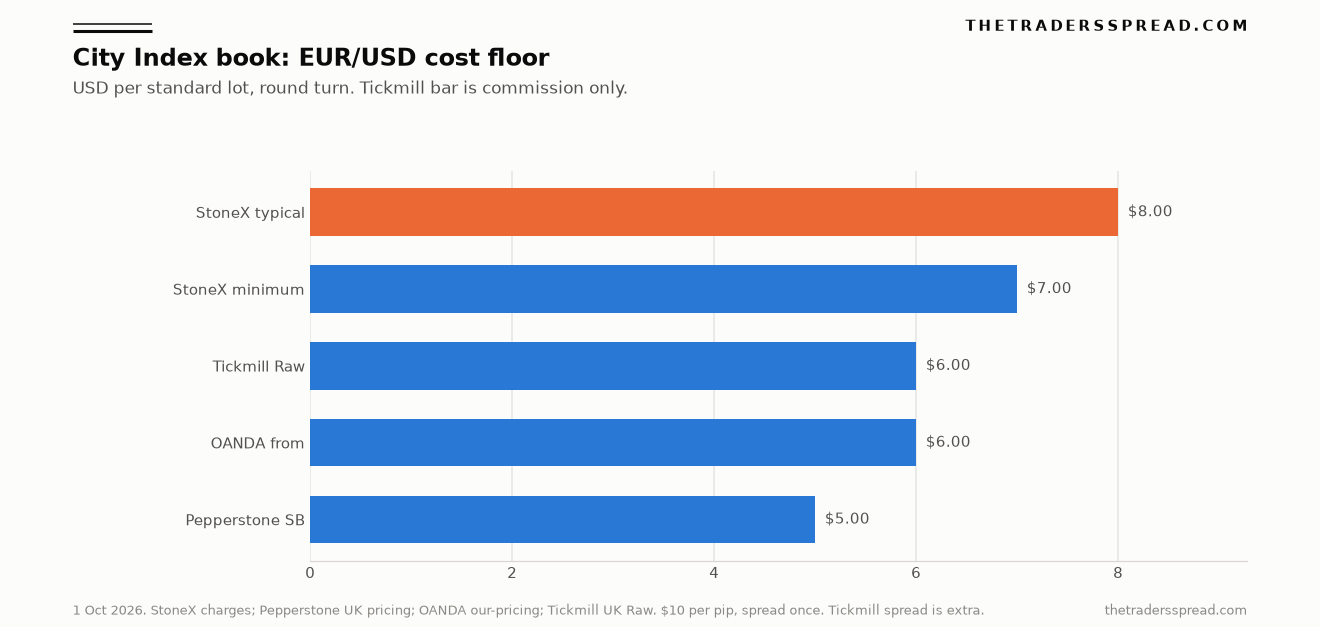
| Book | What was read | EUR/USD figure | Round turn on 1 standard lot |
|---|---|---|---|
| Pepperstone spread bet | UK pricing page, no commission on this account | Minimum spread 0.5 | $5.00 spread floor |
| OANDA | OANDA Europe Limited, our-pricing page. No FX commission figure sat next to the 0.6 | Spreads from 0.6 pips | $6.00 if the spread is the whole FX cost |
| Tickmill Raw | Tickmill UK Ltd Raw account. Spread from 0.0 is extra | $3 per lot per side. Their example: $6 round turn on 1 lot | $6.00 before any spread |
| StoneX minimum | StoneX Financial Ltd charges page, spread bet and CFD, no FX commission | Minimum 0.7 | $7.00 |
| StoneX typical | Same table | Typical 0.8 | $8.00 |
Three peer pages opened on 1 October. IC Markets pricing did not. It is left out rather than filled from an older note.
Pepperstone's UK pricing page prints a spread-bet minimum of 0.5 on EURUSD and no commission on that account. That is the $5.00 bar, not a Razor all-in. Razor shows raw forex spreads from 0.0 and commission from £2.25 per lot per side: cTrader at 6 USD round trip per FX unit, TradingView at 7 USD round trip, and the Pepperstone platform at 3.5 USD per standard FX lot per side. The currency table shows USD 7 when the position is opened. Add a spread that is sometimes near zero and sometimes not, and Razor can finish either side of StoneX's $8 typical. Pepperstone also says it charges no inactivity fee, and that an international bank-wire withdrawal costs 15 GBP. Figures in our Pepperstone review were not reused here.
OANDA Europe Limited, company 7110087, registered office Dashwood House, 69 Old Broad Street, London EC2M 1QS, FCA number 542574, says spreads start from 0.6 pips on EUR/USD. Retail margin on that page starts from 3.3% on EUR/USD. No FX commission was printed beside the 0.6, so the $6.00 bar is a published minimum, not a proved all-in. The OANDA review is linked for the firm, not as the source of today's 0.6.
Tickmill UK Ltd, company 09592225, FCA 717270, at First Floor, The Bengal Wing, 9A Devonshire Square, London EC2M 4YN, prints a Raw account with spreads from 0.0, maximum gearing of 1:30, and fees of $3 per lot per side. Its example: one lot of EURUSD is 3 USD a side and 6 USD round turn. Commissions apply to FX and precious-metals CFDs. The spread is extra, so the chart's $6.00 is a floor. A 0.2 pip spread on top would make $8, level with StoneX's typical. Tickmill's typical-spread table did not render, so none is invented here. The Tickmill review is a link, not the source of the $6.
Charges that do not sit in the spread
Overnight financing is a separate bill. The charges page sets it at 3% either side of a regional benchmark. A UK long pays SONIA plus 3%. A UK short receives SONIA minus 3%. US positions use SOFR the same way, euro positions use €STR, and Australia uses the deposit rate. The charge runs every day the position is open, weekends included. Futures are excluded. FX pairs also take a swap-point adjustment, and the page points to the in-platform sheet. No live fixing is printed, so this review does not turn the rule into dollars per lot.
Leave the account alone and a sterling fee appears. No trade and no open position for 12 months, and the account is inactive. An order that never fills does not count. The fee is £12 a month, or the cash balance if that is smaller. A US-dollar account is $15. EUR and AUD accounts are 15 in those currencies. After three idle years a retail client has to file a reactivation form. Pepperstone's UK page, the same morning, said it charges no inactivity fee.
Share CFDs are the commission exception. UK shares cost 0.08%, minimum £10. US shares cost 1.8 cents a share, minimum $10. That £10 floor dominates a small UK share ticket. An EUR/USD spread bet never meets it.
On CFDs and FX, converting back to the account currency can be up to and including 0.5% away from the firm's quoted price. Spread-bet accounts are usually in sterling, and the page says that conversion does not apply. There is no exchange-data fee. Card deposits, and withdrawals by card or by BACS, carry no broker charge on this page. A GSLO costs nothing up front and a premium only if it triggers. The EUR/USD CFD guide is 4 times the quantity, in account currency, per 0.0001.
A 0.02 and a 20 on the same row
Index rows copy across the spread-bet and CFD tables. UK 100 is 1 point from 08:00 to 16:30 UK, margin from 5%. Germany 40 is 1.2 points in that window. Wall Street is 2 points from 14:30 to 21:15. Outside those hours the tight print does not hold. Gold's minimum is 0.3 points, margin from 5%.
Then the interest-rate block disagrees with itself. Short Sterling 3-month, spread bet: minimum fixed spread 0.02 points, hours 07:30 to 18:00, margin from 20%. The CFD column for the same market, same hours, same 20% margin, prints 20 points. Eurodollar is 0.02 on both the spread-bet side and the CFD side. Euribor 3-month is 0.02 on both. A factor of one thousand sits on one instrument and not on its neighbours. The page does not say which figure a Short Sterling CFD ticket will actually receive. It does not change the EUR/USD typical. It does mean the rates page has to be read in both columns.
A 3.6, and who it fits
This review scores the City Index book, now trading as StoneX Trading, at 3.6 out of 5. The score is a judgement on the pages read on 1 October 2026, not a forecast and not an instruction.
RelatedBlueberry Markets Review 2026: EUR/USD Direct Fee Is $7
What holds the score up is checkable. The contracting company is named, numbered and still Active at Companies House. The footer, the 2022 FCA warning and the Moor House address agree. FX spreads are published as a minimum and a typical, on both tables, with commission off the FX ticket. Financing is a stated 3 points over a named benchmark. Card funding and BACS withdrawals carry no broker fee on the charges page.
What holds it down is on those same pages. The EUR/USD typical of 0.8, or $8.00 on the standard-lot assumption, is wider than Pepperstone's spread-bet floor and wider than the minimums OANDA and Tickmill printed on 1 October. Against Raw, the gap closes once Tickmill's own spread is added. Against Razor, it depends which platform commission applies and how close the raw spread is to zero. The homepage "from 0.5" will keep travelling without the AUD/USD row. The million-trader line will keep travelling without the demo footnote. One rates row prints 0.02 and 20.
The book fits a UK client who wants a sterling spread-bet account at an FCA-numbered entity, who will read the typical column rather than the homepage floor, and who will not leave a funded account untouched for a year. It fits less well if the only goal is the lowest EUR/USD round turn in this set. Watts's line that the real change is the brand is fair to the platforms. It is less fair to the headline count, whose definition changed between the release and the homepage.
Nothing here is a suggestion to open, fund, or close an account. Spreads move inside the day on the variable markets, the typical is a historical average rather than a promise, and 68% is the firm's own figure for how often retail CFD accounts at this provider lose money.
Questions readers actually ask
Is City Index still open in the UK?
StoneX's 9 September 2026 release set the UK brand retirement at 12 September 2026. On 1 October the retail site wore the StoneX Trading name, which the footer ties to StoneX Financial Ltd, company 05616586, FCA number 446717, at Moor House. Existing clients were told their platforms and accounts would stay.
What does the 1 million traders line count?
The asterisk on the individuals homepage, read 1 October 2026, says it is StoneX retail trading live and demo accounts globally in the last two years. The 9 September press release, in the group boilerplate, said more than 260,000 retail accounts, with no demo qualifier and no two-year window. The headings do not carry the footnote. The footnote is the part that stops the two numbers being the same claim.
What is the EUR/USD spread?
On the charges page of 1 October 2026, EUR/USD shows a minimum of 0.7 and a typical of 0.8, on both the spread-bet table and the CFD table, with margin from 3.33% and no FX commission. At $10 a pip on one standard lot, paid once, that is $7.00 and $8.00. The homepage "from 0.5" matches the AUD/USD minimum on that table, not this pair.
Who regulates the account?
The site says the Financial Conduct Authority, number 446717, for StoneX Financial Ltd. Companies House showed that company Active on 1 October 2026 at Moor House. An FCA warning dated 28 October 2022 names the same firm, number and office. The live register panel did not render a status line in this session.
What does an idle account cost?
After 12 months with no trade and no open position, the charges page applies £12 a month on a sterling account, or the cash balance if it is lower. A US-dollar account is $15. An unfilled order does not count as activity. After three idle years a retail client has to complete a reactivation form. Pepperstone's UK pricing page, the same day, said it charges no inactivity fee.
Does overnight financing use a 3 point markup?
On the charges page read 1 October 2026, a UK long pays SONIA plus 3% and a UK short receives SONIA minus 3%. US positions use SOFR the same way, and euro positions use €STR. The charge is daily, weekends included, and futures are excluded. No live fixing is printed, so no dollar amount per lot is derived here.
Disclaimer. This is analysis of published charges and company filings, not a recommendation to open an account or to place a trade. Spread bets and CFDs put capital at risk, and the firm's own notice says 68% of retail investor accounts lose money trading CFDs with this provider. Schedules, footnotes and loss percentages were taken from the firms' public pages on 1 October 2026 and can change without notice. Tax treatment depends on personal circumstances.