

97.8% is the Yes price on no change for the Bank of Japan, and it means the October contract is treating a hold at around 1.25% as close to settled. Gamma-api returned that outcome price at 07:28 UTC on 23 October 2026 for the leg titled "No change". On the same snapshot the best bid was 97.3%, the best ask was 98.3%, and the last trade printed at 98.4%.
A basis point is one-hundredth of a percentage point. Twenty-five basis points, the step this contract is built around, equal 0.25 percentage point on the rate, the distance from 1.25% to 1.50%. The 97.8% figure is a probability price, not a rate. It is the price of the middle leg on Bank of Japan rate decision odds for October. Links to Polymarket are affiliate links, from which The Traders Spread may earn a commission at no cost to you.
Read against the swaps curve, 97.8% is a timing price, not a claim that the hiking cycle is finished. On 19 October, FXStreet carried a note from Ellias Haddad of Brown Brothers Harriman putting the swaps-implied chance of a 25 basis point hike to 1.50% on 30 October at less than 5%, and the chance of a hike on 18 December at 80%. This contract pays on the October meeting alone.
The price did the opposite of the simple story. The Statistics Bureau published September national CPI at 08:30 Japan time on 23 October. The index excluding fresh food rose 2.1% from a year earlier, after 1.7% in August, back above the 2% target. Gamma-api's one-day change on the no-change leg was plus 0.45 percentage points. The hold got more expensive on the day the core rate went back through 2%.
Key facts
- No-change Yes price 97.8%, bid 97.3%, ask 98.3%, last trade 98.4%, at 07:28 UTC on 23 October 2026. Source: Polymarket gamma-api, 23 October 2026.
- Uncollateralized overnight call rate around 1.25%, set 18 September 2026 and effective 24 September. Basic loan rate 1.5%, complementary deposit rate 1.25%. Source: Bank of Japan statement, 18 September 2026.
- September national CPI: all items 2.1%, excluding fresh food 2.1%, excluding fresh food and energy 2.4%, from 1.9%, 1.7% and 1.9% in August. Source: Statistics Bureau of Japan, released 08:30 JST on 23 October 2026.
- July Outlook median for fiscal 2026 CPI excluding fresh food is 2.5%, majority range 2.3% to 2.7%. Source: Bank of Japan Outlook, 31 July 2026.
- Event volume about $265,303, event liquidity about $54,157, about $10,178 traded in the prior 24 hours. The no-change leg held about $77,602 of volume and about $4,660 of liquidity. Source: Polymarket gamma-api, 23 October 2026.
- Tokyo 23-ward mid-month CPI for October is scheduled for 08:30 on 30 October 2026. National October CPI is scheduled for 08:30 on 20 November 2026. Source: e-Stat release calendar, retrieved 23 October 2026.
- Policy meeting 29-30 October 2026, with the Outlook the same day. The following meeting is 17-18 December 2026. Source: Bank of Japan meeting schedule, retrieved 23 October 2026.
Section 1: A 97.8% price is a probability
Five legs share one question: by how many basis points the upper bound of the short-term policy rate changes versus the level in place before the October meeting. The brackets are a cut of 50 basis points or more, a cut of 25, no change, an increase of 25, and an increase of 50 or more. Yes on the middle leg pays when that bracket is the one that resolves.
At 07:28 UTC the book looked like this.
| Leg | Yes price | Last trade | Bid / ask | Volume | Liquidity |
|---|---|---|---|---|---|
| 50bp or larger cut | 0.05% | 0.10% | bid blank / 0.10% | $17,202 | $5,284 |
| 25bp cut | 0.05% | 0.10% | bid blank / 0.10% | $18,320 | $14,744 |
| No change | 97.8% | 98.4% | 97.3% / 98.3% | $77,602 | $4,660 |
| 25bp increase | 1.8% | 1.8% | 1.4% / 2.2% | $75,596 | $14,446 |
| 50bp or larger increase | 0.55% | 0.90% | 0.50% / 0.60% | $76,584 | $13,038 |
Volume is dollars already traded. Liquidity is depth on the book now. The no-change leg leads volume at about $77,602 and trails liquidity at about $4,660, while the 1.8% hike leg has nearly as much volume and about three times the depth. The hold's spread runs from 97.3% to 98.3%.
Over the month, gamma-api shows plus 14.3 points on no change and minus 14.2 on the 25 basis point increase. The week is plus 2.1 and minus 1.85. The day, covering the CPI release, is plus 0.45 and minus 0.35.
The no-change leg is the contract valued below. The cut legs sit at 0.05% with real volume behind them, so they are live markets.
Section 2: How no change gets resolved
The event text on gamma-api pays on the change in the upper bound of the short-term policy interest rate versus the pre-meeting level. The primary source is the Bank of Japan's page for monetary policy statements, and a consensus of credible reporting can stand in if that page stays quiet. The market can resolve as soon as the October statement is out. If the Bank has published nothing by the end of the 17-18 December 2026 meeting, the market resolves to the no-change bracket even though the event end field is 30 October 2026.
The Bank sets one operating guideline, an "around" percent for the uncollateralized overnight call rate. The Fed, by contrast, publishes a range with a numbered ceiling. On 18 September the guideline, the complementary deposit rate and the basic loan rate were 1.25%, 1.25% and 1.5%, and the three moved together. Around 1.50% is the 25 basis point increase, around 1.75% is the 50-point bracket, and around 1.00% is the 25 basis point cut.
Sizes off the brackets round up to the nearest 25. The rules' example counts 12.5 basis points as 25, so a 10 point nudge in the guideline lands in the increase bracket. The middle bracket wins when the guideline stays put.
Other policy contracts on this desk clear on their own statements. The ECB October decision was framed as a no-change price. The Bank of England November decision was framed as a hike price. The Fed December decision was framed as a hike price on a later date. A 97.8% hold in Tokyo stays a Tokyo number.
Section 3: The guideline a hold would leave alone
The September statement set the rate a hold would leave in place. By a 7-2 vote the board said it would encourage the uncollateralized overnight call rate to remain at around 1.25%. The new guideline, deposit rate and basic loan rate took effect on 24 September. The document prints a release time of 11:54 on 18 September.
Votes for the hike were Ueda, Ryozo Himino, Shinichi Uchida, Hajime Takata, Naoki Tamura, Junko Koeda and Kazuyuki Masu. Against were Toichiro Asada, who wrote that core inflation had been below 2% and the old guideline should stay, and Ayano Sato, who wrote that activity and prices were still on their prior pace. Both remain on the Policy Board page as of 23 October, with Ueda still governor. September core at 2.1% meets Asada's number.
The forward paragraph is the reaction function: underlying CPI is approaching 2%, conditions are still accommodative, and the Bank will keep raising the policy rate. Accommodative means conditions that still support activity after the hike to 1.25%. The policy-rate balance is the gap between that guideline and a neutral rate. In The Mainichi's account of the 16 October remarks, Governor Kazuo Ueda of the Bank of Japan said a specific neutral level would be hard to pinpoint. The October contract pays on whether the guideline number moves.
The Japan Times posted the sharpest public line from that Bangkok session, on tolerance for inflation above the target, which is the sentence markets have carried into October.
Bank of Japan Gov. Kazuo Ueda said Friday that he "can't tolerate" underlying inflation rising further above 2%. https://t.co/zkhe4o8cZ8
— The Japan Times (@japantimes) October 17, 2026
On that Mainichi page, Ueda said data since September had been "broadly on track for the BOJ's outlook, with no major new information to warrant a change in its forecast." He added that the Bank would keep raising rates and that the 29-30 October meeting would decide whether the underlying-inflation assessment needs a revision. The CPI print was still ahead of him on 16 October.
Section 4: September prices under the July forecast
The bureau's summary, on the 2025 = 100 base, is the print in the fair value. The rows below are the year-on-year rates Haddad's note can be checked against.
| Measure, year on year | September 2026 | August 2026 | Haddad note, 19 Oct |
|---|---|---|---|
| All items | 2.1% | 1.9% | 2.1% |
| Excluding fresh food | 2.1% | 1.7% | 2.1% |
| Excluding fresh food and energy | 2.4% | 1.9% | 2.3% |
| Food excluding fresh food | 2.9% | 2.7% | outside the note |
| Energy | -0.6% | -0.7% | outside the note |
Headline and the ex-fresh-food rate matched Haddad's note, and the ex-energy rate was a tenth above his 2.3%. The bureau's trial figure puts the gasoline tax abolition and other policy measures at minus 0.82 points on energy. Part of September is policy arithmetic, and part is the stickier basket.
The October meeting replaces the July Outlook. In the July Outlook, the fiscal 2026 median CPI excluding fresh food is 2.5%, range 2.3% to 2.7%, and the median excluding fresh food and energy is also 2.5%. April's medians were 2.8% and 2.6%. The Bank's View expects the ex-fresh-food rate clearly above 2% only from the second half of fiscal 2026. September is still in the first half, and the September hike was delivered while the statement still described that rate as inside 1.5% to 2.0%.
The Bank's English account noted on 19 October that board member Junko Koeda had spoken in Kumamoto on 15 October about activity, prices and policy. The post confirms a board member was on the record about prices two weeks before the meeting.
Board Member KOEDA made a speech entitled "Economic Activity, Prices, and Monetary Policy in Japan" at a meeting with local leaders in Kumamoto on October 15, 2026.https://t.co/mDHz6W9Koy pic.twitter.com/6XQxin88GO
— Bank of Japan (@Bank_of_Japan_e) October 19, 2026
Section 5: A fair value of 94%
The fair value here is a probability from 0 to 1 on the no-change leg. The inputs are the September statement, the July outlook, the September CPI, the dissent text, and the swaps reading Haddad's note gave FXStreet. The Polymarket price is the comparison, kept out of the inputs.
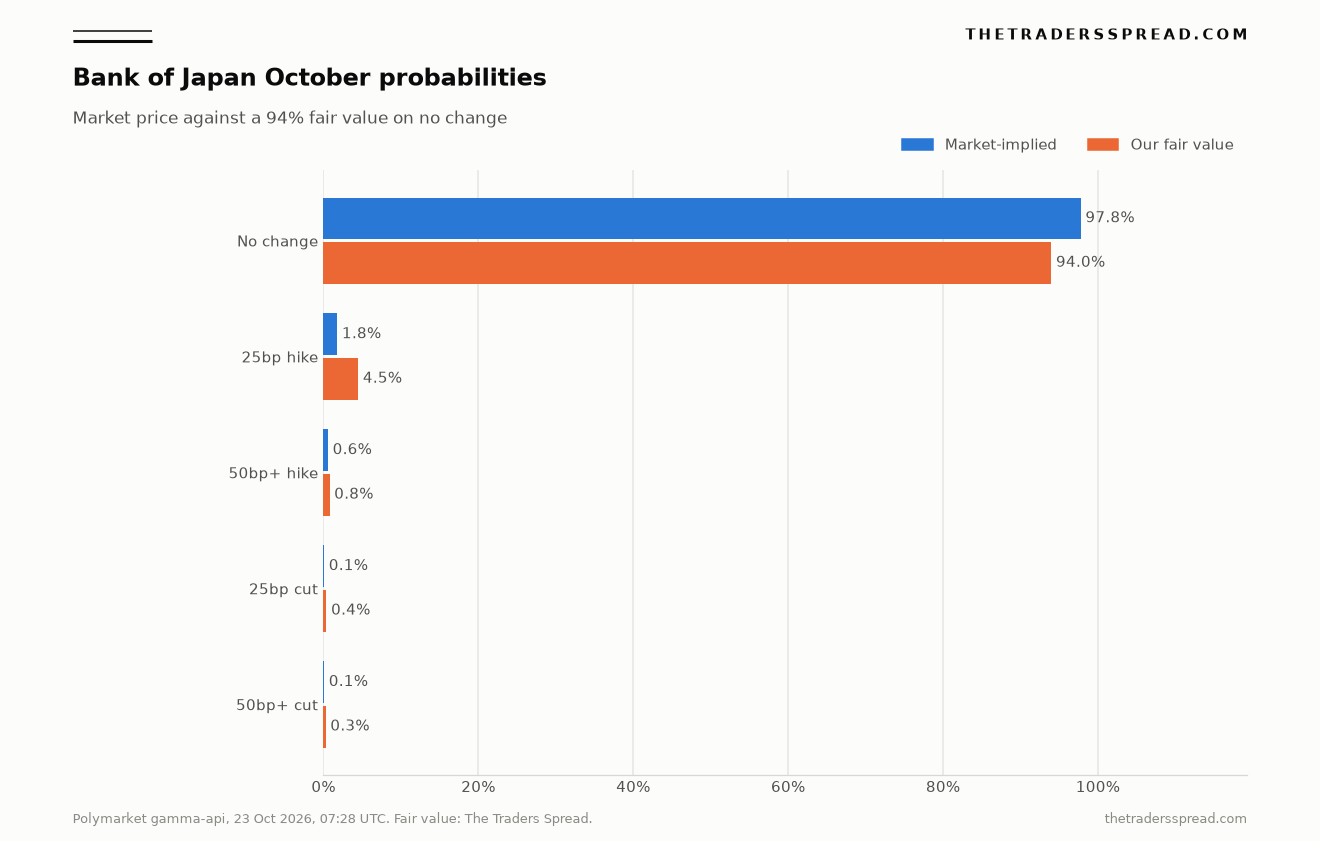
Haddad's note put a 25 basis point hike on 30 October under 5%, before the CPI, and the ex-fresh-food rate then matched him. This fair value uses 4.5%, the top of that band, against Polymarket's 1.8%. October is an Outlook meeting, so forecast and rate can move together, and Asada's objection was core below 2% while core is now 2.1%. The 4.5% weight still treats a second hike, five weeks after 24 September, as the smaller branch.
A hike of 50 basis points or more gets 0.8%, a little above the market's 0.55%, because a move from 1.25% to 1.75% would skip the September pace. Cuts share 0.7%, split 0.4% and 0.3%, against a market price of 0.05% on each cut leg. The September reaction function is a further rise if the baseline holds, so those tails stay near zero.
RelatedA US recession by 31 December is priced at 6.5 cents
Four-point-five plus 0.8 plus 0.4 plus 0.3 equals 6.0. Taken from one, the no-change fair value is 94.0%, or 0.94. A reader who instead puts 2.0% on the 25 basis point hike, 0.5% on a larger hike and 0.1% on cuts gets a hold near 97.4%, almost on the market. The distance between "in line" and "above the fair value" is that choice. The 4.5% hike weight is the assumption doing the work.
| Bracket | Market Yes | Fair value | Gap, points |
|---|---|---|---|
| 50bp or larger cut | 0.05% | 0.3% | -0.25 |
| 25bp cut | 0.05% | 0.4% | -0.35 |
| No change | 97.8% | 94.0% | +3.8 |
| 25bp increase | 1.8% | 4.5% | -2.7 |
| 50bp or larger increase | 0.55% | 0.8% | -0.25 |
The 25 basis point increase is where the fair value sits above the book. At 1.8%, bid 1.4% and ask 2.2%, that leg is under the 4.5% weight. Because the brackets add to one, a cheap hike leg and a rich hold are one argument stated twice. Cut prices of 0.05% round to 0.1 on the chart, and the 0.55% leg rounds to 0.6. The table keeps the gamma-api prints.
Section 6: A few points, after a much larger move
97.8 minus 94.0 is 3.8 percentage points. The hold's bid-ask runs from 97.3 to 98.3, so 94 sits about three points under the bid, outside the quoted book. Beside the 14 point move gamma-api records over the past month, the gap is small. The fair value puts 4.5 points of hike probability back, where the book has left 1.8.
A fair value nearer 97.8% fits a board that waits for December and uses the October Outlook only to describe inflation. Haddad's under-5% October line and Ueda's "on track" remark, spoken before the CPI, both point there. A lower fair value fits a board that treats 2.1%, plus the tolerance line, as a reason to move on 30 October. The 4.5 points already on that branch stop well short of the 15 a coin-flip between October and December would need.
Section 7: Which print would move 94% before 30 October?
September national CPI is already inside the 94%. The next official price print on the e-Stat calendar is the Tokyo 23-ward mid-month CPI for October, at 08:30 Japan time on 30 October, the morning of the statement. National October CPI waits until 20 November, after this contract's October end field. If the statement arrives on anything like the September clock of 11:54, the Tokyo release would be public first.
If that Tokyo ex-fresh-food rate is clearly through the July median path, well above the 2.1% the nation just printed, does the 4.5% weight on a 25 basis point hike still stand, or does the fair value on no change have to fall before a statement exists? If Tokyo instead lands near 2.1%, with the same mix of policy effects the national file showed, what else, besides a leak or a yen move large enough to change the foreign-exchange risk the September statement already named, should move 94% at all before the bracket resolves?
FAQ
What is a basis point, in this contract?
A basis point is 0.01 percentage point on the interest rate. Twenty-five basis points equal 0.25 percentage point, the step from a guideline of around 1.25% to one of around 1.50%. The October book pays in those 25 basis point brackets. A move that falls between brackets is rounded up to the nearest 25, on the example written into the event rules.
What does the policy-rate balance mean?
It is the distance between the policy rate and a neutral setting, the rate that would neither push the economy faster nor hold it back. The September statement called financial conditions accommodative after the hike to 1.25%, meaning conditions that still support activity. Ueda said on 16 October that a single neutral number is hard to name. The contract pays on the guideline. The gap is a description of stance.
When does no change resolve as Yes?
Yes wins if the October statement leaves the upper bound of the short-term policy rate where it was, which in practice means the guideline stays at around 1.25%. A smaller hike than a full 25 basis points rounds up into the increase bracket, so the middle leg stays unpaid. Yes also wins if the Bank has published nothing by the end of the 17-18 December meeting.
Why is 97.8% above a 94% fair value?
The fair value puts 4.5% on a 25 basis point hike, 0.8% on a larger hike and 0.7% on cuts, which leaves 94% for no change. The book puts 1.8% on the 25 basis point hike. The 3.8 point gap is that difference, with a slightly fatter tail on the other brackets. A hike weight near 2% would put the fair value almost on the market price.
Did the September CPI force an October hike?
The ex-fresh-food rate rose to 2.1%, matching the Haddad forecast carried by FXStreet, and the ex-energy rate rose to 2.4%, a tenth higher. The hold price rose 0.45 points on the day. The July outlook already looked for core inflation clearly above 2% from the second half of fiscal 2026, which begins in October. On this fair value the print reopened a slice of hike probability and left the hold as the base case.
This comparison of a market price with a stated fair value is not a recommendation to trade any contract.