
What is an XM deposit bonus actually worth once you pay for it in the spread? That is the question XM's own forex page prices, whether or not a client notices. XM Global Limited, the Belize-licensed entity that xm.com names when read from outside the European Economic Area, publishes two tabs for the same currency pairs on xm.com/forex-trading. On the Standard tab, the account XM markets with bonuses, EUR/USD shows an average spread of 2.0 pips. On the Ultra Low Standard tab, the account XM markets on low spreads, the same pair averages 1.1 pips. Both were read on 24 September 2026. The gap is 0.9 pips, which on a 100,000-euro lot is $9.00 per round turn, because a EUR/USD pip on a standard lot is worth $10 whatever the exchange rate. The answer to the opening question is therefore a break-even, not a yes or no.
Most reviews of XM stop at "spreads as low as" and a list of licences. The number that decides the account choice sits one tab over. XM's own bonus page frames the trade in its own words, with a heading that reads "Deposit Bonus vs lower spreads", and its worked example uses a $100 deposit matched by a 100% bonus credit that XM states is not withdrawable. At a $9.00 premium per lot, a $100 credit has been handed back in spread after roughly 11.1 standard lots of EUR/USD, or about 111 round turns at the 0.1-lot size XM uses in its example. Below that volume the bonus is cheap margin. Above it, the Standard account is the more expensive way to hold the same position, and nothing on the page flags the crossover.
- XM Global Standard account, EUR/USD: 2.0 pips average, 1.6 pips as low as, 1000:1 maximum leverage — xm.com/forex-trading, read 24 Sep 2026
- XM Ultra Low Standard, EUR/USD: 1.1 pips average, 0.8 pips as low as, a 45% lower average than Standard — same page, second tab, read 24 Sep 2026
- Spread premium of Standard over Ultra Low: 0.9 pips, or $9.00 per 1-lot EUR/USD round turn — TTS calculation from XM's published averages, 24 Sep 2026
- 75.12% of retail accounts lose money trading CFDs with XM's Cyprus entity — risk warning on xm.com as served to EEA visitors, read 24 Sep 2026
- Trading Point of Financial Instruments Ltd holds CySEC licence 120/10, dated 5 August 2010, and is on the live CIF list — CySEC register, 24 Sep 2026
- AFSL 443670 now sits with Trading.com Markets Pty Ltd, licensed since 23 December 2013 — ASIC licensee dataset, September 2026 file
Two tabs, one pair: where the 0.9 pips sits
XM's forex page lists its top ten pairs with three numbers each: an average spread, a "spread as low as" floor and a maximum leverage. The Standard tab loads with the page. The Ultra Low Standard tab renders only in the browser, so we read it two ways on 24 September: in the data table shipped inside XM's own page code, which carries both tabs, and in a live browser session served by XM's Cyprus entity, which displays the same Ultra Low schedule. The spread figures matched to the decimal.
| XM Global pair | Standard avg (pips) | Ultra Low avg (pips) | Gap (pips) |
|---|---|---|---|
| EUR/USD | 2.0 | 1.1 | 0.9 |
| USD/JPY | 2.5 | 1.3 | 1.2 |
| GBP/USD | 2.4 | 1.3 | 1.1 |
| AUD/USD | 2.4 | 1.4 | 1.0 |
| GBP/JPY | 3.8 | 2.9 | 0.9 |
| EUR/GBP | 2.4 | 2.0 | 0.4 |
EUR/USD is not the widest gap. USD/JPY carries 1.2 pips between the two tabs and GBP/USD 1.1. EUR/GBP is the exception at 0.4.
The same code bundle shows the pattern on gold. XM's Standard GOLD row averages 5.5 against 3.0 on the Ultra Low GOLD# row (2.6 in countries XM's code flags for reduced spreads), in the units XM's table uses, so the Standard gold spread is about 83% wider. That matters because gold is the instrument XM chose for its own bonus illustration.
How does that compare with the rest of the retail market? The fair comparison is floor against floor, because most brokers publish a minimum or "from" figure and only a few publish averages. We read each peer's own page on 24 September 2026. Pepperstone's Australian costs page, published by Pepperstone Group Limited (ASIC AFSL 414530), gives a Standard-account EUR/USD minimum of 1.0 pip and says plainly that there is "a 1 pip markup on margin FX pairs". Tickmill's Classic account page on tickmill.com, the site Tickmill labels as its Seychelles entity, Tickmill Ltd, quotes spreads from 1.6 pips with zero commission. AvaTrade's forex page quotes EUR/USD from 0.9 pips alongside 400:1 leverage; that page lists six AvaTrade entities without tying the 0.9 figure to one of them, and the 400:1 figure points to the offshore offer rather than AVA Trade EU Ltd.
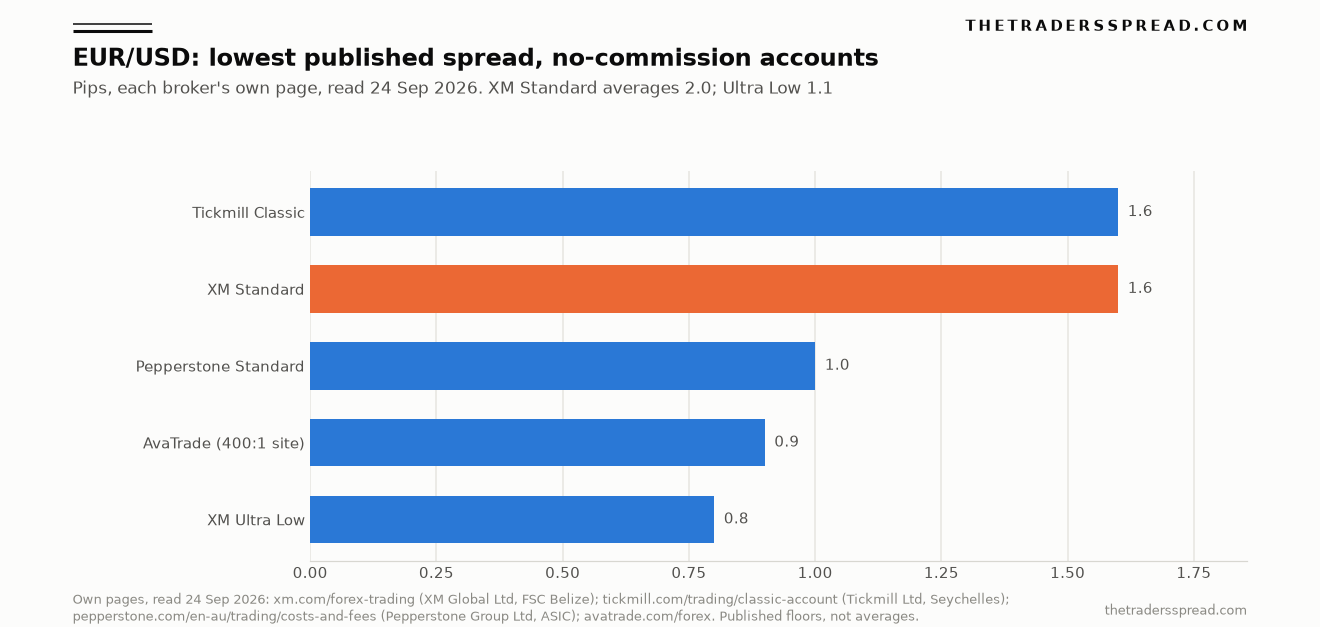
On floors, XM Standard's 1.6 pips ties with Tickmill Classic at the expensive end, while XM Ultra Low's 0.8 is the cheapest floor in the set. XM is simultaneously the dearest and the cheapest broker on the chart, depending on which tab a client opens.
Raw-pricing accounts sit on a different basis and belong in a separate line. IC Markets Global, the trading name of Raw Trading Ltd (Seychelles FSA licence SD018), states on its spreads page, read 24 September 2026, an average EUR/USD spread of 0.1 pips and an MT4 Raw commission of USD 3.50 per side, USD 7.00 per round turn. On its own stated average that is about $8.00 per lot all-in, against $11.00 for XM Ultra Low and $20.00 for XM Standard on spread alone. IC's instrument-level spread table did not render from this host, so the 0.1 figure is the headline number printed in the page copy. For more on how those raw numbers move with account currency, see our IC Markets review and the Pepperstone review.
What the bonus buys, in XM's own worked example
XM does not hide what its deposit bonus is for. The bonus page describes it as "extra margin" and builds a side-by-side table. Two traders each deposit $100. The XM trader receives a $100 credit, so equity shows $200. Both open 0.1 lot of gold at $4,500 with $45 of margin, which on a 10-ounce position worth $45,000 is 1000:1 leverage. The price moves 0.4% against them, a $180 swing. The other trader is stopped out. The XM trader, carried by the credit, survives, the price then rises 1%, and XM's table closes the position at $650 of equity.
Read literally, the example shows a credit that lets a $100 client absorb a $180 loss. That is its entire function. It does not reduce the cost of a trade, it cannot be withdrawn, and XM adds that "Bonus availability and percentage vary by region."
The example also leaves the spread out. On XM's Standard gold row, the average is 5.5 against 3.0 on Ultra Low, so the client who takes the bonus route pays the wider of the two every time the position opens. For a trader making a handful of trades on a small balance, a $100 buffer can outweigh a few dollars of extra spread. For a trader turning over several lots a month, the arithmetic flips within weeks. The bonus page presents the comparison as a strategy choice; the forex page supplies the price of that choice, and a client only sees both by opening two pages and a second tab.
XM's other headline claims sit on its about page: more than 20 million clients from over 190 countries, and more than 13.5 billion trades executed "with zero requotes or rejections". Those are company statements, not audited figures, and we could not test them at a primary source. XM's stable leverage page promises that leverage stays at up to 1000:1 through events such as US payrolls, which is precisely the setting in which a bonus credit gets consumed fastest.
Where an EU address changes the price list
Open the same URL from inside the European Economic Area and the page changes. The legal line switches to Trading Point of Financial Instruments Limited, registration number HE251334, Limassol. The Standard account disappears from the account-types page, leaving an Ultra Low account and a Zero account, both capped at 30:1. The forex table shows only the Ultra Low schedule: EUR/USD at 1.1 pips average and 0.8 as low as, identical to the XM Global Ultra Low tab. The Zero account advertises "fixed commissions and spreads as low as zero", but the commission amount did not appear in the card we could read, so we do not print one.
Why no bonus account in Europe? Because the European regulator removed the tool. In March 2018 ESMA restricted retail CFD sales, and one of the restrictions was "preventing the use of incentives by a CFD provider". Steven Maijoor, then Chair of the European Securities and Markets Authority, said the measures would "restrict the use of leverage and incentives, and provide a risk warning for investors," in the ESMA press release of 27 March 2018. The same release cited national regulators' findings that 74% to 89% of retail CFD accounts typically lose money.
That leaves XM running a two-tier price list under one brand. An EU client gets the cheaper schedule by default, a 30:1 cap and no bonus. A client routed to XM Global gets a choice between 1000:1 with a bonus-eligible Standard account and the same cheaper schedule on Ultra Low. In 2013, when Trading Point bought the xm.com domain, Constantinos Cleanthous, Founder and CEO of Trading Point of Financial Instruments Ltd, said: "The foreign exchange market, to which we provide direct access to our clients has practically no boundaries - nor does XM.COM," according to the company's PR Newswire release of 1 July 2013. Thirteen years on, the price a client sees on xm.com depends on which side of a regulatory boundary the client sits.
Four regulators, two new names on the licences
The Cyprus licence is the anchor. On the CySEC register of Cypriot investment firms, read 24 September 2026, Trading Point Of Financial Instruments Ltd holds licence 120/10, dated 5 August 2010, company number 251334. A sister firm, Trading.Com Markets EU Limited, formerly Trading Point Asset Management Limited, holds licence 256/14. Neither name appears on CySEC's former-firms list. We also paged through all 47 pages of CySEC's Board Decisions register, 1,165 entries with announcement dates from 3 February 2014 to 17 September 2026, and found no decision naming Trading Point or Trading.com. That is a clean record on the register CySEC publishes, not a statement about matters CySEC has not announced.
Australia and the UK tell a rebranding story. ASIC's September 2026 licensee file lists AFSL 443670 under Trading.com Markets Pty Ltd, Sydney, licensed since 23 December 2013, and xm.com/au now serves a Trading.com-branded site that describes itself as operating "in accordance with AU law and ASIC regulations". In London, Companies House shows company 09436004 as Trading.com Markets UK Limited, active, incorporated 12 February 2015, trading as Trading Point of Financial Instruments UK Limited until 7 January 2025. Its accounts for 2025 are due by 30 September 2026. The FCA register is a JavaScript application that cannot be read from our host, so we could not confirm the UK firm's current permissions and do not state them.
Belize is the entity most XM Global clients contract with, and it is the one we could verify least. XM's pages give XM Global Limited, licence 8557558 under the Securities Industry Act 2021, with a registered address at 63 Eve Street, Belize City. The Belize FSC's public search at licensys.belizefsc.org.bz rendered a blank page on 24 September, so the licence number stands on XM's word alone. One wording detail: the regulation page says XM Global is "registered by" the FSC, while the site footer says "regulated by". XM's site files also name XM International MU Limited (Mauritius) and XM (BVI) Limited. We did not check either register. Offshore readers comparing licences may find our AvaTrade review useful, since AvaTrade runs a similar multi-entity structure.
What the published numbers cannot settle
Published averages are the broker's own statistic. XM does not say over what period or which hours its 2.0 and 1.1 pip figures are computed, and a table that averages quiet Asian hours with the London open can look better than a European day trader's experience.
Commissions are the second gap. XM's Ultra Low card promises "even lower swap fees and commissions", which implies a commission line somewhere, yet neither the Standard nor the Ultra Low card we read printed an FX commission amount. XM's forex page says clients "enjoy no hidden fees or extra charges". If Ultra Low carried a per-lot FX commission, our $9.00 premium would shrink, and we would expect XM to print it. Until it does, the comparison stands on spread alone. The XM bonus terms were also outside what we read: the bonus page links to terms we did not verify.
Swaps can outweigh spreads for anyone holding positions for weeks, and XM advertises lower swaps on Ultra Low without publishing the rates on the public page. Our Tickmill review shows how quickly a raw account's advantage can change once financing is counted. For EUR/USD-specific positioning rather than cost, see our EUR/USD forecast.
RelatedNAGA Review 2026: NAGA Capital's 0.9 Is Not the EU 1
Verdict: XM Global is two brokers on one page
We rate XM 3.4 out of 5. The Cyprus parent has held a CySEC licence since 2010, sits on the live register and carries no published CySEC board decision in more than twelve years of the register. The Australian and UK arms are still standing, under a Trading.com name that XM does not explain on its main site. Against that, the entity xm.com names outside the EEA is a Belize firm whose licence we could not see on the regulator's own register, and whose flagship account averages 82% more than the house alternative on EUR/USD.
The Ultra Low account is the XM product that holds up. At 1.1 pips average and 0.8 floor on EUR/USD, it prices below Pepperstone's Standard floor and well below Tickmill Classic, without a commission line on the pages we read, and it is the schedule XM shows visitors inside the EEA. A client who trades more than about 11 standard lots of EUR/USD over the life of a $100 bonus pays more in extra spread on Standard than the bonus credit is worth.
The Standard account suits a narrow profile: a small-balance trader who places few trades, values the credit as a buffer against a stop-out and accepts that the buffer cannot be withdrawn. Anyone trading regularly, anyone whose main cost is the spread, and any EU resident who never sees the Standard tab at all, is better described by the Ultra Low column. Traders who need a raw-spread account with a published commission will find the schedule set out more completely at IC Markets or Pepperstone.
What would change this verdict? A published commission schedule for Ultra Low, a readable Belize register entry for licence 8557558, or a Standard-account average that moves toward the house's own lower tier.
FAQ
What spread does XM charge on EUR/USD?
It depends on the account and the entity. XM Global's forex page, read 24 September 2026, shows EUR/USD at 2.0 pips average and 1.6 as low as on the Standard account, and 1.1 average with 0.8 as low as on Ultra Low Standard. XM's Cyprus entity shows only the Ultra Low schedule, 1.1 and 0.8, with leverage capped at 30:1.
Is the XM deposit bonus free money?
No. XM describes it as extra margin and states that bonuses are not withdrawable. It helps a small account survive an adverse move, as XM's own gold example shows. The account XM markets with bonuses, Standard, averages 0.9 pips more on EUR/USD than Ultra Low, which is $9.00 per standard-lot round turn.
Which regulator covers my XM account?
EEA clients deal with Trading Point of Financial Instruments Ltd, CySEC licence 120/10. Outside the EEA, xm.com names XM Global Limited, which XM says holds Belize FSC licence 8557558; the Belize register did not load for us. The Australian licence, AFSL 443670, now sits with Trading.com Markets Pty Ltd.
Does XM accept clients from the United States?
No. XM Global's site footer, read 24 September 2026, says it does not provide services to citizens of the United States, Canada, Israel or Iran, and that other sanctioned countries are also excluded. Clients should check their own local rules as well, since XM places that responsibility on the user.
Has CySEC fined XM?
We found no CySEC board decision naming Trading Point of Financial Instruments Ltd or Trading.com in the 1,165 decisions published between February 2014 and September 2026. That covers CySEC's public register only. We could not check the FCA register, and we did not review regulators in Belize, Mauritius or the British Virgin Islands.
This review is analysis, not investment advice. CFDs and leveraged forex are complex instruments and carry a high risk of losing money rapidly; 75.12% of retail accounts lose money trading CFDs with XM's Cyprus entity, according to its own risk warning. Your capital is at risk. Spreads, bonuses and leverage vary by entity and change over time; the figures here were read on 24 September 2026 from each broker's own pages.