
Almost every Tickmill review you will read quotes two facts in the same breath: leverage up to 1:1000, and regulation by the Financial Conduct Authority. Both are true. Neither applies to the same account, and no client on earth gets both. Tickmill operates at least four separate regulated entities, and which one onboards you determines your maximum leverage, whether a statutory compensation scheme stands behind your balance, and which regulator hears your complaint. A UK client is capped at 30:1 with Financial Services Compensation Scheme cover; a Seychelles client gets the advertised 1:1000 and no equivalent scheme at all. That is a 33-fold difference in leverage and the difference between having a safety net and not having one — decided entirely by which sign-up page you landed on.
The second thing worth knowing is that Tickmill's commission-free account is the expensive one, and the arithmetic is not close. The Classic account charges no commission and quotes spreads from 1.6 pips; the Raw account quotes from 0.0 pips and charges $3.00 per lot per side. On one standard EUR/USD lot, where a pip is worth $10, Classic costs $16.00 per round turn at its advertised floor and Raw costs $6.00 — 62% less. The break-even sits at a realised Raw spread of 1.0 pips, which a genuine raw-spread feed on the most liquid pair in the world will very rarely reach. "Zero commission" is the more expensive product for essentially every active trader who reads that phrase as a saving.
Key Facts: Tickmill at a Glance
- Classic account: $100 minimum, spreads from 1.6 pips, zero commission, minimum lot 0.01 — Tickmill trading accounts, retrieved 30 August 2026
- Raw account: $100 minimum, spreads from 0.0 pips, $3.00 per lot per side ($6.00 round turn) — Tickmill Raw account, retrieved 30 August 2026
- TradingView Raw is a separate, dearer tier at $3.50 per lot per side ($7.00 round turn), not to be confused with the MT4/MT5 Raw account — Tickmill, 30 August 2026
- Tickmill UK Ltd — FCA Register Number 717270, plus a Dubai Financial Services Authority representative office — Tickmill regulatory disclosures
- Tickmill Europe Ltd — CySEC CIF Licence 278/15, member of the Investor Compensation Fund, Limassol, Cyprus — Tickmill regulatory disclosures
- Tickmill South Africa (Pty) Ltd — FSCA FSP 49464; Tickmill Ltd is registered in Mahé, Seychelles — Tickmill regulatory disclosures
- Maximum advertised leverage 1:1000 on Classic and Raw, against a 30:1 retail cap on major pairs under FCA and ESMA-aligned rules
- Platforms: MetaTrader 4, MetaTrader 5, TradingView, Tickmill Trader, plus WebTrader, a Mac build, a mobile app and VPS — Tickmill, 30 August 2026
The Entity Question Nobody Answers First
Tickmill's footer lists its authorised and regulated entities plainly: Tickmill Ltd (Seychelles), Tickmill UK, Tickmill Europe and Tickmill South Africa. The group also owns Procard Global Ltd, a UK-registered payments subsidiary (company number 09369927) based at 9A Devonshire Square, London. This is a completely standard structure for a global retail broker, and there is nothing improper about it. The problem is that reviews routinely blend the entities into a single set of headline numbers that no individual client can actually obtain.
Consider what changes across the group. Under the Financial Conduct Authority, retail leverage on major currency pairs is capped at 30:1, and client money sits within the Financial Services Compensation Scheme, which protects eligible claims up to £85,000 per person per firm. Under the Cyprus Securities and Exchange Commission, the same 30:1 retail cap applies through ESMA-aligned product intervention rules, and Tickmill Europe's membership of the Investor Compensation Fund provides cover up to €20,000. The Seychelles entity is where the 1:1000 figure lives, and it carries no compensation scheme of comparable standing.
So the honest way to describe Tickmill's leverage is conditional. If the advertised 1:1000 matters to you, you will be onboarded somewhere that does not offer FSCS or ICF protection. If statutory protection matters to you, your leverage will be 30:1. The two headline selling points are mutually exclusive, and a prospective client should decide which one they are actually buying before comparing spreads at all. Our broker comparison applies the same test across the venues we cover, because this trade-off is industry-wide rather than specific to this firm.
Tickmill also restricts a long list of jurisdictions, including the United States, Japan, Iran, India and Singapore. It states explicitly that it is not under the supervision of Japan's financial regulator and does not solicit Japanese residents. Traders in those markets are not part of the addressable base regardless of which entity they approach.
What It Costs to Trade, With the Arithmetic Shown
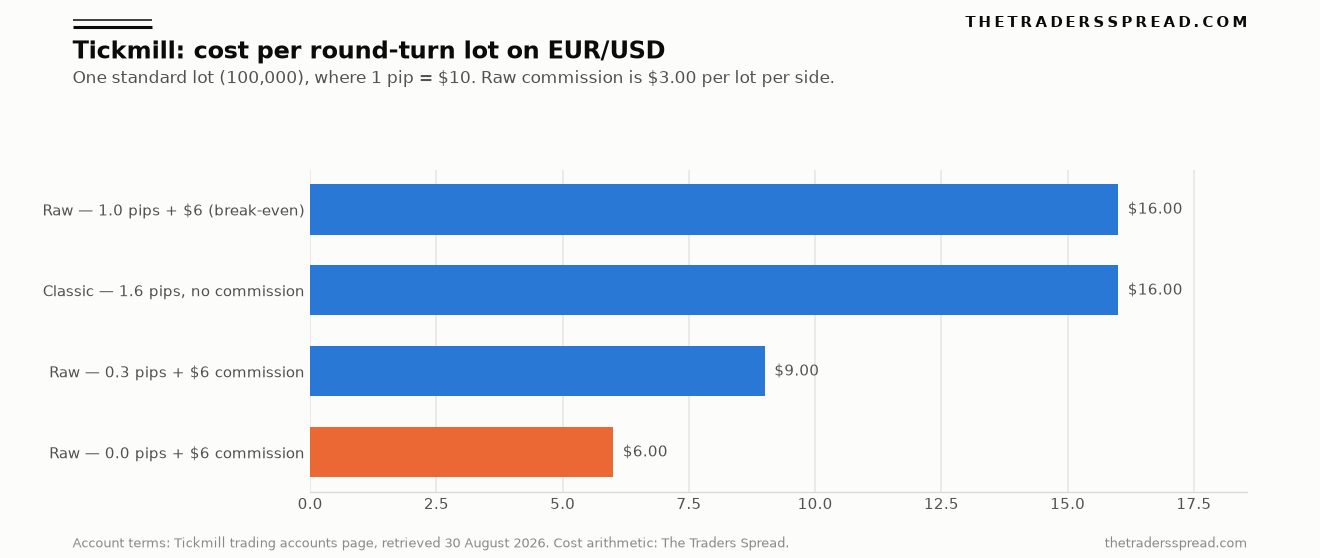
Tickmill offers two live retail accounts on MetaTrader, both with a $100 starting deposit, a 0.01 minimum lot, base currencies in USD, EUR, GBP or ZAR, a swap-free Islamic option and no restrictions on trading strategy. The only meaningful difference between them is how you pay.
| Account | Spread from | Commission | Cost per round-turn lot, EUR/USD |
|---|---|---|---|
| Classic | 1.6 pips | None | $16.00 |
| Raw (MT4/MT5) | 0.0 pips | $3.00 per lot per side | $6.00 |
| Raw at 0.3 pips realised | 0.3 pips | $3.00 per lot per side | $9.00 |
| Raw break-even point | 1.0 pips | $3.00 per lot per side | $16.00 — equals Classic |
| TradingView Raw | 0.0 pips | $3.50 per lot per side | $7.00 |
The mechanics are simple enough to check by hand. On a standard lot of 100,000 units of EUR/USD, one pip is worth roughly $10. A 1.6-pip spread therefore costs $16.00 to cross, and Classic charges nothing further. The Raw account's $3.00 per lot per side becomes $6.00 for a complete round turn, on top of whatever spread is live at the moment of execution. Setting the two equal gives the break-even: Classic matches Raw only when the Raw spread reaches 1.0 pips. One caveat on that commission: the $3.00 applies to the MT4 and MT5 Raw account. Tickmill's separate TradingView Raw tier is priced at $3.50 per lot per side, or $7.00 round turn, and several published comparisons quote that higher figure as though it were the Raw account's.
That threshold is the whole review in one number. A raw-spread account on EUR/USD in normal London or New York hours typically streams well inside 1.0 pips. The Raw account should therefore be cheaper for the overwhelming majority of trading, and the gap widens with volume. A trader turning over 50 standard lots a month saves roughly $500 by choosing the commission account over the commission-free one, on identical execution and identical leverage.
Two honest caveats. First, "from 0.0 pips" is a floor, not an average — advertised minimums are marketing figures at every broker, and the realised spread during rollover, news releases or thin Asian hours will be materially wider on both accounts. Second, the arithmetic above compares advertised terms only; it is not a measure of execution quality, slippage or requote behaviour, none of which can be verified from a pricing page. What the numbers do establish is the direction of the answer, and the direction is not ambiguous.
Platforms, Instruments and the Islamic Option
Tickmill's platform coverage is unusually complete for a mid-sized broker. MetaTrader 4 and MetaTrader 5 are both offered, alongside a WebTrader build, a Mac client, a mobile app and VPS hosting for clients running automated strategies. The firm also supports TradingView directly, accessible with Tickmill Trader Raw account credentials, though that TradingView Raw tier carries the higher $3.50 commission — a meaningful convenience for anyone whose analysis already lives there, and still not universal among brokers at this size.
Instrument coverage spans forex, stock indices, commodities, cryptocurrencies and individual stocks. That is a broad enough shelf for most retail strategies, though it is worth noting that the crypto and single-stock offerings are contracts for difference rather than the underlying assets, with the financing and corporate-action consequences that implies.
The swap-free Islamic account option is available on both Classic and Raw, and Tickmill states that all trading strategies are allowed — relevant for scalpers and algorithmic traders, who are restricted or quietly discouraged at a number of competing venues. Combined with the 0.01 minimum lot and $100 entry, the account structure is genuinely accessible to small accounts without the usual penalty of being pushed onto worse pricing. Traders comparing this against the other venues we have reviewed can see how it sits alongside IC Markets and Pepperstone, which compete directly on raw-spread pricing.
Regulatory Standing and What It Protects
The Financial Conduct Authority entry for Tickmill UK Ltd carries register number 717270. The Cyprus entity holds CIF licence 278/15 from the Cyprus Securities and Exchange Commission and is a member of the Investor Compensation Fund. The South African entity is authorised by the Financial Sector Conduct Authority as FSP 49464. These are the disclosures Tickmill itself publishes, and a broker's stated register numbers are legally required to be accurate; readers who want independent confirmation should search the FCA, CySEC and FSCA registers directly rather than take any review's word for it, including this one.
What that regulation actually delivers is worth stating precisely, because "regulated" is doing a great deal of unexamined work in most broker marketing. FCA and CySEC authorisation brings segregated client money, negative balance protection for retail clients, standardised risk warnings, restrictions on bonuses and inducements, and the 30:1 leverage cap on major pairs. It does not guarantee execution quality, and it does not protect against trading losses — only against the firm's failure, and then only up to the scheme limits.
The tension running through this industry, and through this firm's structure, is that the protections traders say they want are precisely the ones that cap the leverage many of them go looking for. Offshore entities exist because that demand is real. A prospective client's most consequential decision at Tickmill is therefore not Classic versus Raw — it is which regulator they want standing behind the account, and that choice is usually made passively, by geography, before any comparison of spreads takes place.
Verdict: 4.2 out of 5
Rating 4.2/5, derived from published terms. That figure is calculated from Tickmill's own disclosed pricing, platform coverage and regulatory permissions as at 30 August 2026. It is not solicited, not paid for, and not based on proprietary execution data we do not have.
What is genuinely strong. The Raw account's pricing is competitive on arithmetic rather than on marketing — $6.00 per round-turn lot at the advertised floor is a real number that stands comparison with any raw-spread venue. Platform breadth including native TradingView support is above the category average. A $100 entry with a 0.01 minimum lot and no strategy restrictions makes the offering usable for small and algorithmic accounts alike. The multi-entity regulatory footprint, taken on its own terms, is substantive: FCA, CySEC and FSCA authorisations are not trivial to hold.
RelatedPU Prime Review 2026: Who Holds the Client Contract
What holds it back. The headline 1:1000 leverage is available only where compensation-scheme protection is not, and the marketing does not foreground that trade-off. The Classic account's commission-free framing will cost inattentive traders more than two and a half times what the Raw account would, which is a design that profits from misunderstanding rather than from service. And the advertised "from 0.0 pips" tells a prospective client nothing about realised spreads during the hours they will actually trade.
Who it suits. Active traders on major pairs who select the Raw account and understand which entity holds their money. Who it does not. Anyone attracted by 1:1000 who assumes FCA protection travels with it, and anyone whose volume is low enough that the commission structure never pays back the attention it demands.
Frequently Asked Questions
Is Tickmill regulated?
Yes, through several entities. Tickmill UK Ltd holds FCA register number 717270, Tickmill Europe Ltd holds CySEC CIF licence 278/15 and is an Investor Compensation Fund member, and Tickmill South Africa is FSCA-authorised as FSP 49464. Tickmill Ltd is registered in the Seychelles. Which entity holds your account determines the protections that apply to it.
Which Tickmill account is cheaper, Classic or Raw?
Raw, in almost all realistic cases. At advertised terms a standard EUR/USD lot costs $16.00 round turn on Classic and $6.00 on Raw. Classic only becomes competitive if the Raw spread reaches 1.0 pips, which is unusual on a raw-spread feed in liquid hours. The commission-free account is the more expensive one for active traders.
What is the minimum deposit at Tickmill?
$100 on both the Classic and Raw accounts, though Tickmill notes the figure varies by base currency and is lower for accounts denominated in South African rand. Available base currencies are USD, EUR, GBP and ZAR, and the minimum trade size is 0.01 lots on both accounts.
Does Tickmill really offer 1:1000 leverage?
On the offshore entity, yes. Clients onboarded under the FCA or CySEC are capped at 30:1 on major currency pairs by retail product intervention rules, and no amount of account configuration changes that. The 1:1000 figure and statutory compensation-scheme protection cannot be obtained together.
What platforms does Tickmill support?
MetaTrader 4 and MetaTrader 5, TradingView, and the proprietary Tickmill Trader, plus a browser-based WebTrader, a Mac build, a mobile app and VPS hosting. TradingView access uses Tickmill Trader Raw account credentials, which is convenient for traders whose charting already sits on that platform.
Can I use scalping or automated strategies at Tickmill?
Yes. Tickmill states that all trading strategies are allowed on both the Classic and Raw accounts, and offers VPS hosting for clients running expert advisors or other automated systems. A swap-free Islamic account option is also available on both account types.
Analysis and information only; not investment or financial advice, and not a recommendation to open an account. Contracts for difference are leveraged products carrying a high risk of rapid loss. Account terms cited were retrieved from Tickmill's published pages on 30 August 2026 and can change without notice; verify current terms and regulatory permissions directly before acting. The Traders Spread received no payment for this review. Featured image: Limassol Marina by A.Savin, Free Art License, via Wikimedia Commons.
