
Page 5 of AvaTrade's Key Information Document for commodity CFDs carries a heading that European law puts there on purpose: "What are the costs?" Underneath it sits a two-column table. The left column reads "One off costs on Entry and Exit", then "Ongoing costs", then "Incidental costs". The right column explains what a spread is, what overnight interest is, and that a portion of either may be shared with an introducing distributor. Not one figure appears anywhere in it. The document, issued by Ava Trade EU Limited under Central Bank of Ireland authorisation C53877 and dated 1 January 2025, then points the reader onward to a page called Trading Conditions & Charges, where the actual rates are said to live. That page exists, it is public, and it needs no login. On Sunday 20 September 2026 it did not show a single price.
This is the unusual thing about reviewing AvaTrade in 2026. Most brokers publish a price list and argue about whether it is representative. AvaTrade publishes an inactivity schedule, an administration schedule, and almost nothing else. The spread is the product, the fees page says so explicitly, and the fees page also says that to find out what the spread is you must open an account and log in. Every number in this review that AvaTrade itself puts in public is a penalty, not a price. That inversion is the review.
- Inactivity fee of $50, €50 or £50 after three consecutive months of non-use, and every successive three-month period — AvaTrade fees and charges page, read 20 September 2026
- Separate annual administration fee of $100, €100 or £100 after twelve consecutive months of non-use — same page, same date
- The EU Key Information Document's cost table names three cost types and states no figures, and its gold example still uses $2,000 an ounce — AvaTrade PRIIPs KID dated 1 January 2025, read 20 September 2026
- Segregated client money averaged €66.105m against €5.451m of own funds and a 349.73% total capital ratio — AVA Trade EU Limited Pillar 3 report, year ended 31 December 2024
- Nine authorisations in eight jurisdictions, none of them the FCA; the Cyprus licence 347/17 is held by D.T. Direct Investment Hub Ltd — AvaTrade regulation page and the CySEC register of Cypriot investment firms, 20 September 2026
- 70% of AvaTrade's retail investor accounts lose money trading CFDs — risk warning rendered on avatrade.com, 20 September 2026
A cost table with no costs in it
Start with the disclosure the firm cannot opt out of. Under the PRIIPs regime an EU investment firm must give retail clients a Key Information Document before they trade, and the cost section is the point of the exercise. AvaTrade's EU Key Information Document (retrieved 20 September 2026) covers commodity, cryptocurrency, equity and forex CFDs in one file. All four cost sections are identical in structure and identical in content: categories named, mechanisms described, values absent.
The worked examples date the document more precisely than its cover does. The commodity illustration prices one lot of gold at $2,000 an ounce, 100 ounces, $200,000 notional at 20:1 leverage. Gold has not traded near $2,000 since 2023.
Follow the pointer and you reach the Financial Instruments Index. The page loads. The category tabs load. The table header loads, with columns for INSTRUMENT, LEVERAGE, MARGIN, SPREAD, SELL and BUY. Below it, a spinner.
We left it spinning. In a Chrome session on 20 September 2026 the Most Popular tab produced no rows, and neither did the Forex pairs tab after a fresh page load and more than thirty seconds of waiting. The network log for those first ten seconds recorded seventeen requests. They went to AvaTrade's own tracker, to a personalisation service, to two consent-checking endpoints, to Microsoft Clarity, to a pair of advertising pixels fired twice each, and to Google Analytics, which answered 503. None of them fetched an instrument. The page that the legally mandated cost document defers to was, on the day we read it, a header row and six analytics vendors.
The fees and charges page is candid about the alternative. Its instruction for finding a spread runs: log in to your account, search for a specific instrument, click the Details icon, scroll down to the Info section. AvaProtect, the firm's paid downside cover, is priced the same way. Its product page says the premium is derived from expected volatility over the contract period and will vary with trade size and duration, which is true and which is not a number. Cover runs on FX, gold and silver only.
Where the fee page does put a number
Three figures survive all of this, and they are the ones a client pays for doing nothing at all.
The fees page sets an inactivity fee after three consecutive months of non-use, and, in its own words, "every successive Inactivity Period" after that. The amount is $50 on a US dollar account, €50 on a euro account, £50 on a sterling account. Separately, an annual administration fee of $100, €100 or £100 falls due after twelve consecutive months of non-use, described as an offset for the cost of making the service available. The Italian-language version of the same page, which serves the Central Bank of Ireland entity's euro-area clients, carries the identical schedule: €50 per inactivity period, €100 administration.
Neither schedule excludes the other, and neither is illustrated with a worked example. Applied literally to a funded dollar account that is simply left alone, the arithmetic is ours: four inactivity charges in the first twelve months, at months three, six, nine and twelve, is $200, plus the $100 administration fee, for $300 in year one and $600 across twenty-four months.
Put that beside what five competitors publish on their own fee pages, all read on 20 September 2026.
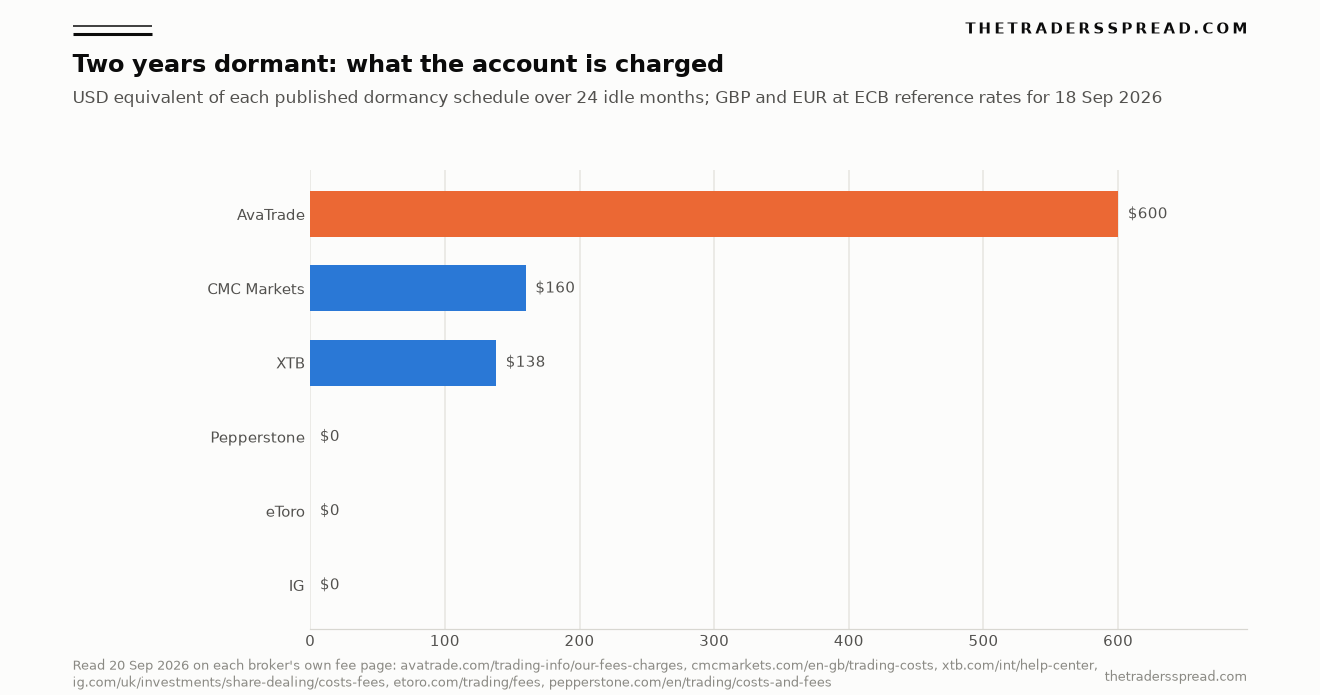
| Broker | What triggers the charge | Published rate | 24 months idle, USD |
|---|---|---|---|
| AvaTrade | 3 consecutive months of non-use, then every successive period; separate annual fee after 12 months | $50 per period plus $100 a year | $600 |
| CMC Markets | No trading activity for a continuous year; nothing deducted if the account holds no funds | £10 a month | $160 |
| XTB | No position opened or closed in 365 days and no deposit in 90 days; never charged on a zero balance | €10 a month | $138 |
| IG | None | "Inactivity fee: Free" | $0 |
| eToro | None | "Inactivity fee: Free" | $0 |
| Pepperstone | None; accounts under ten units of currency unused for three months may be archived and reactivated on request | No account keeping or inactivity fees | $0 |
CMC Markets states a monthly charge of £10 on dormant accounts, with dormancy defined as a continuous year without trading activity and no deduction taken where the account holds no funds. XTB sets €10 a month, payable only when no position has been opened or closed in 365 days and no deposit has been made in 90, and never on a zero balance or an ISA. IG lists its inactivity fee as free, as does eToro on its fees page. Pepperstone writes that it charges no account keeping or inactivity fees, and adds that balances under ten units of currency unused for three months may be archived and restored on request. Interactive Brokers shows a maintenance fee of USD 0 on both its Lite and Pro plans.
Sterling and euro figures convert at the European Central Bank reference rates for the 18 September 2026 close, GBP/USD 1.3344 and EUR/USD 1.1460, read via frankfurter.dev. FX was shut all weekend, so those are reference rates, not a live tick.
AvaTrade's meter starts at three months where the rest of this group starts at twelve or never starts at all, and it is the only broker here running two dormancy charges at once. Our own XTB review found a firm that hides its dealing cost inside an unpublished spread; AvaTrade does that too, and then adds a published penalty on top for the clients who stop dealing.
€66m of client money, €5.5m of capital
The Irish entity does publish numbers, in the one place a MiFID firm has to. AVA Trade EU Limited's Disclosures and Market Discipline Report for the year ended 31 December 2024 is a real balance sheet, and it is more informative than anything on the marketing site.
| AVA Trade EU Limited, 31 December 2024 | Amount |
|---|---|
| Own funds, entirely Common Equity Tier 1 | €5.451m |
| Of which paid-up capital / share premium / retained earnings | €2.440m / €0.168m / €2.843m |
| Own funds requirement (the binding K-factor figure) | €1.559m |
| Total capital ratio | 349.73% |
| Segregated client money held, December 2024 average | €66.105m |
| Daily trading flow, derivatives, December 2024 average | €348.253m |
Client money averaged €66.105m in December 2024, €64.994m in November and €66.649m in October, all segregated and none held on a non-segregated basis. Average daily derivative flow climbed through the quarter, from €293.560m in October to €348.253m in December. Against that the firm holds €5.451m of own funds, every euro of it CET1, versus a €1.559m requirement. The fixed overheads requirement of €1.526m is defined in the same document as one quarter of the previous year's audited fixed expenses, which implies an annual fixed cost base near €6.1m for the Irish company. That is our arithmetic from their published multiplier, not a figure AvaTrade states.
A 349.73% total capital ratio is comfortable. It is also the ratio of a small firm: five and a half million euros of capital behind sixty-six million of client cash and a third of a billion euros of derivative turnover a day. Two executive and three non-executive directors sat on the board at the year end.
The group's public claim is nine million users. The Irish entity, the one European clients actually contract with, held €66m of their money. Both can be true. The gap is worth knowing before assuming group scale means scale in your jurisdiction.
Eight regulators, no FCA
AvaTrade's regulation page lists nine authorisations across eight jurisdictions. We checked the two that matter most to European and Cypriot clients directly against the registers.
The Central Bank of Ireland's own register returns AVA Trade EU Limited, reference C53877, trading as AvaTrade, entity type Investment Firm — MiFID, authorised under Regulation 8(3) and deemed authorised under Regulation 5(2) of SI 375/2017. The register entry was live and matched the firm's claim on 20 September 2026. The Pillar 3 report adds that the company was incorporated in Ireland on 16 July 2008 with registration number 460012 and obtained its MiFID licence the same day, for execution of orders on behalf of clients and dealing on own account.
The Cyprus licence is the one worth reading twice. The footer of every AvaTrade page credits CySEC 347/17 to "DT Direct Investment Hub Ltd", a name that carries no Ava branding at all. CySEC's live list of Cypriot investment firms confirms it on 20 September 2026: D.T. Direct Investment Hub Ltd, licence 347/17, licence date 11 December 2017, company registration number 354263, registered in Limassol. It appears on the current CIF list, not the former one. The relationship is disclosed, but a client who searches the register for "AvaTrade" will not find it.
The rest: Ava Trade Markets Ltd under the BVI FSC (SIBA/L/13/1049), Ava Capital Markets Australia Pty Ltd under ASIC (AFSL 406684), Ava Capital Markets Pty under South Africa's FSCA (45984), Ava Trade Japan K.K. under Japan's FSA (1662) and the Financial Futures Association of Japan (1574), Ava Trade Middle East Ltd under ADGM's FSRA (190018), Ava Trade Kenya Limited under Kenya's CMA (262), and ATrade Ltd under the Israel Securities Authority.
The absence is as informative as the list. There is no FCA entity, no UK site among the twenty-plus country domains the group operates, and consequently no FSCS cover and no Financial Ombudsman Service route for a British client. Ten licences did not stop us finding a weak link at ThinkMarkets; here the count is high and the coverage is genuinely broad, but Britain is simply not in it. We could not verify the Australian AFSL at source: data.gov.au's licensee dataset returned a redirect loop from this host all morning, so 406684 rests on the firm's own statement.
What AvaTrade is actually good at
The criticism above is about disclosure, not competence.
AvaTrade runs an unusually wide platform set for a retail CFD house: MetaTrader 4 and 5, its own WebTrader, the AvaTradeGO app, DupliTrade for copy trading, AvaSocial, and AvaOptions, which offers genuine European-style vanilla FX options rather than the binary imitations that give the category a bad name. The instruments page states that in-the-money options close automatically at intrinsic value at expiry. Very few retail brokers offer the product at all.
AvaProtect is a real feature rather than a marketing label. It reimburses losses on a protected position, up to $1m, for a premium paid up front, and the money is credited as cash with no withdrawal restriction. Coverage is the catch: FX, gold and silver only.
Position limits are published, which is more than most. The instruments page caps Bitcoin pairs at $1.5m per customer, ETH at $750,000, Bitcoin Cash and Litecoin at $200,000, and total crypto exposure at $2.5m. A fixed-spread book such as Trade Nation does not always match that.
RelatedPU Prime Review 2026: Who Holds the Client Contract
The client-money position is clean. Every euro reported by the Irish entity in the fourth quarter of 2024 sat in segregated accounts, with nothing held non-segregated.
The verdict
We rate AvaTrade 2.5 out of 5. The licences are real, the client money is segregated, the capital ratio is three and a half times the requirement, and the product range is wider than the commission-per-lot brokers it competes with. What it will not do is tell you what a trade costs before you hand over identity documents, and the one document European law forces it to publish on costs contains no costs.
It suits a trader who has already opened the account, can see live spreads in the platform, and wants vanilla FX options, a fixed-spread book, AvaProtect on gold, or MetaTrader plus copy trading from a single MiFID-authorised counterparty. It suits someone in Ireland, South Africa, Japan, the UAE or Kenya who values a locally licensed entity over the keenest headline price.
It does not suit anyone comparing brokers on cost before signing up, because there is nothing to compare. It does not suit a scalper or a high-frequency trader, who needs a published raw spread and a stated commission and can get both from Pepperstone in minutes. It does not suit a UK resident, for whom the missing FCA permission removes FSCS protection and the Ombudsman. And it does not suit anyone who funds an account and then trades occasionally: the dormancy meter starts at three months, faster than any peer we checked, and $300 in the first idle year is a real hole in a small balance.
What would change the rating sits entirely within AvaTrade's control. Publish the typical spread table the instruments page was built to hold. Put figures in the Key Information Document cost section, where the regulation intends them. Re-date the performance scenarios to a gold price from this decade. The first two together would move the score a long way, because nothing else here is broken.
Frequently asked questions
Is AvaTrade regulated in the United Kingdom?
No. AvaTrade's regulation page, read on 20 September 2026, lists the Central Bank of Ireland, CySEC, ASIC, the BVI FSC, Japan's FSA, South Africa's FSCA, ADGM's FSRA, Kenya's CMA and the Israel Securities Authority. The FCA is not among them and the group operates no UK website, so a British client gets no FSCS cover and no Financial Ombudsman route.
What does AvaTrade charge if an account goes quiet?
Its fees page sets an inactivity fee of $50, €50 or £50 after three consecutive months of non-use and after every successive three-month period, plus a separate annual administration fee of $100, €100 or £100 after twelve consecutive months. On a literal reading of both schedules a dormant dollar account pays $300 in the first year and $600 over two.
Where can I see AvaTrade's spreads?
Inside the platform. The fees page directs clients to log in, search for the instrument, open the Details icon and read the Info section. The public Financial Instruments Index is built to display typical spreads, described as the median during 07:00 to 18:00 GMT in the previous quarter, but on 20 September 2026 the table returned no rows on either the Most Popular or Forex tabs.
How much client money does the European entity hold?
AVA Trade EU Limited's Pillar 3 disclosure for the year ended 31 December 2024 reports segregated client money averaging €66.105m in December, €64.994m in November and €66.649m in October, with nothing held non-segregated. Own funds were €5.451m of Common Equity Tier 1 against a €1.559m requirement, a total capital ratio of 349.73%.
What is AvaProtect and what does it cost?
AvaProtect is paid downside cover on an individual position, available on FX, gold and silver, that reimburses losses up to $1m over a period the client chooses. The reimbursement arrives as withdrawable cash. AvaTrade prices the premium from expected volatility over the contract term and does not publish a rate card, so the cost is visible only at the point of purchase.
How does AvaTrade compare with IG on fees?
On dormancy they are opposites. IG's UK costs page, read on 20 September 2026, lists its inactivity fee as free, alongside free account opening, closing and maintenance. AvaTrade charges from the fourth idle month. On dealing cost no comparison is possible from public pages, because AvaTrade publishes no spread table and IG's varies by market and account.
This review is analysis and information, not financial advice. Contracts for difference are leveraged products and 70% of AvaTrade's retail investor accounts lose money when trading CFDs with the firm, according to the risk warning displayed on avatrade.com on 20 September 2026. Fees and licences change; every figure here carries its source and read date. Your capital is at risk.