
The idea that OANDA is one broker quoting one price is wrong, and OANDA's own data says so. Pull the average EUR/USD spread from the company's public historical-spread service on 9 September 2026 and ask it the same question five times, once for each licensed division, and five different answers come back. OANDA Europe Limited, the entity holding Financial Conduct Authority permission number 542574, averaged 0.851 pips over the trailing month on a 24-hour basis. OANDA Corporation, the New York entity registered with the Commodity Futures Trading Commission, averaged 1.651 pips on the identical pair over the identical window. That is 94% wider for the same currency, the same brand and the same technology stack. Nothing on either website tells a prospective client this.
What makes the gap interesting is that it does not run one way. OANDA does not operate a single global price book with a US surcharge bolted on; it operates three, and which one is cheapest depends on the instrument. Europe wins EUR/USD and GBP/USD. Asia-Pacific wins USD/JPY by 35% and spot gold by five cents an ounce. North America wins nothing. A UK client and a Sydney client, filling out a form on the same domain, are routed into materially different cost structures on the basis of where their passport was issued, and the only way to see it is to query the API behind a widget nobody reads. Every figure below was pulled live on 9 September 2026, from OANDA's own schedules and the regulators' own registers.
Key facts, verified 9 September 2026
- EUR/USD averaged 0.851 pips at the FCA entity and 1.651 pips at the CFTC entity over the trailing month, a 94% gap — OANDA historical-spread API,
labs-api.oanda.com/v1/spreads, data month 2026-09. - The UK pricing page advertises spreads "from just 0.6 pips on EUR/USD"; the realised 24-hour average at that entity was 42% above the headline figure — oanda.com/uk-en/trading/our-pricing/.
- OANDA Corporation carries three regulatory actions totalling $1.3m in fines: NFA case 25BCC00004 ($600,000, effective 13 June 2025), NFA 21BCC00002 ($200,000, 16 April 2021) and CFTC 20-29 (cease-and-desist plus a $500,000 civil monetary penalty, 21 August 2020) — NFA BASIC, NFA ID 0325821.
- At 31 July 2026 the US entity reported adjusted net capital of $33.19m against a requirement of $26.78m, an excess of $6.41m — NFA BASIC net capital report.
- A 1.0% currency conversion fee is applied to realised profit, loss, adjustments, fees and charges whenever the instrument is denominated outside the account currency — oanda.com/uk-en/trading/our-charges/.
- US clients need a balance of USD $10,000 to access core pricing plus commission, and the commission rate itself is published on neither the US pricing page nor the account-comparison page.
- FTMO completed its acquisition of OANDA Global Corporation from CVC on 1 December 2025, after approvals from five regulators — oanda.com/group/press-release/oanda-acquired-by-ftmo/.
The number OANDA publishes about itself
Most retail brokers publish a "from" spread and stop. OANDA runs a public endpoint reporting the realised average and stability distribution of its own spreads, per instrument, per division, refreshed monthly. It is the most useful thing on the site, buried behind a widget on the historical-spreads page, and read carefully it is also the most awkward document the firm publishes.
Here is what it returned on 9 September 2026 for the trailing month, on a 24-hour basis, with the three price books shown separately. Figures are in pips, except gold, which is in US cents per ounce.
| Instrument | Europe (OEL, FCA) | Asia-Pacific (OAU / OAP) | North America (OC / OCAN) | Cheapest book |
|---|---|---|---|---|
| EUR/USD | 0.851 | 1.051 | 1.651 | Europe |
| GBP/USD | 1.598 | 1.798 | 2.198 | Europe |
| USD/JPY | 1.690 | 1.090 | 1.690 | Asia-Pacific |
| XAU/USD (cents/oz) | 57.10 | 52.10 | 57.10 | Asia-Pacific |
Source: OANDA historical-spread API, labs-api.oanda.com/v1/spreads/spread-stability-and-average, divisions OEL, OAU, OAP, OC and OCAN, retrieved 9 September 2026. Business-hours averages are tighter; the 24-hour figure is the one a swing trader pays.
Two things fall out of that table. The first is that OANDA Canada is priced off the American book, not the European one, which matters to anyone who assumed a Toronto account inherited London pricing. The second is that the Asia-Pacific book, shared by the Australian and Singaporean entities, is the only one that beats Europe anywhere, and it does so on the two instruments a Tokyo-session trader is most likely to hold.
The three-month window tells the same story with slightly wider numbers: 0.896 pips in Europe against 1.696 in North America, an 89% gap. This is not a one-month artefact of August liquidity.
Set against the advertised figure, the UK entity comes off reasonably well. "From just 0.6 pips" is a floor, not a promise, and 0.851 as a round-the-clock mean is a defensible distance above it. USD/JPY is the weaker case: the same page quotes 1.3 pips, and the realised mean was 1.690, exactly 30% higher. We measured the same gap between marketing and tape in our ActivTrades review.
How that lands against the competition
A spread-only account pays its entire dealing cost once, when it crosses the spread. A commission account pays a narrower spread plus a fixed charge. To compare them honestly, both have to be converted into the same unit: US dollars per 100,000-unit EUR/USD lot, round turn. Every competitor figure below was read from that broker's own live schedule on 9 September 2026, not from any archived review.
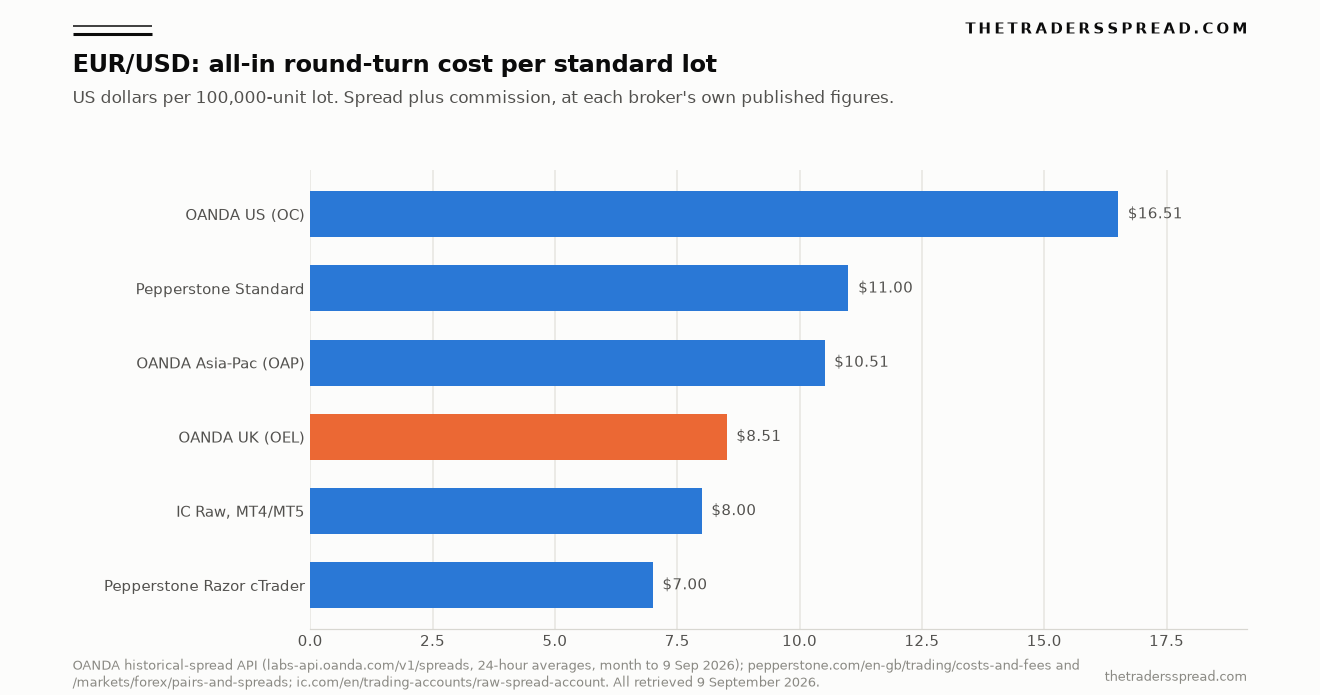
Pepperstone Limited, the FCA entity, publishes a Razor commission of USD 6.00 round trip per FX lot on cTrader and USD 7.00 on MT4 and MT5, charged in full when the position opens, alongside a stated average EUR/USD spread of 0.1 points on Razor and 1.1 on Standard. Raw Trading Ltd, which trades as IC and IC Markets Global under Seychelles Financial Services Authority securities dealer licence SD018, publishes a 0.1-pip average EUR/USD spread on its MT4 and MT5 Raw Spread account with commission of $3.50 per lot per side. Tickmill's Raw account is $3 per lot per side, and the firm's own worked example puts a one-lot EUR/USD trade at $6 round turn, matching the figure in our Tickmill review. Tickmill publishes no realised average EUR/USD spread anywhere retrievable, so it is absent from the chart rather than estimated into it.
OANDA's UK entity is competitive without being cheap. At $8.51 all-in it sits within 6% of IC's raw account and roughly 20% above Pepperstone's cheapest platform, while carrying no commission line, no platform tiering and no minimum balance. Its own American entity, at $16.51, costs more than twice the cheapest bar on the chart. The most telling comparison is the third one: Pepperstone's commission-free Standard account, an FCA product with the same structure, costs $11.00 against OANDA UK's $8.51. That is a real win for OANDA, on like-for-like terms, in the one jurisdiction where the comparison is clean.
Five entities, one brand, five rulebooks
Every licence claim below was checked against the regulator, not against the broker's footer.
United Kingdom. OANDA Europe Limited discloses FCA number 542574 and company number 07110087. The Companies House record confirms the company as active, incorporated 21 December 2009, registered at Dashwood House, 69 Old Broad Street, London EC2M 1QS, with accounts filed to 31 December 2024 and the next set due 30 September 2026. The FCA's own Financial Services Register would not yield: its public interface returns no machine-readable payload to an automated client, and the register's firm API requires a credentialled key. The firm reference number here is therefore OANDA's own disclosure, corroborated by an independent live company record rather than by the FCA directly. The retail risk warning on that entity currently reads 76.6%.
United States. NFA BASIC returns OANDA Corporation, NFA ID 0325821, at 17 State Street, Suite 300, New York, registered with the CFTC as a Futures Commission Merchant and a Retail Foreign Exchange Dealer, approved as a Forex Dealer Member, membership status green.
Australia. The ASIC Australian Financial Services Licensee dataset, September 2026 extract published 2 September, lists AFS Licence 412981 held by OANDA Australia Pty Ltd, ABN 26 152 088 349, licensed since 26 March 2012 from Sydney, authorised to advise, deal and make a market in derivatives and foreign exchange contracts for retail and wholesale clients.
Singapore. The Monetary Authority of Singapore's Financial Institutions Directory, last updated 25 August 2026, lists OANDA Asia Pacific Pte. Ltd. as a Capital Markets Services Licensee for dealing in OTC derivatives contracts and as an Exempt Financial Adviser, chief executive Philip Denis Waters, at One Raffles Place.
Canada. OANDA (Canada) Corporation ULC states regulation by the Canadian Investment Regulatory Organization, with Canadian Investor Protection Fund cover within limits.
That spread of permissions is the asset the current owner bought. FTMO closed its purchase of OANDA Global Corporation from CVC on 1 December 2025, a process that required approvals from five separate regulators and took roughly eight months. "OANDA, a broker with licenses in eight key markets across the world, is the perfect fit to this vision," said Otakar Šuffner, co-founder and chief executive of FTMO, on the day it completed. Ten months earlier, announcing the sale, Gavin Bambury, chief executive of OANDA, described the group as "well positioned for future growth thanks to a global footprint of licenses, OANDA's trusted brand, the scalable technology platform and the broad offering we provide to our customers."
Both men are describing the same thing the spread table describes. A footprint of licences is a footprint of price books.
The costs that never appear in a spread table
OANDA charges nothing to deposit and nothing to withdraw. It then charges for four other things, and the largest of them is invisible to anyone reading a spreads page.
Currency conversion, 1.0%. When an instrument settles in a currency other than the account currency, realised profit and loss, adjustments, fees and charges are converted at the mid price with a 1.0% mark-up or mark-down applied against the client. OANDA's own worked example on the charges page takes 100 GBP of profit into a USD account at a bid conversion rate of 1.282446 against a 1.29540 mid, and the same 100 GBP loss out at 1.308354. On a GBP-denominated account trading US index or US share CFDs, this fee applies to every closed position, and it is charged on the profit or loss, not on the notional. It dwarfs the spread on any position held to a meaningful move.
Financing. Funding rates combine a market rate with an OANDA admin fee: 1.00% a year on most FX pairs, 2.00% on CZK, HUF, SAR, THB and ZAR pairs, 4.00% on Turkish lira pairs, 1% on gold and silver, and 2.50% on indices, shares, ETFs, commodities, other metals and bonds. The worked example on the financing page shows a long 200,000 EUR/USD position funding at 2.68% a year, of which 1% is the admin component. Charges post daily at 5pm New York time, and FX weekend funding is applied on Wednesdays at triple the daily rate.
Share and ETF CFDs. 0.06% of notional to open and 0.06% to close on UK, US, French, German and Spanish shares and on ETFs; 0.08% each way on Belgian, Danish, Finnish, Dutch, Portuguese and Swedish shares. A £20,000 position in a UK share CFD therefore costs £24 in execution charges before any spread or financing.
Inactivity. A monthly fee after twelve months without trading activity, capped at £20 per client per month, levied on the sub-account with the smallest balance first, applied on the third-last weekday of the month, never charged while a position is open and never able to push an account negative. Up to three months of it can be rebated if trading resumes. That is a more generous construction than most of the industry, and considerably more generous than the arrangements we found at XTB.
What the register says about the counterparty
Three enforcement actions sit against OANDA Corporation in NFA BASIC, and the most recent is recent.
NFA case 25BCC00004 took effect on 13 June 2025 with a $600,000 fine and a further sanction recorded as "other", across categories of financial, general conduct and sales practice. OANDA's own statement, dated 29 May 2025, sets out what the complaint alleged: that between January and August 2023 it executed forex transactions initiated by its parent without collecting the required security deposit and improperly offset the resulting exposure for net capital purposes; that from August 2021 to February 2023 it failed to collect correct security deposits from US customers; that a third-party pricing display issue affected customers in 2022; that its promotional materials did not adequately describe its relationship with a cryptocurrency broker; and that it failed to supervise its business diligently. OANDA settled without admitting or denying the allegations and says it has remediated all of them.
Behind that sits NFA 21BCC00002, a $200,000 fine effective 16 April 2021, and CFTC administrative action 20-29 of 21 August 2020, which carried a cease-and-desist order and a $500,000 civil monetary penalty and is flagged in BASIC as a barrable offence.
RelatedScope Markets Review: Saint Lucia Contract, $10 EUR/USD
The financial position is steadier than the conduct record. OANDA Corporation's monthly filings show adjusted net capital of $33.19m at 31 July 2026 against a regulatory requirement of $26.78m, leaving $6.41m of excess. The buffer has narrowed through the year: $7.32m at 31 March, $5.88m at 30 April, $6.40m at 30 June. A cushion of roughly 24% above requirement is adequate rather than comfortable, and nowhere near the capitalisation of a bank-owned broker such as the one in our Swissquote review.
The verdict: 3.9 out of 5
OANDA is the rare retail broker that publishes enough about itself to be caught out by its own data, and the firm deserves credit for that even when the data is unflattering. The UK entity is genuinely good value on a spread-only basis, beating an FCA competitor's commission-free account by 23% on EUR/USD while asking no minimum deposit, and the inactivity policy is among the fairest in the sector.
Three things pull the score down.
The first is the American book. At 1.651 pips on EUR/USD and 2.198 on GBP/USD, a US client is paying roughly double a UK client for the same product, and the alternative — core pricing plus commission — is gated behind a $10,000 balance and priced at a rate the firm does not publish on either the pricing page or the account-comparison page. A broker that runs a public spread API and then declines to print its own commission rate has made a choice about which number it wants shopped.
The second is the 1% conversion fee, which is disclosed clearly but sized aggressively, and which quietly makes OANDA an expensive venue for a non-USD account trading US instruments. The third is the conduct record: $1.3m across three actions, the last of them thirteen months old, in a category that includes supervision and promotional disclosure.
What would change the assessment: a published commission schedule for the US core-pricing plan; a conversion fee at half its current level; and a clean 24 months on the NFA register. What would worsen it: any narrowing of the American entity's net capital excess below the $5.88m level touched in April, or a fourth action.
Frequently asked questions
Is OANDA regulated in the UK?
OANDA Europe Limited discloses authorisation and regulation by the Financial Conduct Authority under number 542574, and Companies House confirms the company (number 07110087) as active at Dashwood House, 69 Old Broad Street, London. The FCA register's own interface did not return machine-readable data to an automated request on 9 September 2026, so the number here rests on the firm's disclosure plus an independent live company record.
Why do OANDA's spreads differ by country?
OANDA operates separate price books per licensed division. On 9 September 2026 its own historical-spread service reported average EUR/USD spreads of 0.851 pips for the European division, 1.051 for Australia and Singapore, and 1.651 for the United States and Canada. The ranking is not fixed across instruments: Asia-Pacific was the cheapest book for USD/JPY at 1.090 pips against 1.690 elsewhere.
Does OANDA charge commission?
Not on FX, index or commodity CFDs at the UK entity, where the spread is the whole dealing cost. The Australian entity offers a Raw account at A$3.50 per 100,000-unit FX lot traded, about US$2.53 at the ECB reference rate of 1.3861 on 8 September 2026, though the page does not state whether that is charged per side or per round turn. The US entity offers core pricing plus commission to clients holding $10,000 or more but does not publish the rate.
What is OANDA's inactivity fee?
A monthly charge applied after twelve months without trading activity, capped at £20 per client per month, taken first from the sub-account with the smallest balance, applied on the third-last weekday of each month. It is not charged while a position is open and cannot take a balance below zero, and up to three months can be rebated if trading resumes.
Who owns OANDA?
FTMO, the Prague-based proprietary trading group, which completed its acquisition of OANDA Global Corporation from CVC Asia Fund IV on 1 December 2025 after securing approvals from five regulators. FTMO has said it intends to run OANDA as a fully standalone business.
How does OANDA compare with commission brokers on cost?
On the figures each firm published on 9 September 2026, a standard EUR/USD lot costs $8.51 round turn at OANDA's UK entity, against $8.00 on IC's MT4/MT5 Raw account and $7.00 on Pepperstone's Razor account through cTrader. The same lot costs $16.51 at OANDA's US entity. Our EUR/USD forecast sets out the price context those costs are paid into.
This review is analysis and information, not financial advice, and nothing in it is a recommendation to open, fund or close an account with any firm named. All pricing, fee and register figures were retrieved on 9 September 2026 and are subject to change without notice. CFDs are leveraged products; OANDA Europe Limited discloses that 76.6% of its retail investor accounts lose money. Capital is at risk.