
On GO Markets' Australian account-types page, the third card from the left reads "Micro account", then "Leverage up to 500:1", then "Minimum Deposit $10 USD". The footer of that same page names GO Markets Pty Limited, AFSL 254963, a company whose retail clients are capped at 30:1 on major currency pairs under ASIC's product intervention order. The "Create account" button under the micro card does not go to the portal.gomarkets.com sign-up used by the Standard and GO Plus+ cards beside it. It goes to apply.gomarkets.mu, a Mauritius domain. The card itself carries no footnote, no entity name and no link to a disclosure document. We read the page on 26 September 2026 at gomarkets.com/en-au, and the EU version, footed by the Cyprus-licensed GO Markets Ltd, carries the identical card pointing to the identical address.
That button is the whole review in miniature. GO Markets runs five legal entities under one logo, and the cheapest-looking product on the regulated pages belongs to none of the regulated ones. The code behind the apply.gomarkets.mu sign-up app, which we downloaded, tells an Australian visitor "You are currently visiting our GO Markets International Ltd website", carries risk text for GO Markets LLC of Saint Vincent and the Grenadines, and asks applicants "from outside Seychelles" to check their local laws. None of the ASIC documents mentions a micro account: the Product Disclosure Statement, the client terms and the target market determination return zero hits for the word. Neither do the Cyprus terms. What a $10 client actually signs is decided by a sign-up flow, not by the licence printed underneath the offer.
Key facts
- GO Plus+ raw-account commission is US$2.50 per side on a USD-base account, AU$3.00 on an AUD base — GO Markets spreads page, read 26 Sep 2026
- Published EUR/USD average spread is 0.1 pips on GO Plus+ and 0.9 pips on Standard, measured 1 to 28 February 2026 — GO Markets spreads and fees page, read 26 Sep 2026
- AFSL 254963 is held by GO Markets Pty Ltd, licence start date 10 March 2004, with authority to make a market in derivatives and FX contracts — ASIC AFS licensee dataset, September 2026 file, downloaded 26 Sep 2026
- "Go Markets Ltd (ex Galactus Ltd)" holds CySEC licence 322/17, dated 25 April 2017 — CySEC register of Cypriot investment firms, read 26 Sep 2026
- The EU site states 71% of retail accounts lose money with GO Markets Ltd in one warning and 70% in another, on the same page — GO Markets EU documents page, read 26 Sep 2026
- The Australian PDS in force is dated October 2023; the Cyprus terms are dated May 2026 — both PDFs linked from GO Markets' documents pages, read 26 Sep 2026
Five companies behind one logo
Most retail reviews of GO Markets describe it as an Australian broker founded in Melbourne in 2006. That is how the company presents itself ("Since 2006, GO Markets has helped hundreds of thousands of traders"), and the Australian licence is real and old. The ASIC licensee file lists AFSL 254963 against GO Markets Pty Ltd, ABN 85 081 864 039, Melbourne, with a start date of 10 March 2004 and a condition set that includes making a market in foreign exchange contracts and derivatives for retail and wholesale clients. Making a market means the licence permits GO Markets to take the other side of client trades.
The group is wider than that. Reading the footers of each regional site and the first page of each set of client terms, all fetched on 26 September, gives this map:
| Entity | Regulator and licence | Site | Client terms version | Governing law |
|---|---|---|---|---|
| GO Markets Pty Ltd | ASIC, AFSL 254963 | /en-au | July 2024 (PDS: October 2023) | Victoria, Australia |
| GO Markets Ltd | CySEC, CIF 322/17 | /en-eu | May 2026 | Cyprus |
| GO Markets Pty Ltd (MU) | FSC Mauritius, GB19024896 | /en | September 2025 | Mauritius |
| GO Markets International Ltd | Seychelles FSA, SD043 | int.gomarkets.com | September 2025 | Seychelles |
| GO Markets LLC | None stated; incorporated in St Vincent and the Grenadines, company 332 LLC 2020 | /en-svg | July 2021 | Not searchable (scanned PDF) |
We verified four of the five against something other than GO Markets' own pages. The ASIC line comes from the government licensee CSV. The CySEC line comes from CySEC's live register, where the firm appears as "Go Markets Ltd (ex Galactus Ltd)". The Seychelles FSA's securities dealer list includes Go Markets International Ltd with the website int.gomarkets.com and an address at IMAD Complex, Ile du Port. The Mauritius licence we could not confirm: the FSC's register returned a 212-byte shell to our request, so the GB19024896 number rests on the Mauritius client terms alone. CySEC's former-firms list returned HTTP 410, as it has for several days, so we could only check the live list.
The Saint Vincent company is the odd one. Its footer does not claim a licence at all; it says GO Markets LLC is incorporated under the St Vincent Business Companies Act and has permission to use the brand from GO IP Pty Ltd of Victoria. Its terms and conditions are an 8.2MB scanned file dated July 2021 that yields fewer than 700 words of machine-readable text. A client cannot search it for the words that matter.
A second detail sits in the Seychelles entity's own September 2025 terms. They are hosted in the same file store as every other GO Markets legal document, yet none of the four gomarkets.com documents pages we read links to them. They live on int.gomarkets.com, which is a separate site. Other multi-licence brokers do this too; our ThinkMarkets review traced ten licences to one Seychelles contract, and the TMGM review found a 1:1000 product sitting on a Vanuatu licence.
What $2.50 buys, and the page that disagrees with it
On price, GO Markets is sharp. The GO Plus+ account charges US$2.50 per side per standard lot on a USD-base account, which is US$5.00 round turn. None of the seven peer quotes we read on 26 September beat it; the nearest were three at $3.00:
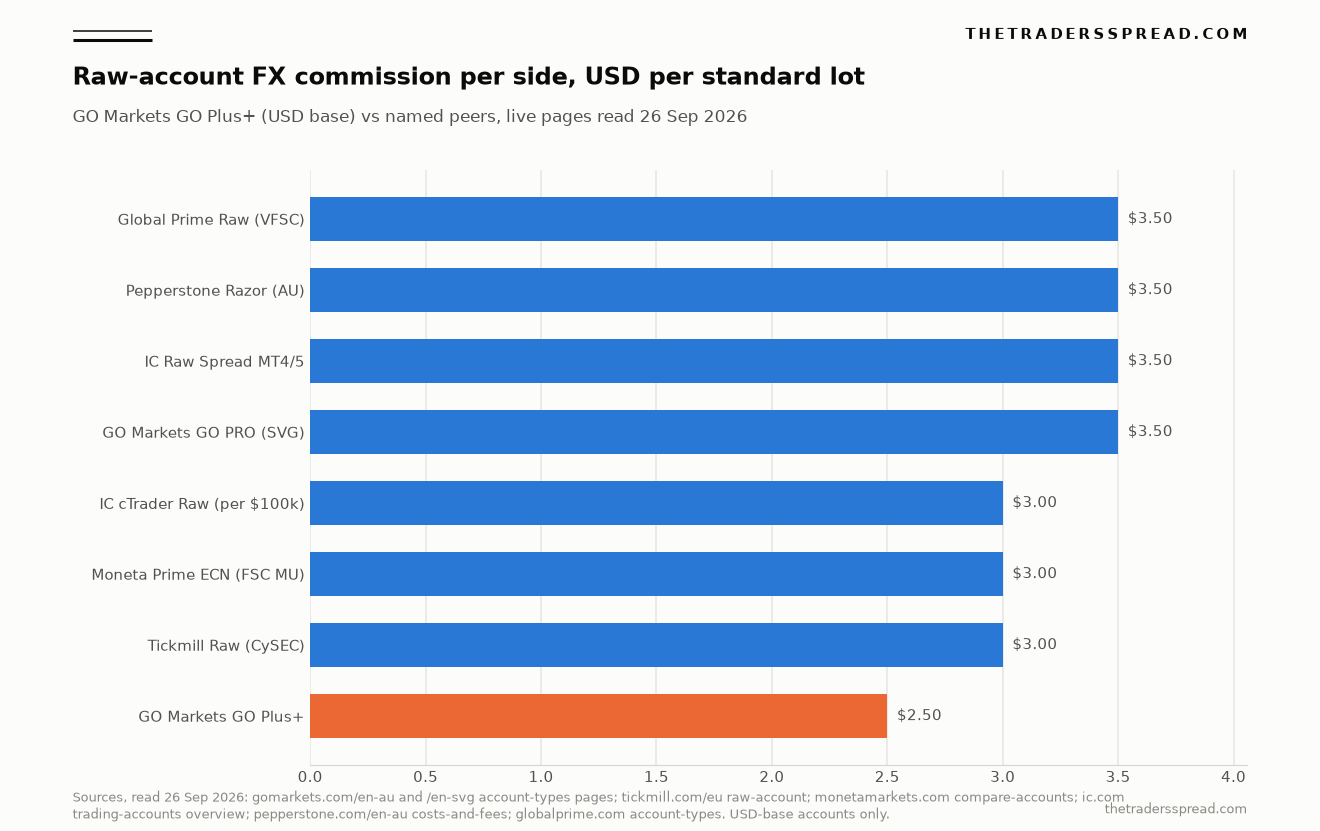
The peer figures, each from the peer's own page that day: Tickmill Europe Ltd (CySEC 278/15) charges $3 per lot per side on Raw. Moneta Markets Trading Limited (FSC Mauritius) charges $3 per side on Prime ECN. IC Markets' ic.com site, operated by Raw Trading Ltd under Seychelles licence SD018, lists $3.50 per side on Raw Spread for MetaTrader and $3.0 per USD 100k on cTrader. Pepperstone's Australian costs page quotes Razor commission "from USD$3.50 per lot, per side". Global Prime, whose footer names Gleneagle Securities Pty Limited under Vanuatu's VFSC, lists $3.5 per side on Raw. GO Markets' own St Vincent GO PRO account lists $3.50, a dollar more than GO Plus+ on the other sites. IC also advertises two new "Raw Pro" tiers at $1.5 and $1.0 per side behind an early-access button; we left them off the chart because no terms were published.
Commission alone flatters raw accounts, so we added GO Markets' published average spread. The spreads-and-fees page gives EUR/USD at 0.1 pips on GO Plus+ and 0.9 pips on Standard, averaged over 1 to 28 February 2026. At $10 per pip on a standard lot:
| Account | EUR/USD average spread | Round-turn commission | All-in per lot |
|---|---|---|---|
| GO Markets GO Plus+ (USD base) | 0.1 pips = $1.00 | $5.00 | $6.00 |
| GO Markets Standard | 0.9 pips = $9.00 | $0 | $9.00 |
| IC Markets Raw Spread, MetaTrader (Raw Trading Ltd) | 0.1 pips = $1.00 (IC's stated average) | $7.00 | $8.00 |
The February averages are seven months old, and GO Markets calls them "indicative only". We treat the 0.1 pip figure as a claim, not a measurement.
Commission also depends on the account's base currency. Using the ECB reference rates for 25 September 2026 (the latest set, via Frankfurter), GO Plus+ costs US$1.98 per side on an NZD base (NZ$3.50), US$2.11 on AUD (AU$3.00), US$2.28 on EUR (€2.00), US$2.50 on USD, US$2.65 on GBP (£2.00) and US$2.74 on SGD (SG$3.50). The SGD account pays 38% more per lot than the NZD account for the same trade. Our FP Markets review found a wider gap, but the pattern is the same.
Here the paperwork splits. The Australian PDS prints round-turn costs of USD 5, AUD 6, GBP 4, EUR 4, NZD 7 and SGD 7, which matches the per-side table on the spreads page. The separate spreads-and-fees page shows "SGD 3" and "NZD 3" per lot, and CHF 2 where the spreads page leaves the CHF cell blank. Two pages on the same site, read minutes apart, disagree on two currencies and leave a third blank. The PDS is the document ASIC holds the issuer to, so we used its numbers.
Where 30:1 stops
The micro card matters because leverage limits are the core retail protection in both of GO Markets' big regulated markets. ASIC introduced its CFD product intervention order in March 2021 and extended it in 2022. Announcing the extension, ASIC Commissioner Cathie Armour said: "Our extension of the product intervention order for five years will ensure that the leverage ratio limits and other protections can continue to reduce the size and speed of retail clients' CFD losses." The same release reported a 91% fall in aggregate retail net losses in the order's first six months, from $372 million to $33 million a quarter. The order runs to 23 May 2027, eight months from now.
Europe got there first. When ESMA agreed its CFD restrictions in March 2018, its then chair Steven Maijoor said the measures "will for the first time ensure that investors cannot lose more money than they put in, restrict the use of leverage and incentives, and provide a risk warning for investors."
Both regimes bind the licensee, not the brand. A client who opens with the Mauritius or Seychelles company is outside them. The Mauritius terms say GO Markets reserves the right not to grant negative balance protection where it considers, "in our sole discretion", that a negative balance was caused by misconduct or market abuse. The Mauritius disclosure statement, in its margin section, says: "You will remain liable for any negative balance which cannot be covered by the closing out of your Positions." The Australian PDS, by contrast, says the company brings negative balances "onto our own balance sheet as a cost of business", and the Australian site's own risk warning states that retail clients have negative balance protection under ASIC's order.
The micro account's own page, which exists only on the St Vincent site, lists a 50% margin level, 500:1 leverage, a $10 starting deposit and 48 instruments with a ".m" suffix, all FX pairs plus XAUUSD.m and XAGUSD.m. Nothing on that page restricts it by residence. The sign-up app does. Its country-restrictions text excludes residents of the United States, Canada, Japan, New Zealand and several others, and a separate pop-up tells visitors detected in Australia that they "will generally be directed" to the ASIC entity. We did not submit an application, so we cannot say which company an Australian applicant finally contracts with. The point is that the ASIC-branded page sends a retail visitor to a flow where that question arises at all.
The documents that have not kept up
A broker's legal documents are its real product description, and GO Markets' set is uneven. The Australian PDS is dated October 2023 and the Australian terms July 2024; the file store's metadata shows both were re-uploaded on 3 July 2026 without a new version date. The Cyprus terms were re-issued in May 2026. The St Vincent terms date from July 2021.
Smaller slips sit on the pages themselves. The Australian documents page ends with a paragraph of lorem ipsum dummy text beneath the terms and conditions link. The EU documents page quotes a 71% retail loss rate for GO Markets Ltd in its main risk box and 70% in the banner below it. The Australian, Mauritius and St Vincent sites all display the Cyprus company's 70% figure in their banners, a statistic that describes a different client book under a different regulator. The EU documents page also lists the Australian wholesale client statement and the Australian dispute policy. None of this changes what a trade costs. It does show how loosely the five entities' pages are separated, which is the same problem the micro card shows in a more expensive form.
Platform choice is broad: MetaTrader 4 and 5, cTrader, TradingView and the in-house GO TradeX app. Account structures include individual, joint, company, trust and, in Australia, SMSF. US share CFDs cost 2 cents a share with no minimum on the Australian site; Australian shares carry 0.08% and a monthly market-data fee of AUD 22, rebated once four trades are placed. Our Pepperstone review and IC Markets review cover the two Melbourne and Sydney peers GO Markets is most often compared with.
What would change this verdict
Three things would move the rating. If GO Markets removed the micro card from its ASIC and CySEC pages, or pointed it at a page that states which entity issues it and on what leverage, the central finding here would fall away and the score would rise by about half a point. If it re-issued the Australian PDS with a current date and reconciled the SGD and NZD commissions across its two pricing pages, the documentation criticism would narrow to the St Vincent file. In the other direction, if an Australian application submitted through apply.gomarkets.mu were accepted by the Seychelles or Mauritius company rather than redirected, that would be a regulatory question for ASIC, not a presentation issue, and we would revisit the review.
We also looked for evidence against our reading. The sign-up code's Australia pop-up is exactly the safeguard one would want, and GO Markets may route every Australian to the ASIC entity in practice. We cannot test that without applying. The finding stands on what the pages show: a 500:1 offer on a 30:1 page, with a link that leaves the licensee's own sign-up.
RelatedMultiBank Review 2026: MEX Atlantic, Not a 0.0 Ticket
Verdict: cheap raw pricing, one card worth reading twice
GO Markets earns its reputation on cost. US$2.50 per side on GO Plus+ undercuts every peer we read on 26 September, and the platform list is as wide as any Australian broker's. The Australian licence dates to 2004, the Cyprus licence to 2017, and both check out against the regulators' own lists.
The weakness is structural, and it is visible on the account-types page. Five entities share one website template, and the one retail product with 500:1 leverage and a $10 entry sits on the Australian and European pages with a sign-up link to a Mauritius domain. The PDS is nearly three years old, two pricing pages contradict each other, and the St Vincent terms cannot be searched.
It suits active FX traders in Australia or the EU who open GO Plus+ directly through the local portal, check that the client agreement names GO Markets Pty Ltd or GO Markets Ltd, and trade in AUD, NZD or EUR where the commission is lowest. It suits less well anyone drawn in by the micro account, because the protections printed at the bottom of the page are not necessarily the ones that come with it. Rating: 3.2 out of 5.
On cost and platform choice alone, GO Markets would sit near 4. The gap to 3.2 is almost entirely the micro-account routing and a disclosure set that trails the website by years. Both sit within the company's control, which is why the section above names them as the triggers for a re-rating.
FAQ
Is GO Markets regulated by ASIC?
Yes. GO Markets Pty Ltd holds AFSL 254963, which the ASIC licensee dataset for September 2026 lists with a start date of 10 March 2004 and authority to make a market in derivatives and FX contracts for retail and wholesale clients. Only accounts opened with that company carry ASIC's protections, including 30:1 leverage on major pairs and negative balance protection.
Which GO Markets entity will hold my account?
It depends on the site and the sign-up flow. The Australian site's Standard and GO Plus+ cards go to portal.gomarkets.com, and the EU cards to app.gomarkets.eu. The micro account card on both goes to apply.gomarkets.mu, whose code references GO Markets International Ltd (Seychelles) and GO Markets LLC (St Vincent). The entity named in the client agreement is the one whose rules apply.
How much does GO Markets charge per lot?
GO Plus+ charges US$2.50 per side on a USD account, so US$5.00 per round-turn standard lot, plus the spread. The published EUR/USD average for February 2026 was 0.1 pips, making about $6.00 all-in. The Standard account has no commission and a 0.9 pip average spread, roughly $9.00 per round turn.
Does GO Markets offer 500:1 leverage?
Through its offshore entities, yes. The Mauritius and St Vincent sites list 500:1 on Standard and GO Plus+ or GO PRO accounts, and the micro account advertises 500:1 on every regional site. Retail clients of the ASIC and CySEC companies are limited to 30:1 on major FX pairs by those regulators' rules.
Is the GO Markets micro account available in Australia?
The card appears on the Australian page, but no Australian legal document mentions a micro account, and its sign-up link leads to a Mauritius domain. The sign-up app tells Australian visitors they will generally be directed to the ASIC entity. We did not apply, so we cannot confirm the outcome for an Australian resident.
This review is analysis based on documents and pages published by GO Markets, its peers and regulators, read on 26 September 2026. It is not financial advice. CFDs are leveraged products and you can lose your capital rapidly; the ASIC and CySEC retail loss disclosures cited above describe how often that happens.