
Trading 212 charges nothing per trade, so the question every one of its customers is quietly pricing is where a zero-commission broker actually earns its money. The answer is no longer a guess. Trading 212 UK Limited filed its 2025 accounts at Companies House on 21 April 2026, and the audited statements put a number on it: revenue of £277.6 million, of which £257.0 million was booked as trading revenue and £20.6 million as net client interest income. Profit before tax reached £123.1 million, up from £52.9 million a year earlier. For a platform whose pitch rests on the word "free", that is a 44% pre-tax margin on the year. This review follows that money line by line: the 0.15% FX fee on the investing side, the spread and overnight financing on the CFD side, and the cash margin on £17.9 billion of client money, then checks each published fee against three rivals' own pricing pages read on 23 September 2026.
Here is the part most reviews skip. The cash business looks like the engine, because the interest rate is the headline number on its cash products, yet it produced only 7.4% of revenue. Trading 212 held £17.92 billion of segregated client money at 31 December 2025 and kept £20.6 million of net interest for the whole year, which is roughly 0.12% of the year-end balance. Trading revenue, the bucket that holds FX fees, CFD results, hedging gains and stock lending, carried the other 92.6%. A customer who only holds sterling cash earns the firm a thin interest margin and little else. The customer buying US shares from a sterling account is the one paying for the app.
Key facts
- Revenue of £277.6m in 2025, up 72% from £161.7m, with profit before tax of £123.1m — Trading 212 UK Ltd full accounts, filed 21 Apr 2026
- Trading revenues £256,998,938 (92.6% of revenue); net client interest income £20,634,754 (7.4%) — same accounts, note 5
- Client money of £17.92bn and client custody assets of £14.57bn at 31 Dec 2025, against £6.94bn and £6.57bn a year earlier — same accounts, note 21
- FX fee of 0.15% on Invest, ISA and SIPP trades in a foreign currency, described as "the only fee Trading 212 can charge" on those accounts — Trading 212 help centre, read 23 Sep 2026
- CFD accounts pay a 0.5% FX fee on the converted result of a closed position, not on its notional value — Trading 212 help centre, read 23 Sep 2026
- 77% of retail investor accounts lose money trading CFDs with the provider — Trading 212 risk warning on the same help-centre pages, read 23 Sep 2026
Where the £277.6 million came from
The strategic report in the filing is unusually plain about the model. On stockbroking, it says clients "do not pay commission for trading nor suffer custody fees", and that the company "earns fees from clients when they trade in a currency different to that in which their cash was deposited", keeps "a portion of the interest earned on uninvested client money" and earns fees through a stock lending programme. On CFDs, income "is primarily generated through the bid-offer spread and overnight financing", plus an FX fee on realised profit or loss in a foreign currency.
The revenue note then splits the total into only two lines. That is the main limit of this analysis, and it should be stated before any conclusion is drawn from it.
| Line (Trading 212 UK Ltd) | 2025 | 2024 | Change |
|---|---|---|---|
| Trading revenues | £256.999m | £150.072m | +71% |
| Net client interest income | £20.635m | £11.646m | +77% |
| Total revenue | £277.634m | £161.718m | +72% |
| Advertising and marketing | £51.450m | £39.539m | +30% |
| Profit before tax | £123.136m | £52.943m | +133% |
| Dividends paid to parent | £54.053m | £13.609m | +297% |
Source: Trading 212 UK Limited, full accounts for the year to 31 December 2025, notes 5 and 7 and the statement of changes in equity, filed at Companies House 21 April 2026.
"Trading revenues" is a mixed bag. Accounting policy 2.5 lists five things inside it: CFD client trading revenue, which is the gain or loss created when clients' contracts close against the company; CFD hedging gains and losses; CFD financing, the overnight charge that carries "a static mark-up"; FX fee income, "calculated as a fixed percentage of the transaction's notional value"; and stock lending income. Gains on the inventory of shares the firm holds to fill fractional orders are also booked there. None of these is broken out.
So the filing cannot tell you whether the 0.15% FX fee or the CFD book earns more. What it can tell you is that the interest spread is the minority stream by a factor of about twelve.
Co-founder Ivan Ashminov has described the model in almost exactly these terms. "People come to us because they pay absolute zero in trading commissions," he said in an interview published in May 2025, where he was identified as co-founder and chair of Trading 212. "We make our money by charging small fees on high volumes." The 2025 accounts are the first set large enough to show what "high volumes" means: funded accounts up 69%, average monthly active users up 84%, and client money and assets combined up 140% in a single year, according to the non-financial indicators in the strategic report.
0.15% against the field
If the FX fee is the price of the product, it has to be compared like a price. The chart below uses each broker's own pricing page, read on 23 September 2026, and compares the fee charged when a customer buys or sells a share or ETF quoted in a currency other than the account's base currency. All four firms describe the fee as a percentage of trade value, which keeps the comparison clean.
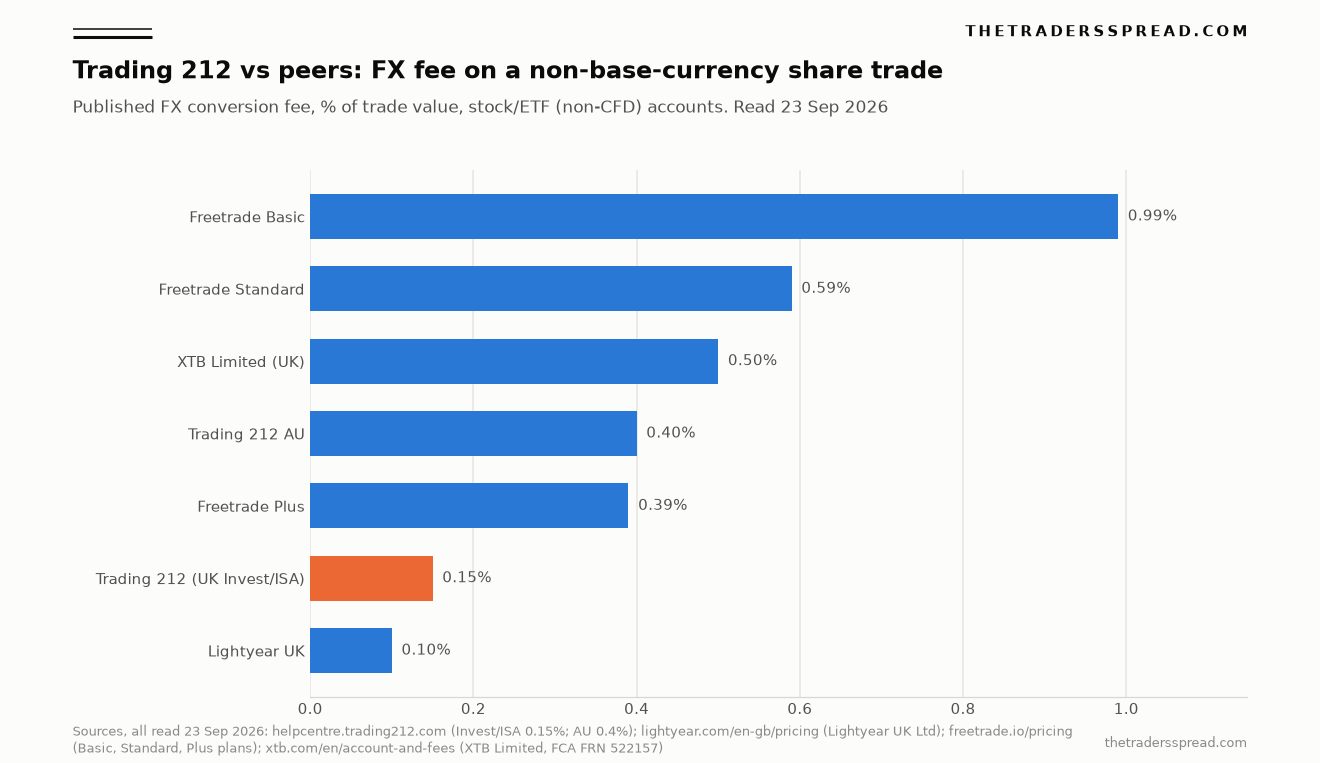
| Provider and entity | FX fee on share trades | Plan cost | Source, read 23 Sep 2026 |
|---|---|---|---|
| Trading 212 UK Ltd (Invest, ISA, SIPP) | 0.15% | None | Trading 212 help centre |
| Trading 212 AU Pty Ltd | 0.4% | None | Trading 212 help centre |
| Lightyear UK Ltd | 0.1% | None | lightyear.com/en-gb/pricing |
| Freetrade Ltd, Basic | 0.99% | £0.00 a month | freetrade.io/pricing |
| Freetrade Ltd, Standard | 0.59% | £5.99 a month, or £59.88 a year | freetrade.io/pricing |
| Freetrade Ltd, Plus | 0.39% | £11.99 a month, or £119.88 a year | freetrade.io/pricing |
| XTB Limited (FCA FRN 522157) | 0.5% | None | xtb.com/en/account-and-fees |
Two things stand out. Lightyear UK is the only firm in this set that undercuts Trading 212, at 0.1% on the live interbank rate. Everyone else charges between 2.6 and 6.6 times as much, and Freetrade needs a £119.88 annual subscription to get within 0.24 percentage points of it.
In money terms, a £10,000 purchase of a US-listed ETF costs £15 in FX at Trading 212 and another £15 on the way out if the proceeds come back to sterling, £30 for the round trip. The same trade costs £20 at Lightyear, £100 at XTB and £198 on Freetrade's free plan. Trading 212's help centre shows the mechanics: with a GBP/USD rate of 1.4000/1.4100, a buy is converted at 1.3979 and a sell at 1.412115, so the fee sits inside the rate and appears on the Review Order screen before confirmation. Dividends are exempt.
The Australian entity is the outlier inside the same group. Trading 212's own "How does Trading 212 make money?" page gives the Invest-side fee as "0.15% FX fee (0.4% for Trading 212 AU)", which makes the identical conversion 2.7 times dearer for a customer of the Australian entity than for one of the UK entity. Earlier reviews on this site found similar entity gaps at Interactive Brokers, where a $2 FX minimum sets the cost of small conversions, and at Saxo, where the FX fee on a US stock buy dwarfed the commission.
One caveat on the table: Trading 212's main pricing page at trading212.com returned a Cloudflare challenge (HTTP 403) from this desk on 23 September, so every Trading 212 figure here comes from its help centre, which is the same company's published documentation and carried update stamps from July to September 2026.
The CFD book runs on different arithmetic
Trading 212's CFD account is sold through the same app but priced on a different logic. The help centre lists commission and custody as free, spreads as "dynamic", and an overnight interest charge on positions held past 22:00 GMT (21:00 during daylight saving), with a weekend charge taken on Sunday. The FX fee is 0.5%, but it applies to the converted result of a closed position. In the company's own worked example, a EUR account closing 310 Nvidia shares at a $37.20 loss converts that loss to €35.38 and adds a fee of €0.18.
That makes the headline number misleading in both directions. A 0.5% fee on a result is small next to a 0.15% fee on notional; the real CFD costs sit in the spread and the overnight line, and neither is published as a fixed number. Spreads are floating on every CFD instrument. Overnight rates, the help centre says, combine market interest rates and borrow fees with "a fixed markup applied per instrument type" and are shown only on each instrument's details page in the app.
That is the exact area the regulator has flagged. In a November 2025 review of CFD providers, the FCA said some firms were "applying varying levels of overnight funding charges without providing clear justification". Mark Francis, director of sell-side markets at the FCA, said at the time: "CFDs are complex, risky products and it is vital that providers act to deliver good outcomes for customers, communicate clearly and provide fair value." The FCA did not name the firms it reviewed, and nothing in the release refers to Trading 212.
Trading 212's own disclosure is that 77% of retail CFD accounts lose money with it. For how two larger CFD brokers price the same product, see the IG review and the Capital.com review on this desk.
There is also a structural change underway that the accounts flag as material. Under note 24, the board approved in February 2026 the first phase of a transfer of CFD hedging to Trading 212 Markets (Ireland) Ltd, "a newly established Group subsidiary", with all CFD hedging and share-dealing trade execution expected to move there during the first half of 2026. The accounts say that as a result, "the risk profile and certain operational exposures of the Company will differ materially" from the December 2025 balance sheet. The note describes where hedging and execution will be managed; it does not say that UK clients will contract with a different entity.
Cash: £17.9 billion held, £20.6 million kept
The interest product is where Trading 212 earns least. Client money rose from £6.94 billion to £17.92 billion during 2025, and custody assets from £6.57 billion to £14.57 billion, a combined £32.5 billion at year end. Net client interest income, which the accounts define as "the difference between interest received on client money and interest paid to clients", was £20.6 million.
Averaging the opening and closing client-money balances gives about £12.4 billion, so the firm's net cut works out at roughly 0.17% a year on that rough average. That is a thin spread.
The Cash ISA shows the same number from the other side. Trading 212's help centre, updated 22 September 2026, says the Cash ISA rate is set "0.15% below the BoE's base rate". The Bank of England's own table, read 23 September 2026, shows Bank Rate at 3.75% since 18 December 2025, which implies 3.60% AER on the tracker. The help centre example uses 4.25% and 4.10% to illustrate; customers see their live rate on the ISA home screen. Uninvested cash on the other accounts is held with banks or in qualifying money market funds, and clients must consent to the QMMF route to earn interest.
Whether this is generous or merely competitive depends on what one compares it with. What it is not, on the filed numbers, is the profit centre.
Who holds the licence, and what could not be checked
The UK business is Trading 212 UK Limited, company number 08590005, registered at 10-15 Queen Street, London EC4N 1TX, and previously named Avus Capital UK Limited until September 2017, according to Companies House, read 23 September 2026. The directors' report states it is regulated by the FCA under FRN 609146 as a MIFIDPRU non-SNI firm. The FCA register itself is a JavaScript application this desk could not fetch, so the FRN is corroborated through the audited accounts and Companies House rather than the register.
PricewaterhouseCoopers LLP audited the 2025 accounts, replacing Buzzacott LLP. The parent is Trading 212 Group Limited, and the related-party note names other group companies including Trading 212 Markets Ltd, FXFlat Bank GmbH and Trading 212 ME Ltd. The average UK headcount was 122 in 2025, of which 34 sat in risk and compliance, up from 18.
RelatedAlpari Review 2026: EUR/USD Ticket Is $25 at Close
Not verified at a primary source for this review: the CySEC authorisation of the Cyprus entity (the CySEC entity list did not return it in static HTML), the ASIC licence of Trading 212 AU, and any live CFD spread, because Trading 212 publishes spreads only inside the app. Readers comparing CFD costs should read our XTB review for the same problem at a peer.
Verdict: cheap to own, priced at the conversion
Trading 212 earns a rating of 4.0 out of 5 on this desk. The score rests on one fact the accounts make visible: for a UK investor holding sterling and buying UK-listed shares and ETFs, the platform charges nothing at all from its side, and the stamp duty and PTM levy that do apply are third-party taxes it lists openly. For an investor buying US shares, the 0.15% FX fee each way is the price, and it is the second-lowest published rate among the four firms checked on 23 September 2026.
Base case (about 60%): the fee schedule stays as it is through 2026 and the growth in accounts keeps FX income rising, which is where the extra revenue comes from. Upside case (about 15%): competitive pressure from 0.1% pricing pushes Trading 212 to cut the UK rate, which would narrow the one gap it has to Lightyear. Downside case (about 25%): margin pressure, falling rates or the Ireland restructuring leads the UK entity to widen the FX fee or align it with the AU entity's 0.4%.
Who it suits: long-term ISA and SIPP investors, and anyone who trades mainly in their own currency. Who it suits less: a CFD trader who wants published spreads and overnight rates in advance, because Trading 212 shows those only inside the app, and customers of the Australian entity paying 0.4%.
What would change this view: a published CFD spread and financing table outside the app, or a filed 2026 account that splits FX fees from CFD revenue. Either would let the second half of the model be scored as precisely as the first.
FAQ
Is Trading 212 really commission-free?
On Invest, ISA and SIPP accounts it charges no commission and no custody fee. Its help centre says the only fee it can charge there is a 0.15% FX fee when an instrument's currency differs from the account currency. Stamp duty, the PTM levy and US SEC and FINRA fees are passed through from third parties and appear on the order review screen.
How does Trading 212 make money?
According to its 2025 UK accounts, £257.0m of £277.6m revenue came from trading revenues, which include FX fees, CFD client results, CFD overnight financing, hedging gains and stock lending. The remaining £20.6m was net interest on client money. The accounts do not split the trading line further, so the share from each source is not public.
What is the Trading 212 FX fee on CFDs?
It is 0.5%, charged on the converted profit or loss of a closed position when the instrument's currency differs from the account currency. Because it applies to the result rather than to the position size, the money involved is small; the help centre example shows €0.18 on a €35.38 loss. Spreads and overnight financing are the larger CFD costs.
Who regulates Trading 212 in the UK?
Trading 212 UK Ltd is regulated by the Financial Conduct Authority under FRN 609146, according to its audited 2025 accounts. Companies House lists the company as active under number 08590005. The FCA's online register could not be fetched automatically for this review, so the number was confirmed from the filed accounts rather than the register itself.
How does its FX fee compare with Freetrade and Lightyear?
On pages read on 23 September 2026, Lightyear UK charged 0.1%, Trading 212 UK 0.15%, and Freetrade 0.99%, 0.59% or 0.39% depending on its Basic, Standard or Plus plan. XTB Limited charged 0.5%. On a £10,000 round trip that is £20, £30, and between £78 and £198 respectively, before Freetrade subscription costs.
Disclaimer: This review is analysis and information, not investment advice or a recommendation to open an account with any provider. CFDs are complex instruments and carry a high risk of losing money rapidly due to leverage; the value of investments can fall as well as rise, and your capital is at risk. Fees and rates quoted were read on the dates stated and may change.