
1:10,000. That is the maximum effective leverage Deriv's own trading-specifications table lists for its Step Index, a CFD on a market that exists only on Deriv's servers. A $10 margin deposit controls $100,000 of exposure. The same product family is advertised a few scrolls away on Deriv's synthetic indices page under the headline "Up to 1:1000 leverage", with the line "Leverage up to 1:1000 on selected instruments", and Deriv's help centre says MT5 clients cannot turn it down: "Leverage is fixed and determined by the asset you trade." We pulled all 107 derived-index rows from the global specifications table on 28 September 2026. Forty-nine of them carry more than the advertised 1:1000. Deriv says its group has served traders since 1999 and counts more than 3 million of them, so this is not a rounding error on a small shop's promotional banner.
The number matters because of who sits on the other side. On a synthetic index, the price source and the counterparty are the same company, and Deriv says so in writing. Its Cayman entity's terms state that "we act as principal and are therefore the counterparty to all trades you enter into", that "we may, over time, generate revenue from clients' potential aggregate losses", and that "we are responsible for setting the price of financial products on the Platforms." Deriv's quant team publicly argues the opposite business model: the house earns from the spread. Both can be true. Only one of them is in the contract.
- Step Index is listed at 1:10,000 maximum effective leverage and a 0.01% margin requirement on Deriv's global MT5 table; the synthetic indices page headline says "up to 1:1000" (Deriv trading specifications and synthetic indices page, retrieved 28 Sep 2026)
- All 107 derived-index CFDs on the global table charge a negative swap on both the long and the short side, for example -7.50 points each way on Volatility 75 Index (Deriv trading specifications, 28 Sep 2026)
- EUR/USD minimum spread is 1.1 pips on the global table, worth $11.00 per round-turn standard lot, against 0.6 pips ($6.00) on Deriv's Malta-regulated EU table (Deriv global and EU specifications, 28 Sep 2026)
- The same Boom 500 Index is capped at 1:5 leverage for EU clients and listed at 1:400 on the global table, an 80-fold gap (Deriv EU and global specifications, 28 Sep 2026)
- Deriv (BVI) Ltd's terms say it "may use your money" to meet its own margining obligations on client trades, and that insolvency cover rests on loan arrangements with its parent (Deriv BVI additional terms, 28 Sep 2026)
- The BVI Financial Services Commission lists Deriv (BVI) Ltd. as "Dealing as Principal" and currently regulated, in a record dated 31 August 2026 (BVI FSC register, 28 Sep 2026)
How a synthetic index gets its price, and who takes the other side
Deriv sells ordinary CFDs on currencies, stocks, commodities and crypto. What sets it apart from every broker this desk has reviewed is the derived-indices catalogue: Volatility, Crash/Boom, Step, Jump, DEX, Trek, Range Break and a dozen other families that trade 24 hours a day, seven days a week, including public holidays. None of them references an exchange price. The Deriv (V) Ltd prospectus describes synthetic indices as "fully independent of the real-world markets" and "generated using a secure random number process", then adds one sentence that settles the structural question: "Deriv is the counterparty for all Derived Indices contracts."
Deriv's defence of that design is public and specific. Prashant Sinha, Head of Quants at Deriv, wrote in a 20 January 2026 post on the company's Expert Insights site that "the price feed for Volatility 75 is generated by a single central algorithm and broadcast to all 2.5+ million Deriv clients simultaneously," and that manipulating it to hit one trader's stop "would trigger thousands of arbitrage opportunities." He also wrote: "Our business model is built on volume—we earn from the spread and the massive flow of activity."
The broadcast argument is sound as far as it goes: a single feed cannot be bent against one account alone. It does not address the book. When the price generator and the counterparty are the same group, a client's aggregate loss is the house's aggregate gain, whatever the feed does, and the Cayman terms quoted above say exactly that. Sinha says the algorithms are "rigorously audited by independent third parties to ensure fairness." We could not find the auditor's name, the audit scope or a report on any Deriv page we fetched on 28 September, so that claim stays unverified here.
Execution language is not consistent across Deriv's own documents either. The group-wide trading terms say at clause 9.1: "When we execute orders, we always act as a principal in transactions with you." The Labuan entity's additional terms say the opposite for its own clients: "we act as agent on your behalf when we execute your orders, and we are not the counterparty to your trades." Each entity's terms state that they prevail over the general document, so a Labuan client is contractually on an agency model. The other entities are not.
Then there is the leverage itself. Of the 107 derived-index rows on the global table, 46 are listed at 1:2000 or higher. Multi Step 2 Index sits at 1:7000, Volatility 5 Index at 1:6000, and Step Index at 1:10,000 with a 0.01% margin requirement. Because Deriv fixes leverage per instrument on MT5, a client choosing Step Index is choosing 1:10,000; the only lever left is position size. Every one of those 107 instruments also debits a swap on both sides of the trade. A holder who is long pays, and so does one who is short. On a synthetic index, the financing rate is simply a number Deriv sets.
Seven companies, five regulators: what the registers show
Deriv's regulatory page, read on 28 September 2026, names a Guernsey holding company, Deriv.com Limited (registration 71479), and seven subsidiaries. It gives company numbers and incorporation dates. It does not print a single licence number. We went to each regulator we could reach.
| Entity | Company no. | Regulator | What we found at the source, 28 Sep 2026 |
|---|---|---|---|
| Deriv (BVI) Ltd | 1841206 | BVI FSC | Register entry "Dealing as Principal", status "Currently Regulated Entities", dated 31 August 2026 |
| Deriv (V) Ltd | 014556 | Vanuatu FSC | Financial Dealers Licensee List: classes A, B, C, Active, licence date 23 December 2022 |
| Deriv (FX) Ltd | LL13394 | Labuan FSA | Listed as a money broker, credit token company and digital financial services provider; GLEIF records a name change (see below) |
| Deriv Investments (Europe) Limited | C 70156 | Malta FSA | Register is a JavaScript application we could not query; entity named in an MFSA clone warning and active on GLEIF |
| Deriv Investments (Cayman) Limited | 406695 | CIMA | CIMA search sits behind reCAPTCHA and returned an error; not independently verified |
| Deriv (Mauritius) Ltd | 209524 | FSC Mauritius | Register search returned 404 from this host; not independently verified |
| Deriv Capital International Ltd (Samoa), Deriv (SVG) LLC | 85936, 273 LLC 2020 | None stated | Deriv's page lists both with an address and no licence |
The BVI record matters most, because the BVI entity's terms carry the counterparty language, and the regulator classifies it the same way: a principal dealer. The Vanuatu licensee list shows Deriv (V) Ltd under company number 14556 with all three dealer classes. Our TMGM review found the same pattern: the high-leverage book runs on the lightest licence in the group.
Labuan produced the one genuine loose end. The Labuan FSA directory, last updated 9 September 2026, lists "Deriv (FX) Ltd." among money brokers. The GLEIF record for the same company number, LL13394, shows its legal name as "Deriv Investment Bank (Labuan) Ltd.", with a change of legal name effective 4 December 2025 and recorded on 22 April 2026. The Labuan directory's banks list, as served to us, contains no Deriv entry, and Deriv's own pages still say Deriv (FX) Ltd holds a money-broking licence. Nothing we found indicates a lapsed or revoked licence. It does mean the regulator's list, the LEI system and the broker's website do not currently agree on what this company is called.
Two more checks came back clean. Neither the CySEC register of Cypriot investment firms nor its former-firms list contains any Deriv entity. In the UK, the FCA register is a Salesforce application we cannot fetch; Companies House shows Deriv (UK) Limited, incorporated 11 June 2020 and active, with a nature-of-business code of 96090, "other service activities". That is not the profile of a UK-authorised broker. We found no surrendered, lapsed or revoked licence anywhere in the group.
Where a client's money actually sits
Client-money wording changes by entity, and the offshore versions are thin. The BVI terms say two things in sequence. First: "We may use your money to meet obligations that we have incurred in margining, adjusting, or settling your derivative trades." Second: "We keep your funds in bank accounts that are separate from our operational accounts. In the event of insolvency, we have loan arrangements between us and our parent company that will always, at minimum, cover any liabilities owed to clients." Separate accounts, then, but usable for Deriv's own hedging margin, with the insolvency backstop resting on an intra-group loan rather than a statutory scheme.
The Cayman entity is more explicit. Client money is held "in a segregated client bank account outside the Cayman Islands, currently in the Isle of Man," and the terms warn that "in the event of default by the Offshore Bank, your money may be treated differently than if held in the Cayman Islands."
Negative balance protection is not a promise. Clause 9.1 of the general terms of use reads: "Negative balance protection may be offered at our sole discretion... We are not obliged to provide negative balance protection at any time or in any circumstances." At 1:10,000, a 0.01% move against the position consumes the whole margin, and a synthetic index that "jumps" by design can gap through a stop. The discretion matters.
No offshore Deriv entity names a statutory compensation scheme. For the Vanuatu and Mauritius entities, the complaint route after Deriv's own 15-business-day process is the Financial Commission, an industry dispute-resolution body whose decisions, per Deriv's terms, bind the broker but bind the client only if accepted. Dormancy is priced loosely: after 12 months without a transaction Deriv reserves the right "to make an adjustment against your Wallet in our favour" and to repeat it every six months, without stating an amount. Deposits carry no Deriv fee, per its help centre; withdrawal fees depend on the payment method.
What it costs: EUR/USD against four peers
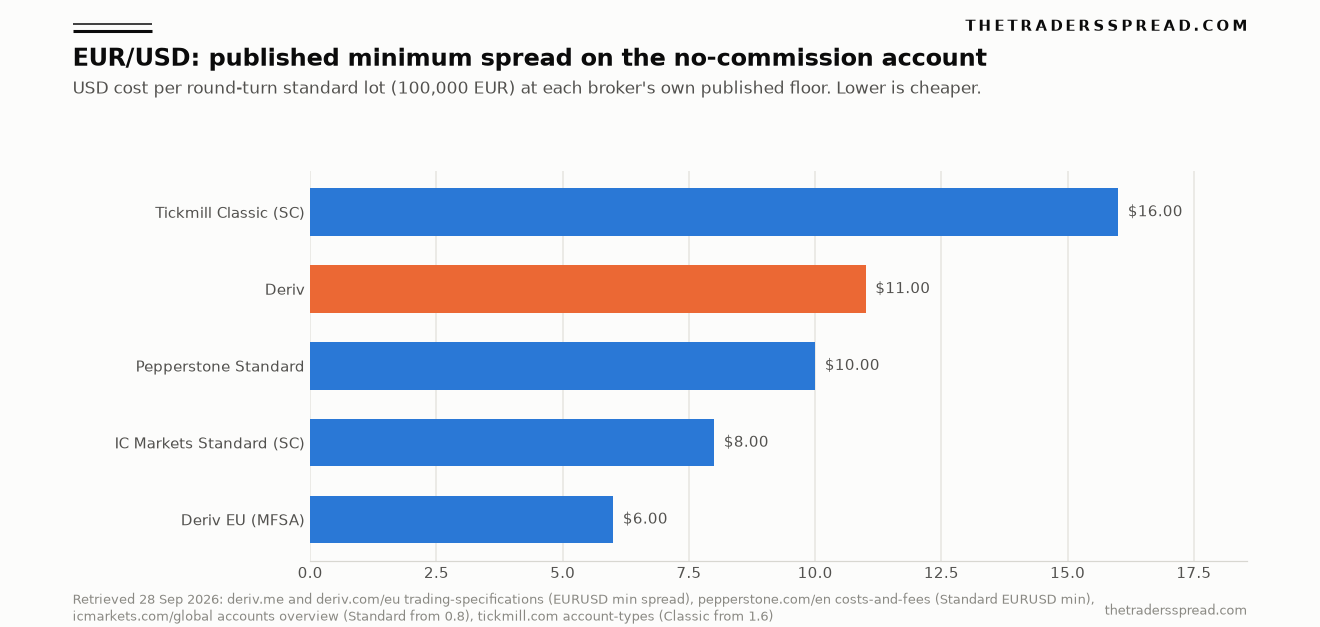
Synthetic indices have no like-for-like comparison anywhere else, so the fair pricing test is a real currency pair on a commission-free account. Deriv publishes a minimum spread per instrument; most peers publish a "from" floor or a pair minimum. Each figure below was read from the broker's own page on 28 September 2026 and converted at $10 per pip on a 100,000-unit lot.
| Broker, account, entity | Published EUR/USD figure | USD per round-turn lot | Source (28 Sep 2026) |
|---|---|---|---|
| Deriv, MT5, global table | 1.1 pips minimum | $11.00 | Deriv specifications |
| Deriv, MT5, Deriv Investments (Europe) Ltd | 0.6 pips minimum | $6.00 | Deriv EU specifications |
| Pepperstone Standard, global /en/ site | 1 pip minimum | $10.00 | Pepperstone costs and fees |
| IC Markets Standard, Raw Trading Ltd (Seychelles) | from 0.8 pips | $8.00 | IC Markets accounts |
| Tickmill Classic, Tickmill Ltd (Seychelles) | from 1.6 pips | $16.00 | Tickmill account types |
Deriv's global EUR/USD sits in the middle of the pack and 83% above what its own Malta entity publishes for the same pair. The regulated EU client gets the tighter quoted floor and 1:30 leverage; the offshore client gets 1:1000 and nearly twice the minimum spread. The Vanuatu prospectus uses a worked example with a floating EUR/USD spread of $15 on one lot, which is closer to what a trader should budget than any floor. For context rather than the chart, Exness shows a previous-day average of 0.8 pips on its Standard EURUSDm symbol, an average rather than a minimum.
The marketing copy runs ahead of the tables in two places. Deriv's MT5 page promises "zero commission trading on all assets", then lists the Zero Spread account a few lines later with "Commission: Yes" and no rate. We found no public page stating what that commission is. The same page advertises the Standard account "from 0.1 pips"; the tightest forex minimum anywhere on the global table is 0.6 pips, on the USDCHF micro contract. Raw-pricing peers publish their rates plainly: Tickmill Raw at $3 per lot per side, IC Markets Raw Spread at $3.50 per lot per side on MetaTrader and $3.00 per $100k on cTrader, and Pepperstone Razor from $3.50 per lot per side. Our Tickmill review and IC Markets review break those schedules down.
What the chief executive says the priority is
Deriv's leadership frames the business as a product-breadth play. "The priority now is simply to keep expanding the range of products while making sure the trading conditions behind them stay competitive," Rakshit Choudhary, Chief Executive Officer at Deriv, told Finance Magnates on 3 September 2026. He also drew a line on the company's AI commentary tool: "It never tells anyone what to buy, sell, or when to act, and it's never framed as a recommendation."
That candour on commentary is not matched on leverage disclosure. The synthetic indices landing page says 1:1000; the specifications table says 1:10,000. This desk found a site-versus-document gap at Global Prime too, where the site said 1:1000 and the disclosure document said 1:500. At Deriv the gap runs the other way: the fine print carries the more aggressive number.
RelatedVT Markets Review 2026: The EUR/USD Lot Is $6, Not 0.0
Verdict: 2.5 out of 5
Deriv earns points for publishing more than most offshore brokers do. Every instrument's minimum spread, margin rate and both swap rates sit in one public table, the entity terms are readable, and the BVI and Vanuatu registers confirm what the broker says about those two licences. Its EU entity, where leverage is 1:30 on EUR/USD and 1:5 on synthetics, quotes a 0.6-pip EUR/USD floor that beats every peer we checked.
It loses them on the product at the centre of the brand. On synthetic indices the client trades against the company that generates the price, under entity terms that describe revenue from "clients' potential aggregate losses", at leverage the client cannot lower, with a swap charged in both directions and negative balance protection offered only at Deriv's discretion. The offshore EUR/USD floor is 83% wider than the Malta one. The Zero Spread commission is unpublished. The Labuan entity's name differs between its LEI record and its regulator's list.
Base case (60%): nothing changes, and Deriv remains a well-documented offshore market maker whose synthetics are closer to a house game than a market. Upside (25%): the synthetic indices page is corrected to the table's real maximum, an independent RNG audit is published with the auditor named, and the Zero Spread rate appears in public. Downside (15%): a regulator in one of the five jurisdictions tightens synthetic leverage by rule, as EU rules already do for Deriv's Malta clients, and the offshore book is repriced.
Who it suits: a trader who wants round-the-clock synthetic exposure, understands they are the counterparty's customer rather than a market participant, and sizes positions so that fixed four-figure leverage never reaches the account. EU residents contract with the Malta entity and get materially tighter terms. What would change our mind: a named independent audit of the price generator, and a single leverage figure that matches across Deriv's own pages.
Frequently asked questions
Is Deriv regulated?
Partly, and it depends on the entity. On 28 September 2026 the BVI FSC listed Deriv (BVI) Ltd as a currently regulated principal dealer, and Vanuatu's FSC listed Deriv (V) Ltd as an active financial dealer. Labuan FSA lists Deriv (FX) Ltd. Two group companies, in Samoa and St Vincent and the Grenadines, are shown on Deriv's page with no licence at all.
Who is the counterparty on Deriv synthetic indices?
Deriv is. Its Vanuatu prospectus states that "Deriv is the counterparty for all Derived Indices contracts," and the Cayman entity's terms add that Deriv sets the prices and may earn from clients' aggregate losses. The Labuan entity says it acts as agent for its own clients, so the answer is entity-specific for ordinary CFDs, but not for synthetics.
What is the maximum leverage at Deriv?
On the global MT5 table read on 28 September 2026, the highest figure is 1:10,000 on Step Index, and 49 of 107 derived indices exceed 1:1000. EUR/USD is 1:1000 on the same table. For EU clients of Deriv Investments (Europe) Limited, EUR/USD is 1:30 and synthetic indices are 1:5. MT5 leverage cannot be lowered by the client.
How much does Deriv charge on EUR/USD?
The global table lists a 1.1-pip minimum spread with no commission on the standard account, about $11 per round-turn standard lot. Deriv's EU table lists 0.6 pips. The Zero Spread account charges a commission that Deriv's public pages do not quantify. Overnight swaps on EUR/USD are -7.48 points long and +2.34 short on the global table.
Does Deriv offer negative balance protection?
Only at its discretion. Clause 9.1 of Deriv's general terms says protection "may be offered at our sole discretion" and that Deriv is "not obliged to provide negative balance protection at any time or in any circumstances." Where it is applied, it nets all open trades in the CFD account rather than assessing each trade separately.
Disclaimer
This review is analysis, not investment advice. CFDs and synthetic indices are leveraged products and you can lose more than your deposit where negative balance protection is not applied. Broker terms, spreads and licences change; figures here were retrieved on 28 September 2026 and should be checked at the source before opening an account. Capital is at risk.