

I keep UnitedHealth on this desk's health-insurance sheet for a narrow reason: the medical care ratio is the figure that has repriced the shares when a filing changed, and the other four drivers matter for what they do to that ratio or to the share count under it. Readers looking up what moves UnitedHealth stock usually stop at the ratio. The filings support the start. They do not support the stop.
Having opened the last four 10-Qs, through 30 June 2026, 31 March 2026, 30 September 2025 and 30 June 2025, plus the 16 July and 13 October releases, two reserve sentences stay apart. October ties $610 million of favorable development, on an 88.4% ratio, to 2026 dates of service. The June 10-Q ties prior-year development to "a favorable respiratory illness season" and to factors that were not individually significant. Call those one number and the ranking below breaks. A guide can reprice a stock while barely moving, which is what AMD shares did while margin guidance stayed at 56%. UnitedHealth's July band, 88.1% plus or minus 25 basis points, is not one quarter.
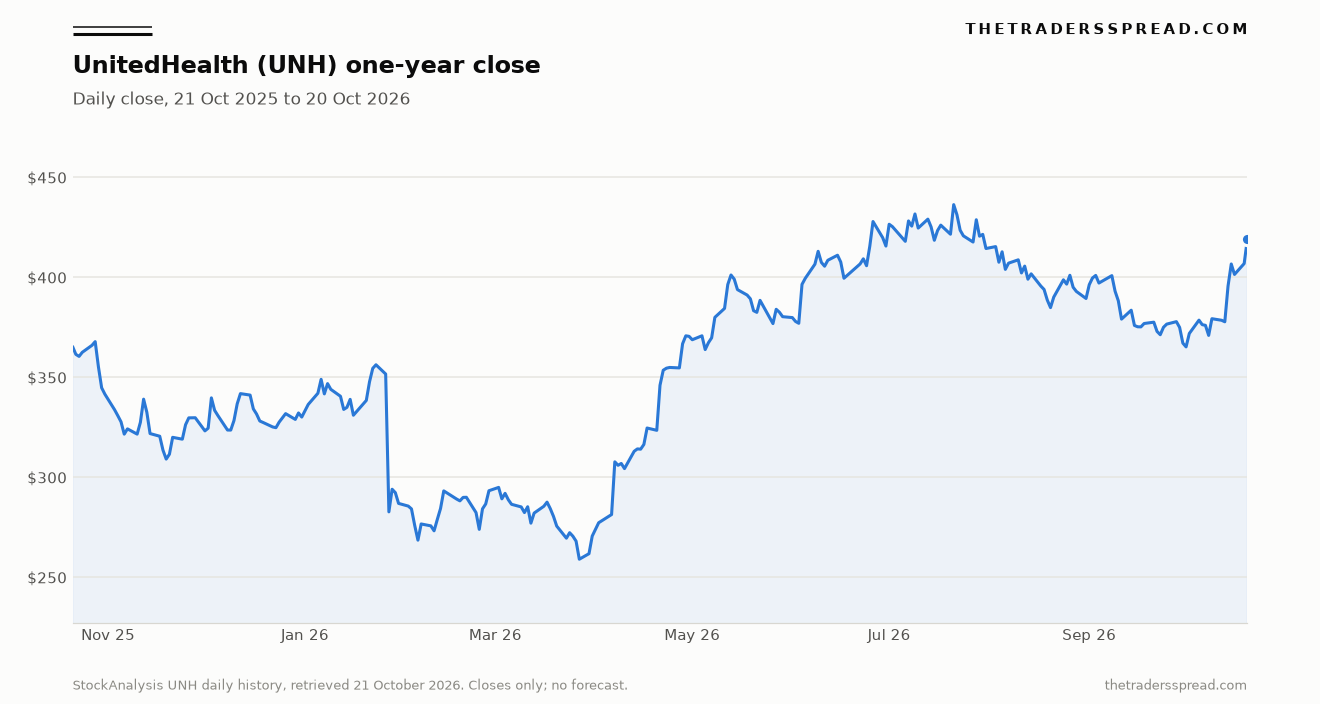
As of the 20 October 2026 close, StockAnalysis showed the shares at $419.26, up 3.04% from $406.88, on volume of 6,889,030. From $365.37 on 21 October 2025 that is a 14.7% gain. The low in the window was $255.965 on 27 March 2026. The high was $461.62 on 16 July 2026. On 27 January 2026 the close was $282.70, down 19.61%, and on 13 October it was $377.76. The chart is that history. It carries no forecast.
Updated 21 October 2026
Key facts
- Third-quarter 2026 medical care ratio: 88.4%, versus 89.9% a year earlier. Source: UnitedHealth earnings release, 13 October 2026.
- Second-quarter 2026 medical care ratio: 86.7%, versus 89.4%. The 10-Q defines it as medical costs divided by premium revenue. Source: Form 10-Q for the quarter ended 30 June 2026, filed 10 August 2026.
- Medicare Advantage people served: 7,565 thousand on 30 June 2026, down 785 thousand, or 9%, from a year earlier. Source: same 10-Q.
- Third-quarter operating earnings: Optum $3.7 billion, UnitedHealthcare $2.8 billion, consolidated $6.6 billion. Source: earnings release, 13 October 2026.
- CMS expects a 2.48% average Medicare Advantage payment increase for 2027, or over $13 billion, and 4.98% with estimated risk-score trend. Source: CMS fact sheet, 6 April 2026.
- Buybacks: about 10.5 million shares at an average $344.08 in the first half of 2026, and $5.0 billion year-to-date by 13 October. Source: Form 10-Q filed 10 August 2026; earnings release, 13 October 2026.
- Close used here: $419.26 on 20 October 2026. Source: StockAnalysis quote, retrieved 21 October 2026.
1. The medical care ratio
This ranks first because the earnings math and the price history keep pointing at it. In the 10-Q filed on 10 August 2026, UnitedHealth defines the medical care ratio as medical costs divided by premium revenue. For the quarter ended 30 June 2026 it was 86.7%, against 89.4% a year earlier. For the six months it was 85.3%, against 87.1%. Earnings from operations were $7,991 million, against $5,150 million. Diluted earnings were $6.04 a share.
The 13 October release then printed 88.4% for the third quarter, against 89.9% a year earlier, with operating earnings of $6.6 billion against $4.3 billion in the year-ago quarter and about $8.0 billion in the June quarter. The ratio rose from the June quarter to the September quarter while operating earnings fell from about $8.0 billion to $6.6 billion. That comparison is the case for the top rank. A Johnson & Johnson page lives on pipeline and litigation. This one lives on a cost ratio.
The June MD&A says medical costs fell because fewer people were served and prior-period development was favorable, offset by a trend the company calls above historical levels, higher No Surprises Act reimbursement, and more intense commercial coding. The operating cost ratio went the other way that quarter, to 12.7% from 12.3%. In September it was 12.8%, down from 13.5% a year earlier. The two ratios do not travel together.
| Quarter ended | Medical care ratio | Medicare Advantage people served (thousands) | Filing |
|---|---|---|---|
| 30 June 2025 | 89.4% | 8,350 | 10-Q filed 11 August 2025 |
| 30 September 2025 | 89.9% | 8,435 | 10-Q filed 28 October 2025 |
| 31 March 2026 | 83.9% | 7,555 | 10-Q filed 5 May 2026 |
| 30 June 2026 | 86.7% | 7,565 | 10-Q filed 10 August 2026 |
The table is a rise, a fall, then a climb back, not a straight decline. September's 88.4% is absent because no third-quarter 10-Q was on the EDGAR list opened for this page. Full-year 2025, in the 27 January 2026 release, was a reported 89.1% and an adjusted 88.9%, up 340 basis points, after a 20 basis point drag from loss contracts inside a charge.
On 16 July the company set a full-year 2026 ratio of 88.1%, plus or minus 25 basis points, tighter than January's 88.8% plus or minus 50. September's 88.4% sits just above the top of that band. March and June were well under it, so one quarter does not pull the year out. The October text raises adjusted earnings to at least $20.50 a share, from July's $19.50 to $20.00, and does not restate a ratio band.
"Our third quarter results reflect the discipline and execution our teams are bringing to every part of our business, as we continue evolving UnitedHealth Group to deliver a simpler, more supportive experience for patients and the clinicians who care for them," said Stephen Hemsley, chief executive officer of UnitedHealth Group, in that October release. The sentence is about execution. The number beside it is still the ratio.
2. Medicare Advantage rates and membership
Second, because Medicare & Retirement is the largest line inside UnitedHealthcare, and the rate notice is set outside the company. June-quarter revenue there was $42,390 million, down $233 million from $42,623 million. The October release puts the September quarter at $42.4 billion, against $43.4 billion, "due to changes in membership and product mix."
People served on 30 June 2026 were 7,565 thousand in Medicare Advantage, against 8,350 thousand a year earlier, down 785 thousand, or 9%. Commercial risk-based membership fell 785 thousand, to 7,655 thousand, while fee-based membership rose 735 thousand, to 22,265 thousand. The ratio in section 1 uses premium revenue as the denominator, so fee-based growth and risk-based shrinkage are not the same event. The March 10-Q already had Medicare Advantage at 7,555 thousand on 31 March 2026. June was only 10 thousand higher. The large step-down was a first-quarter fact.
The October release uses a wider phrase. Seniors served through Medicare Advantage, including complex populations counted in Medicaid, "have contracted by 935,000 since year-end 2025." On 16 July the same phrase was 965,000. The cumulative decline the company reports shrank by 30,000 between those releases. That is not the 10-Q headcount, and it is not the KFF series below.
The June 10-Q says rate notices for years left base rates "well below the industry forward medical cost trend." The 2027 final notice "moved towards" that trend and "remains below." Risk-adjustment changes, it says, cut funding especially for people "with some of the greatest health and social challenges." Offsets on the company's list run from tighter costs and narrower networks to higher member premiums and dropping counties. It still expects membership to contract through 2026, even after a nearly flat June versus March.
On 6 April 2026 the CMS fact sheet put the expected average change at 2.48%, or over $13 billion, versus 0.09% in the advance notice, and at 4.98% with risk-score trend. Effective growth is 5.33%. Rebasing is minus 0.17%, stars minus 0.03%, and the coding-pattern adjustment is zero. Risk-model revision and normalization is minus 1.12%, which CMS says is only normalization because the 2024 model stays. Sources of diagnoses are minus 1.53%.
"Medicare Advantage and Part D should work for the people who rely on them," said CMS Administrator Dr. Mehmet Oz in the 6 April press release. "These updates keep coverage affordable and ensure patients get real value from their plans." Chris Klomp, Director of Medicare and Chief Counselor at the Department of Health and Human Services, said: "CMS' vision for Medicare Advantage and Part D is clear: a great choice for seniors and a smart deal for taxpayers." The 10-Q says the notice still sits below trend. CMS says the net change is 2.48% before risk-score trend. This page does not have the company's unpublished trend figure. That gap is why rates rank above Optum and below the ratio.
KFF's 5 June 2026 brief, updated 1 July, by Meredith Freed, Jeannie Fuglesten Biniek, Anthony Damico, Nancy Ochieng and Tricia Neuman, puts the program at 55% of eligible beneficiaries, 35.2 million of 64.2 million. Citing MedPAC, KFF says 2026 payments are 14% higher per person than traditional Medicare, an extra $76 billion. UnitedHealth Group's share is "dropping to 26% (down from 29%)." The brief says: "In contrast, enrollment in UnitedHealth Group plans decreased by nearly 647,000 from 2025 to 2026." That count is not the 785,000 in the June 10-Q and not the 935,000 in the October release. October also says at least 69% of members are in four-star 2027 plans, in line with expectations. The star effect in the CMS table is minus 0.03%, which does not outrank the rate notice.
3. Optum's earnings against UnitedHealthcare
Third, because a quarter can be decided in a business that does not carry the medical care ratio the same way. The June 10-Q segment table, in millions, is the clean set. UnitedHealthcare took in $86,017 and earned $3,942 from operations. Optum Health was $23,472 and $1,190. Optum Insight was $5,402 and $1,369. Optum Rx was $38,292 and $1,490. Optum in total was $65,663 and $4,049. Consolidated revenue was $112,032 and operating earnings were $7,991. Optum out-earned UnitedHealthcare by $107 million.
Adding $86,017 to $65,663 would double-count. Affiliated Optum revenue is eliminated: minus $39,648 million in the same table, and unaffiliated Optum revenue was $25,442 million. The July release rounds that quarter's margins to 4.6% at UnitedHealthcare and 6.2% at Optum.
| Line | Quarter ended 30 June 2026 | Quarter ended 30 September 2026 |
|---|---|---|
| Medical care ratio | 86.7% | 88.4% |
| Earnings from operations | $8.0 billion | $6.6 billion |
| UnitedHealthcare earnings from operations | $3.9 billion | $2.8 billion |
| UnitedHealthcare operating margin | 4.6% | 3.3% |
| Optum earnings from operations | $4.0 billion | $3.7 billion |
| Optum operating margin | 6.2% | 5.6% |
| Favorable reserve development cited | $860 million | $610 million |
September is why the mix stays third. Optum's lead widened from about $0.1 billion to about $0.9 billion while both sides shrank, and the consolidated ratio still moved with total earnings. Optum Health revenue was $22.9 billion, down 10%, on fewer value-based patients "in markets where Optum lacked sufficient value-based care presence to sustain its clinicians." Earnings were $735 million, a 3.2% margin, against $41 million a year earlier. July had put the June drop at about 5%, roughly 700,000 fewer patients, and earnings of $1.2 billion. The June 10-Q had said that census would keep shrinking.
Optum Insight revenue was $5.5 billion, up 3%, with earnings of $1.3 billion against $920 million. Optum Rx was $39.9 billion against $39.7 billion, earnings $1.7 billion against $1.5 billion, and adjusted scripts were 393 million against 414 million. A manufacturer such as Eli Lilly is a different stock and still a price inside that script count. The June 10-Q records a $3.0 billion deal closed on 2 July 2026 for $1.5 billion cash plus $1.5 billion due within a year. The July release names Alegeus as an Optum Insight purchase that day. The 10-Q does not, so the notes are not merged here.
4. Reserve development is not one number
Fourth, because the dollars can move the ratio and are easy to count twice. July says the second-quarter ratio was affected by $860 million of net favorable prior-period development, "with the majority related to 2026 dates of service." October says $610 million, "related to 2026 dates of service." Together the releases cite $1.47 billion that they place mainly, then entirely, inside 2026.
RelatedQualcomm (QCOM) Forecast: $210 Bull Case vs $145 Bear Case
That is not the prior-year roll-forward. The June 10-Q says prior years' development for the six months to 30 June 2026 came from a favorable respiratory season and from factors that were individually insignificant. The comparable 2025 half had no individually significant factor. Incurred-but-not-reported reserves were $26.5 billion at 30 June 2026 and $26.7 billion at 31 December 2025. Medical costs payable were $38,930 million and $38,427 million. The January release said full-year 2025 development was $140 million favorable.
$610 million is visible beside September operating earnings of $6.6 billion, and it is not those earnings. Both releases park the item inside the ratio. Ranking it first would count the same dollars twice. Ranking it nowhere would ignore a swing that changes how 88.4% reads. A later 10-Q with unfavorable prior-year development beside favorable current-year development would move this driver up. The September split is not in the documents opened here.
5. Buybacks under a debt-to-capital target
Fifth, because the share count changes the per-share result and has not, in these filings, changed the operating result. In the six months to 30 June 2026 the company repurchased about 10.5 million shares at an average price of $344.08, including 6.4 million at $312.73 under forwards settled on 1 July. Remaining board authority at 30 June was 10.6 million shares, with no set expiry. July said $4.0 billion had been bought through mid-July, toward a full-year floor of at least $5.0 billion.
October says $5.0 billion had been repurchased year-to-date, so the July floor is met with a quarter left, and the text does not raise it. Dividends paid year-to-date were $6.2 billion. Debt-to-capital was 41.7% at 30 September, against a target near 40% by year-end, after 41.2% at 30 June and 44.1% a year before that. The board set the dividend at an annual $9.28 in June, from $8.84, and October commits $1 billion to the United Health Foundation. Diluted shares in the June quarter were 906 million, against 910 million, a small per-share effect next to the ratio. Buybacks outrank reserves only if earnings are steady and the leftover authority, or the 40% target, is what caps earnings per share. September was not that quarter.
What would change our mind
The order is the ratio, then Medicare Advantage rates and membership, then Optum against UnitedHealthcare, then reserves, then buybacks. It moves if the filings move. It does not move because a price chart looks unfinished.
Rates go to the top if a later CMS notice meets the industry trend the June 10-Q says the 2027 notice still misses. The ratio would then be a residual of a payment decision. Membership rises with rates only if a filed headcount reverses the contraction still expected through 2026, not because a cumulative phrase narrowed by 30,000 between July and October. KFF's 26% share would have to turn as well. Optum goes above rates if the $735 million at Optum Health keeps falling while UnitedHealthcare's margin holds. Reserves go above the mix if a 10-Q prints unfavorable prior-year development beside favorable current-year development. Buybacks rise only in that stable-earnings case. A close would not reorder the list, and this page does not extend the $419.26 print of 20 October 2026.
Questions readers ask
What is UnitedHealth's medical care ratio?
The June 2026 10-Q defines it as medical costs divided by premium revenue. The June quarter printed 86.7%, against 89.4% a year earlier, and the 13 October release printed 88.4% for the September quarter, against 89.9%. On 16 July the company set a full-year 2026 band of 88.1%, plus or minus 25 basis points. A quarterly print and that full-year band are different objects. The band is what the company asked readers to carry until a later filing restates it.
How many Medicare Advantage members does the company report?
The 10-Q shows 7,565 thousand people served in Medicare Advantage on 30 June 2026, against 8,350 thousand a year earlier, down 785 thousand or 9%. The 13 October release says a wider group, including complex populations counted in Medicaid, had contracted by 935,000 since year-end 2025. KFF, on its own series, put the drop in UnitedHealth Group plan enrollment at nearly 647,000 from 2025 to 2026. Those three counts are not substitutes for one another.
Did Optum earn more than UnitedHealthcare?
Yes in both quarters the releases line up. Optum earned $3.7 billion from operations in the September 2026 quarter and UnitedHealthcare earned $2.8 billion. The June 10-Q shows $4,049 million and $3,942 million. Optum's June revenue of $65,663 million includes affiliated sales, eliminations were $39,648 million, and consolidated revenue was $112,032 million. Adding the two segment revenues overstates the company. September margins in the release were 5.6% at Optum and 3.3% at UnitedHealthcare.
What did CMS set for 2027 Medicare Advantage payments?
CMS's 6 April 2026 fact sheet puts the average change at 2.48%, or over $13 billion, and at 4.98% with estimated risk-score trend. Effective growth is 5.33%, normalization minus 1.12%, and sources of diagnoses minus 1.53%. The June 10-Q says the final notice moved toward medical cost trend and still sits below it. The company does not publish the trend figure it has in mind.
How large are the buybacks, and what would lift them here?
Through 30 June 2026 the company had repurchased about 10.5 million shares at $344.08 on average, with authority left for 10.6 million. By 13 October the year-to-date repurchase was $5.0 billion, the July floor, plus $6.2 billion of dividends. Debt-to-capital was 41.7% against a target near 40%. Buybacks rank higher here only if operating earnings are steady and that authority, or the debt target, is what limits earnings per share. September was not that quarter.