

I have tracked Pump.fun (PUMP) as a fee business, which is a different job from tracking whichever coin the launchpad spun out that morning. The token is what people trade. The business is the slice of each trade the protocol keeps and, on the current rule, destroys. CoinGecko's current_price.usd on 19 October 2026 was $0.00446981, last_updated at 06:54:51 UTC. The market_chart pull from the same hour stamps its last point at 06:54:20 UTC and $0.00446942. Call the spot $0.00447. CoinGecko's own seven-day change is minus 24.2%. Thirty days are plus 9.6%. One year is plus 15.1%. I do not open the file for those percentages. I open it because a burn can remove a few hundredths of one percent of supply in a day while the price gives back a quarter of its value in a week.
On the token page, read the same morning, half of every dollar earned is spent purchasing PUMP and then destroying it. The cumulative figure on that screen is $488.74 million and 172.54 billion tokens, 17.254% of the original supply. The 18 October row destroyed 190.0 million PUMP for $817,400, marked 49.83% of that day's revenue. Against CoinGecko's total supply of 827.2 billion, that day removed about 0.023%. A minus 24.2% week is not a 0.023% story. The burn is a slow sink. The price is attention, routing, and whatever supply is still locked. The page's own disclaimer says the token is not a claim on the $622.35 million annualised revenue printed above the ledger.
That is the argument. The rest is the arithmetic.
Key facts
- Spot $0.00446981 at 06:54:51 UTC on 19 October 2026, with $225.8 million of turnover and a $2.066 billion circulating value — CoinGecko, retrieved 19 October 2026
- Seven-day change minus 24.2%, thirty-day plus 9.6%, one-year plus 15.1%. High $0.00882 on 14 September 2025. Low $0.00115 on 25 June 2026 — CoinGecko, 19 October 2026
- Daily prints of $0.00652 on 5 October 2026 and $0.00120 on 26 June 2026. Series from $0.00392 on 20 October 2025 — CoinGecko market_chart, retrieved 19 October 2026
- Cumulative tokens destroyed: $488.74 million and 172.54 billion PUMP, a 17.254% offset. The 18 October row was $817,400 and 190.0 million tokens, 49.83% of revenue — pump.fun/pump-token, read 19 October 2026
- Stated 90-day annualised revenue $622.35 million, about $1.71 million a day, with a 50% burn target. The same page says custom pairs have left the fee dashboard wrong — pump.fun token page, 19 October 2026
- Bonding curve: creator 0.300%, protocol 0.95%, liquidity-provider fee 0%, total 1.25%. On a canonical PumpSwap pool at 98,240 SOL of market cap and above, the protocol slice falls to 0.050% and the pool takes 0.200% — Fees Page, last updated 17 October 2026
- DefiLlama fees on 18 October: bonding curve $1.736 million, PumpSwap $2.910 million. Thirty-day totals $61.27 million and $116.54 million. Hyperliquid's parent fee total over those thirty days was $84.86 million — DefiLlama daily fees, through 18 October 2026
Where a trade's fee actually goes
Creation carries no platform charge. The Fees Page, last updated 17 October 2026, says a new coin costs no platform fee. The creator pays the Solana network transaction and the small SOL deposit the network requires for the token accounts. Graduation to PumpSwap is a fixed 0.015 SOL for every coin, whatever it is paired with. On a SOL pair that sum comes out of the bonding curve. It is not a second invoice.
The ongoing money is the trade.
On the bonding curve, SOL and USDC pairs pay a creator fee of 0.300%, a protocol fee of 0.95% and no liquidity-provider fee. Total, 1.25%. The creator fee dates from 13 May 2025. A graduated coin gets a canonical PumpSwap pool, tiered by market cap: price in SOL or USDC times 1 billion tokens. From 0 to 420 SOL the protocol still takes 0.930%. At 98,240 SOL and above the protocol fee is 0.050%, the pool takes 0.200%, and the total is 0.300%.
A coin that actually trades, in other words, keeps a nickel of each percent for the protocol and twenty basis points for the pool. The 0.95% protocol fee is a small-coin fee. It is not the fee on the book that turns over.
From 17 October 2026 the official web app and mobile app add a platform fee: 0.45% with no referral code, 0.40% with one. It shows as its own line, including on the first fill at creation. Use another interface and it does not apply. Two days of it sit in the 19 October tape. September's published revenue does not include it. Treating every PumpSwap dollar as if it now paid 0.45% to the protocol ignores a hole the page writes down.
A burn ledger the week did not notice
The methodology note dates revenue to 24 October 2025: curve, PumpSwap and Terminal takings on Solana, Base, Ethereum and BNB, net of referrals and cashbacks, excluding Mayhem Mode. From 28 April 2026, 50% of that revenue is locked to be burned for one year. The disclaimer is colder. PUMP is not a right to revenues. Purchases described there are history, not a promise, except for what was programmed before 29 April 2026. If the lock runs as written, it still covers 31 December. The rest can be switched off.
The page also says not to trust the dashboard blindly. Since custom pairs, the fee dashboard does not correctly reflect revenue or the amount destroyed. A fix is promised. It was not on the screen I read.
The daily rows are still specific. On 16 October the ledger shows 212.7 million PUMP destroyed, $979,200, 51.75% of revenue, at $0.004604. On 17 October, 167.4 million tokens, $770,000, 50.89%, at $0.004599. On 18 October, 190.0 million tokens, 7,900 SOL, $817,400, 49.83%, at $0.004303. Three days, a little over $2.5 million, hugging the 50% line. CoinGecko's daily series over those dates went from $0.00454 to $0.00434, then the 19 October morning stamp at $0.00447. The burn did not stop. The price did not care.
Scale is why.
A 190 million token day is 0.023% of the 827.20 billion still on CoinGecko's total_supply, and about 0.041% of the 462.32 billion circulating. Seventy-three days at that token pace, from 19 October to 31 December, would remove on the order of 1.7% of total supply, and only if the token amount stayed constant. It will not. The dollar amount is a share of revenue, and the token amount depends on the price. It is a real bid. It is not a vacuum that forces $0.007.
A second check does not match. DefiLlama's 18 October figures are gross fees. The curve's protocol slice is 76% of that total, about $1.32 million. PumpSwap's own note puts the protocol at one sixth of reported fees, about $0.49 million. Implied protocol revenue, before Terminal and the new app fee, is about $1.80 million. The dashboard row, if 49.83% is right, implies about $1.64 million. I will not glue a $160,000 gap shut. The page already says custom pairs broke that dashboard.
Baton Corporation's 5 October newsletter, for the Pump Foundation, is a third cut. Curve, PumpSwap and Terminal fees were $16.32 million from 28 September to 4 October, up 20%, the biggest week since September 2025, with Sunday 4 October at $2.53 million. Destruction that week was $7.60 million, 1.34 billion tokens. The cumulative then was $465 million, 16.85% of supply, against $488.74 million and 17.254% on the 19 October screen. Same direction. Not the same ledger. Leave them as two dated sources.
Gross fees, and a peer that keeps almost none
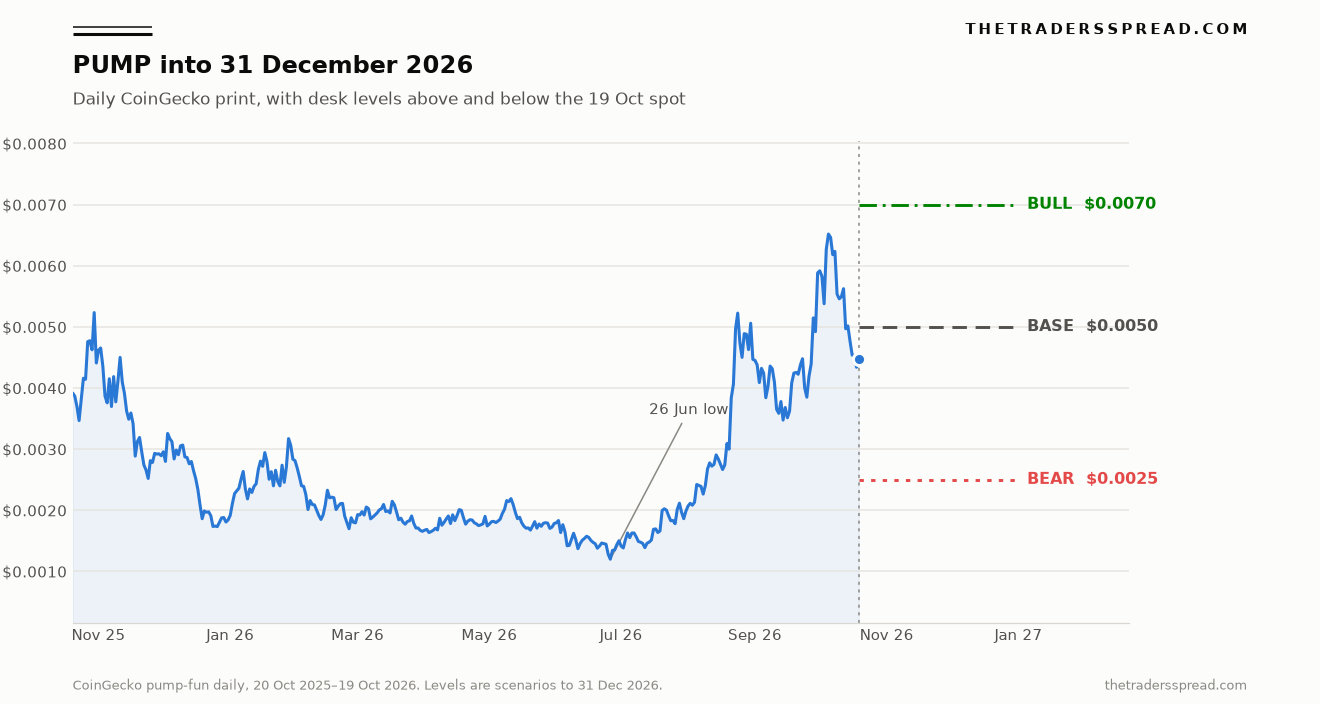
The chart is the CoinGecko daily series from 20 October 2025 to the 19 October 2026 stamp. Bull is $0.0070. Base is $0.0050. Bear is $0.0025. The lines run to 31 December 2026. The 26 June low, $0.00120, is marked because a bear case has to be measured against it. $0.0025 would be a hard fall from here. It would still be more than double that June day.
DefiLlama's fee adapters, last day 18 October 2026, compare the business with Hyperliquid without using the broken dashboard as the only ruler. Our earlier note on Hyperliquid (HYPE) was a price move and a regulatory headline. The table is fees, not that move.
| Gross fees | Bonding curve | PumpSwap | Hyperliquid parent |
|---|---|---|---|
| 18 October 2026 | $1.736 million | $2.910 million | $2.465 million |
| 30 days to 18 October | $61.27 million | $116.54 million | $84.86 million |
| June 2026 | $23.60 million | $39.97 million | $80.98 million |
| September 2026 | $46.41 million | $106.10 million | $91.33 million |
| 1 to 18 October | $38.71 million | $68.59 million | $48.36 million |
Every cell is DefiLlama daily fees, retrieved 19 October 2026. The mobile-app adapter is left out because DefiLlama says those fees are already inside the two Pump rows. Hyperliquid perps were $81.87 million of the parent's $84.86 million over thirty days. That perps note says 99% of fees, excluding builder fees, go to an assistance fund that purchases HYPE, and that the protocol keeps none.
In June, Hyperliquid's fee month beat the curve and PumpSwap combined: $81.0 million against $63.6 million. That is the month of the low, $0.00115 on 25 June. By September the launchpad had flipped the comparison, $152.5 million combined against $91.3 million. The first eighteen days of October kept the order, $107.3 million against $48.4 million.
The token did not follow in a straight line. From the 22 July daily print of $0.00200 to the 19 October stamp is a little more than a double, which rhymes with the fee recovery. From the 5 October high of $0.00652 to the $0.00447 spot is a drop of about 31%, off those two CoinGecko points, during a fortnight when fees were still millions of dollars a day. Fees explain the climb off June better than they explain the last two weeks.
The token page, "data as of Oct 18", counts 868,400 Solana daily active wallets and 94,800 once Pump is excluded. The difference, 773,600, is about 89% of that panel. It is their figure, not a chain census. If it is close, Solana (SOL) can rise on an ETF-asset headline and still be, on this panel, a launchpad with a settlement layer under it. A quiet week of new coins is then the whole week, not a sideshow.
The 5 October newsletter splits volume the way the fee schedule predicts. From 28 September to 4 October, $4.72 billion traded on the curve and PumpSwap, up 14%, the biggest such week since early May 2025. The curve was $1.28 billion. PumpSwap was $3.44 billion. Most dollars sit where a large pool, before the new app charge, pays the protocol five basis points. "1.25% of all volume" is not this company's revenue.
The page does not agree with itself
On 19 October the token page showed two valuations. The burn panel put fully diluted value at $4.32 billion. The live-market panel lower down showed a price of $0.004469, a market cap of $1.79 billion, a fully diluted value of $4.47 billion, circulating supply of 399.46 billion and a total supply of 1 trillion. CoinGecko the same morning showed $0.00446981, a market cap of $2.066 billion, fully diluted value of $3.697 billion, circulating supply of 462.32 billion and total supply of 827.20 billion.
The burn math picks a side. Removing 172.54 billion from an original 1 trillion leaves about 827.5 billion, which is CoinGecko's total, not the live panel's 1 trillion. Price times 1 trillion is about $4.47 billion, the live panel's fully diluted value. CoinGecko's fully diluted field is price times the reduced total, $3.70 billion. The panel's $1.79 billion market cap matches its own 399.46 billion circulating count. The gap versus CoinGecko's 462.32 billion is about 63 billion tokens, a little over $280 million at the morning spot.
The forecast is marked off CoinGecko, because that is the series in the chart and the series with a timestamp I can name. A 14% argument about the float moves any burn-yield ratio. It does not rescue the token from a 24% week.
The same page offers a calculator, labelled illustrative, defaulted to $30 million of monthly protocol revenue, a $1.79 billion circulating value, a 50% allocation, a 5.0 times multiple, $360 million of annual revenue and a 10.1% yield at $0.004469. Those defaults are not the figure at the top of the page. The top says $622.35 million annualised, about $1.71 million a day, closer to $50 million a month than to $30 million. The 10.1% is a slider. Holders are not being paid. Tokens are being destroyed.
RelatedToncoin (TON) Price Prediction: $2.15 Bull vs $1.15 Bear
Routing is how the bear case happens in practice. The fee page exempts "another interface" and does not name Jupiter. Our note on Jupiter (JUP) is that token's 6.38% drop into the 8 October close, not this schedule. If PumpSwap flow misses the official app, the 0.45% never arrives. A higher app fee can then sit next to a lower token, because it taxes only the flow that stays.
Base, bull and bear into 31 December
The base into 31 December 2026 is $0.0050, about 12% above the $0.00447 spot. It assumes the 28 April 2026 burn lock is still on at year-end, and that daily protocol revenue stays near the $1.71 million 90-day average rather than June's slump. Ten weeks of a bid this small do not re-rate the token alone. A grind to $0.0050 is that bid, if attention merely stops getting worse.
Weight on the base: 45%. The bull, at 25%, is $0.0070, about 7% above the 5 October high of $0.00652 and about 21% under the 14 September 2025 high of $0.00882. It needs the 17 October platform fee to land on a large share of volume, and a fee mix near September, when PumpSwap alone showed $106.1 million of gross fees. No new all-time high is required. The October give-back has to be positioning, not another June.
The bear, at 30%, is $0.0025, about 44% under the spot and still more than double the 26 June print of $0.00120. Fees would have to fade toward June's $63.6 million combined, from September's $152.5 million, with flow moving to interfaces that skip the new platform fee. Invalidation of the base is a sustained break under $0.0025, or a halt of the burn outside the slice programmed before 29 April 2026.
One strong session would not change the weights. A month of combined curve and PumpSwap fees back above $7 million a day, with about half of revenue still destroyed, would pull weight toward $0.0070. A month under $3 million a day, or a cut to the 50% target, would pull weight toward $0.0025. Until then the central mark is $0.0050, and conviction stays low.
FAQ
What is the Pump.fun price into December 2026?
CoinGecko showed $0.00446981 at 06:54:51 UTC on 19 October 2026. The central mark for 31 December is $0.0050, with $0.0070 above it and $0.0025 below it. The band is built from the fee schedule, the burn ledger and the fee history. It is not a promise that the token stays inside those prints, and it is not a level at which anyone is told to transact.
Does PUMP pay holders a share of fees?
No. The token page says half of revenue is used to purchase PUMP and destroy it, with the 50% lock dated 28 April 2026 for one year. The disclaimer says the token carries no right to revenues or any other distribution. Destroying supply is not a dividend. The calculator's 10.1% is labelled illustrative and uses inputs that do not match the $622.35 million annualised figure above it.
Why did the token fall while tokens were still being destroyed?
The daily destruction is small next to the float. The 18 October row removed 190.0 million PUMP, about 0.023% of CoinGecko's 827.2 billion total supply, for $817,400. CoinGecko's seven-day change was minus 24.2%, and the drop from the 5 October high of $0.00652 to the morning spot was about 31%. A bid under $1 million a day does not dictate a market with $225.8 million of turnover in the prior day.
How does the 17 October platform fee change the picture?
It adds 0.45% on official app and web trades with no referral code, or 0.40% with one, on top of the other fees. It does not apply through another interface. The $1.71 million a day 90-day average barely includes it. If volume stays in the app, the protocol's take rises. If volume leaves, the fee raises nothing, and the five-basis-point protocol fee on a large PumpSwap pool is what remains.
How do these fees compare with Hyperliquid?
On DefiLlama's series through 18 October 2026, curve plus PumpSwap fees were $63.6 million in June, under Hyperliquid's $81.0 million, and $152.5 million in September, over Hyperliquid's $91.3 million. The thirty days to 18 October were $177.8 million combined against $84.9 million. Gross fees are not revenue. A large PumpSwap pool pays the protocol 0.05%. The Hyperliquid perps note sends 99% of those fees, excluding builder fees, toward HYPE purchases.
Which supply number should the valuation use?
This piece uses CoinGecko: 462.32 billion circulating, 827.20 billion total, a 1 trillion maximum, and a $2.066 billion market cap at 06:54 UTC on 19 October 2026. The token page's live panel that day showed 399.46 billion circulating and a $1.79 billion market cap. The 172.54 billion already destroyed implies a remaining total near 827 billion. The float gap is about 63 billion tokens. It does not settle the December band.
This is analysis, not advice. The levels are scenarios for 31 December 2026, not an instruction to trade. PUMP can go to zero. The burn can be altered outside the slice programmed before 29 April 2026. The company's own page says the token is not a claim on revenue. Capital is at risk.