

We read the KPMG examination of Paxos’s Pax Gold redemption assets, the Pax Gold terms, and the product page, then pulled CoinGecko’s pax-gold market data and a same-session gold ounce and computed the token-minus-ounce gap, the discount to that ounce, and three cases around the live print. Data as of 27 November 2026, from the documents named in the tables below.
| Line | Figure | Source |
|---|---|---|
| Report date | 30 September 2026, 5:00 pm Eastern | KPMG examination of management’s assertion |
| Examiner | KPMG LLP | Opinion dated 23 October 2026, New York |
| Opinion date | 23 October 2026 | Same report, signed that day |
| Redeemable tokens | 435,306 | Exhibit A, line d |
| Fine troy ounces | 435,306 | Exhibit B, London Good Delivery gold |
| Tokens minus ounces | 0 | Our subtraction of those two lines |
| Ethereum | 432,506 | Exhibit A |
| Solana | 2,560 | Exhibit A |
| Base | 235 | Exhibit A |
| Robinhood chain | 5 | Exhibit A |
| Signer | Adam Ackermann, head of treasury and portfolio management | Paxos Trust Company, National Association, 23 October 2026 |
A matched book on 30 September
The report Paxos posts for September is an examination by KPMG LLP, dated in New York on 23 October 2026, of management’s assertion as of 30 September 2026 at 5:00 pm Eastern. The Paxos attestation page links that PDF and leaves October and November of 2026 still unmarked, so September is the latest month on the page. KPMG’s opinion says the assertion is fairly stated, in all material respects, and the opinion covers that assertion while material on the company website sits outside the examination procedures.
Exhibit A counts 435,306 redeemable PAXG. Exhibit B counts 435,306 fine troy ounces of London Good Delivery gold. Subtracting the ounces from the tokens leaves zero. Exhibit C prints a dash on the surplus line, the same zero. Adam Ackermann, head of treasury and portfolio management at Paxos Trust Company, National Association, signed the report on 23 October 2026.
The tokens split across four chains in the exhibit. Ethereum holds 432,506, which is 99.36 percent of the total. Solana holds 2,560, Base holds 235, and the Robinhood chain holds 5. The temporary and permanent restriction rows are marked N/A. The footnote states that every PAXG token is redeemable. The footnotes name Ethereum at 0x45804880De22913dAFE09f4980848ECE6EcbAf78, Solana at 5GgRAEmv8ZxF2PR5hY72Qs5x1bnQ6UK2RbTPoqJ3wSwW, Base at 0xe904AEA5E1b110c9174728fA2efFc8aeD19E98Ef, and the Robinhood chain at 0x121BbE58fe4684057FB66d2dd535A19e16B4f66F.
The gold is allocated London Good Delivery. The report says the company purchases it from StoneX Group Inc. and stores it with Brink’s Global Services Ltd. and Industrial and Commercial Bank of China Ltd (ICBC) Standard Bank, which the report calls LBMA-approved vaults. Management records that the AICPA criteria it applied were built for fiat-pegged stablecoins, and that a gold token sits outside that original scope. Paxos still used the criteria for the count, the asset mix, and the comparison. The background section dates the firm’s conversion: on 12 December 2025, Paxos Trust Company, LLC became Paxos Trust Company, National Association, under Office of the Comptroller of the Currency supervision.
Price against the ounce
CoinGecko’s pax-gold market data, timestamped 07:00:47 UTC on 27 November 2026, puts Pax Gold (PAXG) at $3,641.94. The same payload lists a circulating supply of 447,285.24 tokens, a market cap of $1,628,987,692, a 24-hour volume of $85,156,624, and a market-cap rank of 47. Over 24 hours the page records a rise of $79.62, or 2.24 percent, with a high of $3,648.00 and a low of $3,544.82. The seven-day change is a 2.44 percent rise. The 14-day change is a 6.37 percent decline, the 30-day change a 9.65 percent decline, the 200-day change a 22.06 percent decline, and the one-year change a 12.33 percent decline.
A gold ounce from gold-api.com, symbol XAU, updated at 07:01:19 UTC the same morning, printed $3,649.00. The token sits $7.06 under that ounce. Dividing the dollar gap by the ounce and scaling to basis points gives 19.3. That discount, the zero gap in the September book, and the 23 October opinion date are the three figures this piece adds.
| Measure | Figure | Source |
|---|---|---|
| PAXG spot | $3,641.94 | CoinGecko pax-gold, 27 November 2026, 07:00 UTC |
| Gold ounce | $3,649.00 | gold-api.com XAU, 27 November 2026, 07:01 UTC |
| Token under the ounce | $7.06 | Our subtraction |
| Discount | 19.3 basis points | Our division of that gap by the ounce |
| CoinGecko supply | 447,285.24 | Same coin payload, rounded from 447,285.239257 |
| Supply above the September count | 11,979.24 tokens | Our subtraction from 435,306 |
| Share of the examined count | 2.75 percent | Our division |
| Market cap | $1,628,987,692 | CoinGecko, beside the $3,641.94 price |
| 24-hour volume | $85,156,624 | CoinGecko, same payload |
CoinGecko’s supply is 11,979.24 tokens above the 435,306 examined on 30 September. The September PDF describes the book at 5:00 p.m. Eastern that day and stops there. A higher live supply is a dating gap between two documents, and a later attestation is what would bring the newer tokens inside an examined ounce count. The Pax Gold product page, read the same morning, labels an approximate value in circulation of $2 billion, beside the measured market cap above. The page also says the token divides to 18 decimal places and states a storage fee of zero.
Section 15.2 of the Pax Gold terms, last modified on 12 December 2025, keeps a later storage fee available, collected by minting new tokens, with at least thirty days of notice before it starts. Section 2.4 permits a discount to selected customers for market making. Our $7.06 figure is the secondary-market print versus the ounce. The terms leave the cause of that print unstated. A pool can set its own price from balances and a fee, which is the path in our note on how a Curve stableswap sets a price.
What a holder can take back
Section 4.2 of the terms states that each PAXG token equals one fine troy ounce of London Good Delivery gold. Section 4.3 describes the tokens as fractional ownership of bars held by Paxos Trust for the holders, in LBMA-approved vaults. Section 5.1 compares a token to a warehouse receipt for a pro rata share of allocated gold, with the economic exposure sitting with the holder. On the Paxos site, a wallet lookup is offered for the serial number, purity, and gross weight tied to an Ethereum address.
Allocated delivery is a separate step from holding the token. Section 11.4 sets redemption into allocated gold at a minimum of 430 PAXG, plus the fee the terms place in the Paxos user guide, for each London Good Delivery bar. Tokens above the weight of the bar that is actually delivered are credited back, net of fees. Dollar conversion and unallocated-gold conversion sit in the sections beside that bar rule, and the 430-token minimum is written on the allocated-bar path. Section 4.11 reserves issuance, conversion, and redemption on the Paxos platform for verified customers.
The split between the bar and the print shows up in other tokenized claims as well. Ondo’s treasury tokens raise the same question of what the holder owns when the market price and the underlying asset move on different clocks. A debt-pool synthetic, the structure in our Synthetix case, is a different claim from an allocated bar with a serial number.
The year the daily file records
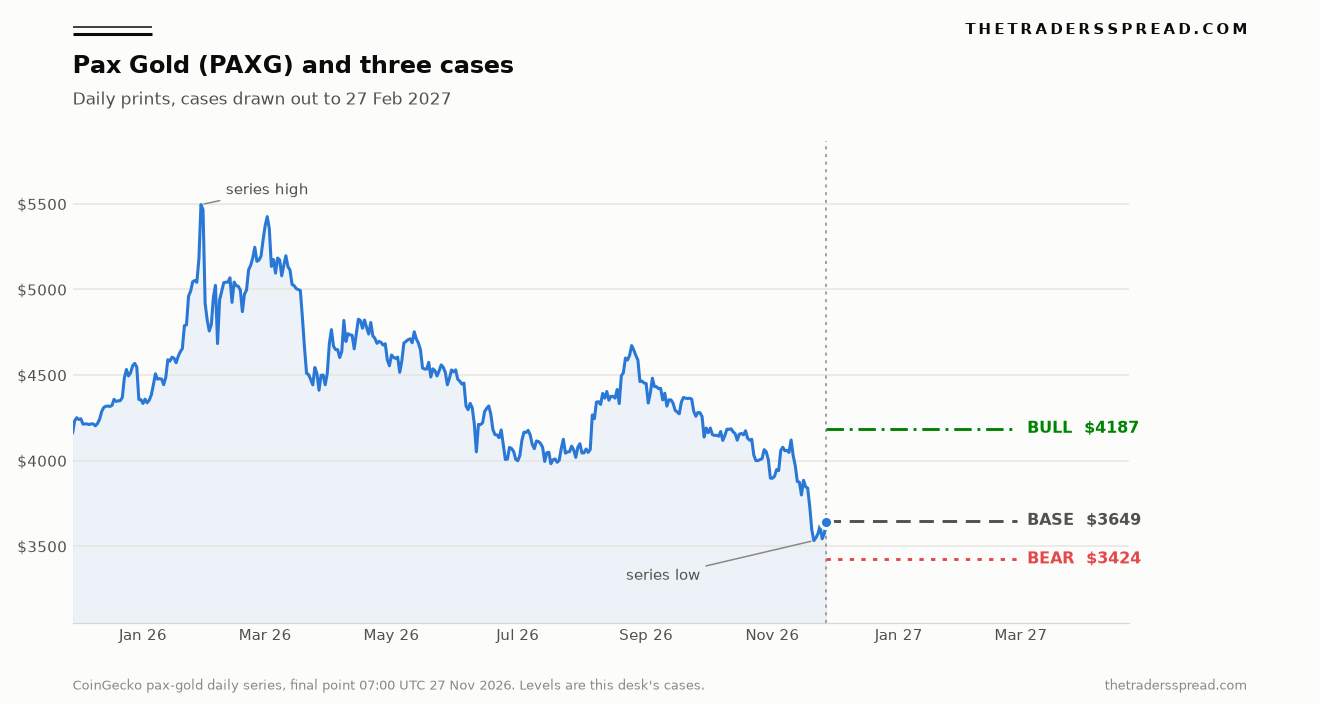
The daily file from CoinGecko, one print a day across 365 dates, runs from $4,160.93 on 28 November 2025 to a final point we set at the live $3,641.94. The high inside that file is $5,495.62 on 29 January 2026. The low is $3,532.81 on 21 November 2026. From that high to the live spot the decline is 33.7 percent. From that low to the live spot the rise is 3.09 percent. CoinGecko’s separate all-time-high field is $5,619.09 on 28 January 2026 at 22:30 UTC, and the endpoint marks the token 35.19 percent under it. The daily file and the all-time-high field are different measurements, and both stay on the record with their own timestamps.
From the first print in the file, $4,160.93, to the live spot, our division is a 12.47 percent decline. The endpoint’s own one-year field is a 12.33 percent decline. The two windows overlap and they are calculated separately, so both figures stay. The average of the last 30 daily prints is $3,851.87, and the live spot sits $209.93 under that average. Inside the recent path, 31 October printed $3,897.72, 10 November printed $4,120.53, and on the attestation date itself, 30 September, the daily file printed $4,190.22.
RelatedCanton Coin slips 0.3% after the burn-rule walkthrough
The chart uses that daily file. The final point is the coin-page price at 07:00 UTC, in place of the file’s earlier 27 November observation, so the dot matches the spot in the tables. The three cases are extended to 27 February 2027 so the lines have length. That date is a viewing horizon for the drawing.
How the three cases are set
The bull case is a one-third retracement of the decline from the 29 January high in the daily file to the 21 November low. Using the file’s unrounded high and low, that level is $4,187.08, and the case is $4,187. It sits $545.06 above the live spot. It also lands $3.14 under the 30 September daily print of $4,190.22, and the rounded case sits $66.47 above the 10 November print of $4,120.53. The bull case is a return toward the late-September area of the file, and it remains above the prints since the middle of November.
The base case is the live ounce, $3,649.00, with the gold price held at the print we pulled and the token repriced to it. The base sits between the bull and the bear, and it sits $7.06 above the token. The bear case takes the unrounded 21 November low and subtracts the bounce from that low to the live spot. The subtraction equals $3,423.67, and the case is the nearest dollar, $3,424. That level is under the live spot and under the low the file printed on 21 November.
| Case | Level | Distance from the $3,641.94 spot | How it is set |
|---|---|---|---|
| Bear | $3,424 | $217.94 below the spot | 21 November low minus the bounce to the live spot, then rounded to the dollar |
| Base | $3,649 | $7.06 above the spot | Live gold ounce from gold-api.com at 07:01 UTC |
| Bull | $4,187 | $545.06 above the spot | One-third retracement of the 29 January to 21 November decline in the daily file, then rounded to the dollar |
The call
At $3,641.94, Pax Gold (PAXG) trades $7.06 under the base, $545.06 under the bull case, and $217.94 above the bear case. The base is the ounce we pulled. The bull case is the one-third retracement. The bear case is the November low minus the bounce already in the price. We leave the directional bias neutral. The matched September book and a 19.3 basis-point discount support a reading that stays near the ounce. The path from the January high, a 33.7 percent decline to the live spot, and a CoinGecko supply that is 11,979.24 tokens above the examined count, keep a wider move available on both sides of the spot. Conviction on that neutral reading is low, a 2 on a five-point scale, because the examined book is 58 days old and the price path is still the larger number.
The matched-book reading changes if a later attestation prints ounces below the redeemable tokens. The open item on supply is a report that covers the tokens outstanding after 30 September, because the current PDF stops at 435,306. The base moves if the live ounce moves away from $3,649.00, since the base is that print. A token print above $4,187 means the price has passed the bull case. A token print below $3,424 means the price has passed the bear case. KPMG’s opinion is tied to management’s assertion on one afternoon in September. The next monthly PDF on the attestation page is the document that refreshes the ounce count.
This is analysis, not advice, and capital is at risk.