
Saxo prices the same trade two ways, and I found that out the slow way this morning. I had the commissions schedule of Saxo Capital Markets UK Ltd open in one tab, the international schedule that Saxo Bank A/S publishes for clients outside the UK in the next, and Saxo's own live pricing feed returning the numbers that sit behind both pages. I priced one standard EUR/USD lot and a $10,000 purchase of a US share through each schedule. Then I took the legal entities to the registers: Companies House for the London subsidiary, the Danish Financial Supervisory Authority's published decisions for the Danish parent, and ASIC's September licensee file for an Australian arm Saxo no longer controls. Everything in this Saxo review was read on 15 September 2026. The short version: a UK client gets the tighter forex spread and the dearer currency conversion, and on a share purchase the conversion is the bigger number by a distance.
On the UK charges schedule, a Classic account that settles a trade in a currency other than its base currency pays the mid rate plus 0.60%. The international schedule says Saxo charges "no more than plus/minus 0.25 percent", and the Swiss and Singapore schedules repeat that ceiling. Buy $10,000 of a US-listed share such as Boeing from a sterling Classic account and the commission is 0.08%, or $8. The conversion is $60. Sell later and both charges recur: about $136 for the round trip before custody, $120 of it currency, against $66 through Saxo Bank A/S. Forex runs the other way. Saxo's pricing feed quotes EUR/USD at 0.8 pips for UK Classic and 1.1 pips internationally, $8 against $11 per 100,000-unit lot. A UK forex trader pays less than the parent's own clients; a UK buyer of US shares pays 2.4 times as much to change money.
- Currency conversion costs 0.60% for UK Classic, 0.40% Platinum and 0.20% VIP, against a 0.25% cap on the international site — home.saxo UK and international charges schedules, read 15 Sep 2026
- EUR/USD minimum spread is 0.8, 0.7 and 0.6 pips across the UK tiers, and 1.1, 0.9 and 0.8 pips internationally — Saxo DynamicPricing feed behind home.saxo FX pricing pages, read 06:54 UTC 15 Sep 2026
- US share commission is 0.08% at Classic on both sites, with a $0.01 minimum in the UK and $1 internationally — same feed, read 15 Sep 2026
- Saxo Bank A/S accepted a DKK 313 million administrative fine for anti-money-laundering failures on 22 January 2026 — Finanstilsynet, published 23 Jan 2026
- Net profit was DKK 539 million in 2025 and DKK 648 million in the first half of 2026 alone, with 1,684,000 clients at 30 June — Saxo Bank annual report 2025 and interim report H1 2026, read 15 Sep 2026
- 60% of UK retail CFD accounts lose money with Saxo, against 64% on the international site — risk warnings on home.saxo, read 15 Sep 2026
Two schedules, one brand: pricing the same trades twice
Saxo runs one platform, SaxoTrader, and sells it through several licensed companies. Which company you sign with depends on where you live. The international site states plainly that its content "relates to Saxo Bank A/S as the parent company" and that client agreements are made "with the relevant Saxo entity based on your country of residence". A UK resident contracts with Saxo Capital Markets UK Ltd, company number 07413871, which Saxo's footer describes as authorised by the Financial Conduct Authority under firm reference 551422.
The schedules share a layout and most of their wording, so the differences are easy to miss. Read together, they show a trade-off rather than a markup.
| Line item | Saxo UK (Saxo Capital Markets UK Ltd) | International site (Saxo Bank A/S) |
|---|---|---|
| EUR/USD minimum spread, Classic | 0.8 pips ($8.00 per 100,000 units) | 1.1 pips ($11.00) |
| EUR/USD minimum spread, VIP | 0.6 pips | 0.8 pips |
| US share commission, Classic | 0.08%, minimum $0.01 | 0.08%, minimum $1 |
| Currency conversion, Classic | 0.60% | 0.25% cap |
| Currency conversion, VIP | 0.20% | 0.25% cap |
| Custody on shares and ETFs, Classic | 0.12% a year | 0.15% a year, varies by residence |
| Small forex tickets | USD 3 fixed commission below 50,000 units | USD 1 minimum commission |
| Inactivity fee | None | None |
The spreads come from Saxo's own pricing service, the same feed that fills the tables on its UK forex pricing page and the international one. Both pages label them indicative minimums that vary by country of residence. That caveat matters, because Saxo's own account tiers page advertises "Major forex pairs 1 pips" for Classic, while the live feed for the same international schedule returned 1.1 pips on EUR/USD and GBP/USD. A tenth of a pip is $1 a lot.
Conversion is the line that decides a share investor's bill. Saxo applies it to "settlement of actual payments", which its UK schedule defines to include "buying/selling cash stocks or paying/receiving options premiums". A Classic client in London has no easy way round it either: the UK schedule says only "Platinum & VIP clients may be permitted, at our discretion" to open additional accounts in other currencies. The UK schedule does not state what Platinum takes; on the international site it is a deposit of EUR 200,000 or a qualifying trading volume. Until a client gets there, the entry tier is the one that pays 0.60%.
Custody runs the other way on the headline rate. The UK charges 0.12% a year on shares, ETFs and bonds at Classic, which is $12 on a $10,000 holding. The Saxo Bank A/S stock pricing page lists 0.15% at Classic plus 25% Danish VAT for EU individuals, though the general charges page exempts residents of Denmark and several other countries.
The conversion fee against five rivals
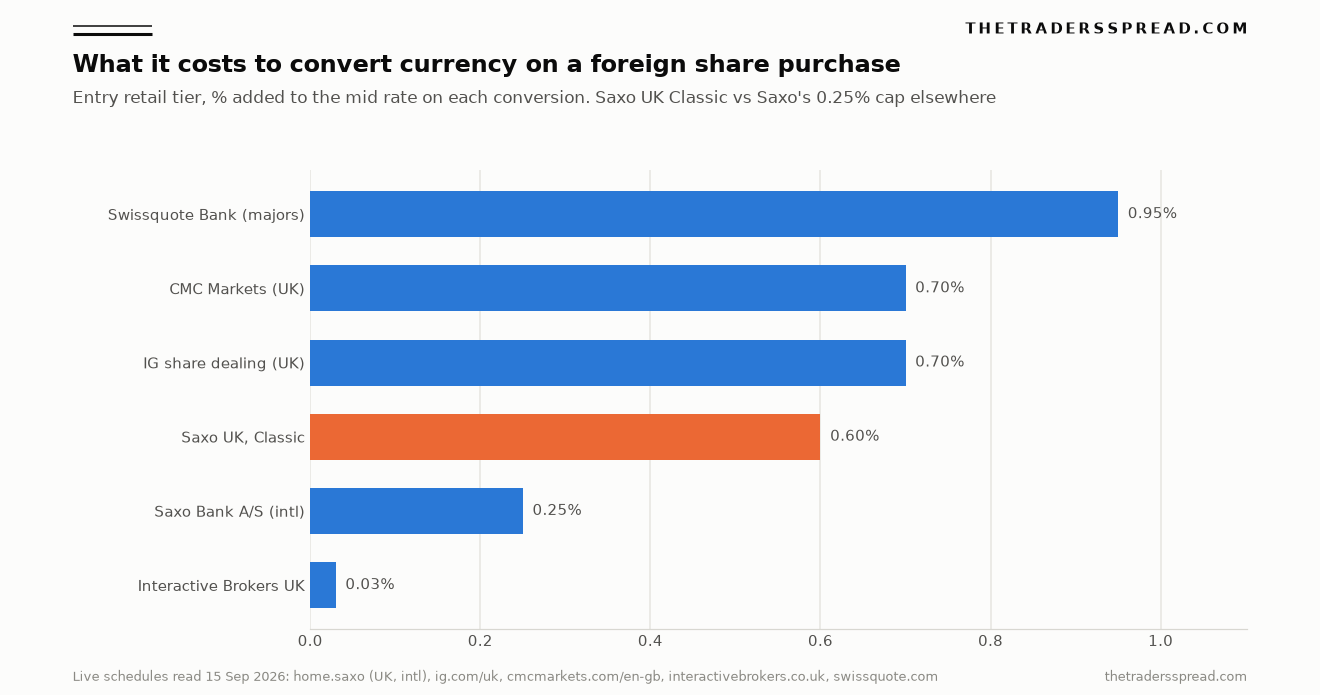
A 0.60% conversion fee sounds high until you line it up against UK competitors, so I pulled each rival's figure from its own live page this morning. The comparison is like for like where the products allow it: the markup a retail client pays on the entry tier when buying a share priced in another currency.
| Provider and product | Conversion fee | On a $10,000 purchase | Source, read 15 Sep 2026 |
|---|---|---|---|
| Swissquote, securities account, major currencies | 0.95% | $95 | Swissquote currency exchange fees |
| IG Trading and Investments Ltd, share dealing | 0.70% | $70 | IG UK charges |
| CMC Markets, UK equities trading | 0.70% | $70 | CMC Markets trading costs |
| Saxo Capital Markets UK Ltd, Classic | 0.60% | $60 | Saxo UK schedule |
| Saxo Bank A/S, international site | 0.25% | $25 | Saxo international schedule |
| Interactive Brokers (U.K.) Limited, auto conversion | 0.03% | $3 | IBKR UK spot currency pricing |
Each figure carries a caveat. IG's UK charges page lists 0.7% on its investing products and 0.8% on spread bets and CFDs, the same split our IG review recorded on 14 September. CMC Markets charges plus or minus 0.7% on shares and CFDs but no conversion on spread bets, and its footer names both CMC Markets UK plc and CMC Markets Investments Limited. Interactive Brokers adds "0.03% to the exchange rate" on auto conversions. Swissquote's 0.95% is the major-to-major rate in a matrix that rises to 2.50% for emerging-market pairs, and its forex account is priced separately, as our Swissquote review set out.
Saxo UK sits in the middle. It is cheaper than IG and CMC on the entry tier and 20 times dearer than Interactive Brokers. What stands out is the gap inside the group. Saxo's own international, Swiss and Singapore schedules cap the same service at 0.25%, which a UK VIP client beats at 0.20% and a UK Classic client pays more than twice over.
This line matters to Saxo's income statement too. The H1 2026 interim report shows price and exchange rate adjustments of DKK 814 million, up from DKK 681 million, "predominantly driven by increased revenue from currency conversion of increased equity trading" as well as higher FX volumes. Conversion is a revenue line the bank names.
Who you sign with: Hellerup, Canary Wharf and the exits
The parent is a bank, and that is the strongest thing in Saxo's favour. Saxo's licence page states that Saxo Bank A/S, company registration 15731249, holds Danish FSA licence number 1149, received its banking licence in 2001 and was designated a systemically important financial institution in June 2023. Deposits with the parent and its UAE, Czech, French, Belgian and Dutch branches fall under the Danish guarantee scheme up to EUR 100,000, with up to EUR 20,000 for securities the bank fails to return.
UK clients sign with the London subsidiary, outside that scheme. The FCA register is a JavaScript application that cannot be read by an automated fetch, so I could not confirm firm reference 551422 there; I corroborated the company instead. Companies House lists Saxo Capital Markets UK Ltd as active, incorporated on 20 October 2010. Its control register shows Saxo Bank A/S, Kim Fournais and Li Shufu all ceasing as persons with significant control on 2 March 2026, the day the new owner closed its purchase.
The other registers match Saxo's licence page. The MAS directory lists Saxo Capital Markets Pte. Ltd. as a Capital Markets Services licensee, FINMA's bank list carries Saxo Bank (Schweiz) AG of Kloten, and the Japanese FSA register dated 31 July 2026 lists Saxo Bank Securities Ltd. Hong Kong's public register would not load today.
The map has also shrunk. The 2025 annual report records the sale of 80.1% of the Australian business to a partner in August 2025, the closure of offices in Shanghai and Hong Kong, and the divestment of the asset management arm. Australian clients moved to Totality, which the report calls a white-label client of Saxo Bank. The licence survived the rename. ASIC's September 2026 licensee file lists AFS licence 280372, first granted in December 2004, under Totality Wealth Limited, and the ABN history shows that company traded as Saxo Capital Markets (Australia) Limited until 12 August 2025. An older comparison that lists an Australian Saxo licence is describing a company that now carries another name.
A DKK 313 million fine and six Danish FSA decisions in 13 months
The supervision that comes with SIFI status is visible in public. On 22 January 2026 Saxo Bank A/S accepted an administrative fine of DKK 313 million from Finanstilsynet. The regulator's notice ties it to failures to collect information on the purpose and intended nature of certain client relationships, and to monitor white-label clients' end customers, between January 2021 and May 2023. The annual report adds that the underlying orders were closed in 2024 and the inspection found no instances or signs of money laundering. The fine equals 58% of Saxo's reported 2025 net profit.
It was not the only decision. A May 2025 anti-money-laundering report rated Saxo's inherent money-laundering risk medium-high because of its many correspondent and white-label relationships. A June 2025 inspection report ordered the board to set operational-risk limits and act on risk-function recommendations repeated for years. In October 2025 it ordered Saxo to fix the way it reclassified retail clients as professional on request, finding the bank had not ensured those clients had experience across all relevant product types. That one lands on traders: Saxo's own account page warns that for professional status "Retail protections do not apply."
The June 2026 order is the one a fee review cannot skip. Finanstilsynet ordered Saxo Bank A/S on 19 June to amend general business terms that, in the regulator's reading, allowed it to change interest rates, fees and other charges to a customer's disadvantage without notice, in breach of Danish good-practice rules. Every fee quoted above comes from schedules governed by those terms.
An April 2026 data-quality inspection ended with the bank doubling its own capital add-on for the issue from 0.2% to 0.4% of risk-weighted exposures.
New owner, record half-year
The shareholder register in older Saxo reviews is out of date. J. Safra Sarasin Group completed its purchase of about 71% of Saxo Bank on 2 March 2026, buying from Geely Financials Denmark A/S, Mandatum Group and minority holders, with approval from FINMA and the Danish FSA, according to the completion release. Daniel Belfer became chief executive. "We are proud to have completed this transaction, and we are excited by what the future will bring," said Jacob J. Safra, Chairman of J. Safra Sarasin Group, in that release. On 6 July Bank J. Safra Sarasin exercised a call option over founder Kim Fournais's remaining 28.69%. Saxo's investor relations page now states that Saxo Holding AG, wholly owned by Bank J. Safra Sarasin AG, holds 100% of the shares.
The numbers under the new owner are strong. Reported 2025 net profit fell to DKK 539 million from DKK 1,005 million, but DKK 313 million of that gap is the fine and a further DKK 71 million is an operational loss from a Wolfspeed reverse stock split; adjusted net profit was DKK 898 million. In the first half of 2026 Saxo earned DKK 648 million, 20% more than in the whole of 2025, and counted 1,684,000 clients with DKK 1,144 billion of client assets. It guides to DKK 1,000 million to 1,100 million for the year. Saxo's investor relations page cites an S&P Global Ratings research update dated 26 August 2026 and an A- long-term rating with a positive outlook.
For a client, the counterparty picture is reassuring. The fine was accepted and booked in the 2025 accounts, the owner is a Swiss private bank, and the total capital ratio stood at 26.5% at mid-year.
Verdict: a bank-grade platform with a costly doorway
Saxo earns a rating of 3.8 out of 5. The platform is broad and the balance sheet is a bank's. One SaxoTrader login reaches more than 23,000 shares on 50-plus exchanges, 250 futures and 3,100 listed options, according to the pricing overview, and the parent is supervised as a systemically important bank. The UK entity's forex pricing holds up: 0.8 pips on EUR/USD at Classic, with no commission on standard lots, is wider than IG's 0.6-pip minimum but tighter than the 1.1 pips Saxo's own parent quotes internationally. A UK VIP pays 0.20% to convert, below the 0.25% on the international schedule.
RelatedHow Much Does a BDSwiss EUR/USD Lot Actually Cost?
The deductions are specific. A UK Classic client buying foreign shares pays 0.60% each way to convert currency and cannot open a second-currency account to avoid it, so on a $10,000 round trip conversion costs 7.5 times the commission. Since May 2025 the Danish FSA has fined the parent DKK 313 million, ordered changes to how it classifies professional clients and ordered it to rewrite terms that let it change fees without notice. None of that threatens client money. It does say the bank's control functions have been catching up with its growth.
Saxo UK suits an active forex or multi-asset trader with enough capital to reach Platinum, where conversion drops to 0.40% and extra currency accounts become possible. At Classic it suits sterling trading, UK shares and forex better than a US share portfolio, where the conversion line will usually outweigh the low commission.
What would change my mind: a UK schedule that brings Classic conversion to the group's 0.25% cap, or opens currency sub-accounts at Classic, would lift the rating by a notch. A further enforcement order touching client classification or pricing terms, or a repeat of the Wolfspeed-style operational loss, would take it down.
Saxo review FAQ
Is Saxo regulated in the UK?
Yes. UK clients contract with Saxo Capital Markets UK Ltd, which Saxo's site says is FCA-authorised under firm reference 551422. The FCA register could not be read by automated fetch today, so we confirmed the company at Companies House, where it is active under number 07413871. The parent, Saxo Bank A/S, is a Danish-licensed bank.
How much does Saxo charge to convert currency?
On the UK site, 0.60% at Classic, 0.40% at Platinum and 0.20% at VIP, added to the mid rate whenever a trade settles in a currency other than the account's base currency, such as buying US shares from a sterling account. The international site of Saxo Bank A/S caps the same fee at 0.25%.
What is Saxo's EUR/USD spread?
Saxo's pricing feed showed indicative minimums of 0.8 pips at UK Classic, 0.7 at Platinum and 0.6 at VIP on 15 September 2026, against 1.1, 0.9 and 0.8 pips internationally. UK trades below 50,000 units carry a USD 3 fixed commission. Our glossary entry on pips shows the arithmetic.
Who owns Saxo Bank?
Bank J. Safra Sarasin AG, through Saxo Holding AG, which Saxo's investor relations page says holds 100% of the shares. J. Safra Sarasin bought about 71% from Geely Financials Denmark, Mandatum and minority holders in March 2026 and exercised a call option over founder Kim Fournais's remaining 28.69% in July. Fournais remains chairman.
Why was Saxo Bank fined in 2026?
Saxo Bank A/S accepted a DKK 313 million administrative fine from the Danish FSA on 22 January 2026 for anti-money-laundering failures between January 2021 and May 2023, covering client due diligence and the monitoring of end clients of white-label partners. Saxo's annual report says the inspection found no instances or signs of money laundering.
Does Saxo charge an inactivity fee?
No. Both the UK schedule and the international general charges page list no inactivity fee. UK clients holding shares, ETFs or bonds pay a custody fee of 0.12% a year at Classic and Platinum and 0.08% at VIP, calculated daily and charged monthly. Our OANDA review found a similar entity-by-entity split in forex pricing.
Disclaimer
This review is analysis, not investment advice, and The Traders Spread is not recommending any broker, product or trade. Fees, spreads and ownership details were read from the sources linked above on 15 September 2026 and can change without notice. CFDs and forex are complex, leveraged instruments: 60% of retail investor accounts lose money when trading CFDs with Saxo's UK entity. Capital is at risk, and losses can exceed deposits on some products.