

Polygon (POL) was marked at $0.0925 on CoinGecko at 06:49 UTC on 20 October 2026, and the file that sets the staking rate under that price still called itself a draft. PIP-92, in the Polygon Improvement Proposals repository, is dated 23 September 2026 and names Adam Dossa as its author. Opened the morning of this article, the status line read Draft. The text tells governance to move 27,334,955.85 POL of accumulated priority-fee share into the Ethereum StakeManager, and to lift the checkpoint reward from 25,212.79 POL to 64,500 POL until 1 December.
Sandeep Nailwal, founder and chief executive of the Polygon Foundation, had already written on 1 October that the change was live. The token is not trading last October's price. The daily close on 21 October 2025 was $0.2007. CoinGecko's all-time low, $0.0677, printed on 1 July 2026. Between those marks POL replaced MATIC, kept a documented 2% emission, and started routing a slice of priority fees toward stake.
The awkward fact is the calendar. PIP-92 does not mint the 27.3 million POL it proposes to hand out. It pays priority fees that PIP-85 had already set aside between 8 April and 8 September, and that never reached stakers because the claim contracts were not deployed. The gross rate on that payout, about 7.71% annualised on the 3,451.7 million POL staked from 9 to 23 September, is scheduled to revert to about 3.01% on 1 December. This forecast runs to 31 December. Treating 7.7% as the New Year's Eve rate uses a number the proposal plans to retire three weeks earlier. At the 20 October spot, 27.33 million POL is about $2.53 million, roughly a quarter of one percent of the $984.2 million market cap, paid to stakers from fees the chain had already collected.
Key facts
- Polygon (POL) last printed at $0.0925, on a market cap of $984.2 million, with $43.4 million of volume in 24 hours and a rank of 76 — CoinGecko id polygon-ecosystem-token, snapshot last updated 06:49 UTC on 20 October 2026.
- That snapshot has the token down 0.5% in 24 hours, 11.3% over seven days, 10.8% over 30 days and 53.9% over one year — CoinGecko market data, 20 October 2026.
- The past year's daily high was a $0.2023 close on 27 October 2025. The low close was $0.0685 on 1 July 2026. CoinGecko's all-time low print is $0.0677 that day, and the all-time high is $1.29 on 13 March 2024 — CoinGecko market chart and coin endpoint, pulled 20 October 2026.
- Initial supply was 10 billion POL, matching MATIC one for one. MATIC taken by the migration contract is held there and is not burned. After June 2025 the documented emission is 2% a year, split between the community treasury and validator rewards — Polygon developer docs, POL page, opened 20 October 2026.
- PIP-92 specifies 27,334,955.85 POL and a checkpoint reward of 64,500 POL from 1 October to 1 December 2026, against a baseline of 25,212.79 POL. The repository copy still said Draft on 20 October — PIP-92, dated 23 September 2026.
- From 20 September to 19 October 2026, fees were 21,350,912 POL, base-fee accrual toward burn was 12,902,176 POL, emissions were 17,457,351 POL, and accrual-adjusted supply rose 4,555,175 POL — POLTRACK, data through 19 October 2026.
What the migration actually did to the token
POL is the gas token and the staking token on Polygon Chain. Polygon's developer docs, opened for this piece, describe it as the replacement for MATIC. Initial supply was 10 billion so the new token would match the old one. A migration contract accepts MATIC and returns the same count of POL. The MATIC then sits in the contract. The docs say it is not burned.
Governance can allow POL to be turned back into the same amount of MATIC. That switch is a control, not evidence anyone will use it. On Polygon Chain the conversion was done at network level, so stakers did not send a separate migration transaction. A bridge back to Ethereum pays POL. Contracts that still expect MATIC can have funds stuck. That fault does not change the 10 billion starting supply.
Emission is the part that keeps moving. The original design was 2% a year, 1% to a community treasury and 1% to validator rewards. The docs say PIP-26 then set validator rewards at 2% in 2023-2024, 1.5% in 2024-2025 and 1% after that, so that with the treasury share the effective rate from after June 2025 is 2%. POLTRACK dates EmissionManager v1.4, aimed at 2% compounded and split equally, to 9 July 2025 at 23:03:59 UTC. Governance can change the rate by upgrading that contract. It cannot, on the docs, exceed a mint-per-second cap in the POL contract.
CoinGecko's circulating supply that morning was 10.635 billion, equal to its total-supply field, and above the 10 billion start. POLTRACK reported on-chain supply of 10.74 billion and a burn-adjusted total of 10.52 billion through 19 October, because it subtracts a burn pipeline that can still sit inside the ERC-20 total. Price and market cap below come from CoinGecko. Fee and emission flows come from POLTRACK.
The fee share is not a switch added for this forecast. PIP-92 says PIP-85 allocated half of post-commission priority fees to stakers, to be claimed on Ethereum. The claim contracts were not deployed. The share piled up from block 85,245,000. PIP-92 is the proposal to pay that pile through the checkpoint reward the network already uses.
The range that matters is this year's
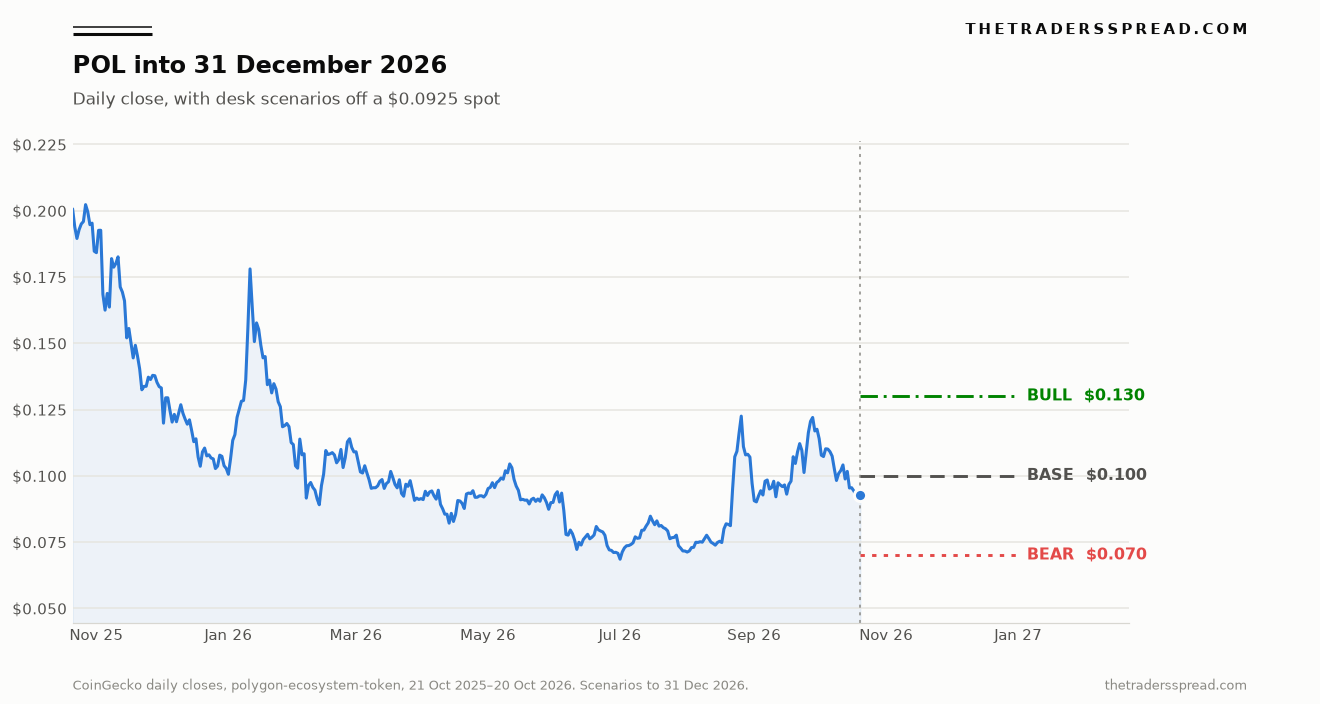
From $0.2007 on 21 October 2025 the token was at $0.1028 by the end of December. A daily close of $0.1780 on 11 January 2026 was back at $0.1118 by month-end. Nothing opened for this piece ties that spike to a change in supply.
After January the tape went quiet. On 24 April the close was $0.0944. Against a spot of $0.0925, half a year is almost flat. The staking window is younger.
June broke it. The low daily close is $0.0685 on 1 July, the same day as the $0.0677 all-time low. August included a $0.1225 close on the 26th. September finished at $0.1176. October has given that back, to a chart mark of $0.0926 on 20 October. The $0.0925 snapshot sits just under it. From 30 September, that is a fall of about 21%.
The band that matters into 31 December is about $0.07 to $0.12. The March 2024 high of $1.29 is not a serious case from nine cents. Supply cuts of a much larger size have moved other tokens here, including Filecoin ahead of a dated cut in new FIL issuance. POL's emission is the other shape: a standing 2% target, already public.
Price did not wait for the reward window to disappoint. Nailwal's post that PIP-92 had gone live is timestamped 20:34 UTC on 1 October. The close that day was already $0.1140, under the September finish. If the higher checkpoint reward is in force, it has coincided with a lower price.
Fees, stake, and where the levels sit
The chart is the CoinGecko daily close for polygon-ecosystem-token from 21 October 2025 through 20 October 2026. Lines to the right of the dotted marker are scenarios to 31 December 2026, not a path. Bull is $0.130, base is $0.100, bear is $0.070. The title rounds the outer two to $0.13 and $0.07.
| Scenario | Level | Versus the $0.0925 spot | What has to stay true |
|---|---|---|---|
| Bear | $0.07 | about 24% lower | The 1 December reward restore lands, net supply keeps rising, and price revisits the July low. |
| Base | $0.10 | about 8% higher | The post-July range holds. $0.12 is not reclaimed, and $0.07 is not broken. |
| Bull | $0.13 | about 41% higher | Burn accrual runs ahead of emissions for a stretch, and the late-summer highs give way. |
Bear under the live quote, bull over it. The same rule is how this desk framed Arbitrum. A bear case above spot would invert the page.
PIP-92 builds the 7.71% from rewards actually paid between 9 and 23 September: about 284,880 POL a day on 3,451.7 million POL staked, or 3.01% annualised. The backlog of 27,334,955.85 POL over 61 days is the increment. Raising the checkpoint reward to 64,500 POL is sized to deliver it, with a small expected surplus and a reconciliation later. The text says base emissions are untouched. No new POL is issued for the uplift.
At $0.0925 that backlog is $2.53 million, the whole two-month uplift. POLTRACK's trailing 30-day staking figure, 5.31% before commission through 19 October, sits between the 3% baseline and the 7.7% window because the lookback includes days before 1 October. It is also a figure before commission, not the gross rate in the proposal. The two percentages measure different things.
PIP-92 which enables 7.7% staking yield on Polygon, powered by priority fees generated by the network, just went live.
Nailwal, founder and chief executive of the Polygon Foundation, wrote that on 1 October 2026. The repository copy opened on 20 October still said Draft. POLTRACK shows 27,334,956 POL allocated to stakers over the 30 days to 19 October, and zero in the latest 24 hours and seven days. That fits one transfer of a backlog, which may include fees collected earlier, better than a daily drip. It is not a reading of StakeManager storage. This desk did not pull that slot.
Fees and new coins did not cancel over those 30 days. Emissions of 17.46 million POL against burn accrual of 12.90 million left supply 4.56 million higher, about 0.04%. POLTRACK puts the share change on an unstaked balance at an annualised minus 0.53%. Staking, on the same page, was 5.31% before commission, or about 4.78% after the supply effect. The staker was paid. The idle balance was diluted, slightly.
A larger burn sits in September. Polygon's 29 September account of stablecoin activity says the community burned 100 million POL that month from base fees collected earlier. Nailwal's words, on 23 September:
BURN COMPLETE: 100 MILLION POL (~1% of POL total supply) IS OFFICIALLY BURNED PERMANENTLY.
The post carries a transaction hash. On the 10.635 billion CoinGecko supply, 100 million POL is 0.94%. At $0.0925 the notional is $9.25 million, more than one month of the emissions just cited, and it does not amend the 2% schedule. The 23 September close was $0.1096. September still finished higher, at $0.1176.
Transfer volume is not the fee take. The 29 September post puts stablecoin transfers above $3 trillion since September 2020, with $741 billion of that in 2026 up to the article. POLTRACK's year-to-date gross fees, base plus priority, are 296,210,576 POL through 19 October. The 30-day fee total of 21.35 million POL is about $1.97 million at the 20 October spot. That product is spot times quantity, not dollars booked each day.
The staker is not the holder
Each checkpoint reward, on PIP-92's terms, splits 10% to the proposer and 90% across validators that signed, then between a validator's own stake, its commission and its delegators. Stake behind a validator that missed the checkpoint earns nothing for it. The 7.71% figure is total checkpoint rewards divided by total stake. A delegator who reads it as a personal rate is skipping commission and missed checkpoints.
Eligibility follows stake during the window, not who was staked when the fees were earned. Someone who stakes in October shares a payout of fees from April to early September. Someone who left before the window does not, on the text of the file. That moves POL toward whoever is staked while the reward is elevated. It is not a new bid for the token.
The other side is the unstaked balance. New POL is still minted for the treasury and the staking pool, and the latest month of burn accrual did not cover it. A holder who does not stake absorbs that dilution and does not receive the checkpoint uplift. POLTRACK says a base-fee burn changes supply. It does not arrive in a wallet.
On 14 April 2026 the Polygon blog announced sPOL, a liquid staking token from Polygon Labs. It said more than 3.6 billion POL were staked then, with about 4% to 5% of that liquid, and that ChainSecurity and Certora had audited the contracts. Those are April figures. The 7.71% rate uses PIP-92's September denominator, 3,451.7 million POL.
Payments do not close this loop on any page opened here. CoinDesk reported on 17 October 2026 that Marc Boiron, chief executive of Polygon Labs, framed the completed Coinme acquisition as a way to keep customer relationships and fee income that had been going to payment intermediaries. Nothing in that report, in PIP-92, or in the POL docs ties Coinme revenue to a POL burn or to the checkpoint reward. A payments business can grow while the emission contract is unchanged.
RelatedStellar (XLM) Falls 6.8% in the Week Chainlink Went Live
Upgrades and token moves come apart the same way. Optimism's move after Upgrade 20 was one print on one date, not a rule that a protocol change lifts the coin. POL has had a migration, a September burn, an April liquid-staking launch and a two-month reward window. The coin is still at $0.0925.
Base, bull and bear into 31 December
The base case is $0.10 by 31 December 2026, about 8% above the $0.0925 spot. It sits in a band the token already traded in the spring, and under the 26 August close of $0.1225 and the 30 September close of $0.1176. It assumes the 1 December restore happens roughly on time, that the 2% emission target stays, and that burn accrual offsets much of issuance without reversing it.
Weights are 45% on that base, 35% on the bear case at $0.07 and 20% on the bull case at $0.13. They are a judgement about paths, not a contract and not an instruction. The largest weight is the base, so the bias is neutral, and the gap between the weights is why conviction is 2 out of 5. The reference level is $0.0925. The downside level that retires the base is $0.07.
The bear case revisits the July floor. $0.07 is just above the $0.0685 close of 1 July and the $0.0677 all-time low, about 24% under spot. It is the path if the reward restore meets another week of rising net supply. Much of the September rally is already gone. What is left is the rest of the trip from nine cents down to the summer low.
The bull case at $0.13 is about 41% above spot, a step through the late-summer closes, not a return to the $0.20 area of October 2025. Burn accrual has to run ahead of the 2% emission for more than a month, or a wider bid has to arrive and stay. A single month of emissions ahead of burn does not get there. A $2.53 million fee distribution does not either.
A daily close above $0.13 means the bull case was too low. A daily close through $0.07 means the July low failed. A 30-day window in which burn accrual clearly exceeds emissions would weaken the supply objection. So would a decision not to restore the checkpoint reward near 1 December. Until one of those prints, the centre of the range is $0.10.
Questions the tape gets
What is the Polygon (POL) price prediction into 31 December 2026?
The base is $0.10, the bull case is $0.13 and the bear case is $0.07, against a CoinGecko spot of $0.0925 at 06:49 UTC on 20 October 2026. Weights are 45% on the base, 35% on the bear and 20% on the bull. Those weights are a judgement, not a traded price. A move to $0.07 retires the base on the downside.
Did MATIC convert to POL one for one?
On Polygon's docs, yes. The migration contract accepts MATIC and returns the same number of POL. Migrated MATIC is held in the contract and is not burned. Governance can enable a conversion back to MATIC. Tokens already on Polygon Chain were converted at network level, and stakers did not have to send a separate transaction. Initial supply was 10 billion.
Is the 7.7% staking rate still the rate at year-end?
PIP-92 sizes a gross rate of about 7.71% only for 1 October to 1 December 2026, on 3,451.7 million POL staked in its September measurement. The same text schedules a restore to about 3.01% on 1 December, by governance rather than by the calendar alone. Commission and missed checkpoints mean a delegator's rate is under the gross figure. This horizon, 31 December, sits after that date.
Does holding POL pay the chain's fees into a wallet?
No. POLTRACK says a base-fee burn changes supply and does not pay an unstaked balance. Over the 30 days to 19 October, emissions of 17.46 million POL exceeded burn accrual of 12.90 million, so measured supply rose. The PIP-92 backlog goes to stakers through the checkpoint reward. An unstaked balance does not receive it.
Why is the bull case $0.13 rather than a return to $0.20?
Closes near $0.20 belong to late October 2025. Getting there by 31 December 2026 would be close to a double from $0.0925 in about ten weeks. The bull case at $0.13 reclaims the $0.1225 close on 26 August and the $0.1176 close on 30 September, then steps through them. It is the top of this year's recovered range, not the whole drawdown.
What would make this map wrong?
A daily close above $0.13 means the base and the bull case were both too low. A daily close through $0.07 means the July low failed. A published change to the 2% emission target, or a 30-day stretch where burn accrual clearly exceeds emissions, would change the supply side. So would a decision not to restore the checkpoint reward near 1 December.
This is analysis, not advice. Scenarios are not instructions to transact. Crypto prices move sharply, and capital is at risk.