
At nine o'clock on a Friday morning in Geneva, a client with USD 2,000 in a Dukascopy Bank account buys one standard lot of EUR/USD. The commission that lands in the ledger a second later is not USD 3.50. It is EUR 3.50. Dukascopy's published fee schedule expresses its volume commission as "USD per 1 million USD traded", and the entry rate for currency pairs is 35, charged on the opening trade and again on the close. The bank's own worked example, sitting further down the same page, then applies that number to the primary currency of the pair rather than to dollars. A purchase of 100,000 euro at a rate of 30 produces a charge of EUR 3.00, and the dollar sign in the column heading turns out to be a unit of account rather than the currency anybody pays in.
On EUR/USD that distinction is the whole review. At the European Central Bank reference rate of 1.1481 for 17 September 2026, the entry-tier round turn of EUR 7.00 is USD 8.04, not the USD 7.00 the header implies. On MetaTrader the same arithmetic turns Dukascopy's published "USD 8.00 per round turn lot" into EUR 8.00, or USD 9.18. Nobody is being overcharged against the published schedule. The schedule simply is not denominated in the currency its column heading names, and on a euro-base pair that gap is 15 per cent of the fee.
- One EUR/USD lot on JForex costs EUR 7.00 round turn, or USD 8.04 at the ECB reference rate of 1.1481 for 17 September 2026 — from the published schedule
- The ladder runs from 35 down to 5 per million: the smallest client pays 7.0x the largest — Dukascopy Bank fee schedule, 18 September 2026
- Minimum deposit USD 100, while the cheapest rate needs USD 3 million on deposit or 3 billion traded in 30 days — dukascopy.com, 18 September 2026
- First-half 2026 profit CHF 1,505,794, down 54.6%, while customer deposits rose 26.3% to CHF 234.2 million — interim balance sheet as at 30.06.2026
- Total capital ratio 18.54% against a 10.50% target, liquidity coverage ratio 1,750% — Annual Report 2025, KM1 table
- Swiss deposits insured to CHF 100,000 through esisuisse; clients of the Riga subsidiary get EUR 20,000 — client protection page, 18 September 2026
A dollar rate charged in euros
Dukascopy Bank SA prices in a way almost no retail competitor copies. Instead of a flat fee per lot, it publishes a rate per million of notional and charges it on every execution. The fee schedule retrieved on 18 September 2026 sets ten tiers for self-directed JForex clients, from 35 per million below USD 5,000 of net deposit down to 5 per million at USD 3 million. The qualifying test is generous: the bank applies whichever of net deposit, equity or 30-day volume gives the lowest rate.
The denomination question is settled by Dukascopy itself. Example 2 on that page walks through a purchase of 100,000 EUR/USD at an applicable rate of 30 and produces "EUR 0.1 × 1.4750 × 30 = CHF 4.43" for a client whose account is held in francs. Strip the franc conversion out and the charge is EUR 3.00 for 100,000 euro of notional. Multiply the entry tier the same way and one lot costs EUR 3.50 a side, EUR 7.00 for the round trip.
There is a second, smaller bite. All volume commissions are converted into the account's base currency "at Dukascopy Bank SA current spot rate adjusted by a 0.5% fee". For a dollar-denominated account paying a euro commission, that lifts the entry-tier round turn from USD 8.04 to roughly USD 8.08. It is four cents a lot, disclosed in a sentence most clients will never read.
The MetaTrader surcharge repays a moment of arithmetic. The schedule describes it as "$0.5 per 1 MT4 lot ($5 per $1 million)", which reads like fifty cents on a round turn. Dukascopy's MetaTrader accounts page publishes the resulting grid in per-lot terms: 8.00 at the entry tier, then 7.6, 7, 6, 4.6, 4.2, 4, 3.8, 3 and 2. Every one of those ten figures reconciles exactly as the JForex rate times two-tenths plus 1.00, which means the surcharge is fifty cents per side. MetaTrader costs a full dollar a lot more than JForex, and the bank never says so in those words.
The ladder, and the price of climbing it
A seven-fold spread between the cheapest and dearest rate is unusual in retail FX, and the most interesting thing about Dukascopy's pricing. At USD 50,000 of net deposit the rate drops to 18 per million, putting a EUR/USD lot at EUR 3.60, or USD 4.13 — cheaper than every commission-based peer here. At USD 3 million it falls to 5 per million, or USD 1.15 a lot. A systematic trader with real capital is being quoted something close to institutional pricing by a bank that will also take a USD 100 opening deposit.
That minimum deposit is the tension. Anyone with a hundred dollars sits in the 35 bracket, paying more per lot than at a Seychelles-licensed broker with no bank licence at all.
Dukascopy does publish a route down. Its volume trading commission discount program offers a 20 per cent rebate to self-trading clients who apply within 30 days of a deposit. The turnover condition is where it gets expensive: required volume equals 30,000 times account equity at application, within one year. On a USD 2,000 account that is USD 60 million, or 600 standard lots, costing roughly USD 4,824 in commission at the entry tier to recover about USD 965 of rebate. Any outgoing transfer before the target is hit cancels the programme, and the page is blunt: accrued discount and related traded volume "are definitely lost and cannot be restored".
What everyone else charges today
Every figure below comes from that firm's own live page, fetched on 18 September 2026, with rate-dependent schedules converted at the ECB reference rate. The comparison is commission only: spreads are excluded because three of these firms publish no static EUR/USD spread at all.
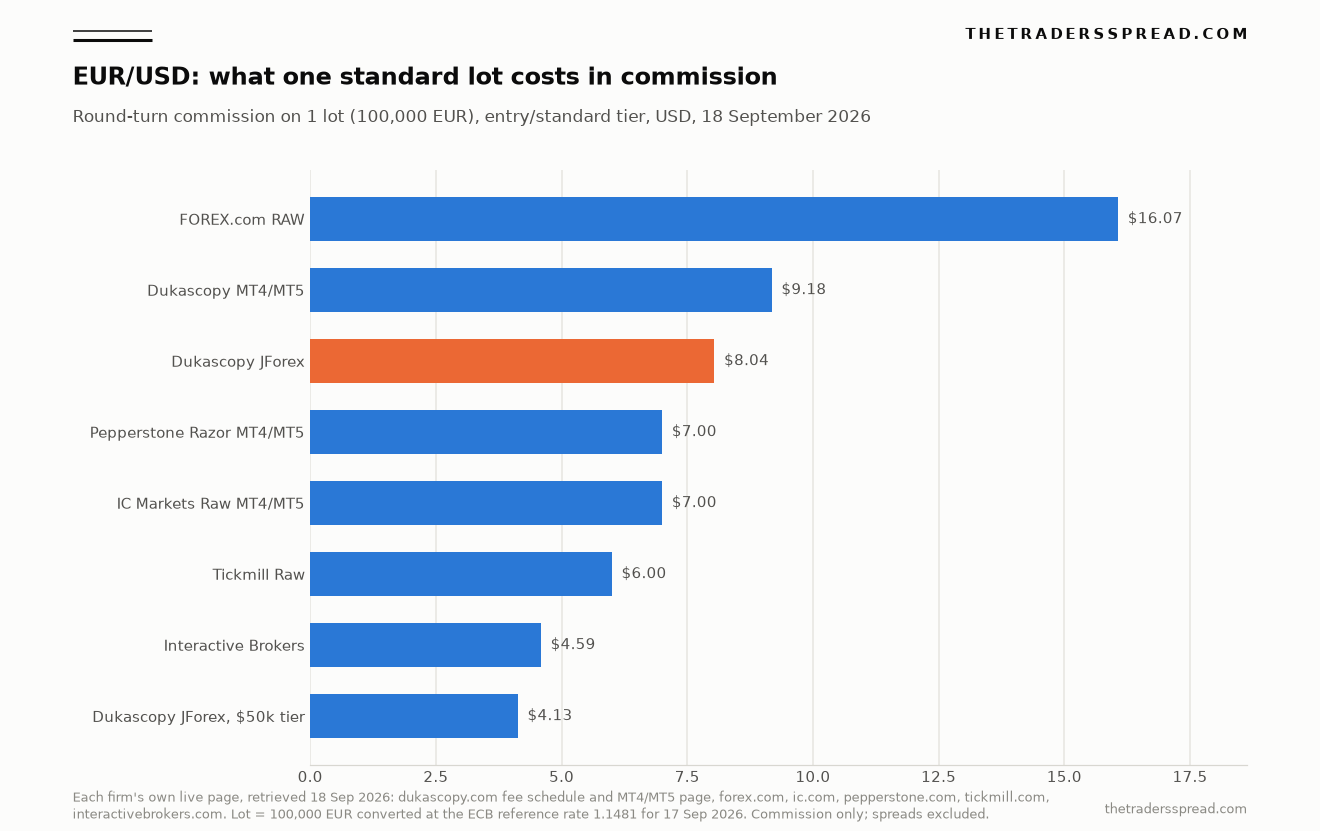
| Firm and entity | Account / platform | Published commission | 1 lot EUR/USD, round turn |
|---|---|---|---|
| Dukascopy Bank SA (Geneva) | JForex, entry tier | 35 per million, each side | EUR 7.00 = USD 8.04 |
| Dukascopy Bank SA (Geneva) | MT4 / MT5, entry tier | 8.00 per round-turn lot | EUR 8.00 = USD 9.18 |
| Dukascopy Bank SA (Geneva) | JForex, USD 50,000 tier | 18 per million, each side | EUR 3.60 = USD 4.13 |
| GAIN Capital Group LLC, dba FOREX.com (StoneX) | RAW Pricing | USD 7 per USD 100k notional, per side | USD 16.07 |
| Raw Trading Ltd, Seychelles FSA SD018 (IC Markets) | Raw Spread, MT4 / MT5 | USD 3.50 per lot per side | USD 7.00 |
| Pepperstone Limited, FCA 684312 | Razor, MT4 / MT5, USD account | USD 7 when position opened | USD 7.00 |
| Tickmill (group site) | Raw, MT4 / MT5 | USD 3 per lot per side | USD 6.00 |
| Interactive Brokers | Spot FX, Tiered | 0.20 basis point of trade value, USD 2.00 minimum | USD 4.59 |
| LMAX Broker Limited, FCA 783200 | LMAX UI / MT4 / MT5 | 0.0025% of notional; per-side not published | not published |
| Saxo Capital Markets UK Ltd, FCA 551422 | SaxoTrader FX spot, Classic | no commission at 1 lot; 0.8 pip minimum spread | none |
| Swissquote (Swiss retail site) | Standard / Premium / Prime | "NO COMMISSIONS"; spreads from 1.7 / 1.4 / 1.1 pips | none |
Two of these firms bill the way Dukascopy does, on notional rather than on lots, and one is far more expensive for it. FOREX.com's RAW Pricing page charges USD 7 per USD 100,000 of notional per side and spells out the consequence itself: 100,000 EUR/USD at 1.1000 is USD 110,000 of notional, so the commission is USD 7.70 a side. At today's reference rate that is USD 8.04 a side, USD 16.07 round turn, double Dukascopy's entry tier. LMAX Global's schedule quotes "0.0025% of the notional traded in the second-named currency", which is USD 25 per million, though it never says "per side", so no round-turn figure can honestly be attributed to it.
Against the flat-fee crowd, Dukascopy's entry tier loses. Tickmill's Raw account page states "$3 per lot per side" and works the same EUR/USD example to USD 6.00 round turn. IC Markets, whose old icmarkets.com URLs now redirect to ic.com, publishes "$3.5 ($7.0 per lot round turn)" for Raw Spread under Raw Trading Ltd. Pepperstone's UK cost page shows "USD 7 when position opened" on a dollar Razor account. Interactive Brokers charges 0.20 basis point of trade value with a USD 2.00 order minimum, or USD 2.30 a side on USD 114,810 of notional. Read as rates per million, IBKR's entry tier is 20 and Dukascopy's is 35: a Dukascopy client needs USD 50,000 on deposit before the bank matches what IBKR quotes on day one.
The spread-only houses sit outside this comparison by design. Neither Swissquote, whose Swiss bank licence we reviewed last month, nor Saxo charges a per-lot commission; both bury the cost in a wider quote, from 1.7 and 0.8 pips. Whether that beats Dukascopy depends on a spread Dukascopy does not publish, the biggest hole in its disclosure.
A broker whose accounts you can actually read
What separates Dukascopy from every other name in that table has nothing to do with pricing. Holding a bank licence, it publishes audited annual reports and half-year statements as PDFs.
The interim balance sheet as at 30 June 2026 shows customer deposits of CHF 234,186,465, up 26.3 per cent from CHF 185,450,929 six months earlier, against total assets of CHF 305.7 million. Client money is arriving. Profit went the other way: the six-month result was CHF 1,505,794, against CHF 3,318,868 in the first half of 2025, a fall of 54.6 per cent, with the operating result down 52.8 per cent.
The revenue mix explains the squeeze and tells a trader something the marketing does not. Result from trading activities came to CHF 8,638,111 in the half, down 25 per cent, while commission income was CHF 2,868,393, up 22.8 per cent. For every franc Dukascopy books in commission it books roughly three from trading activities. The interim statement does not break that line down, and a bank running an ECN alongside a treasury book has several sources inside it; Dukascopy describes SWFX as straight-through and states that it "has no dealing desk and makes no requotes". What the accounts establish is that the volume commission dissected above is a minority of what the business earns.
The balance sheet is conservative to the point of sleepiness. The Annual Report 2025 KM1 table reports total capital of CHF 55.384 million against risk-weighted assets of CHF 298.790 million, a total capital ratio of 18.54 per cent where the Swiss Capital Adequacy Ordinance target is 10.50 per cent. The Basel III leverage ratio is 20.48 per cent and the liquidity coverage ratio, against a regulatory floor of 100, is 1,750 per cent. The ratio slipped from 21.77 per cent a year earlier because risk-weighted assets grew while capital stayed flat.
Protection follows the licence, so it matters which entity holds the money. Swiss deposits are covered by esisuisse to CHF 100,000 per client. The client protection page states that "deposits of the clients of Dukascopy Europe are protected by EU regulation in the amount of EUR 20'000 for each client" — a fifth of the Swiss cover, for someone who arrived through the same brand.
What the pricing pages leave out
Dukascopy Bank SA was founded in Geneva on 2 November 2004 by Andre and Veronika Duka, who the company page says still own 99 per cent of it. FINMA's own list of authorised institutions, downloaded on 18 September 2026, carries it at Genève 15 Aéroport under UID CHE-112.086.322, authorisation type "Bank", supervisory category 5, with none of the register's flags ticked against the row. One nuance: the company page says FINMA regulates it "both as a bank and as a securities firm", and while the list covers 277 banks and securities firms, the authorisation-type field reads only "Bank".
Latvijas Banka's register shows the Riga subsidiary, Dukascopy Europe IBS AS, holding investment-services licence 06.06.08.112/316.1 since 24 November 1997, passported into 25 EEA states. The Japanese FSA's register of financial instruments business operators, current to 31 August 2026, carries the Tokyo arm as Kanto Local Finance Bureau (Kinsho) No. 2408, a Type I operator registered on 8 June 2010. Nothing for the group appeared in Latvijas Banka's sanctions register for 2021 to 2026, though FINMA's warning list could not be queried, so that is not a clean bill. The structure is unusually tidy by the standards of this desk, where ten-licence groups routing retail clients to an offshore contract are common.
The spread disclosure is the weak point, and a serious one for a firm whose pitch is transparency. Dukascopy's average-spreads page is not a table; it is a JavaScript widget served from freeserv.dukascopy.com, and direct requests to that host returned 403 and 204 responses when tested at 07:23 and 07:25 UTC on 18 September 2026. There is no static EUR/USD spread anywhere on the Swiss site, so neither a client nor a reviewer can compare a Dukascopy lot against Swissquote's 1.7 pips or Saxo's 0.8 from published figures. That costs the firm half a point here, exactly as a missing spread did in our XTB review.
RelatedOcta Review 2026: Versustrategy Holds the Global Ticket
Three further charges sit outside the headline grid. Swap-free accounts pay an extra USD 5 per million on currencies and USD 7.5 on metals and CFDs. Clients who appoint an external manager can be charged up to USD 100 per million, nearly three times the retail entry rate. The overnight page is direct about financing: "Dukascopy Bank adds its own carry costs to the rates applied to the clients." Maintenance fees apply after 180 days of inactivity, capped at CHF 100 per client per half-year.
Verdict: what the 3.9 is for
Dukascopy earns 3.9 out of 5 on two rare strengths and loses ground on a common weakness. The strengths are the bank licence and what it forces into the open. No other firm in the table lets a prospective client read a half-year income statement and a capital ratio before funding an account, and 18.54 per cent against a 10.50 per cent target answers the question retail traders most often cannot answer about their broker. The CHF 100,000 esisuisse cover is real money, and the top of the tier ladder is priced like an institutional relationship.
The loss is at the bottom of the ladder, which is where most new accounts sit. A EUR/USD lot at USD 8.04 on JForex, or USD 9.18 on MetaTrader, is more than Tickmill, IC Markets, Pepperstone or Interactive Brokers charge at their standard rates, and the reason it is higher than the published schedule suggests is a currency-denomination rule disclosed only inside a worked example. A firm that publishes its own audited accounts should be able to publish a EUR/USD spread and a plain sentence saying that the dollar column is charged in the base currency of the pair.
The account suits a funded, self-directed trader who values a supervised Swiss balance sheet and either brings USD 50,000 or trades enough volume to reach the 18-per-million tier, where the pricing becomes genuinely hard to beat. It suits algorithmic users who want the JForex API and will measure the spread themselves. It fits less well for a client depositing a few hundred dollars and trading a handful of lots a month, who pays the top of a ladder built for someone else and is offered a rebate that needs 600 lots and a locked account to claim. The gap between those two clients, at the same bank, on the same day, is a factor of seven.
Frequently asked questions
What does one EUR/USD lot actually cost at Dukascopy?
At the entry tier, EUR 3.50 per side and EUR 7.00 round turn on JForex, which is USD 8.04 at the ECB reference rate of 1.1481 for 17 September 2026. On MetaTrader the published figure is 8.00 per round-turn lot, charged in euro on a euro-base pair, so USD 9.18. A 0.5 per cent fee applies on conversion into a non-euro account currency.
Why is a commission quoted in dollars charged in euros?
Because Dukascopy applies the rate to the primary currency of the pair, not to a dollar equivalent. The bank's own Example 2 on the fee schedule takes a 100,000 EUR/USD purchase at a rate of 30 and produces EUR 3.00 before converting to the account currency. On a USD-base pair such as USD/JPY the figures are genuinely dollars; on EUR/USD they are euros, which at current rates is about 15 per cent more.
Is Dukascopy a real bank?
Yes. FINMA's register lists Dukascopy Bank SA at Genève 15 Aéroport with the authorisation type "Bank" and UID CHE-112.086.322, and the bank files audited annual reports anyone can download. esisuisse's own bank search carries it, so deposits are covered to CHF 100,000. Clients booked to Dukascopy Europe IBS AS in Riga get EUR 20,000 instead.
Does Dukascopy publish its spreads?
Not as a static table. The average-spreads page loads a JavaScript widget from freeserv.dukascopy.com, which returned 403 and 204 responses to direct requests on 18 September 2026. That makes an all-in comparison against spread-only firms such as Swissquote or Saxo impossible from published sources, and it is the largest omission in an otherwise detailed disclosure.
How is the business performing?
Customer deposits rose 26.3 per cent in the first half of 2026 to CHF 234.2 million, but six-month profit fell 54.6 per cent to CHF 1,505,794 as the trading result dropped 25 per cent to CHF 8.64 million. Commission income rose 22.8 per cent. Capital and liquidity ratios remain far above requirement.
This review is analysis, not financial advice. Figures come from each firm's own published pages on 18 September 2026 and pricing changes without notice. Trading leveraged foreign exchange and CFDs carries a high risk of loss and your capital is at risk.