
BlackBull Markets prices its ECN Prime account two ways, and both versions sit on its own website. The account comparison table, read on 13 September 2026, lists the Prime commission as US$3.00 per lot, per side. A few clicks away, the trading conditions overview defines the same charge as US$3 per side for every US$100,000 traded. On USD/JPY, where one lot is exactly US$100,000, the two readings agree. On GBP/USD they part company. A standard lot is £100,000, which at the European Central Bank reference rate of 1.3508 on Friday 11 September (via Frankfurter) is US$135,081 of notional. On the overview's formula that lot costs $4.05 a side and $8.10 round turn, 35% more than the table implies. Neither page says which formula the platform bills, and a trader funding a Prime account has no way to tell before the first statement arrives.
The pricing split is the smaller discovery. The larger one is in a 30-page PDF that Black Bull Group Limited, the Auckland company behind the brand, filed with the New Zealand Companies Office on 8 July 2026. BlackBull's support pages call the firm "strictly non-dealing desk". Its audited accounts for the year to 31 March 2026 describe a company that faces clients as principal, while a sister company, Black Bull Trade Limited, takes an equal and opposite derivative against each client trade. The New Zealand entity books no trading profit at all. Its NZ$18.8 million of commission revenue comes from that affiliate. None of the BlackBull web pages we read mentions the arrangement.
- Prime commission is shown as US$3.00 per lot per side in the comparison table and as US$3 per side per US$100,000 traded in the trading conditions overview — blackbull.com, retrieved 13 Sep 2026
- On the notional formula a GBP/USD lot costs $8.10 round turn, against $6.00 on a flat US$3 per lot — The Traders Spread calculation at the ECB rate of 1.3508, 11 Sep 2026
- Commission revenue rose 52.0% to NZ$18,789,341 while profit before tax fell 14.9% to NZ$2,394,627 in the year to 31 March 2026 — Black Bull Group Limited audited accounts (BDO), filed 8 Jul 2026
- Client money held in trust reached NZ$98,951,957 at 31 March 2026, up 85.4% in a year — the same accounts, note 11
- The swap-free admin fee is US$75 per EUR/USD lot at the fifth rollover and every five days after, and US$150 per lot on gold — BlackBull swap-free admin charges page, retrieved 13 Sep 2026
- The group holds an FMA derivatives issuer licence in New Zealand and an FSA Seychelles securities dealer licence (SD045); the September 2026 ASIC licensee dataset contains no Black Bull entity — registers and filings checked 13 Sep 2026
One account, two commission formulas
BlackBull runs three account tiers for most of the world: ECN Standard, ECN Prime and Prime+. All three carry a US$0 minimum deposit, leverage up to 1:500 on forex and metals, swap-free availability and an Equinix London server, according to the comparison page. Standard has no commission and spreads from 0.8 pips. Prime and Prime+ quote spreads from 0.0 pips plus commission, and the page adds that the commission rates apply to FX and metals only.
The inconsistency is not a single stray line. The commissions explained article describes a "fixed commission of $3 per lot". The same comparison page that shows "US$3.00 per lot" also carries an FAQ answer stating that commission "is calculated at US$3 per side for US$100,000 traded", followed by a micro-lot example that reads like a per-lot charge. The trading conditions overview repeats the US$100,000 basis for both Prime and Prime+. Three pages, two formulas, one account. For a USD-base pair the difference is zero. For EUR/USD at 1.1592 it is 48 cents a side. For GBP/USD it is $1.05 a side, or $2.10 on every round-turn lot.
We could not settle the question from a live fill, because this review did not open a funded account. The honest reading is that a Prime trader on EUR- or GBP-base pairs faces somewhere between $6.00 and $8.10 per round-turn lot, and only a trade statement settles which.
Peers make the ambiguity easier to judge, because most of them state their basis. IC Markets' Australian account overview (International Capital Markets Pty Ltd, ASIC licence 335692), retrieved 13 September, prices its cTrader and TradingView Raw Spread account at $3.0 per USD 100k per side and labels the column that way, while its MetaTrader Raw account charges $3.5 per lot per side; our IC Markets review worked through the same notional arithmetic. Pepperstone's Australian costs page (Pepperstone Group Limited, ASIC), retrieved the same day, quotes Razor commission from USD 3.50 per lot per side on MT4 and MT5, with cTrader at 6 USD round turn; see our Pepperstone review for the AUD version. Tickmill's Raw account page, retrieved 13 September, charges $3 per side per lot and gives a worked example: one EUR/USD lot of 100,000 EUR costs 3 USD a side (our Tickmill review covers the rest of that account). Fusion Markets' Zero account page, retrieved the same day, charges $2.25 per side per standard lot, the cheapest list price in this set; our Fusion Markets review explains which entity sits behind it.
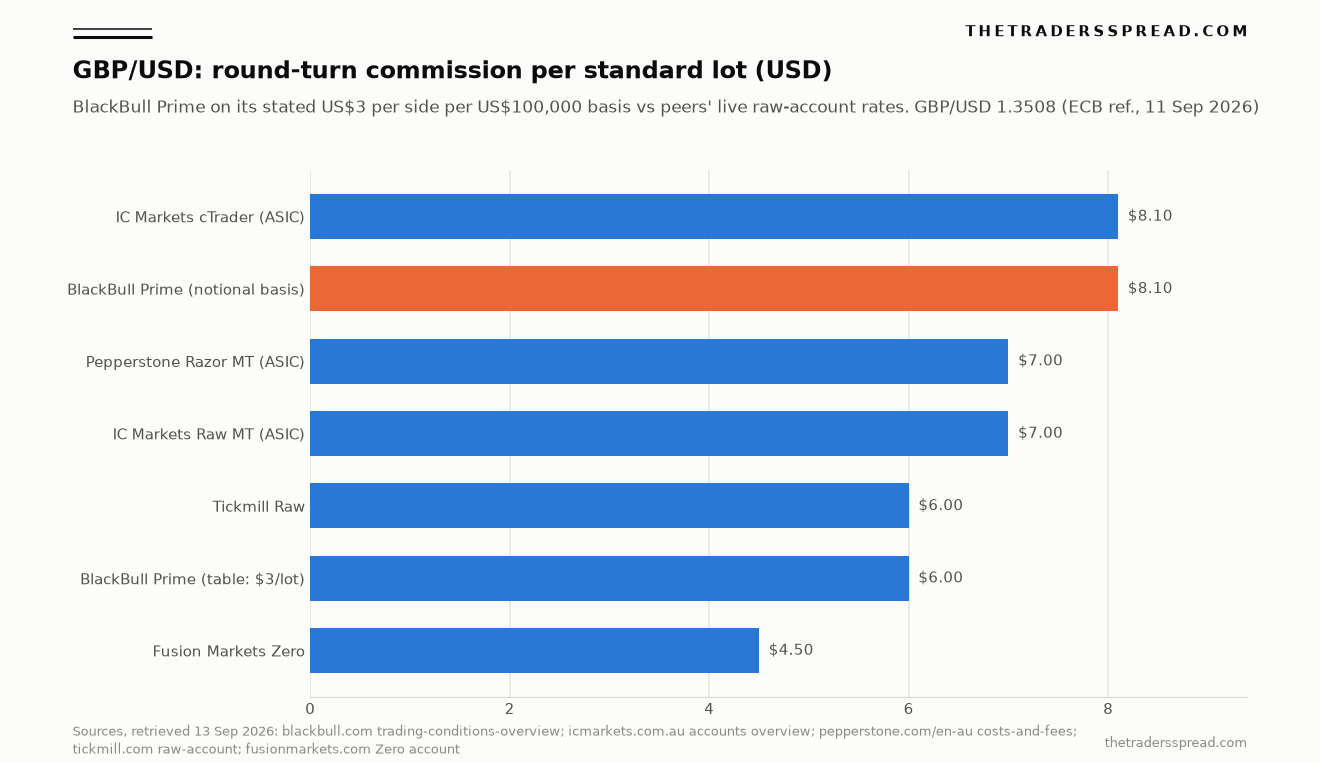
| Broker and account (platform, entity) | Stated commission | Basis | GBP/USD round turn per lot |
|---|---|---|---|
| BlackBull ECN Prime (all platforms) | US$3.00 per side | Per US$100,000 (overview) or per lot (table) | $8.10 or $6.00 |
| IC Markets Raw, cTrader/TradingView (ASIC) | $3.00 per side | Per USD 100k notional | $8.10 |
| IC Markets Raw, MetaTrader (ASIC) | $3.50 per side | Per lot | $7.00 |
| Pepperstone Razor, MT4/MT5 USD account (ASIC) | USD 3.50 per side | Per lot | $7.00 |
| Tickmill Raw (tickmill.com) | $3.00 per side | Per lot of 100,000 base units | $6.00 |
| Fusion Markets Zero (fusionmarkets.com) | $2.25 per side | Per standard lot | $4.50 |
Commission only, spreads excluded. All figures read from each broker's live page on 13 September 2026; GBP/USD converted at the ECB reference rate for 11 September.
Prime+ is where BlackBull claims its lowest price. The commissions article calls it "an equivalent commission of $2 per lot". The Prime+ page shows how that number is reached: a monthly rebate, paid per round turn on FX and metals, of $1 for 200 to 500 lots, $1.50 for 500 to 1,000 lots and $2 above 1,000 lots, with a Diamond tier from 5,000 lots priced on request. Only a trader clearing 1,000 lots a month gets to the $2 figure. At 300 lots a month the net cost is $5 per round turn on the flat reading, which is still dearer than Fusion's list price.
Who takes the other side of a BlackBull trade?
The ECN execution page says BlackBull matches orders electronically, and the trading conditions overview says the firm offers only ECN and straight-through processing, "which both prevent this practice and conflicts of interest". The audited accounts describe the plumbing differently.
BDO Audit Pty Ltd signed the report in Sydney on 21 May 2026, with Tim Aman, Director at BDO Audit Pty Ltd, as engagement partner. Its key audit matter states that the group entered into an arrangement in a principal capacity with Black Bull Trade Limited "whereby the related party accepted equal and opposite positions for client trading activity". Client gains and losses were therefore fully offset, and the group realised no net trading income. The auditor flagged the related-party revenue and balances as a key audit matter because of their size and "the complexity associated with the back-to-back derivative arrangement". The 2025 accounts explain how the NZ company is paid for this: commission revenue is a percentage of the net profit Black Bull Trade earns from trading with the group and hedging those trades with external liquidity providers.
Back-to-back structures are common among CFD groups, and an affiliate that hedges every ticket with outside banks behaves much like a bridge. The accounts do not say what share of client flow Black Bull Trade offsets externally, or how much it keeps. What they do establish is that the company clients face is paid out of an affiliate's trading profit, and that the affiliate sits on the other side of each trade. That is a group-level risk book, whatever the execution is called on the order ticket.
Black Bull Trade Limited is also the entity BlackBull's legal page names for share investing (FSP1002113 in the site footer), although the same page prints the parent's FSP403326 above that section.
An Auckland licence and a Mahé contract
Black Bull Group Limited is company 5463921, incorporated on 18 September 2014 and wholly owned by Black Bull Global Limited, according to the Companies Office record fetched on 13 September. Its three directors are Michael Walker, a director since incorporation, Selwyn Loekman (appointed December 2017) and Simon Botherway (appointed March 2023). BlackBull's entity explainer says the company is licensed by the Financial Markets Authority as a derivatives issuer. The FMA website returned a Cloudflare challenge to every request from this host, so we could not read the licence entry itself. The audited accounts corroborate it: the capital note says the company complied with the Standard Conditions for derivatives issuer licences throughout the year, reporting net tangible assets of NZ$9,140,257 against a floor of the greater of NZ$1 million or 10% of average revenue. Oddly, BlackBull's own compliance page mentions only the FSP registration and the Financial Services Complaints Limited dispute scheme, which undersells the licence.
The New Zealand entity primarily serves New Zealand residents. Everyone else eligible signs with BBG Limited, a Seychelles company (number 857010-1) that BlackBull says holds FSA licence SD045. The FSA Seychelles capital-markets register, read on 13 September, lists BBG Limited under securities dealers with the trade name Black Bull Markets. BlackBull's complaints page gives a +248 Seychelles phone number and names the FSA as the escalation route. The pattern is familiar from our ThinkMarkets review: the headline licence and the contract most clients sign are different things.
There is no Australian, British or EU licence behind the brand. The ASIC AFS licensee dataset for September 2026, roughly 6,500 licensees, contains no entity with "Black Bull" in its name, yet BlackBull's help centre lists a local bank transfer option for Australia. Companies House shows Black Bull Group UK Limited, incorporated 23 April 2015, with Michael Gray Walker as director and a business-support SIC code; the group accounts describe it as a payment clearing subsidiary. The FCA register is a JavaScript application we could not query, so its FCA status is unverified. The site footer says the offer is not intended for residents of the EU, the UK or India, even though a second table on the comparison page advertises local INR payments. The restricted list excludes the US, Canada and Japan.
Where NZ$98.95 million of client cash sits
BlackBull says client funds sit in segregated accounts with ANZ Bank New Zealand. The accounts agree and add the legal basis: cash designated as client funds is held separately in trust under the Financial Markets Conduct Act 2013. That balance was NZ$98,951,957 at 31 March 2026, against NZ$53,366,889 a year earlier.
The liability side is less tidy. The balance sheet records NZ$13,694,793 of client funds owed directly to clients, plus related-party payables of NZ$91,366,891. Note 24.2 splits the gross figure into NZ$69,655,693 of "client funds payable" and a NZ$37,028,661 shareholder loan, both owed to Black Bull Global Limited, interest-free and repayable on demand. The notes do not say which clients the parent-level funds belong to. Against those balances the company's net assets were NZ$9,669,103, so related-party payables stood at 9.4 times equity.
Income grew 29.9% to NZ$41.2 million, yet profit before tax fell. The main reason is the reseller fee paid to the parent, which the 2025 accounts describe as payment for use of Black Bull Global's intellectual property; it rose 98.0% to NZ$10,893,845. Employee costs reached NZ$8.6 million and platform costs NZ$7.4 million. The NZ company is profitable, audited and above its licence capital floor, but it is a thin operating shell compared with the cash that passes through it.
What the commission line leaves out
Swap-free accounts are available at BlackBull's discretion to residents of 22 listed countries (one of them, Algeria, also sits on the restricted list), and they are not free. Under a schedule applied to all positions open on or after 13 October 2025, the admin charges page levies a fee per position at the fifth rollover and every five days after, weekends included. EUR/USD costs US$75 per lot, GBP/USD US$20, USD/JPY and gold US$150, GBP/CHF US$170, and the US 500 CFD US$10. A ten-night EUR/USD hold therefore costs US$150 per lot, which is more than 20 round-turn commissions on the Prime account.
Withdrawals cost US$5 per request, according to the fees page; Prime+ members are exempt. Deposits are free from BlackBull's side, though the page warns that Australian card providers add 2.5%. There is no inactivity fee.
Stop-out rules are the other inconsistency. The margin page puts the margin call at 70% and the stop-out at 50%, matching the trading conditions overview. The second table on the comparison page shows 50% and 20%. A trader sizing positions to the looser figure would be closed out much earlier than expected. Leverage runs to 1:500 on forex and metals, while index CFDs such as the Nasdaq contract carry a fixed 1:100. MT4, MT5, cTrader and TradingView are available on every account type.
RelatedTitan FX Commissions Contradict Zero Advertisement
Verdict: priced like its peers, disclosed less clearly
We rate BlackBull Markets 3.3 out of 5. On USD-base pairs and gold the Prime account costs US$6 per round-turn lot, level with Tickmill and below the MetaTrader tiers at IC Markets and Pepperstone. On EUR- and GBP-base pairs its own overview puts the charge at $6.96 and $8.10, which would make it one of the dearer raw accounts in our peer set. The problem is less the number than the fact that three BlackBull pages define it two ways.
The broker suits New Zealand residents best. They get the FMA-licensed entity, trust accounts at ANZ under the Financial Markets Conduct Act, and access to an independent dispute scheme. It also suits traders who want TradingView, cTrader and MetaTrader under one login, and swap-free traders who close within four nights.
It suits less well anyone outside New Zealand who assumes the Auckland licence covers them: their contract is with a Seychelles securities dealer. Swap-free swing traders face fees that dwarf the commission. And anyone who takes "strictly non-dealing desk" as a statement about the whole group will find the audited note on Black Bull Trade hard to square with it.
What would change the rating: a single published commission definition with worked examples per pair, which could lift it to 3.8; disclosure of how much client flow Black Bull Trade hedges externally; and an FMA register entry we can read directly. A move to charge the notional rate on the Standard account, or any adverse FSA Seychelles action against BBG Limited, would push it below 3.
BlackBull Markets FAQ
Is BlackBull Markets regulated?
Partly, depending on where you live. Black Bull Group Limited holds a Financial Markets Authority derivatives issuer licence in New Zealand, confirmed by its audited capital note, and mainly serves New Zealand clients. International clients contract with BBG Limited, listed as a securities dealer by the Financial Services Authority of Seychelles. We found no ASIC, FCA or EU licence for the brand on 13 September 2026.
How much commission does the BlackBull Prime account charge?
BlackBull states US$3 per side, but its pages disagree on the basis. The comparison table says per lot; the trading conditions overview says per US$100,000 traded. On USD-base pairs both give US$6 round turn. On GBP/USD at 1.3508 the notional formula gives $8.10 per lot, and on EUR/USD at 1.1592 it gives $6.96.
Is BlackBull Markets a true ECN broker?
BlackBull markets itself as ECN and strictly non-dealing desk. Its audited 2026 accounts show the New Zealand entity faces clients as principal, with the affiliate Black Bull Trade Limited taking an equal and opposite position on each client trade and hedging with outside liquidity providers. The accounts do not disclose how much of that flow is offset externally.
Are BlackBull swap-free accounts free of charges?
No. A per-position admin fee applies from the fifth rollover and recurs every five days, with weekends counted. It is US$75 per lot on EUR/USD, US$20 on GBP/USD, and US$150 on USD/JPY and gold, prorated for smaller sizes. Positions closed before the fifth rollover avoid it, according to BlackBull's admin charges page.
Where does BlackBull keep client money?
In segregated trust accounts with ANZ Bank New Zealand, held under the Financial Markets Conduct Act 2013, according to BlackBull and its audited accounts. The trust balance was NZ$98.95 million at 31 March 2026. The same accounts record NZ$69.66 million of client funds payable to the parent company, without saying which clients those funds relate to.
Disclaimer
This review is independent analysis for information only and is not investment advice or a recommendation to open an account with any broker. CFDs and leveraged forex are complex products and carry a high risk of losing money rapidly; you can lose more than your initial deposit on some accounts. Broker fees, licences and conditions change: check the provider's current documents before trading. Capital is at risk.