
No, Axi does not charge $4.50 round turn on its Pro account. It charges $4.50, or $7.00, or $3.50, and every one of those numbers was live on axi.com on 4 September 2026, printed by Axi, about an account called Pro. The retail page at axi.com/uk/trading-accounts says "$4.5 round trip". The Australian page says "$7 round trip". The professional-client page at axi.com/uk/trading-accounts/professional-account also says $7 for Pro, and offers a cheaper Elite tier at $3.50 that needs $25,000 to open. None of the four pages tells a visitor which figure applies to them, because the variable that decides it is not the account name at all. It is the client classification you hold and the legal entity that ends up on your contract.
That produces an inversion nobody markets. In the United Kingdom, professional-client status is sold as an upgrade: 400:1 leverage instead of 30:1, 500:1 on the Elite tier, and what Axi's own professional page calls "50% lower commissions". Read the two tables side by side and the promise inverts. A retail trader on Pro pays $4.50 round turn. Convert to professional and stay on Pro, and the same trade costs $7.00, up 56%. The 50% saving is measured against the professional Pro rate, not the retail rate they were paying. Only a professional who also funds $25,000 into Elite reaches $3.50, a 22% cut on the retail price rather than a halving. The upgrade that promises cheaper trading is dearer for anyone taking it without a five-figure balance.
Key facts, all read on 4 September 2026
- Retail Pro commission is $4.50 round trip per standard lot; the professional-client Pro rate is $7.00 and Elite is $3.50 with a $25,000 minimum — axi.com/uk/trading-accounts and axi.com/uk/trading-accounts/professional-account, read 4 September 2026.
- The Standard account carries no commission and a headline EUR/USD spread of 0.68 pips for retail clients, but "from 0.7 pips" on the professional page — same broker, same pair, two numbers — Axi trading-accounts pages, read 4 September 2026.
- Axi's binding Retail Client Product Schedule prices the Pro commission in your account currency: USD $4.50, GBP £3.50, EUR €4.00, JPY ¥500, CHF 4.50, NZD $7.00 — AxiCorp Retail Client MT4 Product Schedule, effective 29 September 2025.
- Retail leverage is capped at 30:1 in the UK and Australia and runs to 400:1 for professional clients; the offshore schedule sets liquidation at 20% against 50% at the regulated entities — Axi Product Schedules, effective 14 April 2026 and 6 July 2026.
- Inactivity costs US$10 a month (or ¥1,000, or zł40) after twelve months with funds but no trades, charged until the balance is gone — Axi Product Schedules, read 4 September 2026.
- Axi's UK risk warning puts the share of losing retail accounts at 66.36%; the Cyprus entity's own figure is 67.24% — axi.com/uk and axi.com/eu, read 4 September 2026.
- Card and e-wallet deposits above US$50,000 in a month attract a 3.0% fee; withdrawals under US$50 that do not clear the account attract US$25 — Axi Product Schedules, read 4 September 2026.
The cheapest bar on the board is the least verifiable
Ranked against nine competitor products whose schedules we read the same morning, Axi's retail Pro rate sits joint-first, and that deserves saying plainly before anything else: on advertised commission, a US-dollar Axi Pro client pays 36% less than a Pepperstone Razor, IC Markets Raw or Eightcap Raw client.
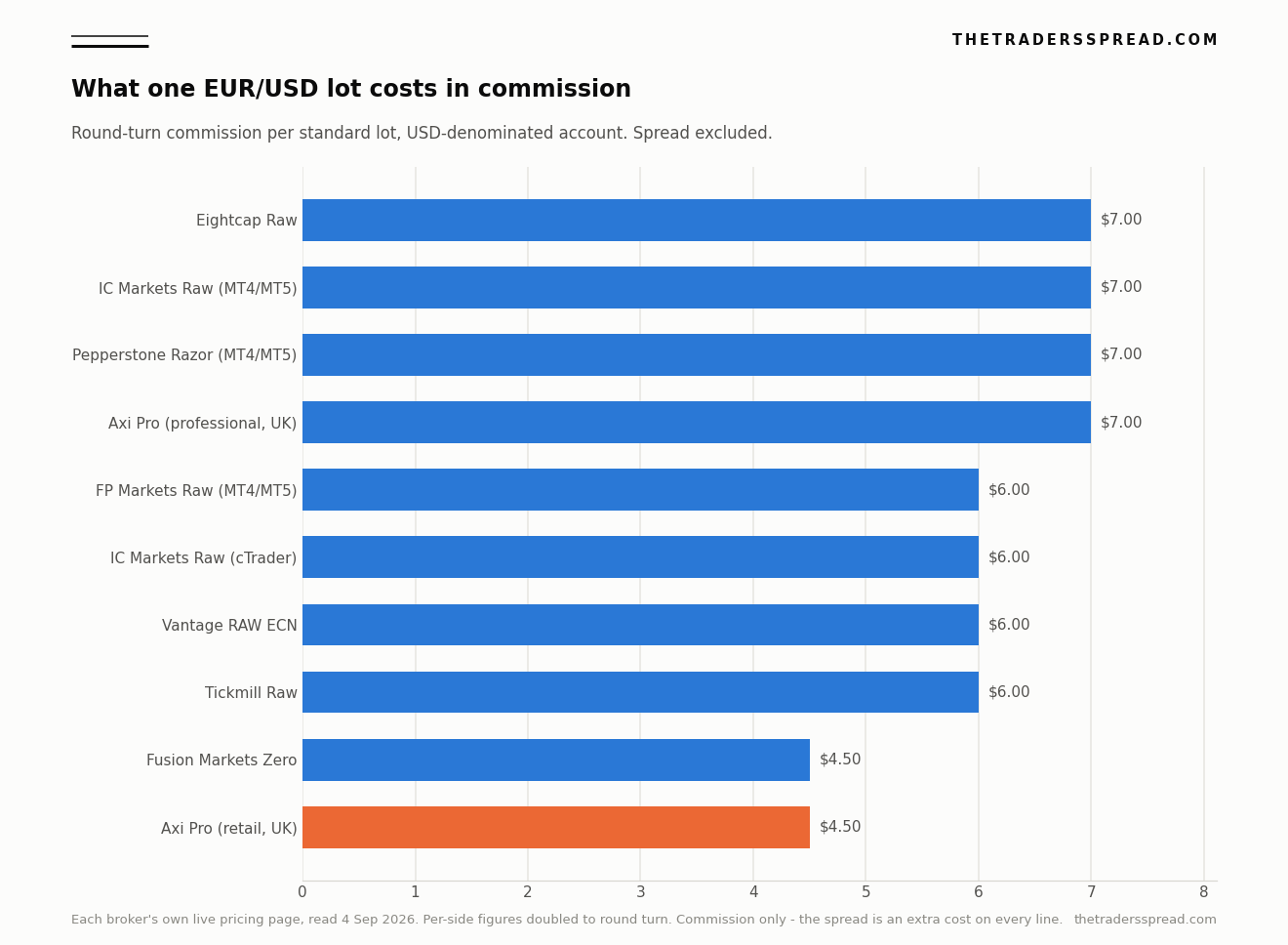
Two things about that chart matter more than the ranking. The first is what it excludes. Only one broker on it publishes a typical EUR/USD spread, and IC Markets contradicts itself doing so: its account page says "average on EURUSD being 0.1 pips" while its own spreads table prints 0.01. Everyone else publishes "from 0.0", which is a floor, not a cost. Adding a "from 0.0" spread to a commission compares a real number to an aspiration, which is why this chart shows commission only.
The second is that Axi's bar is the only one on the board that Axi's own documents dispute.
| Product, USD account | Published unit | Round turn, 1 lot | Source page |
|---|---|---|---|
| Axi Pro (retail) | "$4.5 round trip" | $4.50 | axi.com/uk/trading-accounts |
| Fusion Markets Zero | "USD 4.50 commission", $2.25 per side | $4.50 | fusionmarkets.com/Trading/Zero-Trading-Account |
| Tickmill Raw | "$3 per lot per side" | $6.00 | tickmill.com/trading/raw-account |
| Vantage RAW ECN | "USD $3 (round turn $6)" | $6.00 | vantagemarkets.com/trading/fees/commission |
| IC Markets Raw, cTrader | "$3.00 per side per 100,000 USD traded" | $6.00 | ic.com/global/en/trading-pricing/spreads |
| FP Markets Raw, MT4/MT5 | "3 USD" per side | $6.00 | fpmarkets.com/mt4-5-fees-charges |
| Axi Pro (professional) | "$7 round trip" | $7.00 | axi.com/uk/trading-accounts/professional-account |
| Pepperstone Razor, MT4/MT5 | "USD$3.50 per lot, per side" | $7.00 | pepperstone.com/en-au/trading/costs-and-fees |
| IC Markets Raw, MT4/MT5 | "USD 3.50 (USD 7.0 round turn)" | $7.00 | ic.com/global/en/trading-accounts/raw-spread-account |
| Eightcap Raw | "$3.50 ... each side per standard lot" | $7.00 | eightcap.com/en/account-types |
Every figure above was read from the broker's own live page on 4 September 2026. Per-side figures have been doubled; round-turn figures are left alone. That normalisation is not pedantry. Quote Tickmill Raw at $3.00 and Pepperstone Razor at $7.00 in one sentence and a missing unit has manufactured a 133% error, the commonest defect in broker comparisons and why our Tickmill review labours the point.
Your account currency moves the price by three quarters
Axi's marketing prices the Pro account in dollars. Its Product Schedule does not. The schedule sets a separate commission for each account denomination, and the spread between them is far wider than the spread between Axi and its competitors.
| Account currency | Schedule commission, 1 standard contract | USD equivalent | vs USD account |
|---|---|---|---|
| JPY | ¥500 | $3.21 | −29% |
| AUD | $4.50 | $3.24 | −28% |
| NZD | $7.00 | $4.11 | −9% |
| CAD | $6.00 | $4.35 | −3% |
| HKD | $35.00 | $4.46 | −1% |
| USD | $4.50 | $4.50 | — |
| PLN | zł17.00 | $4.56 | +1% |
| EUR | €4.00 | $4.65 | +3% |
| GBP | £3.50 | $4.72 | +5% |
| SGD | $6.00 | $4.73 | +5% |
| CHF | 4.50 | $5.57 | +24% |
Commissions from the AxiCorp Retail Client MT4 Product Schedule effective 29 September 2025, converted at the European Central Bank euro reference rates for 3 September 2026, the most recent business day, from the ECB's own daily feed. A Swiss-franc Axi account pays 74% more commission than a yen account on the identical lot. The trader chose that when they picked a funding currency, without being told it was a pricing decision.
Fusion Markets does it differently: its support pages state that commission is charged proportionally to notional volume in the base currency of the pair and then converted, so a EUR/USD lot is billed in euros whatever the account holds. Axi bills in the account currency at a rate fixed per currency. Neither approach is wrong. Neither is visible on the page where a trader picks their denomination.
Which Axi actually ends up on the contract
"Axi" is not a company. Axi's own DP World Tour announcement of 30 July 2026 describes it as "a brand name encompassing multiple entities within the Axi Group", which is unusually candid and worth taking literally.
Reading the footers and legal-document pages on 4 September 2026, the group presents at least five faces. The UK path and the international path both served the same footer: Axi Financial Services (UK) Limited, registered in England and Wales under 6050593, authorised by the Financial Conduct Authority under firm reference number 466201, registered at 1 Finsbury Market, London. The Australian and New Zealand path is AxiCorp Financial Services Pty Ltd, holding AFS licence 318232 and New Zealand FSP 518226; ABN Lookup returns it as an active North Sydney company under ABN 85 127 606 348. The European path is the one that will surprise people: axi.com/eu carries the line "Axi is a trading name of Solaris EMEA Ltd", a Cyprus company registered as HE376148 under CySEC licence 433/23, whose client agreement lives on a different domain at axi-solaris.com. Dubai gets a DIFC branch of the Australian company. And the offshore Product Schedule, effective 6 July 2026, is issued by AxiTrader LLC, registration 4303 LLC 2025 in St Vincent and the Grenadines.
The offshore Product Disclosure Statement still names a different company: AxiTrader Limited, BCN 25417 BC 2019, in a document dated 8 August 2022. Four years is a long time for a disclosure to sit unrefreshed while the entity issuing the schedule changed underneath it.
What follows from the entity is not cosmetic.
- Axi Financial Services (UK) Limited. FCA-authorised. Negative balance protection for retail clients, Financial Services Compensation Scheme cover to £85,000 for retail and most professional clients, Financial Ombudsman Service access. Retail leverage 30:1.
- AxiCorp Financial Services Pty Ltd. AFS licence 318232, plus FSP518226 and a live FMA derivatives issuer licence. Negative balance protection for Australian and New Zealand retail clients, but the dispute forums differ: Australians reach AFCA, New Zealanders reach the Financial Dispute Resolution Service. Australia operates no compensation scheme equivalent to the FSCS, so a failure leaves clients with the trust account and the liquidator.
- Solaris EMEA Ltd. CySEC-supervised under licence 433/23. The Cyprus regulator's own list of licensed investment firms carries it as SOLARIS EMEA LIMITED, which is to say a search of that register for the word Axi returns nothing at all.
- AxiCorp Financial Services Pty Ltd (DIFC Branch). DFSA reference F003742, licensed since April 2018 and endorsed for retail clients, but its only registered financial service is arranging deals in investments. It does not deal as principal in Dubai. Complaints route back to the Australian ombudsman in Melbourne.
- AxiTrader LLC. Registered, not licensed. Its own disclosure says so in terms: "The FSA does not regulate, monitor, supervise or licence margin FX and contracts for difference issuers. The FSA has not reviewed or approved this PDS." Disputes go to the Financial Commission, a private industry body. The schedule carries no negative balance protection clause and lists "interest applied to negative balances" as a chargeable item.
The 20% liquidation level in the offshore schedule, against 50% everywhere else, is the sharpest expression of the difference. A regulated Axi account is closed out with half the margin still standing. The offshore account is allowed to burn down to a fifth before Axi intervenes, which is more rope and, on a gapping move, more distance to fall through.
The 2020 suspension, and what ASIC required afterwards
Axi's Australian licence has been suspended once, and the detail matters more than the headline.
On 2 January 2020 ASIC suspended AFS licence 318 232 for four months. The regulator's own release lists what it found: failures to "pay client money into an account with an Australian authorised deposit-taking institution", to lodge product disclosure statement in-use notices, to comply with the ASIC derivative transaction rules and the client money reporting rules, and to lodge financial statements by the due date, plus a breach of the licence condition on compliance measures.
AxiCorp took it to the Administrative Appeals Tribunal, won a stay, and kept trading throughout. The matter closed in March 2021 on consent orders. ASIC imposed additional licence conditions requiring an independent expert review of AxiCorp's controls, a floor of three full-time-equivalent compliance staff until the end of 2022, and a bar on appointing corporate authorised representatives over the same window. On 9 March 2021 the Tribunal set the suspension aside. Nothing further has followed in the five years since.
Client money handling was the first item on ASIC's list. A firm that got that wrong and then rebuilt its compliance function under an expert review is not the same risk as one that never had the problem, and readers can price that difference themselves. It is absent from most of the reviews ranking Axi on commission.
What the sponsorship budget is telling you
Axi has spent 2026 buying reach. In July it became the DP World Tour's Official Online Trading Partner, and Rajesh Yohannan, Chief Executive Officer at Axi, framed it in performance terms: "Golf and trading share the same DNA: success comes down to preparation, discipline, and the fine margins that separate good from great."
The reply from the other side of the deal is more revealing about who is being sold to. Guy Kinnings, CEO of the DP World Tour, described the audience Axi bought: "Our audience is affluent, financially savvy and come from all four corners of the globe, giving Axi the perfect marketing platform to build from."
Affluent and globally distributed is exactly the profile that gets steered toward professional classification, where the commission is $7.00 and negative balance protection ends. Axi's own Elite page states it in one line: "Negative balance protection is not available for professional accounts." The broker is not hiding that. It is printing it on a different page from the one carrying the price, which is the same pattern we found at Fusion Markets and FP Markets.
The costs that never reach a comparison table
Three charges in Axi's schedules do more damage to a small account than any commission line.
Inactivity is the first. Twelve months with funds and no trades triggers US$10 a month, deducted until the balance reaches zero, at which point Axi may close the account. Offshore, a zero-balance dormant account can go after six months rather than the twenty-four the Australian and Dubai schedules allow. Withdrawals are the second: free above US$50 or for the full balance, US$25 otherwise, so a partial withdrawal of $60 nets $35. Card and other non-bank deposits above US$50,000 in a month attract 3.0%, while bank transfers stay free at any size.
RelatedNAGA Review 2026: NAGA Capital's 0.9 Is Not the EU 1
Financing dwarfs all of them for anyone holding overnight. Axi's UK fees page works a GBP/USD example at −6.50 points on a standard lot, which is $65 a night and $325 over five nights. That is 72 round turns of Pro commission consumed in a working week by one held position, and no comparison built on commissions alone will surface it. Our Eightcap review hit the same wall from the other side, with a broker publishing no swap rates at all. Axi at least publishes the method.
The verdict
Rated 3.5 out of 5. The pricing is genuinely competitive, the FCA and ASIC entities carry real protections, and on advertised commission the retail Pro account sits at the cheap end of a field of ten. What costs Axi a point and a half is that a prospective client cannot determine their own price from Axi's public pages without knowing in advance which of five entities will hold their money and which client classification they will be given.
The profile it fits: a retail client in the United Kingdom or Australia, funding in the local currency, trading intraday on MT4, who wants FCA or ASIC protection and a commission that beats most of the raw-spread field. On a UK retail Pro account at $4.50 round turn with 30:1 leverage and FSCS cover, the paperwork matches the marketing.
The profile it does not fit: anyone being walked toward professional classification. The economics reverse. Commission rises 56% to $7.00 unless $25,000 goes into Elite, leverage jumps to 400:1 or 500:1, and negative balance protection disappears — three changes that each raise risk, presented as an upgrade. Anyone being onboarded to AxiTrader LLC in St Vincent and the Grenadines is in a different position again, with a 20% liquidation level, no negative balance protection clause, and a private industry body rather than an ombudsman at the end of a dispute.
What would move the rating up: one published price list naming the entity, the client classification and the account currency in a single table, and an offshore disclosure document that names the company actually issuing the schedule. What would move it down: evidence that clients in FCA or ASIC jurisdictions are being routed offshore.
FAQ
Is Axi regulated?
Yes, by several, and which one covers a client depends on the entity they onboard to. Axi Financial Services (UK) Limited holds FCA firm reference number 466201. AxiCorp Financial Services Pty Ltd holds AFS licence 318232 and New Zealand FSP 518226. The European business trades as Solaris EMEA Ltd under CySEC licence 433/23. AxiTrader LLC is registered, not licensed, in St Vincent and the Grenadines.
What does Axi actually charge on EUR/USD?
On the retail Pro account with a US-dollar balance, $4.50 round trip per standard lot plus the spread, which Axi advertises as starting from 0.0 pips and does not publish as a typical value. On the professional Pro account the commission is $7.00. On the Standard account there is no commission and the advertised EUR/USD spread starts at 0.68 pips.
Does Axi offer negative balance protection?
For retail clients of the UK, Australian, New Zealand and Dubai entities, yes, and each Product Schedule says so explicitly. Professional clients do not get it: Axi's Elite page states that "negative balance protection is not available for professional accounts". The offshore AxiTrader LLC schedule contains no negative balance protection clause and lists interest on negative balances as a chargeable item.
How does Axi compare with Pepperstone and IC Markets on cost?
On advertised commission for a US-dollar account, Axi's retail Pro rate of $4.50 round turn is 36% below Pepperstone Razor and IC Markets Raw on MT4 and MT5, both at $7.00, and 25% below IC Markets on cTrader at $6.00. The comparison covers commission only. None of the three publishes a typical EUR/USD spread, so total cost cannot be ranked from public data.
Is there an inactivity fee?
Yes. After twelve continuous months with funds in the account but no trading activity and no open positions, Axi charges US$10 a month, or the equivalent in the account currency, and continues charging monthly. Yen accounts pay ¥1,000, Hong Kong dollar accounts HK$80, Polish zloty accounts zł40. Axi reserves the right to close a zero-balance inactive account without further notice.
This review is analysis and information, not financial advice, and not a recommendation to open an account with Axi or any broker named in it. Every figure was read from a primary source on the date stated, and brokers change their schedules without notice. CFDs are leveraged products and most retail accounts lose money; Axi's own UK disclosure puts that at 66.36%. Capital is at risk. The relevant Product Disclosure Statement and Product Schedule are worth reading in full, alongside independent advice.