
Uranium did not stall in 2026. The claim that it did rests on a category error: reading a thinly traded discretionary market as though it were the price of the commodity. Uranium has two prices, and only one of them has gone sideways. The spot price for U3O8 sits near US$89.72 per pound against a long-term contract price of US$95.50 — and the term price, the one utilities actually sign, has not printed a single down month in 2026. The gap between those two numbers is the whole story, and most coverage of this market never mentions that a second number exists.
Here is the part that is not being said anywhere else. In December 2023, uranium spot traded 33.8% above the term price; by January 2024 the premium reached 39.2%. Today that relationship has inverted — term now sits 10.6% above the July spot print. That flip is not sentiment. It is mechanical, and it can be traced to one balance sheet. The Sprott Physical Uranium Trust, the vehicle that supplied the marginal spot bid through the 2021–2023 melt-up, closed on 28 August at a 5.70% discount to net asset value. A closed-end physical trust trading below NAV cannot issue units at the market, and a trust that cannot issue units cannot buy pounds. Remove the marginal buyer from a market that traded just 55.3 million pounds all last year and spot stops discovering anything. Utilities, meanwhile, keep contracting off-market — at prices that keep going up.
Key facts
- Uranium spot is marked at US$89.72/lb as of 28 August 2026, derived from the Sprott Physical Uranium Trust's own holdings: US$7,330,090,268 of U3O8 across 81,697,348 pounds — Sprott, daily pricing, 28 August 2026.
- The industry-average month-end spot price was US$86.38/lb on 31 July 2026 and the long-term price US$95.50/lb — Cameco, from UxC and TradeTech month-end publications.
- The term price has risen 7.3% in 2026 (US$89.00 to US$95.50) with zero down months. Spot has posted three down months over the same seven prints — same source.
- Spot-market volume has fallen 46% since 2021, from 102.41 million pounds to 55.3 million, while long-term contracting rose 61.6% to 116 million pounds — Cameco supply and demand disclosure, citing UxC.
- Over the last five years roughly 589 million pounds were contracted long-term against 815 million pounds consumed in reactors — a 226-million-pound coverage shortfall — and UxC puts cumulative uncovered requirements at about 3.1 billion pounds to the end of 2045 — same source.
- Uranium equities have de-rated hard against that backdrop: the Global X Uranium ETF (URA) closed at US$45.57 on 28 August 2026, down 5.79% on the day and 26% below its late-January high — stockanalysis.com, 28 August 2026.
The two-price market, and why only one of them is real
Uranium is not a screen-traded commodity in any meaningful size, and there is no exchange where a utility can lift an offer for a year of fuel. Cameco is explicit about the structure in its own contracting framework disclosure: "Most run-rate fuel requirements in our industry are procured under long-term contracts. The spot market is thinly traded, where utilities tend to buy small, discretionary volumes."
That sentence is doing more work than it looks. It means the headline uranium price quoted in most market commentary is the clearing price of the residual, optional slice of demand — not the price at which the world's reactors are actually fuelled. The published spot number is a monthly industry average computed by two consultancies, UxC and TradeTech, from privately negotiated transactions. Cameco publishes the composite; it does not set it.
The mechanism that inverted the spot-term relationship is a liquidity mechanism, not a fundamental one. Between 2021 and 2023 the Sprott trust raised equity at a premium to NAV and converted it directly into physical pounds, absorbing a large fraction of available spot material and dragging the published price from US$32 to US$91. When the units fell to a discount, the machine stopped. The trust still holds 81,697,348 pounds — roughly 1.48 times the entire volume the spot market traded in all of 2025 — but at a 5.70% discount it is a static warehouse, not a bid.
Strip the financial bid out and what remains is utilities buying discretionary top-ups. That is a market that can drift for a year while the underlying contract book tightens, which is precisely what the data shows. It is the same structural point we made about the industrial complex in our copper price prediction: the price on the screen and the price in the supply chain can separate for far longer than most positioning assumes.
The producer with the clearest view of both books describes it the same way. "The long-term uranium price strengthened further, supported by increased on and off-market contracting activity in the first half of the year as customers' increasingly focus on security of supply," said Tim Gitzel, Chief Executive Officer of Cameco, in the company's second quarter results on 31 July 2026. Note which of the two prices he reaches for. Not the one on the screen.
Who is actually buying, and at what price
Follow the contracting volumes and the picture sharpens. In 2021, spot changed hands at 102.41 million pounds against 71.79 million in the long-term market — a market dominated by financial and trader flow. By 2025 that had reversed completely: 55.3 million pounds spot against 116 million contracted long-term. Utilities went from a minority of the volume to two-thirds of it.
The 116 million pounds contracted in 2025 still sits below replacement rate. Cameco's read is unambiguous: "The annual volume remained below replacement rate, potentially increasing the cumulative level of uncovered requirements in the future, when primary supply is expected to be limited, and secondary supply stocks have been drawn down." Against roughly 180 million pounds of annual reactor consumption, a 116-million-pound contracting year is a deficit being deferred, not resolved.
And the price utilities paid for that deferral rose while spot fell. The average spot price in 2025 was US$73.54, down 13.6% from US$85.14 in 2024. Over the same calendar year the long-term price climbed to US$86.50 in December, a 14-year high. Two prices for the same molecule moved in opposite directions for twelve consecutive months. That does not happen where spot is doing genuine price discovery.
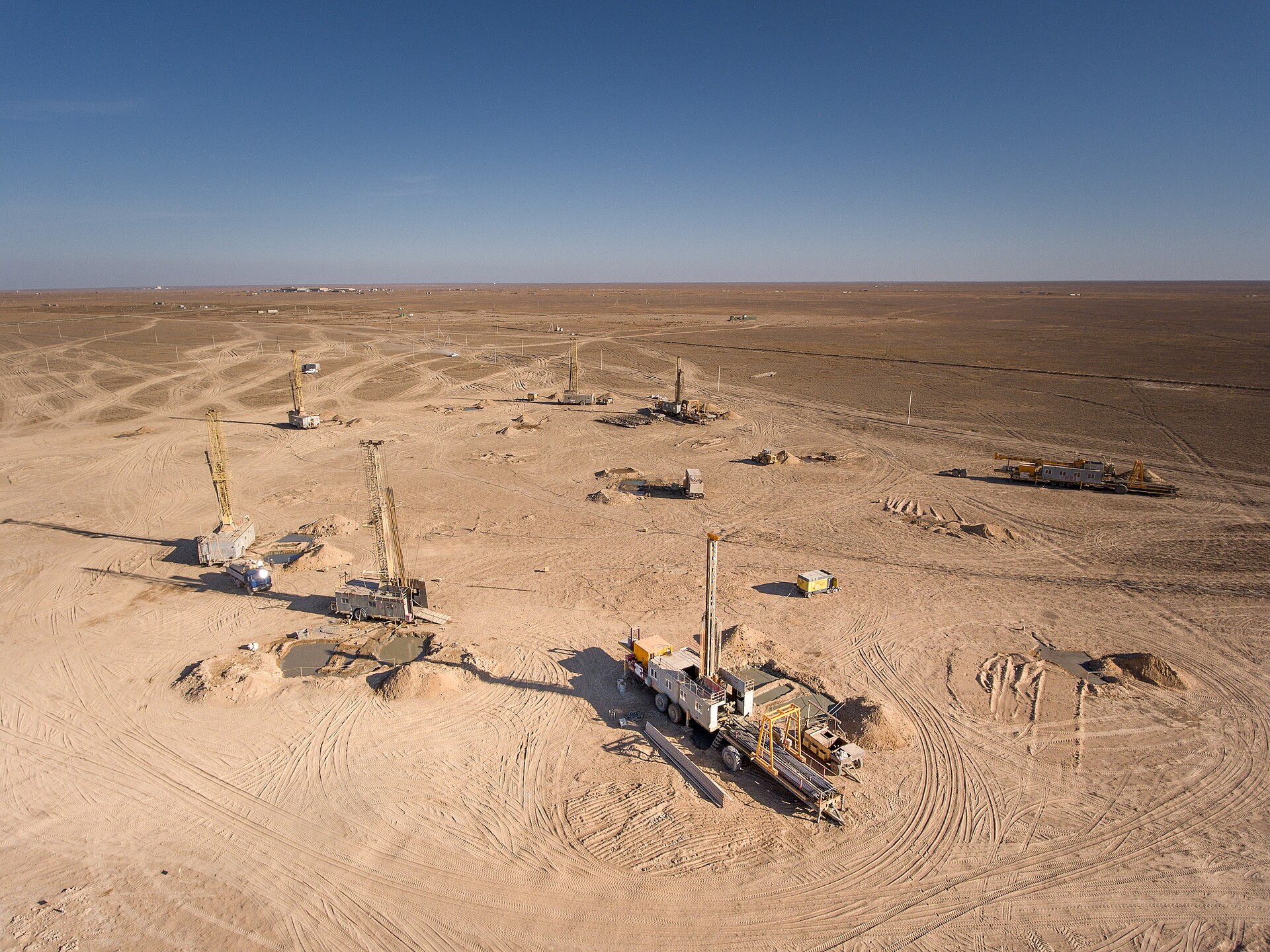
Supply is not obliging, either. Cameco guides to 19.5–21.5 million pounds of U3O8 for its own account in 2026 and held that range at the half-year despite what it describes as temporary unplanned disruptions at Key Lake and McArthur River during the second quarter and at Cigar Lake after it. More telling is the Kazakh leg: JV Inkai, the joint venture with Kazatomprom pictured above, remains on track for 10.4 million pounds on a 100% basis, but of Cameco's 4.2-million-pound purchase allocation only 0.8 million pounds were delivered in the first half. Roughly 3.4 million pounds have to arrive before year-end. Guidance that is intact but back-loaded is guidance with a timing risk attached.
The fuel-cycle services sit further up the same curve, and they moved first. Conversion term pricing hit historic highs in 2025 with a 27% average annual increase, against a 4% rise in conversion spot; enrichment spot and term rose over 10% and 6% respectively versus 2024. UF6 conversion and SWU are the genuine bottleneck in the Western fuel chain, and when the services a utility cannot substitute are repricing three to seven times faster than the raw pound, the constraint is not in the ground. But that squeeze has stalled in 2026, and the honest reading says so: spot conversion has fallen from US$81.00/kgU in March 2025 to US$64.50 in June 2026, and spot enrichment has been pinned at US$200/SWU for six months. Term conversion kept climbing, US$50.00 to US$55.50 — the same spot-versus-term signature as uranium itself, but the downstream repricing is largely done rather than in progress. It is a familiar pattern to anyone who followed the silver move to $69.57 and the gold ratio at 66 — the tell showed up in the derivative market before the headline metal.
What the price series actually shows
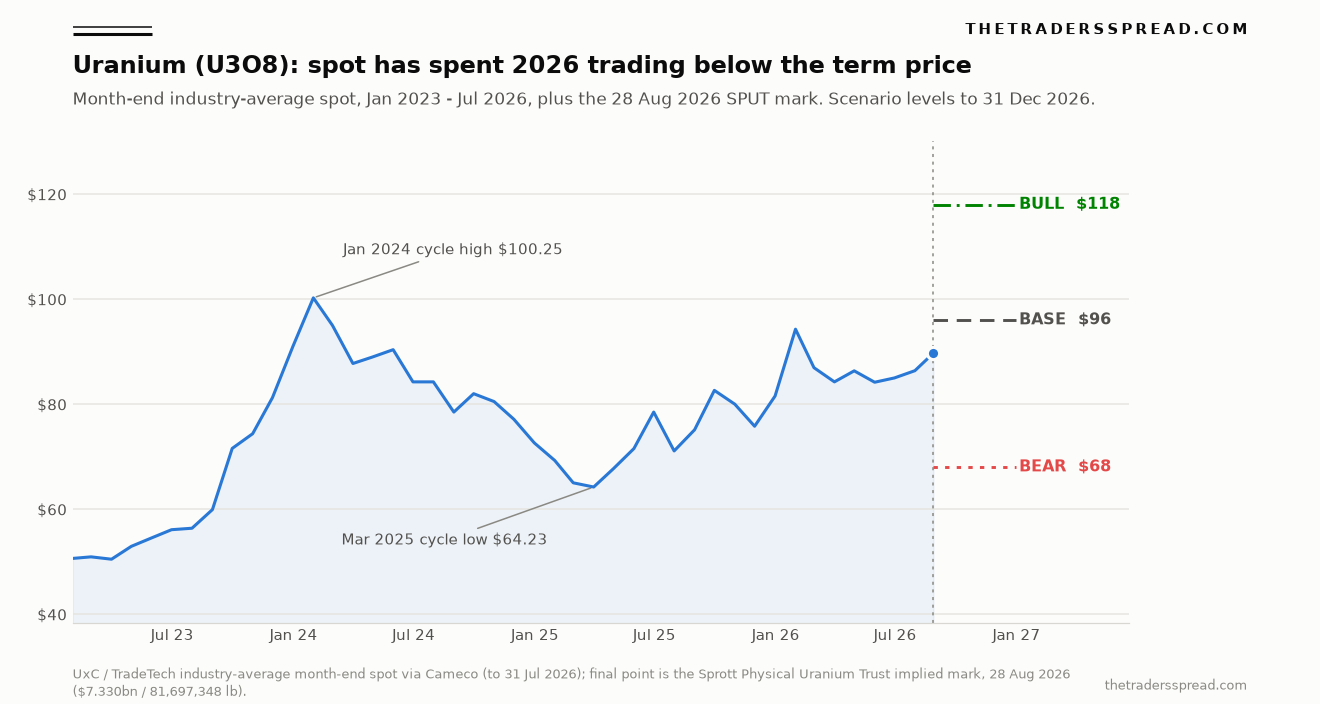
The series is a completed cycle and a base. Spot ran from US$50.63 in January 2023 to a US$100.25 month-end peak in January 2024, gave back 35.9% into a US$64.23 low in March 2025, and has spent seventeen months rebuilding. The 2026 range is narrow — US$84.18 to US$94.28, a span of just 12% — which for uranium is close to dormant. Realised volatility that low in a market with this much structural tension usually resolves rather than persists.
Here is the synthesis that matters. Combine the price series with the contracting series and the equity tape and three sources tell one story:
| Measure | Dec 2023 | Dec 2025 | Latest 2026 | Direction |
|---|---|---|---|---|
| Spot price (US$/lb) | 91.00 | 81.55 | 89.72 (28 Aug) | Flat over 32 months |
| Long-term price (US$/lb) | 68.00 | 86.50 | 95.50 (31 Jul) | +40.4% |
| Spot vs term | +33.8% | −5.7% | −6.1% | Inverted |
| Spot volume, full year (Mlb) | 55.03 | 55.3 | — | Structurally thin |
| Term volume, full year (Mlb) | 159.60 | 116.0 | — | Below replacement |
| URA ETF (US$) | — | — | 45.57 (28 Aug) | −26.3% from Jan high |
The long-term price is up 40.4% since December 2023 while spot is fractionally lower and the equities that are supposed to be levered to uranium are 26% off their late-January high. Uranium miners are being marked against a spot price that, by the industry's own volume data, prices less than a third of the material that moves. That is a mispricing of the reference, not necessarily of the asset.
The 28 August session made the point unusually cleanly. URA fell 5.79%, URNM 7.19% and Cameco 5.94% — while uranium itself fell 0.61%. There was no uranium news that day. Fed Chair Kevin Warsh used his Jackson Hole debut to warn that "we must be confident that underlying inflation is moving to our objective, clearly and at sufficient speed", the two-year yield jumped 12 basis points and September hike odds repriced sharply — the move we covered in our note on the September Fed decision. The longest-duration, pre-revenue nuclear names fell hardest. That is a discount-rate event wearing a uranium costume.
One caution, from the market's own analyst of record. UxC's August 2026 research is headlined "Inventory Levels Continue to Rise, but Excess or Mobile Inventories are Limited," and its review of the 2025 European Supply Agency report is titled "Inventories Rose as Russian Imports Remained High." Inventories are building. The bullish reading is that most is strategic and immobile; the bearish one is that inventory is inventory, and it caps spot until drawn down.
The structural tension: enrichment, sanctions and where the bottleneck really sits
The binding constraint in the Western nuclear fuel chain is not uranium in the ground. It is the conversion and enrichment capacity that turns a pound of yellowcake into something a reactor can use, and that capacity is concentrated in exactly the jurisdiction the West is trying to exit.
The United States' Prohibiting Russian Uranium Imports Act bans Russian low-enriched uranium under a waiver regime that terminates no later than 1 January 2028, with the prohibition itself running to 2040. Europe has no equivalent statutory ban, which is why the Euratom Supply Agency was still reporting high Russian volumes for 2025. Cameco's risk framing is that sanctions "added to the delivery risks for nuclear fuel supplies coming out of Central Asia" — Kazakh material, the largest single source of primary supply, has historically reached Western buyers along routes through Russia.
That is the asymmetry a uranium bull case rests on. Replacing Russian enrichment requires Urenco and Orano to build centrifuge capacity on multi-year timelines, and a tight SWU market mechanically raises natural uranium feed requirements, because underfeeding and overfeeding decisions shift with the SWU price. It is one of the few places where a downstream bottleneck raises upstream volume requirements rather than destroying them.
Cameco frames the consequence plainly in its 2025 market review: "risk has shifted from producers to utilities." Over two-thirds of global fuel supply comes from state-owned entities, and a utility guaranteeing 60 years of operation cannot treat that as a spot-market problem. The IEA's World Energy Outlook 2025 expects global electricity demand to grow by at least a third by 2035.
The call: base, bull and bear into year-end 2026
All levels reference the 28 August 2026 mark of US$89.72/lb. The horizon is 31 December 2026.
RelatedGold Price Prediction: $5,050 Bull Case vs $3,960 Bear
Base case — US$96/lb (45% probability). Spot converges to the term price. This requires nothing dramatic: no supply shock, no new financial buyer, simply the continued absence of loose material as utilities work through a contracting backlog that has run below replacement rate for two straight years. The term price at US$95.50 is the gravitational centre, and in a market where the term price has not fallen once in 2026, convergence upward is the path of least resistance. A probability-weighted blend of the three scenarios lands at US$95.60, effectively the term price.
Cameco's Grant Isaac, President and Chief Operating Officer, framed the oddity on the 31 July earnings call: "we are still not at replacement rate demand across the industry... And yet we found ourselves back into a mid-90s long-term uranium price on its way to three digits likely, and that's in the absence of replacement rate demand." A cycle-peak contract price without a contracting cycle is either the bull setup or the bear warning.
Bull case — US$118/lb (30% probability). Spot breaks the January 2024 high of US$100.25 and overshoots. The trigger is the return of a financial bid: the Sprott trust's discount closes and flips to a premium, restarting at-the-market issuance into a market that clears 55 million pounds a year. Layer a production shortfall on top and the move is violent, because there is no inventory buffer in the spot venue itself. The precedent is recent: spot ran 61.4% in the five months to December 2023, so a 31.5% move from here sits well inside this market's realised range.
Bear case — US$68/lb (25% probability). Spot retests the March 2025 low of US$64.23 without breaking it. The path is mundane: Kazakhstan delivers full guidance, restarted mines ramp on schedule, the inventory build UxC is flagging turns out to be mobile rather than strategic, and utilities — having front-loaded 2023's 159.6 million pounds of contracting — step back from the market entirely. The Sprott discount persists or widens, keeping the financial bid absent. This is the scenario in which the term price also finally rolls over, and it is the one most traders under-weight because the contracting narrative is so widely held.
The bear case has one specific problem, and it is three days old. On 27 August Boss Energy cut Honeymoon's FY2027 guidance to 1.25–1.30 million pounds from 1.41 million, and rebuilt its resource estimate down to 20.8 million pounds — 42% less contained metal than the 2019 model carried. Restarted in-situ recovery supply keeps arriving late and smaller. The Australian dollar reads partly off the same complex — see our AUD/USD forecast — and live levels sit on our markets page.
What would change my mind. The single cleanest disconfirmation of the base and bull cases is the term price itself: if the UxC/TradeTech long-term price prints a monthly decline below US$93.00, the entire thesis is void. The argument here is that the term price is the true signal and spot the noise. If the signal turns down, the structural read is wrong and the appropriate level set is the bear case, not the base. Two secondary triggers: a Sprott premium re-establishing above +2% would pull the bull case forward materially, and a full-year 2026 contracting print above 125 million pounds, against 116 million in 2025 and roughly 33 million in the first half, would confirm the utility bid is intact and argue against the bear.
Frequently asked questions
What is the uranium price right now?
The 28 August 2026 mark is approximately US$89.72 per pound of U3O8, derived from the Sprott Physical Uranium Trust's disclosed holdings of 81,697,348 pounds valued at US$7,330,090,268. The last published industry-average month-end spot was US$86.38 on 31 July 2026, with the long-term price at US$95.50. Sprott marks against a composite of TradeTech, UxC, S&P Platts and Numerco quotations.
Why are there two uranium prices?
Uranium is not exchange-traded in meaningful size. Utilities buy the bulk of their fuel under privately negotiated multi-year contracts, which produces the long-term or "term" price. A small residual market handles discretionary volumes and produces the spot price. In 2025 the spot market cleared 55.3 million pounds against 116 million contracted long-term, so the term price governs most of the material that actually moves.
Does the Sprott Physical Uranium Trust move the uranium price?
Historically, yes — decisively. When the units trade above net asset value the trust can issue new units and convert the proceeds into physical pounds, making it the marginal spot buyer. That drove much of the 2021–2023 rally. At a discount, as on 28 August 2026 when units closed 5.70% below NAV, the mechanism switches off and the trust becomes a static holder.
How much uranium is not yet contracted?
UxC estimates cumulative uncovered utility requirements at roughly 3.1 billion pounds of U3O8 to the end of 2045. Over the last five years about 589 million pounds were contracted long-term against roughly 815 million pounds consumed in reactors, a shortfall of 226 million pounds that has to be closed at some future price.
Disclaimer: This article is market analysis and information only. It is not investment advice, an offer, or a recommendation to transact in any instrument. Uranium is an unusually illiquid market with no retail spot venue, and the securities referenced carry significant risk. Prices and levels cited are as at the dates stated and will change. Capital is at risk. Conduct your own research and consider your circumstances before making any financial decision.