
The Fed September decision — a Polymarket contract that settles on how many basis points the upper bound of the federal funds target range moves at the FOMC meeting on 15–16 September 2026 — is not, whatever the headlines say, a referendum on whether inflation is too high. It is a referendum on which inflation gauge the Committee believes. In July the Fed's preferred measure, core PCE, ran at 3.3% while core CPI ran at 2.5%. That 0.88 percentage-point gap is not a rounding difference. Calculated from the St Louis Fed's own index levels, it is the widest the Fed's favoured gauge has run above the CPI since October 1983.
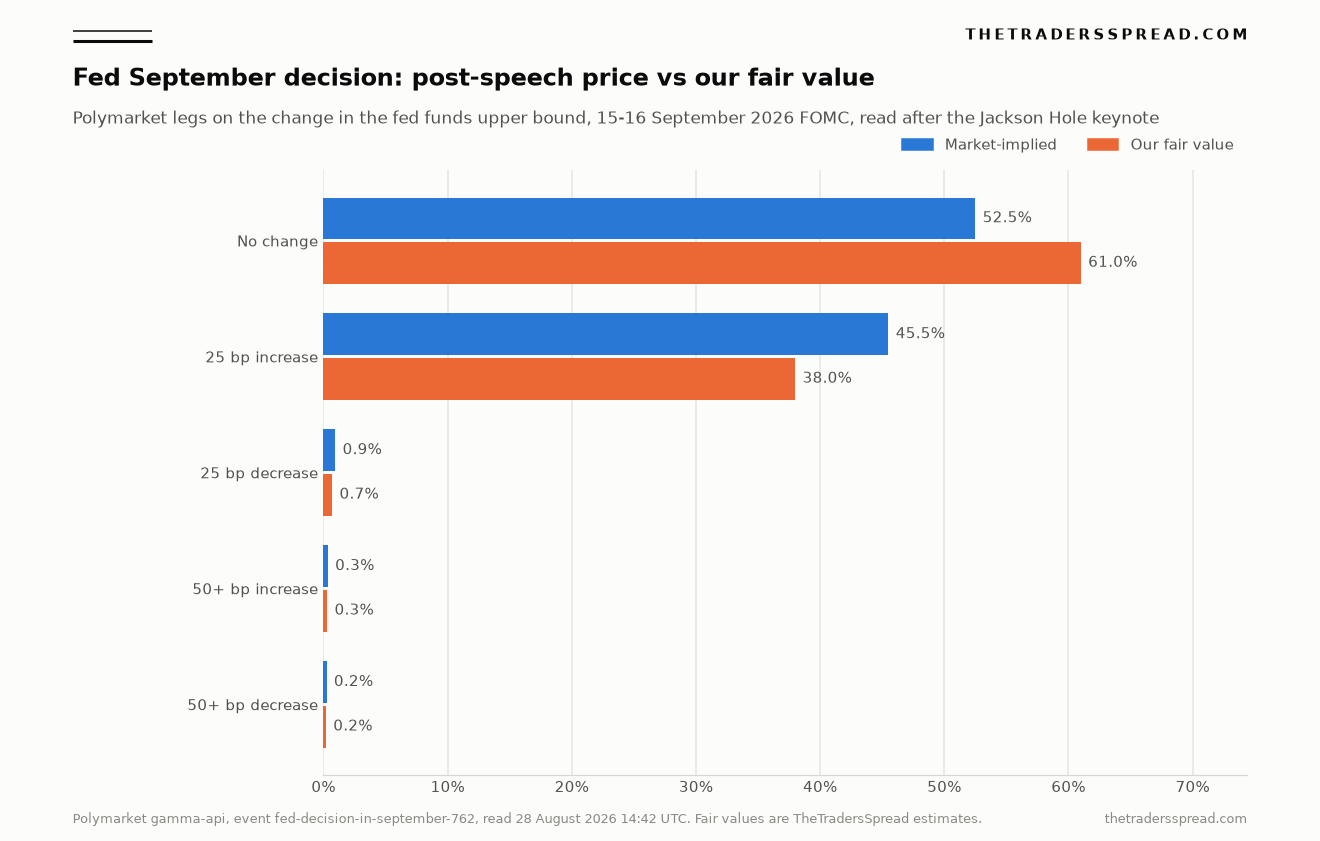
On Friday morning Chairman Kevin Warsh answered that question in public, and the contract moved further in ninety minutes than it had in a fortnight. In his first Jackson Hole keynote he said he would "be hard pressed to describe broad financial conditions as restrictive", declared the labour market "consistent with full employment", and set out an explicit standard for tightening. The 25 basis-point hike leg repriced on Polymarket from 29.5% before the speech to 45.5% by 14:42 UTC — a sixteen-point move, on $2m of fresh volume, in response to a speech that named no meeting. We think that overshoots, and the reasoning is arithmetic rather than sentiment.
Key facts
- Polymarket repriced from 69.5% to 52.5% on no change, and 29.5% to 45.5% on a 25 bp hike, within 90 minutes of the keynote, on $58.5m of event volume — Polymarket gamma-api, 28 August 2026, 13:13 and 14:42 UTC.
- Warsh said he would be "hard pressed to describe broad financial conditions as restrictive" — Jackson Hole keynote, 28 August 2026.
- The federal funds target range has been 3.50%–3.75% all year, held on a 9–3 vote in July — FOMC statement, 29 July 2026.
- All three dissenters wanted a 25 bp increase: Beth Hammack (Cleveland), Lorie Logan (Dallas) and Neel Kashkari (Minneapolis) — FOMC minutes, released 19 August 2026.
- The June median dot put the funds rate at 3.8% for end-2026, up from 3.4% in March — Summary of Economic Projections, 17 June 2026.
- Core PCE was 3.3% year on year in July and headline PCE 3.7%, both unchanged from June; Warsh noted the six-month rate is running at 4.1% — BEA, released 28 August 2026.
- Core CPI was 2.5%, down from 2.6%, while the energy index was still 14.7% higher year on year — BLS release USDL-26-1378, 12 August 2026.
- Payrolls fell 23,000 in July and the unemployment rate was 4.1% — BLS release USDL-26-1291, 7 August 2026.
What the Fed did in July, and the precedent that matters
On 29 July the FOMC left the target range at 3.50%–3.75%, where it has sat all year, on a 9–3 vote. Three simultaneous dissents in the same hawkish direction is rare, and the closest modern precedent cuts against the hawks: at the September 2016 meeting Esther George, Loretta Mester and Eric Rosengren all dissented in favour of an immediate quarter-point increase. The Committee held anyway, and did not actually raise rates until December.
The statement itself was blunt. It described activity as "expanding at a solid pace despite elevated uncertainty that owes, in part, to the conflict in the Middle East", and closed with a sentence that reads less like a forecast than a pledge: "The Committee will deliver price stability." That language was introduced in June and, per the minutes, "almost all members agreed that it was appropriate to retain" it.
The arithmetic is what turns this into a September problem. The current midpoint of the target range is 3.625%. The June Summary of Economic Projections put the median end-2026 federal funds rate at 3.8% — reachable only by raising rates once. Three meetings remain: September, 27–28 October and 8–9 December. If the median participant honours their own dot, one of those three carries a hike, which distributes roughly a third of the probability to each before any other information.
The dissenters' reasoning pushes that weight forward. The minutes record that a few of them "judged that doing so would likely help forestall the need for a steeper and potentially more costly sequence of tightening moves at a later stage" — the classic case for moving early and small. Readers following our prediction-market work will recognise the structure from our analysis of the Brazilian presidential election market, where the crowd's headline number also concealed a mispriced tail.
What Warsh actually said, and why it changes the arithmetic
Until Friday the strongest argument against a September move was the Chair himself. Kevin Warsh took over in May 2026 and has refused to supply the forward guidance markets treat as an entitlement — he opened his keynote by calling his own outline a trail map, "just don't call it forward guidance". Analysts expected evasion. "I'm not really expecting much of anything," said Luke Tilley, chief economist at M&T Bank and Wilmington Trust Investment Advisors, beforehand.
They did not get evasion. On the labour market — the doves' best card since payrolls fell 23,000 in July — Warsh said "the labor markets are consistent with full employment". On financial conditions he was equally direct, noting credit spreads near the low end of their historical ranges and banks reporting easier commercial lending standards: "Credit and loan markets are showing few signs of policy restraint … on balance, I would be hard pressed to describe broad financial conditions as restrictive."
On inflation he went further than the July statement did. He put the 12-month PCE change at 3.7% and the six-month change at 4.1% — an acceleration, not a plateau — and disaggregated the 199 components of the PCE basket to argue the breadth is still abnormal: 54% of goods and services showed price increases above 3% over the past year, against 32% in the two decades before the pandemic. "While this summer's PCE and CPI readings were better than expected," he said, "they do not tell me that underlying trends have meaningfully improved."
Then came the reaction function that Mark Cabana, head of U.S. rates strategy at Bank of America, had told clients would be the hawkish outcome: "In short, we expect Warsh to signal that he is prepared to raise rates again if inflation does not continue to moderate." Warsh's formulation was his own — "We must be confident that underlying inflation is moving to our objective, clearly and at sufficient speed. Otherwise, we have work to do" — but the content is the same. He tempered it with a line that will be quoted for months: "I stand here today committed to a discipline, not to a decision."
The data: two inflation gauges telling different stories
Put the Bureau of Labor Statistics CPI release for July beside the Bureau of Economic Analysis PCE release for the same month, and the Fed's own preferred measure is running nearly a full percentage point hotter than the index the public sees. That divergence is the reason Warsh can call the inflation problem unresolved while the headline CPI rate is still falling.
Core CPI rose 2.5% in the year to July, down from 2.6% in June. Core PCE, released on 28 August, was 3.3% — flat on the month and exactly the figure the June projections had pencilled in for the whole of 2026. We pulled the underlying index levels for both series from the St Louis Fed (PCEPILFE and CPILFESL) and computed the spread. Between 2005 and 2024 core PCE averaged 0.31 percentage points below core CPI. In July 2026 it was 0.88 points above.
Since January 1960 only twelve prior months have shown a gap that wide: August 1973, then an unbroken run from December 1982 to October 1983. The last time the Fed's favoured gauge diverged this far above the CPI, Paul Volcker was chairman. A committee looking at core PCE sees an inflation problem that has stopped improving; a committee looking at core CPI sees one nearly solved. Both committees are the same twelve people — and on Friday the Chair told everyone which index he is reading.
| Contract leg | Pre-speech 13:13 UTC | Post-speech 14:42 UTC | Our fair value | Edge |
|---|---|---|---|---|
| No change (3.50%–3.75%) | 69.5% | 52.5% | 61% | +8.5 pp |
| 25 bp increase | 29.5% | 45.5% | 38% | −7.5 pp |
| 25 bp decrease | 1.35% | 0.95% | 0.7% | −0.25 pp |
| 50+ bp increase | 0.35% | 0.35% | 0.3% | −0.05 pp |
| 50+ bp decrease | 0.35% | 0.25% | 0.2% | −0.05 pp |
Market prices read from the Polymarket gamma-api at 13:13 UTC and again at 14:42 UTC on 28 August 2026, either side of the Jackson Hole keynote. Event volume rose from $56.5m to $58.5m across the move. Fair values are TheTradersSpread estimates. The full order book for each leg is on Polymarket.
One input cuts the other way. Brent traded at $100 a barrel on 23 July, its first visit to three figures since late May, as US–Iran attacks escalated; by 25 August it was $88.24. July CPI showed the energy index down 1.5% on the month even as it stood 14.7% higher on the year. Those annual comparisons unwind on their own as the 2025 base rolls forward. Warsh's answer was that "the recent rise in overall commodity prices also bears watching" and that breadth — 54% of the PCE basket above 3% — matters more than any single component. Our recent work on the silver move and the gold ratio covers the same real-rate mechanism from the metals side.
Why a sixteen-point move looks like an overshoot
Set the economics aside. The Federal Reserve does not surprise markets with rate increases. It is not a written rule but it is close to an iron regularity of the modern committee: moves are socialised through speeches and testimony until pricing has largely converged, and only then executed. A rise delivered into pricing of 30%, where this contract sat on Friday morning, would be a communications failure severe enough to damage the transmission mechanism the Fed depends on.
That was the strongest argument for the no-change leg on Friday morning — and it is precisely the argument Warsh spent an hour dismantling. Socialising a move is exactly what a Chair does when he tells an audience of central bankers that financial conditions are not restrictive, that the labour market is at full employment, and that absent clear progress "we have work to do". The market took roughly forty minutes to work that out, then repriced sixteen points at once. The question is whether it stopped in the right place.
We do not think it did. Start from the dot plot: a June median of 3.8% implies one increase across three remaining meetings. Even granting near-certainty that the hike happens at all this year, September has to take roughly half of that probability to justify 45.5% — and Warsh named no meeting, closing instead on the line that he is "committed to a discipline, not to a decision". The speech raised the odds that the Committee tightens. It said very little about when, and the contract only pays on September.
A further complication has nothing to do with the dual mandate. Treasury Secretary Scott Bessent said in late August the department would at least double its buybacks of off-the-run debt from 9 September, lifting the usual $2bn weekly figure. Rising long yields — the 30-year sat at 5.18% on 26 August, the two-year at 4.19%, some 44 basis points above the top of the current target range — are being addressed by the fiscal authority just as the monetary authority is asked to tighten. "We're in a unique set of conditions here, where actions by the Treasury have undermined Warsh's move," Joseph Brusuelas, chief economist at RSM, told CNBC. "Therefore, the Fed chair is in between a rock and a hard place." For the dollar-side consequences of that repricing, see our current AUD/USD forecast.
The call: fair value on the Fed September decision
We put fair value on no change at 61%, against a post-speech market price of 52.5%, and on a 25 basis-point increase at 38% against 45.5%. The edge is roughly 8.5 percentage points on the no-change leg. It is worth being explicit that our number moved twice today. Before the keynote we had no change at 78%, on the view that the Chair had not prepared the ground and that a committee facing a negative payroll print would not move. Warsh removed both planks, so we cut it. The market then cut it a great deal further, and at 52.5% it has gone past where the evidence supports.
The discipline is the dot plot. A June median of 3.8% implies one increase across September, 27–28 October and 8–9 December. For September alone to be worth 45.5%, the market must believe both that the hike is near-certain this year and that it lands at the first available meeting. The dissenters' "forestall a steeper and potentially more costly sequence" logic does argue for front-loading, which is why our 38% sits above a uniform third rather than at it. What it does not support is coin-flip odds on a meeting the Chairman pointedly declined to name.
RelatedFrench Presidential Election: Le Pen 33.4%, Bardella 2.5%
Two scheduled catalysts stand between here and resolution: the August employment report on 4 September and the August CPI on 11 September, both at 8:30 a.m. Eastern. The CPI lands four days before the meeting opens, inside the communications blackout that begins on 5 September, when no official can publicly react to it. That is the event the contract is really about, and it is why we would rather own the no-change leg at 52.5% than the hike at 45.5%: the burden of proof sits with a single inflation print, and Brent at $88.24 — down about 12% from 23 July — makes a soft energy contribution the more likely outcome.
What would change our mind, in order of importance: a core CPI print of 0.3% or higher on 11 September, which would meet Warsh's "sufficient speed" test in the wrong direction; an August payrolls figure on 4 September above roughly 125,000, removing what remains of the labour-market objection; any of the July dissenters or a Board governor explicitly naming September before the blackout; or Brent recovering above $100 on renewed escalation with Iran. Any one of those takes our fair value on no change below 50% and inverts the position. Live pricing on each leg of the September contract is the fastest read on whether the repricing has continued.
The contract resolves on 16 September on the change in the upper bound of the target range. Our base case is that the range stays at 3.50%–3.75% and that the hike implied by the dots lands in October or December — the same outcome the Committee chose in 2016, after the same number of hawkish dissents. More calls of this kind sit on our prediction markets desk.
Frequently asked questions
Will the Fed raise rates in September 2026?
The market is close to split. After Chairman Kevin Warsh's Jackson Hole keynote on 28 August 2026, Polymarket priced a 25 basis-point increase at 45.5% and no change at 52.5%, having been 29.5% and 69.5% earlier the same day. Our fair value is 38% for a hike. The FOMC meets on 15–16 September.
What did Warsh say at Jackson Hole?
He said he would "be hard pressed to describe broad financial conditions as restrictive", judged labour markets "consistent with full employment", and set a standard: the Fed must be confident inflation is moving to target "clearly and at sufficient speed. Otherwise, we have work to do." He also stressed he was "committed to a discipline, not to a decision".
Why would the Fed hike when CPI inflation is falling?
Because the two main gauges disagree. Core CPI was 2.5% in the year to July, but the Fed's preferred measure, core PCE, was 3.3% — a gap of 0.88 points, the widest since October 1983. Policymakers target PCE, and Warsh noted its six-month rate is running at 4.1%, faster than the 12-month figure.
What did the three dissenting votes mean?
At the July meeting Beth Hammack, Lorie Logan and Neel Kashkari voted against holding, preferring an immediate 25 basis-point increase. Three simultaneous hawkish dissents is rare. The closest precedent is September 2016, when three presidents dissented the same way — and the Committee still waited until December to move.
Which data releases decide the September decision?
Two. The August employment report lands on 4 September and the August CPI on 11 September, both at 8:30 a.m. Eastern. The CPI arrives during the communications blackout that starts on 5 September, so officials cannot publicly respond to it before the meeting opens on 15 September.
How does the Polymarket contract resolve?
It settles on the number of basis points by which the upper bound of the federal funds target range changes at the September 2026 FOMC meeting, versus the level immediately beforehand. Five mutually exclusive legs run from a 50+ bp cut to a 50+ bp increase. Resolution is dated 16 September 2026.
This article is analysis and information only. It is not investment advice, and nothing in it is a recommendation to buy or sell any contract, security or instrument. Prediction-market contracts carry the risk of total loss of the amount committed, and availability is restricted in some jurisdictions. Prices and probabilities quoted were accurate at the times stated and move continuously. Capital at risk. Do your own research.